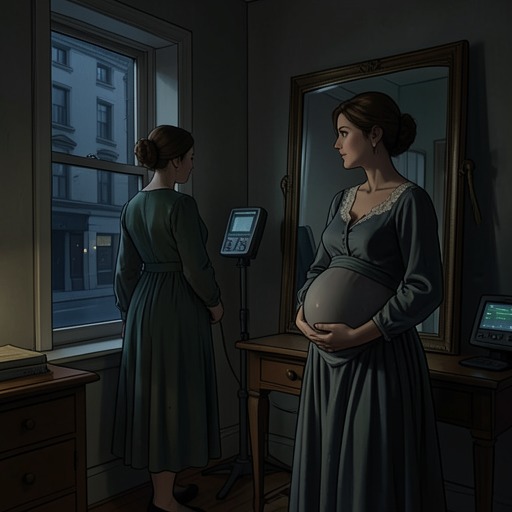
Christmas Night 1859
PossessionChristmas Night 1859 marks the moment Sabine de Kercoz recognizes Christabel LaMotte’s concealed pregnancy, changing her interpretation of Christabel’s silence and of her father’s protectiveness. Recorded in Sabine’s journal, the scene turns an unspoken suspicion into knowledge, while leaving the family unsure how to speak or act.
The Christmas observance
On Christmas Eve, Sabine and her father attend midnight Mass, as they always do. Her grandfather had refused to enter the church because he was republican and atheist; her father, though his beliefs might not satisfy the priest, values the continuity of the Breton community and its festivals. Christabel identifies herself as Anglican in England but follows the Catholic faith of her Breton forebears while staying with the family. During Advent she has increasingly visited the church, where she looks at the sculpted figures of the Calvary.
The service brings different accounts of the Nativity into the same conversation. Sabine’s father recalls a Breton belief that animals speak in their barns on that night, when the world is reconciled in primeval innocence. Christabel contrasts this with Milton’s use of the older tradition that Greek travelers heard shrines lament the death of Pan at the Nativity. Sabine watches her father put his cloak around Christabel’s shoulders and lead her to the family’s place at the front of the church. At the time, Sabine imagines the gesture as a prefiguration of their future life together; the discovery that follows makes her reconsider what she has been seeing.
Sabine recognizes the pregnancy
After the candles are lit and the congregation is seated, Sabine notices that Christabel is not kneeling. Christabel lowers herself carefully and leans back against a pillar, pale and looking unwell. With her hands clasped beneath her bosom, and her body held in a protective posture familiar to Sabine from other women, she inadvertently makes visible what she has concealed. Sabine realizes that Christabel is pregnant and understands that she had come to the household for sanctuary.
The recognition also revises Sabine’s view of her father. She now believes he has probably known about the pregnancy for some time, perhaps even before Christabel arrived. What Sabine had interpreted as special feeling, or had suspected as a sign of attachment, she now reads as pity and protectiveness. Her journal ends the entry with uncertainty about what she should say or do: the new knowledge explains the household’s situation without resolving how to respond to it.
The secret and its consequences
The pregnancy remains difficult to discuss in the following months. Sabine later records that Christabel has become visibly advanced in pregnancy, yet forbids any conversation about her condition or expectations. Sabine’s father wants to tell her that the child will be welcomed as family and cared for, but says that he cannot bring himself to open the subject. He fears that raising it may alienate or distress Christabel, whom he worries may be in a dangerously divided state of mind. In place of direct discussion, he offers small acts of kindness, while conversations continue on literary and philosophical subjects.
The household’s silence contrasts with the practical questions it cannot settle. Christabel does not disclose the child’s origins or make plans with the family, and Sabine’s father cannot secure a conversation about the coming birth. Christabel eventually disappears and later returns frail, but the account of Christmas Night itself does not explain what happened during her absence. In a later letter, Christabel reveals that her daughter was born in Brittany and that her sister Sophie took the child to England and raised her as her own. The journal scene therefore records the first recognition of the pregnancy, not its eventual resolution.
Retrospective significance
The episode’s importance lies in the difference between seeing and being able to speak. Sabine identifies what Christabel’s guarded posture reveals, but recognition does not give her or her father permission—or confidence—to question Christabel directly. The journal preserves both the certainty of the discovery and the uncertainty of the household’s response, making silence part of the event’s history rather than a mere gap in it.
The later disclosure of the child’s concealed parentage gives this Christmas scene its wider consequence. Christabel’s need for protection leads to a birth arranged away from her family and an upbringing under another maternal identity; much later, the social and legal disadvantages attached to illegitimacy help explain why such concealment mattered. The Mass does not disclose that future, but it is the point at which Sabine first understands that Christabel’s refuge carries a secret that will shape more than one generation.