Food Is Love
QueenieFood Is Love is the family’s unofficial motto and one of the clearest expressions of how care moves through Queenie’s household: not only as something said, but as food offered, shared, and accepted. Its meaning is affectionate without being uncomplicated. The same family culture that treats a meal as an answer to distress can make eating a source of discomfort, and the motto’s warmth sits beside an awareness of judgment about weight. Across scenes of crisis and reunion, food becomes a practical form of attention, even when difficult feelings remain unspoken.
Meaning and Family Usage
Queenie identifies the phrase as her family’s unofficial motto, describing a shared understanding in which feeding someone is a way of caring for them. The expression is not presented as a formal rule or an abstract belief; it is visible in domestic gestures. Her grandmother asks whether Queenie has eaten, prepares food when she is struggling, and directs her toward the kitchen. Later, Queenie encourages her mother to eat and helps by offering a way to think about the task. At a family gathering, food is passed around the table. These actions give the motto a practical meaning: concern is made tangible through meals and small acts of assistance.
The saying does not erase the difficulty that can accompany food. Queenie adds that the family’s unofficial motto is also “Have You Put on Weight?” The juxtaposition makes the affection more complicated: food can signify welcome and care, but bodies and eating are also subject to comment. The book therefore presents the motto as a recognizable family language, not as proof that every meal is easy or that care always arrives without pressure. Its emotional force comes partly from this tension between being fed and being judged.
A Meal Offered During Distress
When Queenie is at her grandparents’ home, she says she cannot eat and asks whether she can go to sleep. Her grandmother answers that food comes first, tells her she has put fish fingers on, and points her toward the kitchen. The meal is specific and ordinary, not a grand gesture. That modesty matters: her grandmother responds to Queenie’s immediate condition with something she can provide, even though Queenie is not ready to explain what has happened with Tom.
At the table, Queenie eats fish fingers and soggy toast while considering whether to tell her grandmother about Tom. She cannot bring herself to share the information and waits to see whether her grandmother will ask. The scene places practical care beside emotional reserve. The food is offered without Queenie first having to disclose the reason for her distress; at the same time, being fed does not make her ready to talk. The motto names a real form of support, but it does not turn a meal into an instant solution to heartbreak or a substitute for conversation.
Care Shared Between Queenie and Sylvie
The motto also appears in the changing relationship between Queenie and her mother, Sylvie. At dinner, Sylvie explains that eating has become difficult: she feels a lump in her throat when she tries to eat and has to concentrate on getting food down. She connects this struggle with the drawn-out recent months in which she has had to see Roy, and says she has largely been living on tea. The scene makes clear that nourishment is not automatically easy simply because the family values feeding one another.
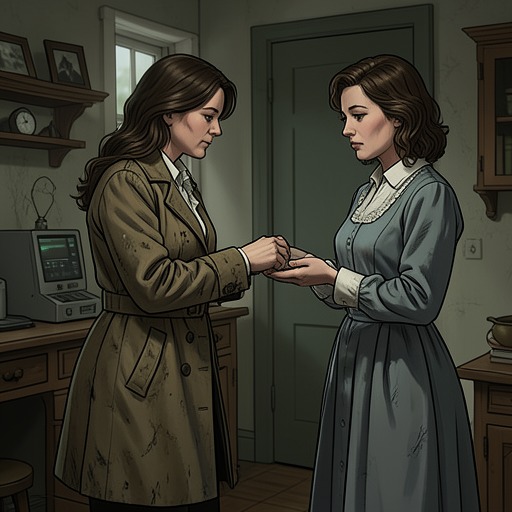
Queenie offers Sylvie an image drawn from her own experience. When eating feels especially difficult, she imagines a bird in her stomach, with its movement representing hunger; feeding the bird, she says, will make the flapping stop. Sylvie says she dislikes birds, especially pigeons, but Queenie clarifies that the image is what matters. She encourages her mother to feed the bird, pours her a glass of water, and watches as Sylvie eats another forkful. The exchange turns care into a reciprocal act: Queenie does not merely receive family support but adapts a strategy that has helped her and offers it to her mother.
Sylvie thanks Queenie for being caring and says she does not know where Queenie got that quality. Queenie replies that she must have got it from her mother. That answer gives the motto an intergenerational dimension. Care is not described as belonging to only one person or moving in only one direction; mother and daughter recognize it in each other while Sylvie is still struggling. The scene’s tenderness rests on an effort to eat together, rather than on a claim that either woman’s difficulty has disappeared.
Food Around the Family Table
At the later family gathering, food forms part of a busy shared scene. Maggie slices pizza and puts pieces on Sylvie’s plate for her to taste. Sylvie picks up a slice, takes a large bite, and laughs at something Maggie says. Queenie, having stepped away briefly, returns to the table and looks around at relatives occupied with one another: Kyazike shows Diana a makeup video, while Cassandra and Darcy talk intensely. The meal is one element in a larger picture of family life, where conversation, attention, and food circulate together.
The moment does not establish that every family conflict has been settled. Instead, it shows Sylvie participating in the gathering and accepting food while enjoying Maggie’s company. Queenie and her mother exchange smiles across the table, and Sylvie raises her glass to Queenie. Against the earlier scene in which eating required effort and encouragement, this shared meal offers a distinct image of connection. Food here is not a cure or a declaration that hardship is over; it is part of the ordinary setting in which family members can be present with one another.
Significance
Food Is Love links care to concrete actions: preparing fish fingers, offering a glass of water, encouraging another person to take a forkful, or putting pizza on a relative’s plate. The expression gives these gestures a shared family meaning, allowing help to be offered even when a person is reluctant or unable to explain what is wrong. Queenie’s effort to help Sylvie also shows that the family’s care is reciprocal rather than confined to elders tending to younger relatives.
The motto remains deliberately imperfect. The family’s concern with eating exists alongside the pressure suggested by “Have You Put on Weight?”, and the scenes of difficulty show that food can be hard to accept or manage. By keeping both aspects visible, the narrative makes the phrase more than a sentimental slogan. Food can carry affection without resolving distress; a meal can create room for connection without requiring disclosure. Its significance lies in the ordinary, repeated work of noticing, offering, and sharing.