Intergenerational trauma
QueenieIntergenerational trauma in Queenie’s story is not an abstract inheritance but a family history carried through abuse, silence, fear, and the late effort to speak. As Queenie recalls what Roy did to her and her mother, she begins to understand how violence shaped both generations; the testimony is painful, but it also makes room for recognition and a future not wholly governed by that past.
Family History and Childhood
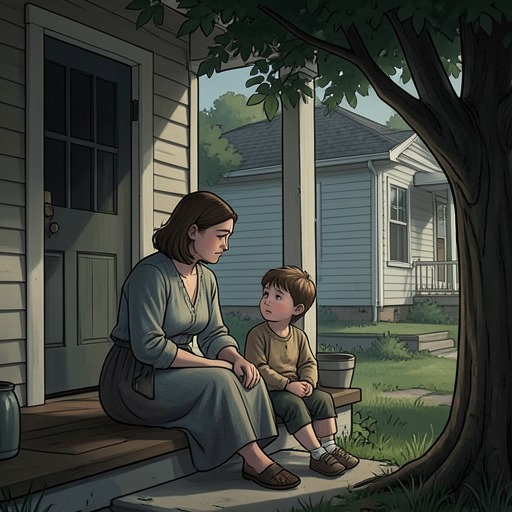
In therapy with Janet, Queenie first describes her mother as kind, mild-mannered, and trusting, then remembers the small world they shared before Roy moved into their home in Mitcham. Roy mocked Queenie’s voice and called her a “bounty,” a racial insult that made her feel misread even within her own family. When she stopped speaking to him in the hope that he would stop targeting her, he found other ways to unsettle her: he broke her belongings, falsely accused her of wrongdoing, and made her sleep in the car. Over time, Queenie’s mother spoke to her only about daily routines, while the couple’s relationship took precedence over the closeness mother and daughter had once shared.
Separation, Abuse, and Silence
As Queenie continues, the family history becomes more than Roy’s cruelty toward a child: his control also narrowed her mother’s life. Roy began disappearing for weekends to see other women, and Queenie recognized his infidelity even when her mother avoided confronting him. When her mother finally did challenge him, she returned to the flat with a black eye and split lip. Queenie’s memory of that moment is bodily as well as verbal: while telling Janet, she looks down to find that her nails have pierced her palm.
The flat had begun as a place for Queenie and her mother after Roy wanted them out, but the arrangement changed until Queenie was living there mainly by herself. She thinks she was eleven, the age she started menstruating, and insists that she could manage alone and that the arrangement was better than living with Roy. Janet names the danger in leaving a vulnerable child in that situation; Queenie’s account, by contrast, shows how she had learned to present abandonment as self-sufficiency. Her mother stayed with Roy, and the separation repeated the loss of the close, shared world Queenie remembers from before he entered their home.
The Past in Queenie's Adult Life
The effects of this family history do not appear only in Queenie’s memories of childhood. After her separation from Tom, she is at a party with Darcy and Fran, drinking heavily and trying to drown her sorrow. Once Darcy explains the breakup, the friends recruit a group of six to make Queenie an OkCupid profile. Queenie says she does not want to participate, but she is too tipsy to resist when Fran takes her phone and starts directing how she should pose. The scene places the newly single Queenie in a moment of apparent sociability while showing how distress, alcohol, and other people’s attention can leave her with little room to assert what she wants.
The same conflict between wanting company and trying to set limits surfaces during a ride home with a Welshman. Queenie considers stopping the encounter, but the prospect of returning alone to a cold, empty bed, still wearing Tom’s T-shirt, feels harder to face than a fling. She tells herself that it can be casual and have boundaries; instead, the man digs his nails into her thigh, bites her cheek, and forces her face toward his. Queenie punches him in an attempt to make him stop. The episode does not equate adult experiences with her childhood abuse, but it echoes a painful gap between Queenie’s efforts to manage risk and the boundary violations she actually encounters.
That vulnerability exists alongside pressures that cannot be reduced to family history. In therapy, Queenie describes how anti-Black stereotypes shape the attention she receives: while her friends are offered dinner dates, men touch her without permission and speak to her in explicitly sexual terms. She connects this treatment to a fear that she will be rejected simply for being herself, and to the difficulty of imagining a loving relationship untouched by that fear. Her account places intimate harm within a wider pattern of racialized and gendered objectification, rather than treating it as a private failure to choose well.
At work, other forms of pressure converge. Gina tells Queenie that Ted has filed an HR complaint, describing Queenie as pursuing him and making him uncomfortable; the complaint leads to her suspension while it is investigated. Gina also points to Queenie’s lateness, distraction, failure to contribute to the paper, and inability to look after an intern, noting that she already has an official warning. The scene does not establish that childhood trauma caused these workplace problems. It does show Queenie struggling amid overlapping personal and professional difficulties, while the company’s focus falls on her conduct and her precarious standing rather than on the full circumstances she says have been weighing on her.
Recognition and the Possibility of a Different Inheritance
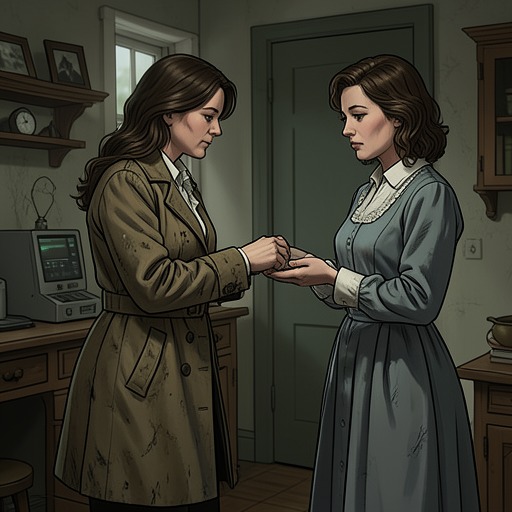
Sylvie’s account of Queenie’s name revises the daughter’s understanding of the woman she had described as meek and diminished. Recalling the newborn Queenie gripping her finger, Sylvie explains that she chose a name more powerful than the delicate princesses she had read about: she saw a child who could grow strong and brave. Queenie recognizes that the woman who once dressed in matching outfits with her until she was eight and told her she was strong enough to be a queen had been battered by men until she could no longer find her voice. The discovery does not erase Sylvie’s failures to protect her daughter; it lets Queenie hold her mother’s tenderness and her mother’s damage in view at once.
Wilfred, too, names the resemblance he feared when Queenie came to stay. He had seen fear and resignation in her, and worried she would end up like Sylvie. His memory reaches back to Sylvie arriving after Roy had hit her so severely that she nearly could not get up. But Wilfred distinguishes Queenie’s course from the one he feared: he tells her she did not let the violence take her and recognizes the fight in her. His words connect the generations without making their experiences identical; the inherited pattern is visible, but it is not presented as an inevitable fate.
The novel also locates recognition in relationships that allow Queenie to reconnect without making her distress someone else’s responsibility. Darcy has quietly kept in touch with Queenie’s cousin and comes to visit; she had considered inviting Kyazike but judged that might be too much for Queenie at that moment. Queenie admits how much she misses Kyazike and hopes to return to her usual texting, while Darcy tells her she need not apologize for switching off. When Darcy says she feels she should have helped more, Queenie insists that her mental health was not Darcy’s responsibility and apologizes for having placed too much on her. That exchange does not resolve the family history or promise a simple recovery. It shows Queenie beginning to speak about what was hidden, recognize care without turning it into an obligation, and imagine connection that need not reproduce the silences and abandonment of her childhood.