My Immortal
REMy Immortal is the song through which Tabitha Moore gives Elena Seelbaugh a direct, emotionally overwhelming experience of the future she has been describing. Tabitha knows that the song will eventually become associated with Evanescence and Amy Lee, but she refuses to exploit that knowledge by stealing or appropriating the music. Instead, she offers Elena a fragile demonstration in the fellowship hall, where uncertain piano playing gives way to a performance whose emotional force makes the song feel like a revelation. For Elena, the result is not merely proof that Tabitha remembers something from another time: it is the first piece of music that creates the profound bond she had hoped to find through Ziggy’s mixtapes.
Future Knowledge and Refusal to Exploit It
Tabitha introduces My Immortal while discussing whether a friend from the future might help Elena see a gothic rock group before it became famous. Elena is skeptical of the prediction. At Springton High, she believes she is one of only three students with a genuinely dark or brooding style, and her encounters with Ziggy at the Fairfield Hot Topic have reinforced her sense that such people are destined to remain loners and outcasts. The possibility that gothic music could achieve mainstream success therefore sounds to her like another dubious story from Tabitha.
Tabitha’s knowledge is specific but incomplete. She can recite nearly every Evanescence song from memory and remembers the opening of My Immortal, yet she does not know enough about the earlier musical landscape to explain exactly how the group would be classified in Elena’s era. She also refuses Elena’s suggestion that future knowledge might be used to help the musicians. Tabitha will not steal their songs, even though she recognizes that she could potentially reproduce them. Her admiration for Evanescence and Amy Lee matters more to her than any advantage gained from foreknowledge; she insists that no one else could sing the songs with Amy Lee’s particular force.
The Fellowship Hall Performance
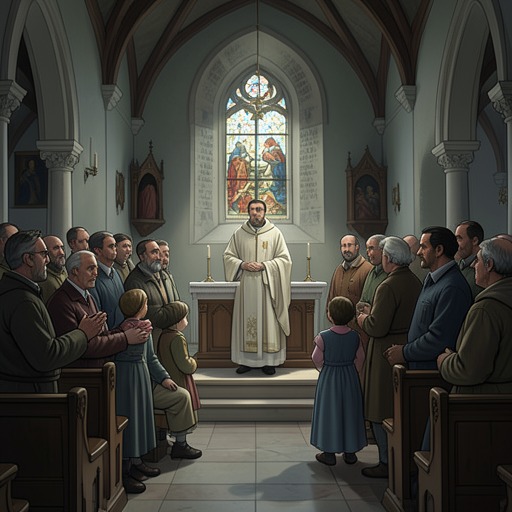
Because the period lacks real internet access, even arranging a trip to hear Evanescence becomes difficult. Tabitha suggests first finding out whether Elena actually likes the music and offers to sing for her. Elena leads her to the fellowship hall, a large community room with hundreds of chairs stacked near the wall, folded tables moved aside, and a stage at the far end. The ordinary church space becomes the setting for an unexpectedly theatrical event.
Tabitha initially exposes the limits of her memory and musical training. She admits that the piano had once been part of an early hologram novelty, so she never learned to play properly. Her remembered repertoire consists of simplified fragments, including the opening of My Immortal, a basic Swan Lake passage, and portions of Tattletale’s theme; Malaxa and Say So have largely disappeared from her memory. After several minutes of experimental, unmusical playing, she acknowledges that too much time has passed and that she can no longer reliably reconstruct the other pieces.
She identifies My Immortal as the song Elena wants to hear, but another limitation immediately appears: Tabitha cannot sing it softly. She explains that the ballad demands projection, and the performance begins with her cautiously placing her fingers on the piano keys and finding a confidence absent from the earlier attempts. The melody is unfamiliar to Elena, but it sounds coherent and unexpectedly beautiful. Tabitha’s measured pauses and renewed concentration elevate the music beyond a casual recollection.
The song’s first words, “I'm so tired of being here—,” transform the atmosphere. Elena hears the lyrics as heavy with sadness and pain, and the fit between Tabitha’s remembered notes and words convinces her that the performance cannot be improvised. When Tabitha sings, “Suppressed by all my childish fears…,” her voice gathers force; at “THESE WOUNDS WON’T SEEM TO HEAL, THIS PAIN IS JUST TOO REAL…,” the emotional intensity becomes openly overwhelming. Her piano knowledge runs out, and she drops her hands into her lap, but her voice carries the song forward. With her eyes closed and her attention concentrated entirely on singing, she gives the remembered music an intensity that exceeds her technical limitations.
Elena’s Recognition
The performance changes Elena’s understanding of both Tabitha and the music. She had doubted that the song existed and suspected that Tabitha was feeding her a line of nonsense about the future. Once Tabitha sings, however, Elena can no longer treat the knowledge as fabrication. The song’s emotional structure, its lyrics, and its melody operate together as evidence of an experience Tabitha genuinely possesses, even if she cannot fully explain how she remembers it.
Elena’s reaction is more than musical approval. She feels chills and recognizes an operatic quality that makes the song impossible to perform casually or quietly. Ziggy’s mixtapes had been intended to create a connection, but they had not produced the feeling Elena was seeking. My Immortal does. The song takes hold of her with a complete emotional embrace, giving her the sense of aliveness and attachment she had wanted but could not force into existence through the earlier music.
The scene also turns private recognition into public witness. Two adult women near the kitchen stop talking and approach; Mrs. Moore appears at the door, bewildered; other churchgoers gather and congratulate Tabitha after the song. Elena remains dazed, while Tabitha, beaming, asks what she thinks and modestly says that the attempt still falls short of Amy Lee’s performance. Elena’s response is emphatic: the singing was amazing, and she immediately wants to know who Amy Lee is and how to obtain the original recording.
Memory, Performance, and Narrative Function
My Immortal functions as a material expression of Tabitha’s divided identity. She possesses knowledge from a later era, but that knowledge is not a perfectly preserved archive. The failed attempts to recall Malaxa and Say So, the uncertainty over the piano, and the years since she last practiced all show memory deteriorating under ordinary conditions. Yet the song survives differently: its words, melody, and emotional contour remain sufficiently intact to be reconstructed in 1998, even when Tabitha’s instrumental technique does not.
The performance therefore establishes a contrast between technical mastery and emotional truth. Tabitha cannot play the entire accompaniment, cannot reproduce Amy Lee’s voice, and cannot offer Elena a flawless historical artifact. What she can provide is an embodied act of remembering. The song becomes persuasive not because it is perfect, but because the imperfections expose the effort required to bring it across time. Its authority comes from the way Tabitha’s voice joins remembered lyrics to present feeling.
For Elena, the song also becomes a form of witnessing. She does not merely accept Tabitha’s account of the future; she experiences a fragment of that future through sound and discovers that it speaks to her own loneliness. The fellowship hall, normally associated with communal church activity, briefly becomes a space set apart from routine. A song remembered from another era interrupts ordinary conversation, draws strangers together, and creates a bond between two girls that earlier cultural references had failed to establish.
Significance and Immediate Aftermath
The significance of My Immortal lies in the way it converts future knowledge into relationship rather than power. Tabitha could use what she knows to claim authority, profit, or control over the music’s emergence, but she chooses instead to share a small, incomplete performance with Elena. That choice preserves the song’s integrity while allowing it to become meaningful in the present.
Afterward, Elena drifts away in a daze, still hearing the lyrics and wanting to preserve the experience. She imagines having her tape recorder ready the next time Tabitha performs, suggesting that the song has become something she needs to document as well as remember. Meanwhile, Tabitha plays the melody again for her parents, with Mrs. Moore sitting beside her and Mr. Moore hovering nearby. The fellowship hall gradually fills with churchgoers, and the women’s Bible study group delays its meeting to gather around the family at the piano. My Immortal thus ends its first appearance not as a private secret but as a shared event: a piece of future music becomes, through Tabitha’s imperfect and passionate performance, a present source of recognition, wonder, and community.