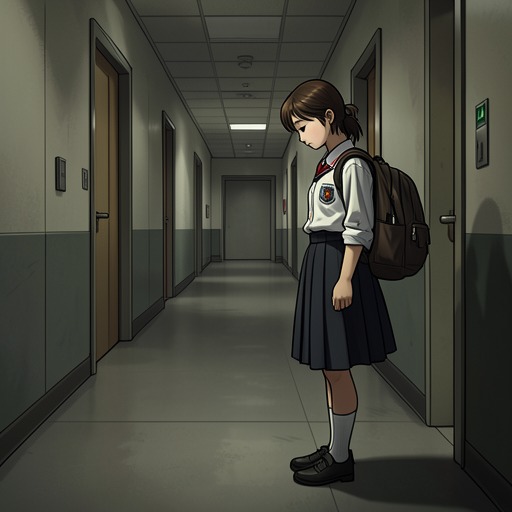
Springton School Board
RESprington School Board is the governing district institution responsible for oversight of Springton High and the schools around Springton. In Tabitha Moore’s story, it functions both as a delayed authority and as a bridge between the school, the police, lawyers, families, and the wider community. Its decisive significance lies in the contrast between the institution’s earlier failure to stop harassment and its later attempt to investigate, discipline, apologize, and restore Tabitha’s access to education.
Institutional Role and Early Recognition
Springton School Board first appears as an institution capable of recognizing Tabitha’s unusual academic performance. After she writes an essay for her Language Arts final, the board contacts her family, arranges for part of the essay to be published in the Tribune, and recommends her for AP English at Springton High. The recommendation is notable because Tabitha’s earlier school record had not marked her as an exceptional student: Elena Seelbaugh remembers her from Mrs. Hodge’s Language Arts class as someone whose grades were not especially strong. The board’s intervention therefore helps publicly recast Tabitha from an underestimated middle-school student into an advanced writer whose work merits special placement.
That academic recognition also becomes part of Tabitha’s complicated identity at Springton High. Her essay is evidence of achievement, but it attracts questions about why she has suddenly become so capable. Alicia Brooks even suspects that the essay may have concerned the future, a suspicion that touches the secret knowledge Tabitha carries without the board understanding its source. The board can identify and reward her intellectual ability, but it cannot initially interpret the emotional and social pressures surrounding it.
Escalation from School Discipline to Public Liability
The board’s authority becomes more urgent after violence and harassment surrounding Springton High students. When Chris Thompson’s father seeks to reverse his son’s suspension, a school administrative clerk explains that the district school board must meet before the suspension can be altered because civil or criminal action is pending. The possible outcome is not merely a school punishment but an expulsion hearing. The board thus stands at the point where a playground confrontation has become a matter involving police notices, legal claims, and institutional responsibility.
Pamela Cribb, acting as a board representative, rejects Principal Edwards’s assumption that the matter has been resolved. She regards the situation as a developing crisis rather than an ordinary dispute between students. Her concern expands beyond Chris Thompson and the immediate confrontation: Springton police are preparing a county lawyer to press charges, the parent-teacher association is receiving angry calls, and the law offices of Seelbaugh and Straub have submitted another notice of claim. The board is being threatened with legal action before it has even gathered the relevant information, exposing the consequences of Springton High’s attempt to smooth over a pattern that should have received immediate attention.
Cribb responds by ordering Erica Taylor, Brittney Taylor, and Kaylee Mendolson removed from class for suspension under the board’s immediate harassment investigation. Her decision directly challenges the principal’s reluctance to act on what he sees as conflicting student accounts. The disciplinary response is imperfect and pressured, but it marks an institutional shift: harassment is no longer treated as a private quarrel or a simple he-said, she-said dispute. It has become an investigated pattern with possible criminal, civil, and educational consequences.
Investigation and Direct Contact with Tabitha
The board’s investigation includes a review of Tabitha’s student record. Mrs. Cribb learns that Tabitha is a ninth-grade graduate of Laurel Middle School, has a December birthday, is fully vaccinated, and has been recommended for advanced placement English. A rumor involving inappropriate conduct with a teacher is recorded but explicitly treated as unsubstantiated. At the same time, Mrs. Albertson reports that Tabitha is at the top of her class. The file therefore contains both the institutional residue of gossip and concrete evidence of academic excellence, illustrating how school records can preserve stigma while also documenting achievement.
Cribb later visits Tabitha at home and introduces herself as being there on behalf of Springton School Board. The meeting takes place after Tabitha has decided to withdraw from Springton High. Rather than waiting passively for the board to determine her future, Tabitha explains that she needs the paperwork for withdrawal, short-term justification for absences, and accreditation for homeschooling before she can be declared truant. Her precise requests force the board to confront her as an active participant in an educational decision rather than merely as a student requiring management.
During that visit, Cribb reports that Clarissa Dole stole Tabitha’s notebook while pretending to ask for a bathroom break and threw it into a nearby ladies’ room trash can. Clarissa is suspended pending an expulsion hearing, along with Chris Thompson, Kaylee Mendolson, Brittney Taylor, and Erica Taylor. Cribb also explains that Kaylee admitted spreading the malicious rumor about Tabitha and Mr. Simmons, a rumor serious enough to threaten Mr. Simmons’s job. The board’s response therefore addresses both physical or direct harassment and the circulation of damaging allegations.
Protection Offered and Institutional Failure Acknowledged
Cribb offers Tabitha a formal apology and admits that Springton High’s administration acted too little, too late, or not at all when it should have intervened. She also tells Tabitha that several teachers want her advanced by a grade because the freshman curriculum does not challenge her. The board wants her to return after a short break, possibly as a sophomore, and promises to make Springton High a safe environment.
The offer reveals the board’s two-sided position. It recognizes Tabitha’s ability and attempts to repair the educational opportunity that harassment has damaged, yet its promise arrives only after the school has already exposed her to escalating hostility, stolen work, rumors, and violence. Tabitha refuses the proposed return, denying that she is brilliant and declining to resume the role the institution now wants to assign her. Her refusal shows that institutional correction cannot automatically restore trust or erase the personal cost of the school’s delay.
The board’s limitations are underscored after the Halloween attack leaves Tabitha in a vegetative state. While her family is overwhelmed by the apparent loss of her life, the expulsion hearing proceeds with little fanfare: Chris Thompson is expelled, while the other girls are released from suspension under academic probation. The uneven outcome suggests an institution trying to distribute responsibility amid legal and public pressure rather than producing a simple, comprehensive resolution.
Connection to Police, Media, and Reform
Springton School Board operates within a larger network of institutions. The Springton police become involved in notices of claim and criminal proceedings, while Seelbaugh and Straub represent a legal route through which families can challenge the school. The board’s investigation also intersects with the public response to Tabitha’s earlier role in the Springton South Shooting and to the later Halloween violence. When Channel 7 News connects the incidents, schools across the district remove their students from class for lectures on teen violence and introduce new zero-tolerance anti-bullying measures into the student code of conduct.
These reforms give the board broader symbolic importance. Tabitha’s suffering becomes part of a public campaign about school safety, even though the local news had previously overlooked the bullying itself. The institution therefore reacts most visibly when private harassment becomes spectacular violence and a media story. Its later action may protect future students, but the timing also exposes the familiar institutional pattern in which warning signs are minimized until injury, lawsuits, police involvement, and public anger make inaction impossible.
Springton School Board is consequently neither a simple villain nor an uncomplicated protector. It recognizes talent, investigates misconduct, disciplines several students, acknowledges administrative negligence, and offers Tabitha a safer academic path. Yet its intervention is reactive, arrives after serious damage, and cannot compel Tabitha to trust the school again. Through the board, the story examines how education systems distribute recognition and punishment, how children’s testimony gains force only when supported by police and legal institutions, and how a belated promise of safety may still fail to restore the life that institutional neglect has already disrupted.