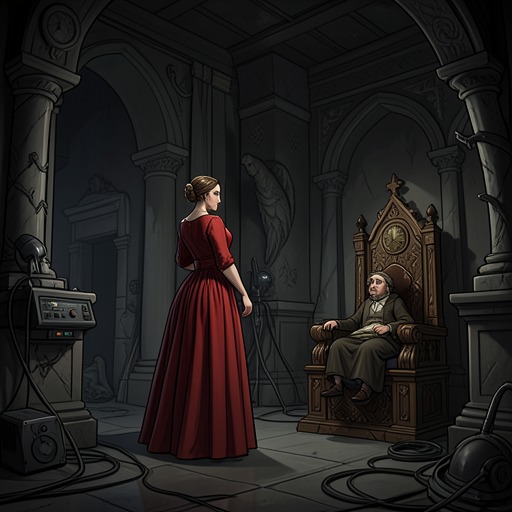
Springton High Art Club
RESprington High Art Club is the school-based creative organization through which Alicia Brooks begins to find recognition and belonging at Springton High School. More than an extracurricular label, it provides a place where her art can be shown, assessed, and developed among peers, turning work that might otherwise remain private into cultural and social capital within the school.## Nature and Setting The club meets on Fridays in the art building, although its ordinary purpose is less a formal social gathering than an open period for members to practice their craft. Casey and Matthew Williams are the first club members Alicia knows, and the group’s structure leaves room for different forms of visual work rather than restricting participation to a single medium. Matthew’s invitation specifically asks whether Alicia does photography, while Casey’s own contribution is cartooning, showing that the club accommodates varied artistic identities.
The organization also has a public-facing purpose beyond its weekly meetings. Later in the school year, members are expected to hold an art show, and Springton High School administration plans to assign them the task of painting a new school mural over the old one. These projects give the club a collective relationship to the school’s physical environment: its members do not merely produce images for themselves, but may replace an existing public surface and make student creativity visible across the institution.## Membership and First Encounters Alicia’s introduction to the club occurs through Elena Seelbaugh, who identifies her as prospective art-club material and brings her to meet Casey in the library. Casey, an older student with light brown hair in a shaggy bob, a summer-camp T-shirt, shorts, and an initially too-cool manner, is waiting with a smartphone and later sets aside a Game Boy. The scene establishes a contrast between Alicia’s nervous uncertainty and Casey’s casual familiarity with the school’s social and technological world.
Casey begins by sharing her own work: a worn spiral notebook filled with panel after panel of stylized animals and speech bubbles. Her comic centers on Cocoa Cinnabun, a pet bunny drawn in a style reminiscent of Garfield comics, with plots involving laziness, chewing through forbidden objects, and knocking over a wastebasket. Alicia and Tabitha Moore examine the notebook, while Alicia also passes over her portfolio. The exchange is reciprocal rather than an audition conducted by adults; each girl reveals her work to the other, and the club’s potential community begins through mutual looking.
Casey’s response to Alicia’s portfolio is immediate and emphatic. She exclaims that the drawings are serious, asks to see Alicia’s newer work, and calls other students over to look. Her enthusiasm brings Elena and Matthew into the encounter, while Alicia’s art becomes the center of attention without Alicia having to force herself into the conversation. Casey also responds warmly when Tabitha compares Cocoa Cinnabun to Garfield and Hello Kitty, helping turn an initially tense introduction into a moment of shared popular culture.## Recognition and Artistic Capital The club’s most important early function is its recognition of Alicia as an unusually accomplished young artist. At a later meeting, Mr. Peterson introduces her through a giant print of her Tabitha in Motion picture and tells the group that the work is already being published in a newspaper. The public display gives Alicia’s image a scale and status beyond the original drawing, while the newspaper publication confirms that her talent has begun to circulate outside the classroom.
Alicia’s portfolios deepen that impression. The group’s general assessment is that, despite being a freshman, her work is at a college level; only two other members, both painters, are regarded as reaching a comparable standard. This judgment does not erase Alicia’s difficulty fitting in or making friends, but it changes the social terms on which she enters the club. She is not merely tolerated as a newcomer. Her work supplies a form of cultural authority, and the club’s response makes her cautiously optimistic about belonging there.
Matthew Williams adds a different form of welcome by inviting Alicia to join the Friday meetings and asking whether she works in photography. Casey’s reaction is less measured but equally important: she openly admires Alicia’s drawings and displays them to others. Together, these responses establish the club as a field in which artistic competence can produce recognition even when ordinary social confidence is harder to achieve.## Evidence, Photography, and the Club’s Wider Function The club also becomes connected to the violence surrounding Springton High School. During the library meeting, Alicia suddenly remembers that she had a camera with her on the day of the shooting. She had forgotten it amid everything happening to Tabitha and had left it in class, but the camera may contain photographs from the scene where Tabitha and Alicia witnessed the first officer being shot, rather than from the later, larger parking-lot shooting.
Casey immediately understands the potential importance of the forgotten camera. She closes her sketchbook, rises, and proposes telling Mr. Peterson so the film can be developed in the art room. Her reaction shows the club’s practical infrastructure as well as its artistic one: the art room contains equipment and an adult supervisor who might help convert an overlooked object into evidence. Alicia’s camera therefore shifts from a personal possession to a possible record of a crime, and the club becomes an intermediary between creative practice, institutional support, and public truth.
The moment also reveals the limits of the club as a refuge from the rest of school life. The same space that offers cartoons, portfolios, and enthusiastic recognition is drawn into the investigation of violence affecting its students. Alicia is exhausted and has not been sleeping, while Elena is incredulous that such a significant object could have been forgotten. The club cannot remove the trauma surrounding the shooting, but it gives Alicia a setting in which the fact can be recognized and acted upon.## Narrative Significance Springton High Art Club represents a different model of school belonging from popularity, athletic status, or inherited social confidence. Its members arrive with distinct practices—Alicia’s serious drawings, Casey’s Cocoa Cinnabun comics, Matthew’s interest in photography—and the club’s loose organization allows those practices to meet without requiring them to become identical. Its future art show and mural project extend that exchange into public space, promising a collective presence within Springton High School.
For Alicia, the club’s significance lies in the convergence of artistic validation and social possibility. Casey’s excitement, Matthew’s invitation, Mr. Peterson’s presentation of Tabitha in Motion, and the group’s assessment of Alicia’s college-level work all make her talent legible to other people. At the same time, the forgotten camera demonstrates that art and documentation are not sealed off from danger. The club can display beauty, encourage friendship, and potentially preserve evidence; its importance comes from holding those functions together. In a school marked by harassment, injury, and social uncertainty, it offers Alicia not an escape from reality but a community through which reality can be seen, shared, and sometimes changed.