Tabitha's Misdiagnosis of Brain Death and Awakening
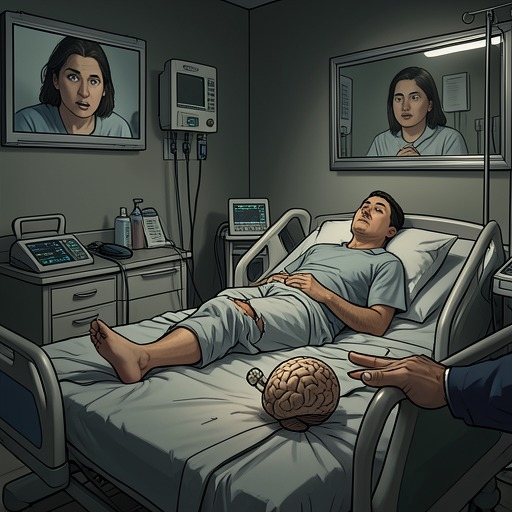
RETabitha's Misdiagnosis of Brain Death and Awakening is the central life-and-death reversal in Tabitha Moore's second chance at life. The event begins in the language of finality: Tabitha Moore has been declared brain dead, taken off life support, and placed in a hospital room where her grieving family waits for her body to pass away. It ends when her apparent serenity breaks into movement, distress, and a whispered plea for help, followed by her return to consciousness. The reversal is not presented as a simple medical correction; it is filtered through a child's insistence, a mother's shock, Tabitha's trapped awareness, and the unsettling fact that she has already been legally dead for two days.
Medical Finality and the Human Cost of Certainty
Tabitha's condition is treated as irreversible. The doctors' judgment, as explained to Hannah MacIntire, is that Tabitha has no brain activity and will never wake up again. She is described as being in a vegetative state and permanently comatose, with life support already withdrawn and only a few days of visiting remaining before the Moore family expects a quiet death. The medical explanation tries to make the situation comprehensible to Hannah by comparing Tabitha to Sleeping Beauty: she is said to be resting, free from pain and distress, but unable to return.
That explanation creates a sharp contrast between institutional certainty and the signs available to an attentive witness. Tabitha's body had appeared peaceful for several days, and the bandages around her head were the only obvious evidence of the injury. Yet the apparent calm conceals an experience that the medical account cannot explain. Her face becomes troubled, her brow furrows, her eyes clamp shut as if she is suffering, her breathing accelerates, and her lips tremble. The event therefore turns on a failure of interpretation: the same body read by adults as peacefully dying is read by Hannah as someone having a nightmare.
Hannah MacIntire's Recognition and Sandra's Reversal
Hannah MacIntire is the first person to resist the official conclusion. She calls for her mother and insists that Tabitha is having a bad dream, despite being told that someone without brain activity cannot dream or wake. When Hannah reports that Tabitha grabbed her hand, her observation gives the supposedly impossible claim a physical confirmation. Hannah does not possess medical authority, but she notices contact, movement, and distress rather than accepting the explanation imposed on her.
Sandra MacIntire initially tries to reassure Hannah that nothing is wrong, but she freezes when she sees Tabitha's altered condition. The girl's body is no longer serene: it jerks slightly, her breathing grows faster, and a barely audible plea emerges from her. Tabitha's fragmented request for help changes the scene from a vigil for the dead into an emergency. Sandra immediately recognizes that the diagnosis cannot account for what is happening and panics, declaring that Tabitha cannot be brain dead before rushing to find someone.
Hannah remains physically involved in the rescue. Sandra tells her to keep holding Tabitha's hand and not let go, and Hannah squeezes it while repeatedly urging Tabitha to wake up. Her insistence becomes a form of witnessing: she does not merely report an anomaly but stays connected to Tabitha while Tabitha struggles toward consciousness. The event's reversal is thus carried by a child whose attention outlasts the adults' certainty.
Awakening After Legal Death
Tabitha's return is harsh rather than serene. Her eyelids flutter, her body stirs restlessly, and she fights to pull herself back into consciousness. When she finally jolts awake, the first sensation is not relief but pain: smelling salts burn through her sinuses, bright light overwhelms her, and her exhausted body feels stiff and difficult to control. Three faces crowd around her, while an emotionally choked woman speaks to her from a reality Tabitha cannot immediately identify.
A doctor tells Tabitha that she is lucky and that she has been legally dead for two days. The remark gives the event an especially disturbing paradox. Tabitha has not merely survived a grave injury; she has crossed a legal and medical boundary that was supposed to be permanent, leaving behind a death certificate that records a condition contradicted by her living body. Her first conscious contribution is a pain rating of six, rising toward seven, a precise bodily report that reasserts her as a speaking patient rather than a silent medical object.
The awakening does not conclude the injury. It begins Tabitha's long convalescence, with severe pain, exhaustion, confusion, and the need for morphine and continued medical attention. The event changes the expected outcome from quiet death to difficult recovery, but it does not erase the damage or make the return uncomplicated. Survival is presented as an opening into treatment, memory, and consequences rather than as an instant restoration of ordinary life.
Guilt, Memory, and the Burden of Second Chances
The awakening gains its full significance from the guilt surrounding Tabitha's attempt to alter the timeline. Earlier, she believes that Jeremy Redford died because of her actions, even though her intervention also changes the circumstances surrounding the South Main Shooting and leads police to him. She experiences the death not as an abstract improvement to history but as a personal moral burden. The same pattern appears when she realizes that her parents failed to tell her about Danny Moore's arrest, an event she had expected to anticipate and repair through her knowledge of the future.
Her guilt also returns through the bullying investigation. When Mrs. Cribb asks why the harassment against Tabitha was so intense, the discoloration beneath Tabitha's cast recalls the childhood friend she abandoned. She understands that forty-seven years have passed without her confronting what she failed to do for Ashlee Taylor. The later disclosure about the Taylor sisters' abuse clarifies the ethical structure of Tabitha's memory: she had witnessed unexplained bruises, threats, and Ashlee's withdrawal, but fear and class-based powerlessness kept her silent.
The crisis affects other witnesses as well. Elena Seelbaugh, believing Tabitha may have died after Elena encouraged her to go somewhere she considered safe, collapses under the conviction that she caused Tabitha's death. Her reaction shows how Tabitha's disappearance produces secondary guilt in those who think they should have prevented it. When Tabitha awakens, that apparent death is reversed, but the fears and responsibilities produced by it do not simply vanish.
Narrative Significance
The event is a decisive peripeteia: the story moves from life toward death and then reverses direction at the point when death seems settled. Its recognition scene belongs first to Hannah MacIntire, whose ordinary observation exposes the limits of the official diagnosis, and then to Sandra MacIntire, who sees the evidence and acts. The sequence turns a hospital vigil into a rescue and makes attention—not authority alone—the condition of recognition.
The episode also concentrates the book's recurring conflict between the body as a managed medical status and the body as lived experience. Tabitha is classified as brain dead, vegetative, permanently comatose, and legally dead, yet her distress, grasping hand, changing breath, whispered speech, and returning consciousness contradict those categories from within. Her body is not merely a symbol of miraculous survival; it is a damaged, suffering body whose condition must still be assessed, medicated, and rehabilitated.
Most importantly, the awakening gives Tabitha's temporal displacement an ethical shape. Knowledge of the future has not allowed her to control every consequence: she misses Danny Moore's arrest, carries guilt for Jeremy Redford's death, and remains haunted by her failure to protect Ashlee Taylor. Her return from presumed death therefore supplies neither omnipotence nor absolution. It gives her another opportunity to act, tell the truth, and accept the costs of intervention. The event's deepest reversal is consequently not only from death to life, but from passive certainty to renewed responsibility.