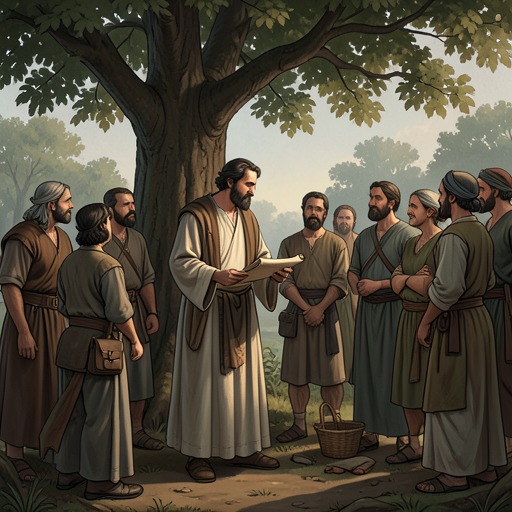
Fate and human agency
RamayanaFate and human agency form a continuing tension in the epic, not a settled choice between helpless submission and effortless control. Ráma explains his departure for the forest as Fate’s work, yet the same narrative gives voice to the claim that human power can turn Fate aside. The contrast makes destiny at once an account of suffering and a challenge to action: what happens may be bound to former deeds, but how a person meets it remains consequential.
Fate as an Explanation of Events
When Ráma declares that Fate sends him into the wilderness, he frames exile as a force larger than any single person’s wishes. He extends that claim beyond his own immediate loss: Fate is beyond comprehension, and life, death, joy, pain, anger, fear, loss, and gain are all subject to its power. The breadth of this catalogue makes Fate an encompassing explanation for the turns of human existence rather than a label for one unfortunate event.
The reference to former deeds gives this explanation a moral dimension. The passage presents past actions as bonds that can shape present circumstances, linking what a person experiences to what has already been done. It does not, however, specify a particular past deed as the cause of Ráma’s exile. Its force lies instead in the larger proposition that the present is not wholly self-created: human lives unfold under conditions they cannot fully understand or command.
Agency as Resistance
The argument does not end in submission. Another voice rejects the idea that noble people should bow their heads to Fate and insists that courage need not fail when Fate threatens. The claim that this moment will reveal both the power of Fate and the power of human beings makes the conflict explicit: neither side is treated as an illusion, and the outcome is framed as a test of their relation.
That resistance becomes especially vivid in the image of power turning Fate aside, which is compared to an elephant advancing with furious force. The metaphor gives agency physical momentum; Fate is not merely an abstraction but an opposing force to be met. Yet the promise to resist does not erase the earlier account of destiny. The passage holds the claims together, presenting human strength as meaningful precisely because it confronts a power that appears to exceed it.
Duty, Promise, and Consequence
The theme also takes shape through obligations that constrain choice. In the episode of Ráma’s exile, Daśaratha’s anguish at his son’s lot makes the consequence of the decision painfully personal. The king’s distress does not alter the course of events; instead, it shows how a decision understood as binding can impose suffering even on those who grieve over it. Ráma’s promise and departure therefore turn the abstract language of destiny into a conflict lived within a family and a kingdom.
A later appeal to Ráma to accept the rule rightly his, made by Jabali while Bharata is earnestly asking him to return, places practical choice beside Ráma’s reputation for truthfulness. The scene’s framing, in the canto titled “The Praises Of Truth,” links his response to the value of keeping faith. Read alongside the exile, it suggests that agency is not simply the freedom to choose whichever outcome is most advantageous. A person’s commitments shape the choices available and their consequences; Ráma’s conduct is defined in part by what he will not abandon, even when another course is urged upon him.
Prophecy and the Pattern of the Narrative
The epic also uses foretelling to make destiny visible before its fulfilment. In the canto titled “Rávan Doomed,” a saint tells the king that four sons will uphold his royal line. The prediction gives the future a place in the story before the promised children’s deeds can establish their significance. It does not explain every later choice or consequence, but it places individual lives within a larger anticipated order.
Elsewhere, the canto “The Sacrifice Begun” accompanies imagery of spring returning and lilies appearing in lovelier hues after winter. This seasonal renewal offers a formal contrast to the language of bonds and unavoidable loss: the world moves through change, and what follows hardship may take a different shape. The poem does not equate natural recurrence with human control, but the image broadens the theme beyond argument. Fate supplies the pressure of what cannot simply be wished away; agency appears in the responses, promises, and acts through which characters meet that pressure. The epic’s sustained tension is therefore not a simple verdict on whether people are free, but an account of responsibility exercised within limits they cannot wholly master.