How to Enter the Tower
RapunzelIn “Rapunzel,” How to Enter the Tower is a rule of access built around a single, extraordinary passage: Rapunzel’s long braids, lowered from the tiny window to the ground. The tower has neither stairs nor door, and the person who can summon Rapunzel and climb her hair controls who crosses its boundary. What first serves Mãe Gothel’s authority is learned and reused by the prince, then becomes part of Gothel’s deception; the method makes the tower’s isolation both concrete and vulnerable to reversal.
The Tower and Its Restricted Entrance
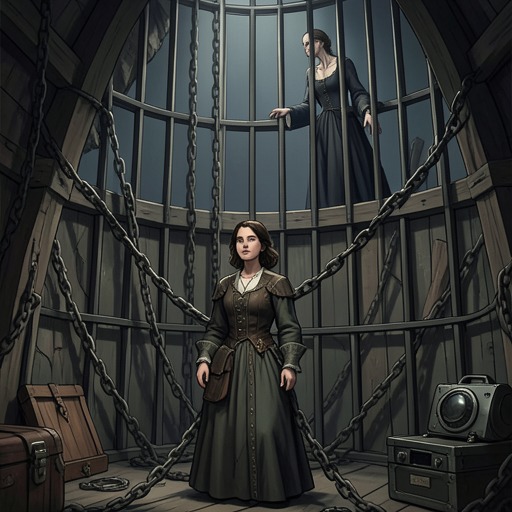
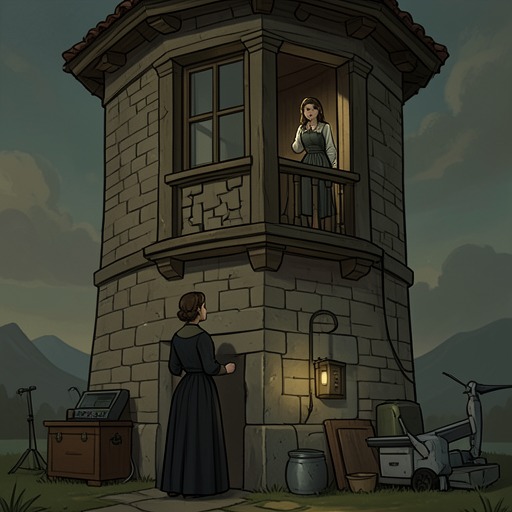
At twelve, Rapunzel is taken into the forest and locked in a tower without stairs or a door. Its only described opening is a tiny window high above the ground. The architecture admits no ordinary approach: someone outside cannot simply walk in, and Rapunzel cannot leave by a conventional exit. Access instead depends on the hair she can lower from the window, making the tower’s boundary something that can be crossed only through a particular person and a repeated procedure.
This arrangement gives Mãe Gothel control of the tower’s sole entrance. When she wants to go inside, she stands at its foot and calls for Rapunzel to let down her braids. Rapunzel uncoils them, ties them to the window’s latch, and drops them to the ground; Mãe Gothel then climbs up. The sequence is practical as well as ceremonial: a summons, a response, hair secured to the latch, and an ascent. No key or hidden door is introduced. The story establishes the braids themselves as the means by which the otherwise inaccessible tower can be entered.
The Summons as a Repeatable Procedure
The call “Rapunzel, Rapunzel! Jogue as suas tranças.” is the recognizable signal that initiates the entrance. Mãe Gothel uses it to gain access, and Rapunzel’s response converts her hair into a ladder. The same words recur when the prince, having watched Mãe Gothel arrive and climb, tries the method himself. He goes to the tower the following day as evening begins, calls from below, and climbs the braids when they fall. The procedure is therefore not physically restricted to Mãe Gothel: once its pattern has been observed, another person can reproduce it.
The prince’s access begins with observation rather than invitation from Mãe Gothel. While hidden behind a tree, he sees her approach and hears the call; he then understands how she gets to the window. On his own visit, Rapunzel is frightened to find a man entering, since she has never seen one before. He speaks gently and explains that her singing moved him so deeply that he could not rest without seeing her. The entrance thus brings an unfamiliar visitor into Rapunzel’s confined life, and what had been a route reserved for the person who imprisoned her becomes the means by which Rapunzel and the prince meet.
Control, Discovery, and the Planned Escape
The braids’ function changes when the prince begins visiting. He and Rapunzel arrange to meet at night because Mãe Gothel is present during the day. Their access depends on repeating the same call-and-climb routine that enables Gothel’s visits, but now it allows a relationship to develop beyond her knowledge. The entrance remains physically unchanged; its significance changes with the identity and purpose of the climber.
Their meetings lead to a plan for departure that exposes the limits of the hair-ladder method. Rapunzel asks the prince to bring a skein of silk on each visit so she can weave a ladder. Once it is ready, she intends to climb down and leave with him on his horse. Her braids can bring a visitor up, but they do not provide the planned means of escape; the lovers must devise another route. The contrast makes the entrance a mechanism for contact, not a complete solution to confinement.
Mãe Gothel discovers the secret after Rapunzel asks why it is so much harder to draw her up than the young prince, who reaches the window in a moment. The comparison inadvertently reveals that someone else has been using the entrance. Until then, the repeated visits had escaped notice; Rapunzel’s question gives away the prince’s access and turns the routine that enabled their meetings into evidence of her disobedience. The tower’s security has depended not on an impassable structure but on Mãe Gothel’s presumed exclusive command of its passage.
The Entrance Reversed
In her fury, Mãe Gothel cuts Rapunzel’s braids and takes her away to a desert, where Rapunzel must live miserably. This act destroys the familiar means of ascent and removes Rapunzel from the tower. On the same day, however, Mãe Gothel uses the severed braids to preserve the appearance of access. She ties them to the window’s latch and lowers them when the prince arrives and calls as before. The very instrument that had carried Rapunzel’s response to the ground now disguises her absence.
The prince climbs, expecting to find Rapunzel, but meets Mãe Gothel instead. The deception turns the entrance into a trap: the familiar call still receives a visible answer, and the prince can still ascend, yet the person and purpose behind the route have changed. Mãe Gothel tells him that Rapunzel is gone forever. In despair he jumps from the tower; he survives, but the thorny bramble where he lands scratches his eyes and leaves him blind. The false entry therefore leads not to reunion but to separation and injury.
Beyond the Tower
The eventual reunion takes place not through the tower entrance but in the desert. After wandering for years, the blind prince reaches the place where Rapunzel is living with the twins she has borne, a boy and a girl. He hears a familiar voice and follows it; Rapunzel recognizes him, embraces him, and weeps. Two of her tears fall into his eyes, and his sight returns. The story’s final restoration does not reopen the tower or restore the cut braids. Instead, recognition, movement toward a voice, and tears replace the earlier call, latch, and ascent as the means by which the separated pair find one another.
The entrance rule organizes a series of reversals: Mãe Gothel’s private route is observed, imitated, exposed, and finally falsified. Its dependence on Rapunzel’s hair makes her body the means through which the tower’s boundary can be crossed, while her confinement prevents that access from amounting to freedom. The prince can enter but cannot carry her out by the same method; when the hair is cut, even the appearance of a working entrance can conceal loss. The story ultimately places reunion beyond the structure that had governed their meetings, making the tower’s access procedure a temporary instrument of control rather than the route to a lasting resolution.