Rapunzel Theft and Child-Handover Pact
RapunzelThe Rapunzel Theft and Child-Handover Pact is the bargain that transforms a husband’s secret theft of lettuce into the sorceress’s claim to his unborn child. Made under fear and without the child’s participation, it sets the story’s central conflict in motion: the sorceress takes Rapunzel and raises her apart from her family, while the girl later seeks a life of her own beyond the tower.
The Theft and the Sorceress’s Demand
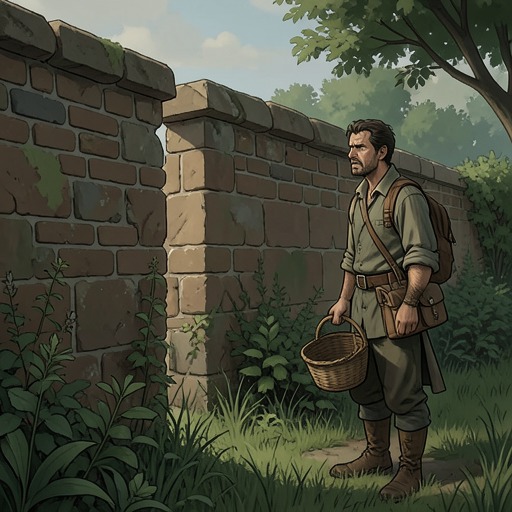
The chain begins with the wife’s intense desire for rapunzel growing in the garden behind the couple’s house. Her husband loves her and reasons that it is better to fetch the plant than let her die. At nightfall he climbs the wall, jumps into the garden, tears out a handful, and carries it home. His wife immediately makes a salad and eats it voraciously. The lettuce tastes so good that by the next day her appetite for it has tripled, leaving her husband feeling he must return.
The second visit brings the theft into the open. Again arriving after dark, the husband has crossed the wall when the sorceress appears in front of him. She angrily accuses him of sneaking into her garden and stealing her lettuce like a common thief, and warns that he will regret it. The theft is therefore not a hidden offense that simply supplies the wife’s craving: it gives the sorceress leverage over the husband and his family.
A Promise Made Under Fear
The husband explains that he took the lettuce because his wife saw it through the window and wanted it so desperately that she said she would die without it. The sorceress’s anger subsides. She offers to let him take as much lettuce as he wants, but only if he gives her the child when his wife gives birth. She promises to care for the child as a mother and says the child will lack nothing.
The agreement is made in a threat-laden encounter, not through a choice shared by all those whose lives it will shape. The husband is terrified and agrees to everything; the unborn child has no part in the bargain, and the wife’s desire for lettuce is the circumstance that prompts the visit, not a recorded agreement to surrender the baby. The sorceress’s promise of maternal care makes the exchange sound protective, but it also gives her the power to decide the child’s future. The bargain is a story event, not a formal legal contract: its force comes from fear, the husband’s assent, and the sorceress’s subsequent ability to claim what was promised.
Fulfillment and Captivity
When the time comes to deliver the child, the sorceress arrives punctually, names the girl Rapunzel, and takes her away. The pact thus becomes an enacted separation: the parents’ promise determines where their daughter will live before she can make any choice of her own. The narration gives no account of the parents contesting the handover or of the sorceress’s promised care being tested at that moment; what it establishes is the transfer itself and the name she gives the child.
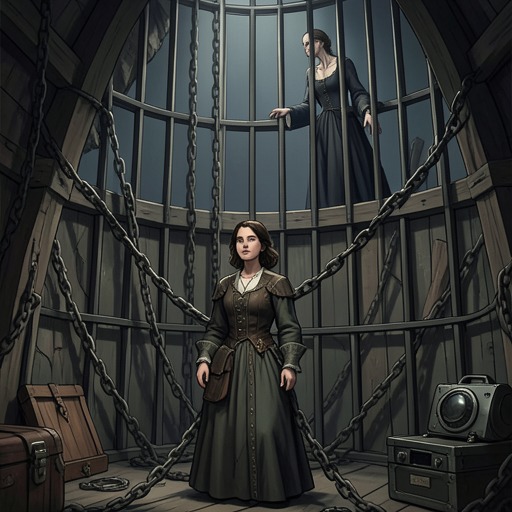
Rapunzel grows up to be described as the most beautiful girl in the world. When she is twelve, the sorceress takes her into the forest and locks her in a tower without stairs or a door, with only a tiny window high above the ground. The sorceress’s original claim to raise the child has become control over her movement and isolation. She can enter by calling for Rapunzel to lower her long, fine hair, which Rapunzel fastens to the window latch and lets fall to the ground so the sorceress can climb up. The hair becomes the practical means by which the guardian who took Rapunzel can reach her in the otherwise inaccessible tower.
The Bargain’s Lasting Consequences
The pact does not end with the handover. Years later, the Prince hears Rapunzel singing from the tower and discovers that the sorceress uses her hair to enter. He climbs the braids himself, meets Rapunzel, and speaks kindly to her. Though she is frightened at first because she has never seen a man, she loses her fear; when he asks her to marry him, she accepts and proposes a means of leaving. He is to bring a skein of silk on each visit, and she will weave it into a ladder. They agree that he will come at night, when the sorceress is away during the day. Rapunzel’s plan marks a sharp contrast with the original pact: the first decision about her fate was made by adults without her; now she participates in planning her departure and a future with the Prince.
The sorceress discovers the visits after Rapunzel asks why it is so much harder to pull her up than the young Prince, who reaches the tower in a moment. In fury, she cuts off Rapunzel’s braids and exiles her to a desert, where Rapunzel lives miserably. The cut hair also becomes a deception: the sorceress ties it to the window latch and lets it fall when the Prince calls, so he climbs expecting to find Rapunzel. Instead, the sorceress tells him that Rapunzel is gone forever. He leaps from the tower, survives, but is blinded by the brambles below; he wanders for years, grieving and living on roots and berries.
The story finally reverses the separation initiated by the handover. The Prince reaches the desert, where Rapunzel is barely surviving with the twins—a boy and a girl—she has borne. Hearing her familiar voice, he follows it; Rapunzel recognizes him, embraces him, and weeps. Two tears fall into his eyes, and his sight suddenly returns. He goes back to his kingdom with Rapunzel, and they live there amid great celebration, happy for many years. The ending does not undo the coerced bargain by recovering the childhood taken from Rapunzel; instead, it closes the long consequences of the sorceress’s claim with reunion, a family of their own, and a shared life beyond her control.