The Witch’s Garden
RapunzelThe Witch’s Garden is the enclosed plot behind a couple’s home where the story’s decisive bargain begins. Its wall and the enchantress’s fearful reputation make it a forbidden place; its unusually lush lettuce makes it an irresistible one. A husband’s nocturnal trespass to obtain the plant for his pregnant wife sets in motion the surrender of their child, connecting the garden’s produce to the tower, exile, and eventual reunion that follow.
Setting and Forbidden Abundance
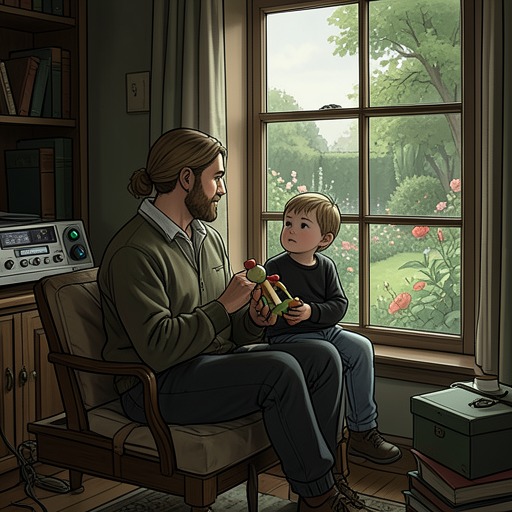
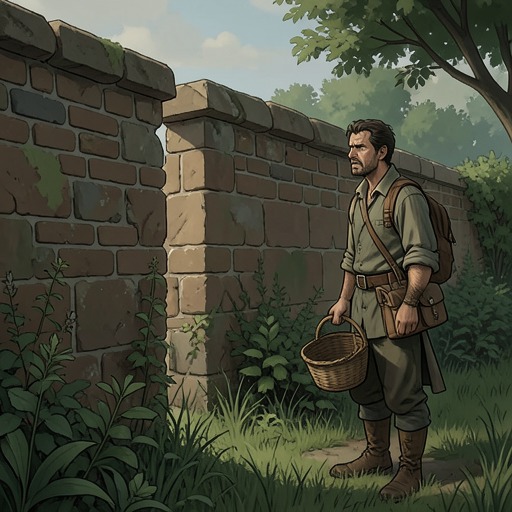
The garden lies behind the house, visible through a small window at the back. It is described as splendid, full of beautiful flowers and vegetables, and enclosed by a high wall. The garden belongs to a powerful enchantress feared throughout the surrounding area, so the wall is more than a physical boundary: it marks a space no one dares enter. From the house, the woman can see what she wants but cannot safely reach it.
Her attention fixes on a particular bed of rapunzel, a kind of lettuce. It looks exceptionally fresh and green, its abundance sharpened by its inaccessibility. The woman’s desire grows day by day until she becomes pale and miserable, convinced she will die if she cannot eat some. The garden thus first enters the story as a scene of longing: a cultivated provision is visible just beyond the domestic space, but its ownership and the fear surrounding it place it out of reach.
The Theft and the Bargain
The husband responds to his wife’s distress by deciding that obtaining the lettuce is preferable to letting her die. At night he climbs over the wall, rushes into the garden, pulls up a handful of rapunzel, and carries it home. His wife makes a salad and eats it voraciously. The plant tastes so good that the next day her appetite is three times greater, and the husband feels he has no choice but to return for more. The first visit briefly answers her craving; it also intensifies it and makes another breach of the boundary seem necessary.
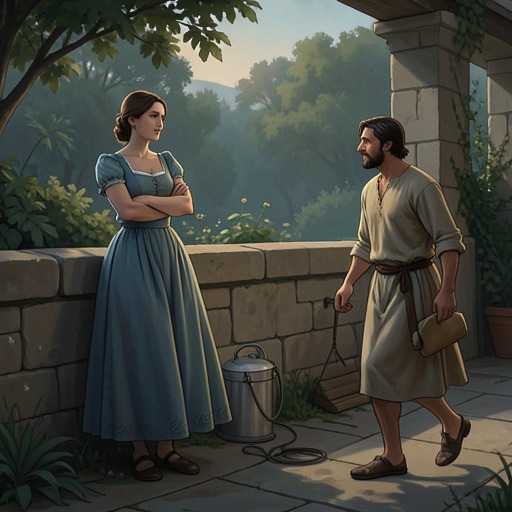
On the second night, the enchantress is waiting in the garden. She confronts the husband for entering secretly and taking her rapunzel like a thief, and warns that he will regret it. He pleads for mercy, explaining that his wife saw the plant from their window and said she would die without it. Rather than simply punish him, the enchantress offers to let him take as much rapunzel as he wants on one condition: when his wife gives birth, he must hand the child over to her. She promises to care for the baby as a mother and provide everything needed.
Terrified, the husband agrees. The promise is made by the parents, under pressure from the enchantress, before the child is born; the child has no part in it. When the time comes, the enchantress arrives punctually, names the baby Rapunzel, and takes her away. The garden therefore becomes the site of an exchange whose cost falls not on the person who entered it but on the child whose future the adults have promised.
From Garden Boundary to Tower
The garden itself is not where Rapunzel is raised or confined. At twelve, she is taken to the forest and locked in a tower with no stairs or door, a tiny window high above the ground, and no ordinary way in. Yet the garden’s original boundary-crossing anticipates the later architecture of confinement: access is controlled, and Rapunzel’s life is shaped by decisions made by others. The enchantress’s bargain over lettuce becomes the beginning of her authority over the child.
The tower’s only entrance depends on Rapunzel’s long, fine golden hair. When the enchantress calls from below, Rapunzel lowers her braids, ties them to the window latch, and lets them fall to the ground; the enchantress climbs up them. Later, the prince watches this method and uses it to enter. The contrast is pointed: in the garden, the husband crosses a wall by force and secrecy, while at the tower, entry depends on a repeated call and Rapunzel’s own act of lowering her hair. The story moves from stolen access to a means of access that Rapunzel can also turn toward escape.
The Garden’s Consequences
The original bargain continues to govern events long after the lettuce has been taken. Rapunzel and the prince plan to leave the tower together: he is to bring silk thread on each visit so she can weave a ladder. When Rapunzel inadvertently reveals that the prince has been visiting, the enchantress discovers the secret, cuts Rapunzel’s hair, and banishes her to a desert. The hair that once enabled the enchantress to enter the tower is destroyed as a means of access, and Rapunzel is removed from the place where the bargain’s consequences have kept her.
The enchantress then uses the cut braids to deceive the prince, lowering them from the tower window in response to his call. He climbs up expecting Rapunzel and finds the enchantress instead. After she tells him he will never see his beloved again, he leaps from the tower; he survives but is blinded by the thornbush where he falls. Years later he reaches the desert, where Rapunzel is struggling to survive with the twins she has borne, a boy and a girl. He recognizes her voice, she recognizes him, and her tears restore his sight. They return to his kingdom and live happily for many years.
The garden’s role is therefore concentrated at the story’s beginning but extends across its entire chain of cause and consequence. A visible bed of lettuce prompts a desperate crossing, the crossing produces a coerced promise, and that promise leads to the child’s removal and the tower’s long separation. The ending reverses that separation not through another bargain or controlled passage, but through the reunion of Rapunzel and the prince in the desert. The garden is absent from that final scene, yet the loss and reunion it set in motion remain bound to its first forbidden harvest.