Presumption of innocence and prosecution’s burden of proof
RetributionThe Presumption of innocence and prosecution’s burden of proof is the principle that the state must establish a defendant’s guilt rather than require the defendant to prove innocence. In William Rupert Bantling’s murder trial, that allocation of responsibility becomes both a legal rule and a contest over how facts should be interpreted: the prosecution presents a chain of incriminating circumstances, while the defense argues that vivid accusations and suspicion cannot substitute for proof.
The burden in the courtroom
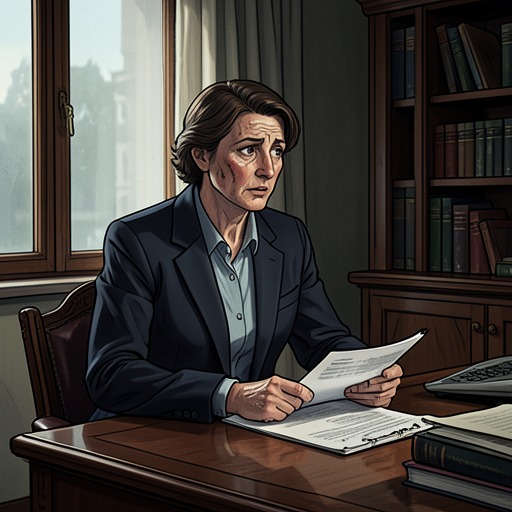
Lourdes Rubio’s opening statement makes the distinction between accusation and evidence the center of the defense. She warns the jury that the prosecution’s account is not itself proof, and challenges the assumption that troubling facts, simply placed beside one another, necessarily establish guilt. Her argument directs attention away from the emotional force of the case and toward the state’s obligation to substantiate its conclusion.
Rubio applies that principle to the principal pieces of evidence against Bantling. She disputes the interpretation of the scalpel found in his shed, presenting it as a tool used in his taxidermy work rather than a murder weapon. She also contests the meaning of blood evidence and the presence of Anna Prado’s body in the trunk of Bantling’s Jaguar. On each point, she emphasizes that Bantling is not required to prove the alternative account she offers; it is the prosecution that must prove its case.
A chain of evidence under challenge
The trial’s competing accounts make the quality and source of evidence as important as its apparent force. The Jaguar had been left at a tinting business, where it remained overnight in an unsecured lot and was accessible to more than ten employees. The owner testified that no one had looked in the trunk after Bantling dropped the car off. Those circumstances gave the defense a concrete alternative to the prosecution’s account of how Anna Prado’s body came to be there, without establishing who, if anyone, had placed it in the trunk.
Forensic testimony likewise unsettles what initially appeared to be a straightforward link between Bantling’s work and the murder. The number-five scalpel could be used in taxidermy, and testing indicated animal blood on its blade; the red blood cells had nuclei, unlike human red blood cells. The sample was too small for an accurate DNA test. A pathology expert further characterized blood patterns on the blade and drops found in the shed as manufactured. These claims do not independently establish Bantling’s innocence. They show how a defense can challenge the prosecution’s interpretation of physical traces and make the jury consider whether those traces bear the meaning assigned to them.
That contest is intensified by the gap between circumstantial force and forensic certainty. The crime-scene team processing the silo and warehouse had found no fingerprints, semen, hairs, foreign DNA, or other trace evidence there. In court, Rubio also stresses the absence of physical evidence linking Bantling to Anna Prado’s death beyond the disputed material presented by the state. The novel thus distinguishes the accumulation of suspicions from the reliability and probative value of each item.
Investigative conduct and evidentiary legitimacy
The burden of proof cannot be separated from the way evidence is obtained. In questioning Officer Chavez, C.J. Townsend identifies inconsistencies in his account of following Bantling’s Jaguar, including the street layout that made the described route implausible. She also challenges the anonymous tip that prompted the stop: it offered no driver description, license plate, or explanation of how the caller knew about the alleged drugs. As presented, the information gave police little basis to assess the caller’s credibility or the reliability of the allegation.
C.J. recognizes that the stop and subsequent search lacked probable cause. The search nevertheless led police to Anna Prado’s body and opened the way to a broader investigation of Bantling. C.J. chooses to help conceal the illegality, telling herself that a small sacrifice of professional integrity serves the greater good and that, without the body, there would be no case. The choice exposes a tension at the heart of the prosecution: an effort to convict a suspected killer may be weakened, not strengthened, when the state relies on evidence obtained through unlawful conduct and hides how it was obtained.
What the trial can and cannot settle
The defense’s evidence does not prove that every alternative explanation is true, just as the prosecution’s evidence does not become conclusive simply because it forms a disturbing narrative. The jury’s task, as the novel frames it through the opposing openings and testimony, is to assess whether the state has met its burden while accounting for weaknesses, competing explanations, and uncertainties in the evidentiary chain. The principle protects against treating the defendant’s failure to explain suspicious circumstances as proof of guilt.
The rule also casts a critical light on the prosecution’s compromises. C.J.’s decision to conceal the unlawful stop puts the pursuit of conviction in conflict with the standards that make a conviction legitimate. The case therefore tests more than whether the evidence points toward Bantling: it asks whether the state can demand trust in its conclusions while evading the rules that govern how those conclusions are reached.