Bollacher
ReunionBollacher is a classmate of Hans Schwarz at the Karl Alexander Gymnasium whose remembered role changes from a mocking observer of Hans’s friendship to an active participant in antisemitic abuse. His confrontation with Hans gives the school’s political transformation a personal face; years later, his name on a list of the dead returns the narrator to the cruelty of their last exchange and the difficulty of judging who deserved to die.
Identity and Place in the Class
Bollacher belongs to the group of boys around Hans and Konradin, but is initially marked out as an exception to the class’s gradual acceptance of their closeness. As their friendship becomes ordinary to the others, Bollacher remains notable for having coined the pair’s nickname, Castor and Pollack. The label makes him an early observer of the friendship, though not a confidant or an ally. Later, Hans recalls that Bollacher had hardly spoken to him for a month before the classroom confrontation, so their connection is defined less by sustained companionship than by acts of public mockery and hostility.
The narrator’s account identifies Bollacher through what he does in relation to Hans: he watches, names, taunts, challenges, and eventually shares a farewell message with another boy. The book gives little access to his private life or motives. His significance therefore lies in the changing conduct that the school environment permits, and in how that conduct persists in Hans’s memory after the classmates themselves have been scattered by political events and war.
Friendship and the School’s Changing Atmosphere
Bollacher’s nickname belongs to the earlier period when Hans and Konradin’s friendship had become an established part of classroom life. The class at first reacted with surprise, then largely took the friendship for granted. Bollacher is singled out as the exception, while the Caviar also respond by cutting the pair socially. His contribution is a teasing name rather than, at that point, the public racial abuse that marks the later scene. The contrast makes the progression in his conduct especially clear: the boy who had mocked a friendship becomes one of those who use antisemitism to confront Hans directly.
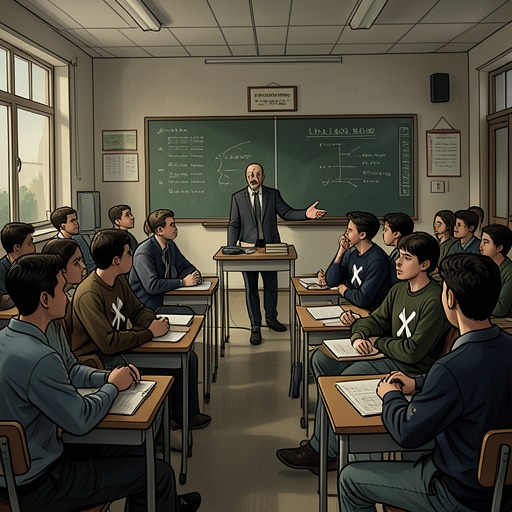
That confrontation follows a broad change in the school’s atmosphere. Political unrest had once seemed distant from the boys’ daily concerns, even as Nazi and Communist clashes were reported elsewhere and antisemitic incidents appeared in Stuttgart. At school, a new history master’s teaching brings nationalist and racial ideas into the classroom. Soon afterward, Hans hears a heated discussion about Jews before entering and finding Bollacher among the boys facing him. The episode places Bollacher’s behavior within a climate that has altered ordinary classroom relations, without making him merely a passive bystander: he takes the initiative in humiliating and challenging Hans.
The Classroom Confrontation
When Hans enters the classroom, Bollacher and Schulz remain standing and look directly at him. Bollacher grins at Hans in a way the narrator compares to the contemptuous reaction of someone looking at an animal in a zoo. Schulz, meanwhile, holds his nose as if Hans were unpleasant. Hans considers answering the challenge physically but decides that doing so would not undo the poison already spreading through the school. He goes to his desk and pretends to review his homework, as Konradin does nearby.
Bollacher then rushes toward Hans and tells him to return to Palestine, treating Hans as an outsider in his own country. He takes a small printed paper from his pocket, moistens it, and sticks it to Hans’s bench. The paper carries an antisemitic call blaming Jews for Germany’s troubles and urging people to wake up. Hans asks Bollacher to remove it; Bollacher refuses and threatens to break Hans’s bones if he does so himself. The encounter has become more than an exchange of insults: the paper turns a political slogan into an object placed directly in Hans’s space, and Bollacher makes Hans choose whether to submit to it or resist.
Hans strikes Bollacher, and the two boys fight without skill. The narrator understands the struggle as both a personal fight and a confrontation between Nazi and Jew, with Hans fighting for what he regards as the better cause. Bollacher swings at him, misses, trips, and becomes caught between two desks just as the history master enters. He gets up and accuses Hans of attacking him. The sequence leaves no doubt that Hans struck first, but it also shows the provocation that preceded the blow and Bollacher’s effort to present himself as the injured party.
Authority, Separation, and Departure
The master asks Hans why he attacked Bollacher. Hans explains that Bollacher had told him to return to Palestine. The master dismisses that as friendly advice rather than an insult and sends both boys back to their places, adding that they can fight outside if they wish. His response refuses to recognize the antisemitic meaning of Bollacher’s words, and the lesson resumes as though the conflict were merely a schoolyard quarrel. The classroom’s authority thus compounds the isolation of the boy targeted by the abuse.
That evening, Hans waits until the others have gone, hoping Konradin might remain to help or console him. Bollacher is not part of that expectation, but his action has helped create the crisis in which Hans needs his friend. No one is waiting for Hans when he leaves. Hans subsequently avoids Konradin, believing that being seen with him would embarrass Konradin and that the separation would be welcomed. He describes himself as alone at school; even an earlier interaction with Muscle Max ends, and the teachers seem to have forgotten him. Bollacher’s confrontation is not presented as the sole cause of Hans’s departure, but it is one of the events through which the school becomes a place of increasing exclusion before Hans leaves Germany for America on his birthday.
The Farewell Verse and Later Memory
Two days before Hans’s departure, Bollacher and Schulz send him a joint poem. Its brief farewell invokes Moses and Isaac and places Hans among the condemned. The verse carries the classroom’s hostility into the private moment of leaving: rather than offering a neutral goodbye, the two boys turn Hans’s Jewish identity into the means of a final insult. Its wording remains distinct in the narrator’s memory long afterward.
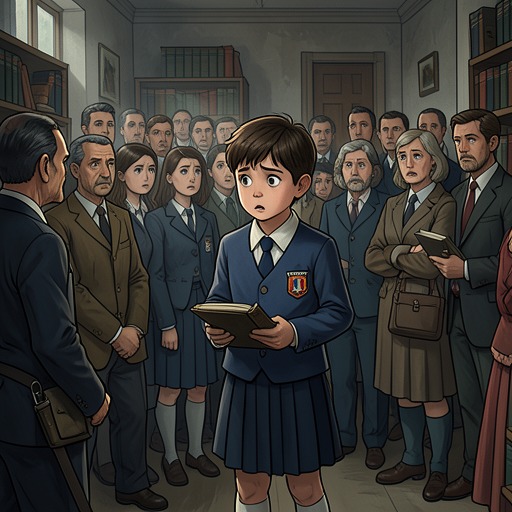
Years later, while going through the names of his former classmates, Hans remembers Bollacher when he reaches the entry recording him as dead, with his grave unknown. The memory differs from his response to boys whose faces have faded: Bollacher comes back clearly, along with the poem he and Schulz wrote. Hans declares that Bollacher deserved death, then immediately qualifies the judgment, insisting on the uncertainty of whether anyone deserves to be killed. When the thought returns, he again affirms it conditionally. The repeated qualification does not erase his anger; it exposes the strain between remembered injury and a moral judgment the narrator cannot state without reservation.
Bollacher’s fate is left at the level of the class list: he is dead, and his grave is unknown. The list records that twenty-six of the forty-six boys in Hans’s class died for the thousand-year Reich. Bollacher’s entry therefore belongs both to the intimate history of a schoolroom insult and to the larger record of a generation consumed by Nazism. His enduring narrative role rests on that uncomfortable conjunction: he persecuted Hans, yet later appears among the dead whose fate forces Hans to revisit the limits of vengeance and justice.