Dr. Schwarz
ReunionDr. Schwarz, a respected physician in Stuttgart and the father of Hans Schwarz, embodies a German-Jewish patriotism that treats belonging to Germany as more fundamental than religious difference. Twice wounded in the First World War, he remains ready to defend the country, and for years regards Nazism as a temporary affliction rather than a force capable of remaking his home. His confidence persists even as political exclusion reaches his family; his final public stand against antisemitic intimidation briefly turns a crowd against its instigator, but cannot secure a future for him and his wife.
Identity and Background
Dr. Schwarz’s sense of home rests on a long family presence in Stuttgart and on an identification with Swabia and Germany. Hans recalls that the family had lived in Stuttgart for at least two hundred years, though its older origins were uncertain. In that household’s understanding, Jewish ancestry was real but secondary: the family belonged first to Swabia, then to Germany, and then to the Jewish community. Their observance was limited. On Yom Kippur, Hans’s mother went to the synagogue; his father refrained from smoking and travelling not out of personal religious belief, but to avoid hurting others’ feelings.
His public standing reinforced his confidence that this belonging was recognized. He was a popular doctor, respected by Jews and Gentiles alike. On his forty-fifth birthday, a deputation of prominent citizens led by the mayor visited him, the Stuttgarter Zeitung printed his picture, and Gentiles serenaded him with Eine Kleine Nachtmusik. Above his bed hung the Iron Cross, First Class, earned in wartime; his officer’s sword and a picture of the Goethe-Haus in Weimar completed a private arrangement of patriotic and cultural emblems. To him, these tokens were evidence of a durable bond with Germany, not merely decorations from a past life.
Assimilation and National Faith
Dr. Schwarz openly called himself an assimilant and wanted to be identified with Germany. He could even imagine the complete absorption of Jews into German society, provided it would benefit the country over time. Yet his assimilation did not mean that he considered Jewish life culturally empty: he believed Jews who had not wholly integrated could enrich German culture. His position held national attachment and a distinct Jewish contribution together, even as he hoped the distinction between them might become less consequential.
That conviction shaped his vehement opposition to Zionism. When a Zionist came to collect money for Israel, Dr. Schwarz argued that a claim to Palestine after two thousand years made no more sense than an Italian claim to Germany on the basis of Roman occupation. He predicted that such a project would bring prolonged bloodshed and conflict with the Arab world, and questioned what Jerusalem had to do with a man from Stuttgart. The dispute became personal when the visitor invoked Adolf Hitler as a reason to doubt Germany’s security. Dr. Schwarz refused to revise his faith in his country, comparing Nazism to an illness that would pass once economic conditions improved. He appealed to German cultural achievement and to the twelve thousand Jews who had died for the country in the First World War.
When the visitor dismissed him as a typical assimilant, Dr. Schwarz accepted the description proudly. He saw the Zionist, not himself, as disloyal to Germany. The encounter exposed the limits of his confidence: evidence of a growing threat was already being brought to him, but he judged the country by its cultural inheritance and by his own service to it. In his view, the Nazi movement was a surface sickness on a healthy body, something that could be treated while the country recovered. His reputation, decorations, and public honors served as assurances that he would remain protected within the nation he had helped defend.
Fatherhood and the Family Home
His patriotism also appeared in the way he received Hans’s aristocratic friend, Konradin von Hohenfels. When Konradin visited, Dr. Schwarz entered Hans’s room after not having done so for months, clicked his heels together, stood almost at attention, and formally introduced himself. He addressed his guest with conspicuous deference, recalling acquaintances among aristocratic military circles and launching into stories about them. He eventually remembered that patients were waiting in his surgery, invited Konradin to visit again, and left beaming with pleasure and pride in Hans.
The scene shows a man who could be quiet and peaceable in ordinary life, but whose regard for German traditions and social standing came readily to the surface. His elaborate welcome suggests that his son’s friendship with a member of an illustrious family mattered to him. The same national and social world that gave him a sense of security shaped the home he hoped Hans would inherit: Germany was not an abstraction, but the place where family history, professional respect, and inherited customs seemed to fit together.
The Decision to Send Hans Away
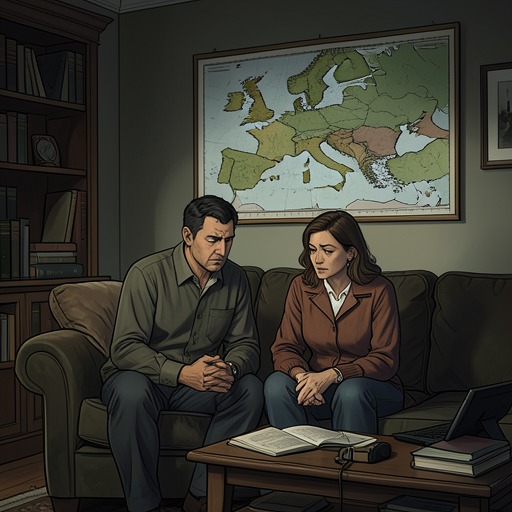
By the beginning of December, that security had begun to fail in practical terms. Dr. Schwarz had aged over the preceding six months and was having difficulty breathing. He and Hans’s mother decided to send their son to the United States, where relatives in New York City could care for him and help arrange university study. Dr. Schwarz acknowledged that school had become difficult for Hans and expected university to be harder still. He presented separation as temporary, believing that Germans would come to their senses within a few years.
The decision divided the family’s responses to danger. Hans was young and had a future ahead of him, so his parents judged that he should leave; they themselves would stay. Dr. Schwarz insisted that Germany was their fatherland and home and that they belonged there. He also urged Hans not to argue, recognizing how painful the decision would be for them. Hans left school at Christmas and departed for the United States on his birthday, January 19. In a letter written shortly before the departure, Konradin likewise assured Hans that his parents would remain safe and could live out their lives in peace. That confidence would soon be disproved.
Defiance, Death, and Aftermath
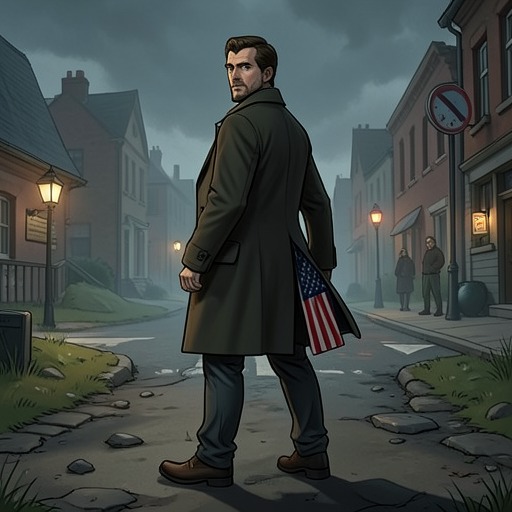
A Nazi was eventually stationed outside Dr. Schwarz’s surgery with an antisemitic notice warning Germans to avoid Jews. Dr. Schwarz responded by putting on his officer’s uniform and decorations, including the Iron Cross, First Class, and standing beside the man who had been posted there. The gesture made his wartime service visible at the very place where Jews were being publicly marked as people from whom others should keep away. As a crowd gathered, its silence turned to muttering and then to aggressive jeers directed at the Nazi. The man packed up and left; he did not return, and no one replaced him.
That immediate reversal did not restore the protection Dr. Schwarz believed his service had earned. A few days later, while his wife was asleep, he turned on the gas; both died. Hans later records that his parents did not end in Belsen, but their deaths nonetheless followed the public exclusion his father had tried to confront. In their final days, the father’s uniform and decorations could summon a crowd’s hostility toward the Nazi, yet they could not make Germany a safe home for the family.
Dr. Schwarz’s ending gives tragic force to the contrast between his enduring national faith and the reality that overtook it. His son’s account sets his earlier certainty against his final act of defiance and death, without presenting the public retreat of one Nazi as a lasting victory. After his parents died, Hans avoided meeting Germans where possible and stopped opening German books, even Hölderlin. Dr. Schwarz’s belief in belonging thus survives in the narrative as both a source of dignity and a devastating misjudgment: the country he considered home rejected the people whose lives and service he had taken as proof that they belonged.