Iron Cross, First Class
ReunionThe Iron Cross, First Class is both a record of Dr. Schwarz’s military service and a domestic emblem of the security he believes that service has earned him. Hans Schwarz recalls it first above his father’s bed, then on his father’s uniform during a public act of defiance. In the gap between those appearances, the decoration’s promise of protection meets the reality of antisemitic exclusion.
Place in the Home and Family History
The medal hangs above Dr. Schwarz’s bed beside his officer’s sword and a picture of the Goethe-Haus in Weimar. Together, the objects evoke a life anchored in German military service and cultural belonging. Dr. Schwarz had been wounded twice in the First World War and was prepared to fight for Germany again; the Iron Cross, First Class made that service visible in the family home.
Hans frames the decoration as an unfailing talisman. His father is respected by Jews and Gentiles, has received a visit from prominent citizens led by the Mayor on his forty-fifth birthday, and has been pictured in the Stuttgarter Zeitung. He treats Nazism as a temporary affliction of an otherwise healthy country, something that would pass if left undisturbed. The medal’s place above the bed belongs to this confidence: past sacrifice and present standing seem to Dr. Schwarz to secure his place in Germany.
Worn in Public Defiance
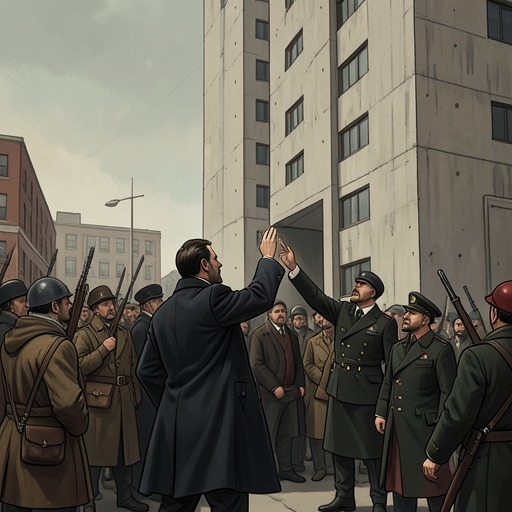
That assumption is tested when a Nazi is posted outside Dr. Schwarz’s surgery with a notice warning Germans to avoid Jews and declaring contact with them defiling. Dr. Schwarz puts on his officer’s uniform and decorations, including the Iron Cross, First Class, and takes his stand beside the official. The act makes his military record impossible to overlook precisely where the boycott seeks to mark him as an outsider.
The crowd first gathers in silence, then grows and turns its hostility on the Nazi. Embarrassed by the gathering, the official eventually leaves; he neither returns nor is replaced. The medal accompanies a momentary public reversal: the man sent to stigmatize Dr. Schwarz is driven away, while the decorated doctor remains beside his surgery. Yet the episode does not establish that the Iron Cross has secured lasting protection.
Meaning and Limits
The medal’s significance rests on the tension between what it certifies and what it cannot guarantee. It bears witness to Dr. Schwarz’s service to Germany, but that service does not exempt him from the Nazi campaign against Jews. The father’s uniform and decorations give visible form to his conviction that he belongs to the country; the boycott notice demonstrates that others are trying to deny that belonging.
A few days after the Nazi official’s departure, Dr. Schwarz turns on the gas while his wife is asleep, and both parents die. The account does not identify the Iron Cross as a cause of their deaths, nor does the decoration prevent them. Its earlier image as a talisman is therefore bitterly limited: a record of courage and national service, it can testify to Dr. Schwarz’s claims on Germany but cannot make those claims safe. Hans’s memory of the medal preserves both the father’s patriotism and the failure of patriotic credentials to shield a Jewish family from persecution.