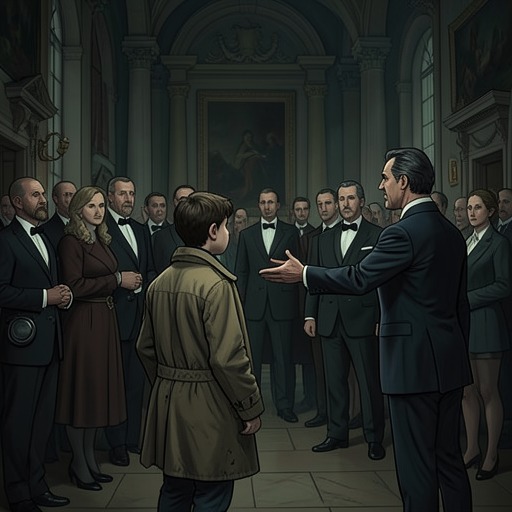
Konradin Avoids Hans at the Opera
ReunionKonradin Avoids Hans at the Opera is the public rupture that makes an unspoken limit in the boys’ friendship impossible to ignore. At a performance of Fidelio, Konradin von Hohenfels recognizes Hans Schwarz and passes him without greeting him, even as the Hohenfels family presents itself to the audience with aristocratic assurance. The refusal is brief, but its meaning unfolds through Hans’s response, Konradin’s eventual explanation, and the iron gates that close between them afterward.
Setting and Staging
Hans attends the opera on a ticket his mother has obtained for him. Wilhelm Furtwängler is conducting; the orchestra tunes, an elegant crowd fills the house, and the president of the Republic is present. Yet, in Hans’s account, the audience’s attention shifts from the president to the Hohenfels family as they enter through a door beside the front row of the stalls. Their arrival gives the scene its social scale: the Countess wears a tiara, necklace, and earrings of diamonds, while a diamond-studded star shines on the Count’s chest. Hans sees them move as people accustomed to being watched, with a sense of inherited standing that he associates with nine centuries of family history.
Konradin, dressed in a dinner jacket, follows his parents. Before taking his seat, he looks around, bows to people he recognizes, and appears at ease. Then he sees Hans. Hans is certain Konradin has registered him, but Konradin lets his gaze travel across the stalls and balconies without offering even a small sign of recognition. The curtain rises, leaving the two boys and the rest of the audience in darkness. The opera’s setting thus briefly conceals the slight while making Hans’s certainty about what happened all the sharper.
The Refusal in the Foyer
At the first interval, Hans goes to the foyer before the applause has died away. He waits beside a Corinthian marble column, trying to look disdainful, and watches for the Hohenfels family. As they approach, his thoughts turn toward the pain he expects: he considers fleeing rather than risk confirmation that his friend has rejected him, but cannot make himself leave. The grand foyer—with its crystal candelabra, gold-framed mirrors, and cyclamen-red carpets—frames a private trial as a public spectacle.
The family advances together, the Countess between the Count and Konradin. She acknowledges acquaintances with nods and a jeweled hand raised in a gentle, fan-like motion; the Count inclines his head to acquaintances and to the president, who bows in return. The crowd makes way for them. Hans remains in their path, waiting for the truth he believes their progress toward him will disclose.
When they are only a few steps away, Konradin looks at Hans, smiles, and raises his right hand to his lapel as if removing a speck of dust. The family continues past. Hans reads the gesture not as recognition offered but as a way to avoid acknowledging him in front of his parents. The procession continues through the foyer, smiling and accepting the spectators’ attention. A little later the Count and Countess return without Konradin and pass Hans more than once. When the bell rings for the second act, he leaves and goes straight home to bed without being seen by his parents.
The Explanation
The next morning Hans feels weak after a bad night’s sleep and a dream of two lions and a lioness attacking him. At school, Konradin is initially absent. When he arrives, each boy attends to his own desk and books without looking at the other. After the lesson, Konradin comes over, puts his hands on Hans’s shoulders—a gesture he has not made before—and asks questions, but avoids asking whether Hans enjoyed the opera. He waits for Hans at the end of the day, and they walk home together as though nothing has happened.
Hans sustains that pretense for half an hour, then asks why Konradin cut him the night before. Konradin blushes and turns pale. He first denies the slight, suggesting that Hans imagined it or was oversensitive, and says he could not leave his parents alone. Hans insists that the encounter was real and connects it to a pattern: Konradin has invited him to the Hohenfels home only when his parents were away, although Hans’s own parents are known to Konradin. Hans says he does not need a social relationship with them, only a brief introduction so he will not feel like an intruder. He would rather be alone than humiliated, and insists that no count or prince can make him inferior.
Konradin replies that Hans is his only friend and that he likes him more than anyone else; he denies being ashamed of him. Hans accepts that reassurance but asks why Konradin changed in the presence of his parents and why the introduction has never happened. Konradin then explains that his mother comes from a distinguished, formerly royal Polish family and hates Jews. He says she regards them as beneath the serfs and as untouchable, fears them despite never having met one, and considers Hans’s friendship with her son a stain on the Hohenfels family’s honor. In her view, Hans has undermined Konradin’s religious faith and is connected to world Jewry and Bolshevism. Konradin says he has argued with her and had to fight for each hour he spends with Hans; at the opera, he did not dare speak to him because he feared hurting him.
Konradin distinguishes his father’s attitude from his mother’s: the Count generally does not care whom his son meets, though he might object to a Jewish girl as a prospective wife and would not want to hurt his wife. Konradin’s account makes clear that the refusal is not evidence that he considers Hans unworthy, but it does not undo the public rejection. He admits that he has tried to conceal the problem and lacked the courage to discuss it earlier. He also asks Hans to accept that he cannot control the circumstances created by his parents, while acknowledging that he has failed his friend.
The Closed Gate and Its Consequences
Hans gives Konradin his hand but cannot meet his eyes, afraid that either boy might begin to cry. As they part, Konradin slowly shuts the iron gates separating Hans from his world. He goes to the door, touches a button, and the door slides open silently; from inside, he turns and waves. Hans does not wave back. He grips the bars like a prisoner seeking release, while the griffons above hold the Hohenfels coat of arms aloft. The image turns the family’s boundary into a physical barrier and gives visible form to what Hans has just learned: his friend can meet him outside the household, but Hans will not be admitted into it.
Konradin never invites Hans home again, and Hans is grateful that he has the tact not to repeat the invitation. The boys continue to meet as before, and Konradin still visits Hans’s mother, but those visits become less frequent. Their friendship does not end at the opera door; rather, the encounter changes what its continuation can mean. Both know that it will never again be as it was and that the scene begins the end of their friendship and childhood. In retrospect, Hans’s account presents the refusal as both an intimate wound and a revelation of the antisemitism governing the Hohenfels household: affection survives, but it cannot make the family’s exclusionary boundary disappear.