The Bauer Family Home Catches Fire
ReunionThe Bauer Family Home Catches Fire is the disaster that turns Hans Schwarz’s abstract awareness of suffering into a personal crisis of faith. The three children who die are not anonymous figures in a distant catastrophe: Hans knows them by sight, remembers their family in the garden, and encounters the traces of the fire the next day. His response changes his belief in a benevolent God and sets him and Konradin von Hohenfels against one another over whether suffering can be reconciled with faith.
The Family and the Fire
The Bauers are Hans’s neighbors. He does not know them well, since their children are too young for him to play with, but he has watched the parents and children romp together in their garden. One memory remains vivid: Mr Bauer pushes one of his little girls higher on a swing, her white dress and reddish hair moving like a candle among the apple trees. That image of ordinary family happiness becomes the contrast against which the fire is remembered.
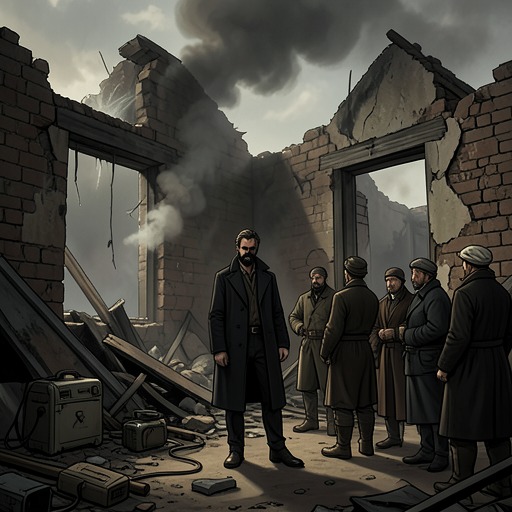
One night, while the parents are out and the maid has gone on an errand, the Bauers’ wooden house catches fire. The flames spread so quickly that the fire engines cannot arrive before the three children—a girl of four, a girl of seven, and a boy of twelve—have burned to death. Hans does not witness the fire or hear the maid and mother scream. He learns what happened the next day, when he sees the blackened walls, burnt dolls, and swing ropes charred and dangling from the shrivelled tree. The cause of the fire is not given, and the parents’ fate is not described.
From Catastrophe to Crisis of Faith
The sight shakes Hans more than the large-scale disasters he has previously heard about or read of: earthquakes, volcanic destruction, mass drownings, and the million soldiers killed at Verdun. Those deaths had reached him as statistics; the Bauer children are different because he has seen them and remembers their lives close to his own. Their deaths make suffering particular and immediate, and prompt the question of what the children or their parents could have done to deserve such a fate.
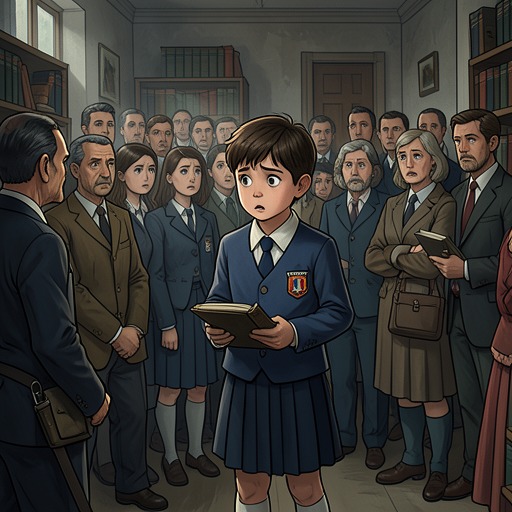
Hans concludes that either God does not exist or that a deity who permits such suffering must be monstrous if powerful and futile if powerless. He rejects the idea of a benevolent master-mind and argues passionately with Konradin, who was raised in a strict Protestant faith. Konradin agrees that the fire was terrible but believes there must be an answer beyond their understanding. He urges humility before the explanations developed by wiser and more experienced religious authorities; Hans refuses to accept that appeal as an explanation for the children’s deaths.
The Dispute and Its Aftermath
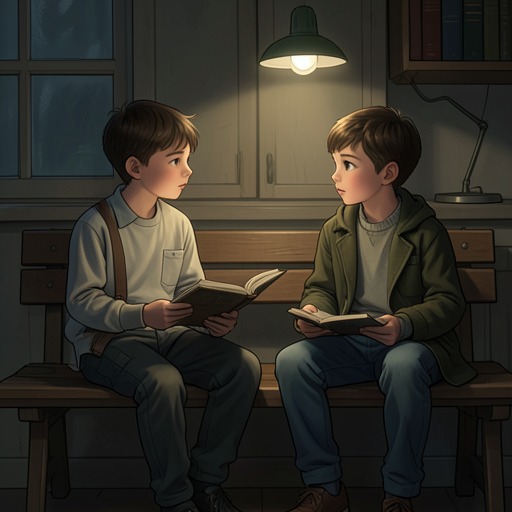
Unable to answer Hans himself, Konradin consults his pastor and returns reassured. He reports that Hans’s argument has been dismissed as the immature, untrained thinking of a schoolboy and as blasphemy. The pastor’s account, as Konradin relays it, invokes evil as necessary for people to appreciate good, just as ugliness makes beauty perceptible. Yet Konradin cannot make the explanation convincing to Hans, and their discussions reach a deadlock. The event therefore produces no shared resolution: one friend abandons belief in a benevolent God, while the other retains faith without being able to defend it to his friend.
Cosmic Scale and the Question of Life
Around this time, Hans is reading about light-years, nebulae, galaxies, and stars vastly larger than the sun. The scale of the universe reinforces the doubt kindled by the fire: Earth seems like a pebble among countless others, and Hans wonders how a deity could take an interest in what happens across so many celestial bodies. Yet the result is not only despair. After a period of it, his attention shifts from the question of what life is to what a person should do with a life that seems valueless and, somehow, uniquely valuable. He and Konradin discuss that problem almost daily as they walk through Stuttgart, looking up at Betelgeuse and Aldebaran. The deaths remain without an explanation, but the question they leave behind becomes practical: how life ought to be spent.
In the memoir’s remembered sequence, the fire is both a family tragedy and the point at which distant arguments about God acquire human faces. Its force lies in the contrast between statistical death and the remembered swing, dolls, and charred ropes. The physical remnants do not settle the dispute between Hans and Konradin; they make it impossible for Hans to treat that dispute as merely theoretical.