Interdiction d’aider au suicide
SatanInterdiction d’aider au suicide—the prohibition on assisting suicide—is the legal boundary around a family crisis that the novel refuses to reduce to a simple contest between law and mercy. As Lucille’s Alzheimer’s disease advances, she repeatedly asks Georges D’Anjou to help end her life; he moves from rejecting the request to considering a plan, but the evidence does not establish that he carried it out or assisted her death. After Lucille is found dead in the cold, suspicion turns that private anguish into a public dispute over whether anyone, especially a judge, may help another person die without facing legal consequences.
The request and the caregiving crisis
Lucille’s cognitive decline becomes unmistakable after she fails the driving test she must take after turning seventy-five and loses her license. The diagnosis is Alzheimer’s disease. Her growing confusion and paranoia alternate with moments of lucidity, in which she recognizes her deterioration and begs Georges to find a way for her to die. She fears losing herself to an incurable illness and says she does not want her family to witness or endure that decline.
Her requests are not presented in isolation from the conditions of care. Georges, an elderly former Superior Court judge, is living with Lucille’s disorientation and increasingly difficult behavior in their large family home. Isabelle withdraws from the household’s distress, while Georges’s early indignation gradually gives way to exhaustion and a diminished horror at the thought of helping Lucille. The scene in which Lucille tries to get into his office to find his locked pistol makes the conflict concrete: Georges refuses to give her the weapon and says its ammunition is kept elsewhere, but her pleading continues to wear down his resistance.
Georges’s contemplated plan
In the Québec setting of 2009–2010, Georges’s deliberation develops from a passing thought into a plan he considers in detail. He frames it to himself as hastening an inevitable death and sparing Lucille and her family a prolonged ordeal. His former professional standing as an officer of justice sharpens the contradiction: he is contemplating an act that he knows would cross a legal and moral boundary.
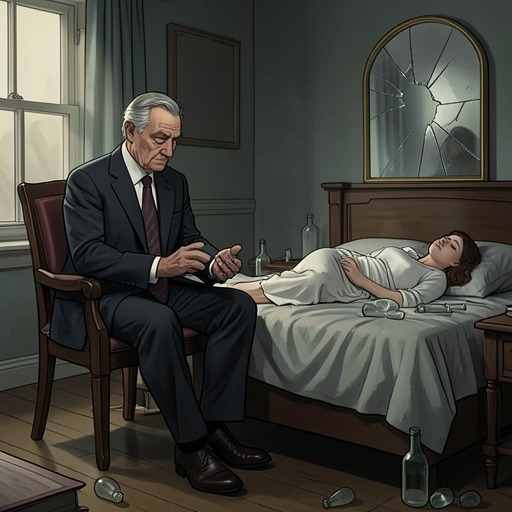
Georges considers poisoning Lucille with the death cap Amanita virosa, a mushroom he knows from his youthful interest in mycology. He imagines gathering it near the family chalet at Pont-Rouge, grinding the caps, hiding the powder in sweetened drink, and destroying the remains. But when he consults his mycology books, he relearns that poisoning can begin with violent cramps, delirium, convulsions, vomiting, and diarrhea, followed by a potentially prolonged course of organ failure. The suffering he discovers in the details collides with his intention to offer a merciful, discreet death. The account establishes his planning and his recoil at the likely agony; it does not establish that he administers poison.
Lucille’s death and the limits of what is known
A few days after Isabelle leaves again for Cuba, Lucille goes out of the house during the night. The alarm has been disabled since she became ill. Barely dressed and wrapped in a sheet, she walks into the bitter December cold and wind coming from the river. At daybreak she is found dead on the Plains of Abraham, at the place where Montcalm fell in 1759. Her death is described as the result of the cold; the account does not show Georges providing her with a means of suicide or arranging her exposure.
That distinction matters to the rule’s place in the story. Lucille’s repeated requests and Georges’s contemplated poisoning make assistance a real possibility within the family’s crisis, but neither her requests nor his thoughts prove that he helped cause her death. The narrative keeps the legal question open even as it makes the emotional and caregiving pressures behind it impossible to ignore.
From family tragedy to public controversy
The authorities initially approach the death with restraint and deference toward a family respected in Québec City for three generations. Georges himself calls the police when Lucille is discovered. But rumor quickly turns to accusation: a politician calls the death suspicious, and claims of an affair between Georges and Clémentine circulate. A journalist’s account of Roger Bolduc’s disappearance in New York during the 2001 World Trade Center attacks further expands the scandal, though it does not establish a connection to Lucille’s death.
The case becomes a national debate involving Alzheimer’s societies, older people’s organizations, feminists, and advocates and opponents of choice, euthanasia, and assisted suicide. Some argue that gradual hypothermia is a gentle death; others insist that any assistance by Georges would require him to be tried and punished, with no exception for a servant of justice. The prohibition is thus presented not as a settled answer to Lucille’s suffering but as the charged point at which private consent, cognitive vulnerability, care, suspicion, and public accountability collide. The novel preserves the difference between a desperate wish, a contemplated intervention, and an accusation: the controversy grows far beyond what the established facts can resolve.