By the seventeenth or eighteenth century
The Cameo Pair
An Italian lapidary crafts two fine onyx cameos depicting the mythological twins Castor and Pollux. Their later history becomes tangled with royal collections, family inheritance, and the novel’s recurring suspicion that violence has left a supernatural stain on the stones.
The pair passes through the collection of the Regent, though its whereabouts and ownership become uncertain amid the upheavals of French history. One cameo eventually remains with the Castelmont family; the other is lost.
1782
A Royal Gift
[Louis XVI](entity:character-recall-character-louis-xvi-18a5f574db30) gives a pair of cameos to his childhood friend [Delphine de Castelmont](entity:character-recall-character-delphine-de-castelm-e2c3e08c1a65) to mark the birth of her twin sons. The gift binds the stones to the Castelmont family and places them at the center of a succession story that will reach across the Atlantic.
Delphine keeps the cameos close, later entrusting one to each son. She exacts a solemn promise that neither will ever part with his stone, a pledge whose consequences outlast the family’s first generation.
During the French Revolution in the 1790s
The Barzac Massacre
Revolutionaries attack the Castelmont estate at Barzac, killing Delphine’s husband and several members of the family. The violence destroys the old household and sends the two young twins into hiding.
The family tragedy becomes the beginning of a bitter split: Charles and Louis flee separately, carrying the cameos their mother has sewn into their clothes. Their escape preserves both the stones and the rivalry that will later shape the D’Anjou family’s history.
1794
Delphine’s Execution
After being arrested in [Paris](entity:location-recall-location-657453741ed3), [Delphine de Castelmont](entity:character-recall-character-delphine-de-castelm-e2c3e08c1a65) is brought to the guillotine. She dies without knowing how far the family’s separation and the hidden cameos will carry their effects.
Her sons remain in flight, each believing the other an enemy. The stones become both heirlooms and evidence of a contested inheritance, although neither twin can yet know how much bloodshed will follow them.
From 1794 into the early nineteenth century
The Twins’ Separate Exiles
Charles and Louis escape [France](entity:location-recall-location-4f282e1af8a7) by different routes. Charles joins the royalist émigrés in Germany, while Louis reaches England and eventually sails for America.
Their separation hardens into permanent hostility. The cameos travel with them as tokens of their mother’s promise and as emblems of the inheritance that each believes the other has taken.
After the Bourbon Restoration
The Inheritance Dispute
Following the return of the Bourbons, Charles reclaims the Castelmont family’s French properties and establishes himself as the recognized heir. Louis returns from America to assert his own claim, relying on his seniority as the elder twin.
Charles refuses to recognize him and, according to the later reconstruction, makes repeated attempts on his life. Louis eventually abandons [France](entity:location-recall-location-4f282e1af8a7) again, but continues pursuing his inheritance from across the Atlantic.
By the early nineteenth century
The Missouri Ranch
[Louis de Castelmont](entity:character-recall-character-louis-de-castelmont-aa8950720d44) follows westward settlement through [Louisiana](entity:location-recall-location-e662c8ad18f8) and Texas before establishing a ranch near [Carthage, Missouri](entity:location-recall-location-68d4dfa25c27). He becomes a prosperous frontier landholder and builds a life far from the family estate seized by his brother.
The ranch places him near the dangerous routes of the expanding American frontier. It is there that the old inheritance feud eventually catches up with him.
November 2, 1842
The Ranch Attack
A band of Sioux attackers raids the ranch near Carthage, kills its inhabitants, and burns the buildings. A contemporary newspaper reports the destruction, then a later correction casts doubt on whether anyone was present or whether an attack even occurred.
[Loïc](entity:character-recall-character-lo-c-51d185eee479)’s later research suggests that the raid may have been engineered by Charles to eliminate his twin and secure the inheritance, though he never finds conclusive proof. The conflicting records leave the massacre suspended between documented violence and deliberate concealment.
November 1842
The Flight Through the Snow
A young mixed-race woman flees the [Missouri](entity:location-recall-location-f321c7abc52b) violence with a baby in her arms, traveling north through hardship and danger. She gives up much of her clothing to keep the infant warm and carries a small pouch containing a cameo pinned to the child’s wrappings.
Her identity and her precise relationship to the baby remain uncertain. Her desperate journey, glimpsed at the novel’s opening, becomes the missing link between the ranch massacre, the cameos, and the D’Anjou family’s origins.
November 28, 1842
The Baby Found
Near Florissant, [Religious of the Sacred Heart of Jesus](entity:organization-recall-organization-173a4091e06e) follow a barking dog to a young woman dead in the snow, still holding a living infant. A fine cameo is fastened to the baby’s clothes, while the woman is buried anonymously in the parish cemetery.
Jesuit records describe the discovery and the religious community’s search for adoptive parents. A childless French-Canadian couple named D’Anjou takes in the infant, who is baptized Élie, though the record’s handwriting later leaves uncertainty about his original name.
December 1842
Élie’s Adoption
The infant found in the snow is baptized and adopted by a French-Canadian D’Anjou couple near St. Louis. The family raises him without disclosing, or perhaps without knowing, the full story of his birth and the woman who saved his life.
The cameo remains associated with Élie, and later becomes the secret object that he hides until death. His adoption gives the D’Anjou family its American-born founder while leaving his biological descent unresolved for generations.
During Élie D’Anjou’s youth and later life
Élie’s Hidden Cameo
Élie grows into a formidable man, serves in the Union army during the Civil War, and eventually leaves the [United States](entity:location-recall-location-5d55e9152db1) for [Quebec](entity:location-recall-location-0d1ec311cdf3). He keeps the cameo but conceals its history, eventually sewing it into his clothing and asking that it be buried with him.
Stories of his frontier past, his violence, and his unknown origins circulate in the family and in [Touladi](entity:location-recall-location-touladi-ab7150d99f8e). The stone becomes a private burden: a possible clue to his parentage and, in his own mind, an object associated with evil.
1889
Mathilde Leaves Home
After the death of her mother in childbirth, [Mathilde](entity:character-recall-character-mathilde-2c0a7a61ddb3) D’Anjou rebels against her father, Élie, who had refused a Caesarean section on religious grounds. She flees the family home and is cast out of the family’s life.
Her departure becomes one of the family’s enduring silences. She eventually makes a life in [Cuba](entity:location-recall-location-cuba-419261c764da), but her descendants remain unknown to the D’Anjous in [Quebec](entity:location-recall-location-0d1ec311cdf3) for decades.
1920
Égide’s Death
[Égide D’Anjou](entity:character-recall-character-gide-d-anjou-9b4c766759a5) is killed in the forest by a gunshot described as accidental, though family lore later suggests that the intended target may have been his father, Élie. The unknown shooter is never identified.
The death deepens the family’s sense of inherited misfortune. Decades later, [Régis](entity:character-recall-character-r-gis-52ae422d7352) will consider whether the cameo and Élie’s concealed American past might have been connected to the killing.
August 1942
Élias Falls at Dieppe
[Élias D’Anjou](entity:character-recall-character-lias-d-anjou-cafeb500397b) is killed during the disastrous [Dieppe Raid](entity:event-recall-event-33fdaad2e8c2). In a final letter, he describes a frightening dream of his grandfather Égide pointing toward a sinister object shining in black and violet.
His death joins a growing sequence of losses remembered by the family. The dream later seems to Guillaume like a warning connected to the mysterious cameo recovered from Élie’s grave.
November 13, 1944
The Storm Uncovers the Grave
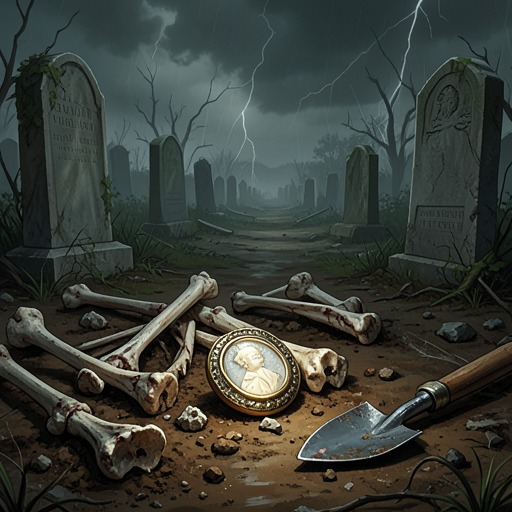
A violent storm, hail, and an earthquake devastate [Touladi](entity:location-recall-location-touladi-ab7150d99f8e). A landslide tears through the cemetery, exposing several graves and the remains of [Élie D’Anjou](entity:character-recall-character-lie-d-anjou-7c8ba3cd0d27), whose body still bears the cameo.
The discovery shocks the village and seems to give physical form to its old legends. The statue of Saint Michael is damaged, strange hoof-like tracks appear in the snow, and [Grébiche](entity:character-recall-character-gr-biche-118a773e70e9) declares that the stone is the Devil’s stone.
November 18, 1944
The Family Examines the Cameo
The D’Anjou family gathers around the recovered cameo. [Régis](entity:character-recall-character-r-gis-52ae422d7352) identifies the carved figure as one of the mythological twins, probably Castor or Pollux, and concludes that the stone is a European work of considerable age.
Marthe reveals that Élie had told her he was adopted and feared the stone as something malevolent. The family decides to photograph it and keep it secured, while [Grébiche](entity:character-recall-character-gr-biche-118a773e70e9)’s public warnings deepen the sense that the object carries a curse.
November 1944
Grébiche’s Warning
Outside the family meeting, [Grébiche](entity:character-recall-character-gr-biche-118a773e70e9) tells the townspeople that the cameo is cursed and links it to the storm, the damaged statue, and the mysterious tracks in the snow. Donat Côté repeats her cries, his mental state deteriorating into a lasting village legend.
The villagers gradually stop discussing the grave’s disturbance, partly under the curé’s pressure. The family keeps the cameo, but the phrase “stone of the Devil” remains attached to it and to later misfortunes.
August 14–15, 1945
Loïc’s Birth and Loss
As news arrives that Japan has surrendered, [Marie-Ange D’Anjou](entity:character-recall-character-marie-ange-d-anjou-8a61323d59df) goes into labor. [Loïc](entity:character-recall-character-lo-c-51d185eee479) is born weak, while his mother dies from the delivery; the doctor suspects another fetus but does not tell the family.
Guillaume takes the newborn into his household, and the baby’s near-death state leaves him suspended between survival and loss. The hidden death of Loïc’s twin sister becomes a defining, unspoken absence in his life.
August 1945
Loïc Is Adopted
Guillaume and [Marie-Louise](entity:character-recall-character-marie-louise-dc16e386532b) take responsibility for [Loïc](entity:character-recall-character-lo-c-51d185eee479), with the agreement of his biological father, [Alcide Bolduc](entity:character-recall-character-alcide-bolduc-0def6b2325e6), and the Bolduc relatives. The family has him baptized and raises him in the [Founder’s House at Touladi](entity:location-recall-location-touladi-6f949aaf2244).
Loïc grows up with multiple women caring for him and two competing paternal claims: Guillaume’s daily devotion and Alcide’s intermittent presence. His divided belonging becomes a central emotional pattern long before he understands it.
Late 1940s to early 1950s
The Childhood at the Founder’s House
[Loïc](entity:character-recall-character-lo-c-51d185eee479) grows up in a dark, isolated household, afraid of the Founder’s portrait and comforted by Guillaume’s songs and his grandmother’s stories. The hidden cameo remains in the house’s safe, while family memories and village rivalries shape the child’s sense of danger.
His imagination turns ordinary surroundings into a threshold between the living and the dead. He later remembers this childhood as the beginning of his extraordinary sensitivity to dreams, memory, and unseen presences.
October 13, 1951
The Earthquake and Plane Ride
An earthquake shakes the [Founder’s House](entity:location-recall-location-2d84967a89a7) while [Loïc](entity:character-recall-character-lo-c-51d185eee479) is in the upstairs bathroom. Once the family gathers and the shaking stops, Guillaume lets him join his brother Maurice for a flight in Alcide’s seaplane.
From the air, Loïc sees [Touladi](entity:location-recall-location-touladi-ab7150d99f8e) as a fragile arrangement of small houses and imagines the dead beneath the cemetery. The flight exhilarates him but also sharpens his sense that both his home and his place in the family are precarious.
October 13, 1951
The Fathers’ Quarrel
At a bonfire, Guillaume comes to bring [Loïc](entity:character-recall-character-lo-c-51d185eee479) home, while Alcide insists that the boy is his son and belongs with the Bolducs. Their dispute escalates into a public exchange of political and family insults, leaving Loïc terrified between the two men.
Guillaume suffers a serious heart attack soon after returning home. [Grébiche](entity:character-recall-character-gr-biche-118a773e70e9)’s intervention helps revive him, while Alcide departs by plane that night, again leaving his son behind.
Late 1951
Alcide Leaves Touladi
After the quarrel, Alcide flies away from [Touladi](entity:location-recall-location-touladi-ab7150d99f8e) by night. The family does not know where he has gone or when he will return.
His disappearance deepens [Loïc](entity:character-recall-character-lo-c-51d185eee479)’s sense of having been left without a stable biological father. Alcide’s flight is an early sign of the self-exile that will eventually take him far from his children.
Summer 1952
The 1952 Election Violence
The provincial election campaign intensifies the rivalry between the Bolduc family’s [Union nationale](entity:organization-recall-organization-union-nationale-0beaea8176ce) supporters and the D’Anjou-linked Liberals. [Clovis Lacroix](entity:character-recall-character-clovis-lacroix-de81c82799b2) resigns his teaching position rather than submit to political pressure and organize against the local machine.
On election day, Clovis and other young Liberals barricade themselves in [Roland Bolduc](entity:character-recall-character-roland-bolduc-5b2d98df2f95)’s garage to prevent the distribution of alcohol to voters. A fight breaks out, and Clovis injures Roland, setting off a chain of legal and personal consequences.
After the 1952 election
Clovis Is Imprisoned
Clovis is arrested for attempted murder and imprisoned in [Rimouski](entity:location-recall-location-rimouski-c789a506ec70). A D’Anjou lawyer helps secure his release and prevent a lasting criminal record, but the case ends his prospects as a teacher.
Clovis moves toward journalism and revolutionary circles in Montreal, eventually becoming associated with the [Quebec Liberation Front](entity:organization-recall-organization-bc7d8971e4aa). His later political life grows out of the local violence and factional pressure he experienced in [Touladi](entity:location-recall-location-touladi-ab7150d99f8e).
February 1953
Alcide’s Plane Disappears
Alcide works as a pilot for [Hollinger Ungava Transport](entity:organization-recall-organization-hollinger-ungava-b5920d356f84) in the northern [Quebec](entity:location-recall-location-0d1ec311cdf3)–[Labrador](entity:location-recall-location-labrador-84635171c1b9) air service. During a flight between [Sept-Îles](entity:location-recall-location-sept-les-a6efa6372c08) and [Schefferville](entity:location-recall-location-schefferville-01b47b123881), his plane vanishes in a storm and is presumed lost.
The company’s pension supports his children, including [Loïc](entity:character-recall-character-lo-c-51d185eee479)’s education. The wreckage and the remains of Alcide and his copilot are not discovered until decades later, leaving Loïc to imagine his father disappearing into the snow and sky.
Winter 1953
Momo’s Illness and Death
[Maurice Bolduc](entity:character-recall-character-maurice-bolduc-0aa8edcf4e03), known as Momo, becomes gravely ill with hydropisie and can no longer play as he once did. [Loïc](entity:character-recall-character-lo-c-51d185eee479) notices his brother’s quiet acceptance and remembers a moment of extraordinary closeness as they watch the evening sky together.
Momo dies young, and Loïc encounters a corpse for the first time at the wake. His grandmother’s suggestion that Alcide has come to take the boy frightens Loïc and adds to his lifelong fear of death and abandonment.
November 21, 1954
The First Television
Guillaume makes the [Founder’s House](entity:location-recall-location-2d84967a89a7) the first home in [Touladi](entity:location-recall-location-touladi-ab7150d99f8e) to receive a television set. Villagers crowd into the house to watch distant images appear on the screen.
The new medium transforms communal life: people begin gathering around broadcasts, then gradually retreat into their own homes. [Loïc](entity:character-recall-character-lo-c-51d185eee479) later sees television as a force that displaced the village’s religious and social traditions.
September 11, 1959
Grébiche’s Cabin Burns
A fierce fire destroys [Grébiche](entity:character-recall-character-gr-biche-118a773e70e9)’s isolated cabin before dawn. The remains are removed under official supervision, and the village is told that she died in an accidental fire, though no one can establish what happened to her body.
Rumors blame [Romuald Bolduc](entity:character-recall-character-romuald-bolduc-657bdce50362), who had recently quarreled with her, while others call the blaze supernatural. [Loïc](entity:character-recall-character-lo-c-51d185eee479) remembers a dream of Grébiche summoning [Touladi](entity:location-recall-location-touladi-ab7150d99f8e)’s dead and later interprets the fire as another turn in the family’s curse.
October 1964
Guillaume Dies in the Forest
Guillaume goes hunting near [Sugarloaf Mountain](entity:location-recall-location-466cd1446eab) and is found dead in the forest beside a deer he has shot. His heart gives out, though his death recalls the earlier loss of his father, Égide.
[Loïc](entity:character-recall-character-lo-c-51d185eee479) returns from Montreal to mourn the man who raised him. The funeral brings home the depth of Guillaume’s ties to the forest and the community, while the family’s last strong presence in [Touladi](entity:location-recall-location-touladi-ab7150d99f8e) begins to disappear.
October 1964
The Cameo Moves to Quebec
After Guillaume’s death, Georges removes the cameo from the Founder’s safe and takes it to [Quebec](entity:location-recall-location-0d1ec311cdf3) City. [Loïc](entity:character-recall-character-lo-c-51d185eee479) resents the haste and feels excluded from a family inheritance that has shaped his childhood.
Georges also discovers a concealed American birth-certificate extract in the safe. The document later helps [Régis](entity:character-recall-character-r-gis-52ae422d7352) investigate Élie’s origins, while the transfer marks the decline of the D’Anjou household in [Touladi](entity:location-recall-location-touladi-ab7150d99f8e).
October 1970
The October Crisis
As a young student, [Loïc](entity:character-recall-character-lo-c-51d185eee479) joins political meetings and protests against [Pierre Elliott Trudeau](entity:character-recall-character-pierre-elliott-trud-d31b71fe34ff)’s use of the War Measures Act and the deployment of soldiers in Montreal. He experiences the crisis as an attack on civil liberties and on [Quebec](entity:location-recall-location-0d1ec311cdf3)’s political life.
Years later, the memory complicates his decision to work for Trudeau alongside [Régis](entity:character-recall-character-r-gis-52ae422d7352). The political divide becomes another version of the family conflict between competing loyalties and paternal claims.
1975
Loïc Joins Trudeau’s Office
[Régis](entity:character-recall-character-r-gis-52ae422d7352) recruits [Loïc](entity:character-recall-character-lo-c-51d185eee479) to work in the federal prime minister’s office. Loïc accepts chiefly because he wants to work with his admired cousin, despite his misgivings about Trudeau’s policies toward [Quebec](entity:location-recall-location-0d1ec311cdf3).
He becomes a hidden speechwriter and observer, caught between his own nationalist sympathies and Régis’s federalist commitments. The job revives the childhood pattern of being emotionally divided between two fathers.
November 15, 1976
The Parti Québécois Victory
[Loïc](entity:character-recall-character-lo-c-51d185eee479) watches the Parti Québécois win the [Quebec](entity:location-recall-location-0d1ec311cdf3) election from Trudeau’s office in [Ottawa](entity:location-recall-location-ottawa-b85b17c926b9). While his colleagues grieve, he privately welcomes the result, which he sees as a chance for Quebec to recover its political agency.
[Régis](entity:character-recall-character-r-gis-52ae422d7352) regards the victory as a national disaster, and their unspoken disagreement becomes increasingly painful. Loïc recognizes that he can no longer remain neutral between his political convictions and his loyalty to his cousin.
After the 1976 election
Loïc Confesses to Régis
[Loïc](entity:character-recall-character-lo-c-51d185eee479) tells [Régis](entity:character-recall-character-r-gis-52ae422d7352) that the federal government’s confrontation with [Quebec](entity:location-recall-location-0d1ec311cdf3) has made it difficult for him to continue in the prime minister’s office. He hopes to return to journalism rather than help wage what he sees as a fratricidal political struggle.
The discussion overwhelms Régis, who soon suffers a serious heart crisis and undergoes open-heart surgery. Loïc prepares to leave the office while their relationship remains under pressure from political difference and affection.
During Loïc’s years in Ottawa
The Haunted East Block
While working in the old East Block, [Loïc](entity:character-recall-character-lo-c-51d185eee479) hears voices, whispers, and spectral sounds that seem to emanate from the building’s past. [Régis](entity:character-recall-character-r-gis-52ae422d7352) dismisses such experiences as hallucinations and refuses to credit the paranormal.
Loïc keeps the episodes to himself, interpreting them as evidence that history leaves traces in places and minds. His supposed sensitivity to the unseen becomes part of the larger mystery of his dreams and his connection to the cameo.
Spring 1985
Lévesque’s Political Decline
Working in [Quebec](entity:location-recall-location-0d1ec311cdf3) politics, [Loïc](entity:character-recall-character-lo-c-51d185eee479) watches [René Lévesque](entity:character-recall-character-ren-l-vesque-26da0742c911)’s government weaken amid factional maneuvering, declining support, and the leader’s deteriorating health. Loïc refuses to join a group planning for Lévesque’s replacement while still employed in his service.
Lévesque eventually resigns, leaving Loïc with a profound sense of a political cause coming apart. The episode reinforces his distrust of opportunism and his recurring feeling that he is present at historical turning points without truly controlling them.
During Loïc’s adulthood before the 1990s
The Affair with Brigitte
[Loïc](entity:character-recall-character-lo-c-51d185eee479) begins a passionate relationship with [Brigitte](entity:character-recall-character-brigitte-689c81a268c6), whose literary interests, spiritual experimentation, and charisma draw him into an intense but unstable bond. Their attraction repeatedly shifts into arguments and violence, with each projecting old wounds onto the other.
Loïc gradually recognizes the relationship as a destructive narcissistic mirror, but the intensity makes it difficult to leave. He connects his hunger for fusion to the loss of his twin and to the unseen forces he believes have followed his family.
During the 1980s
The Abortion and Breakup
An unexpected pregnancy forces [Loïc](entity:character-recall-character-lo-c-51d185eee479) and [Brigitte](entity:character-recall-character-brigitte-689c81a268c6) to decide whether to have a child. They choose an abortion, an event that intensifies Loïc’s grief and his sense of inherited loss.
The relationship ends, leaving him to withdraw from social life and reassess the identities he has built around work, politics, and romance. He begins to understand how deeply his early trauma shapes his longing for union and fear of abandonment.
After Loïc’s separation from Brigitte
Laurette’s Death
[Laurette](entity:character-recall-character-laurette-37240d7db695), who had cared for [Loïc](entity:character-recall-character-lo-c-51d185eee479) throughout his childhood, is diagnosed with advanced cancer and dies soon afterward. Loïc returns to [Touladi](entity:location-recall-location-touladi-ab7150d99f8e) to empty her apartment and is overwhelmed by the loss of the last close member of his adoptive household.
Her death ends the D’Anjou family’s active presence in the village. The [Founder’s House](entity:location-recall-location-2d84967a89a7) later burns and is sold to [Romuald Bolduc](entity:character-recall-character-romuald-bolduc-657bdce50362), with no memorial erected at the site.
May 1994
The Last Meeting with Régis
[Loïc](entity:character-recall-character-lo-c-51d185eee479) visits the aging [Régis](entity:character-recall-character-r-gis-52ae422d7352) in [Ottawa](entity:location-recall-location-ottawa-b85b17c926b9). Régis admits that serving Trudeau cost him his philosophical and literary independence and that politics has become an anti-poetry in which he feels spiritually diminished.
The conversation is affectionate but marked by regret and exhaustion. Neither man knows it will be their last meeting, and Loïc later remembers it as a final chance to hear Régis speak candidly about his life and faith.
1995
The 1995 Rupture
[Loïc](entity:character-recall-character-lo-c-51d185eee479) openly supports [Quebec](entity:location-recall-location-0d1ec311cdf3) sovereignty during the 1995 referendum campaign, while [Régis](entity:character-recall-character-r-gis-52ae422d7352) remains committed to the federalist cause. Their disagreement becomes a rupture, and Régis cuts off contact.
Loïc later regrets allowing political division to destroy their closeness. The estrangement becomes one of the novel’s central examples of his divided loyalties and of love damaged by history.
May 1996
Régis Finds the Twin Cameo
At a private exhibition in [Paris](entity:location-recall-location-657453741ed3), [Régis](entity:character-recall-character-r-gis-52ae422d7352) sees a photograph of a cameo matching the one from Élie’s grave. The display identifies the matching piece as Pollux and records that its Castor counterpart disappeared during the Revolution.
Régis realizes that the D’Anjou heirloom may be part of the royal pair once held by the Regent. He photographs the Pollux cameo, but his conversation with [Victor Bourdieu](entity:character-recall-character-victor-bourdieu-f1f864948cb0) also gives [Charles de Castelmont](entity:character-recall-character-charles-de-castelmo-d85c047a9f75) a lead to the missing stone.
July 1999
Régis Dies
[Régis](entity:character-recall-character-r-gis-52ae422d7352) dies suddenly in his [Quebec](entity:location-recall-location-0d1ec311cdf3) City apartment, where his body is not discovered for several days. An autopsy raises the possibility of poisoning, but the official account attributes his death to heart failure.
His papers, including decades of research into the cameo, are left to [Loïc](entity:character-recall-character-lo-c-51d185eee479). The delayed delivery of the files and the unresolved circumstances of Régis’s death later feed Loïc’s suspicions about a wider plot.
June 11, 1999
Régis Finds the Rescue Record
Before his death, [Régis](entity:character-recall-character-r-gis-52ae422d7352) discovers a Jesuit manuscript describing a baby found alive in the snow near Florissant in 1842, with a cameo attached to his clothes. The record links the infant to the D’Anjou couple who adopted him.
The discovery establishes that the cameo did not necessarily come from a battlefield theft, as the family had long suspected. It opens a new line of inquiry into Élie’s birth, the dead woman’s identity, and the Castelmont family.
July 1999
Roger’s Secret Interest
[Régis](entity:character-recall-character-r-gis-52ae422d7352) records an unsettling meeting with [Roger Bolduc](entity:character-recall-character-roger-bolduc-3fe45249e482), who asks pointed questions about the cameo’s image, age, meaning, and market value. Régis does not trust the sudden interest and plans to tell Georges.
The note becomes important when Roger later disappears with the family stone. [Loïc](entity:character-recall-character-lo-c-51d185eee479) sees it as evidence that the theft was planned well before the September 2001 attacks.
2000
The Dot-Com Crash
Roger’s technology investments collapse after the dot-com bubble bursts. He tells Isabelle that he has nearly lost his fortune, but secretly keeps money in offshore accounts.
The hidden assets later strengthen the D’Anjous’ belief that Roger may have fled with the cameo and money. Isabelle knows more than she admits, because she has helped him gain access to her father’s safe.
By September 2001
The Cameo Deal
[Charles de Castelmont](entity:character-recall-character-charles-de-castelmo-d85c047a9f75) arranges through intermediaries to buy the D’Anjou cameo from Roger. The plan calls for an expert to authenticate the original, make a convincing replacement, and pay Roger millions through a Swiss account.
Isabelle has obtained the combination to her father’s safe and helps Roger access the family stone. The transaction sets up a meeting in [New York](entity:location-recall-location-75b9ea4bd176) on September 11, but the attacks will interrupt the scheme before the exchange is settled.
September 11, 2001, before 8:46 a.m.
Loïc’s Prophetic Dream
[Loïc](entity:character-recall-character-lo-c-51d185eee479) dreams of a violent catastrophe in a skyscraper, with his cousin Roger beside him and a flaming stone falling through the scene. He wakes at the moment the first plane strikes the [World Trade Center complex](entity:location-recall-location-c77e2d087cf3).
The coincidence convinces him that the dream may have carried Roger’s experience at the instant of death. He calls Isabelle, tells her what he saw, and urges her to contact the authorities if Roger cannot be reached.
September 11, 2001
The Attacks and Roger’s Disappearance
Roger, who had secretly diverted his trip toward [New York](entity:location-recall-location-75b9ea4bd176), disappears during the destruction of the [World Trade Center](entity:location-recall-location-world-trade-center-4aee445e06aa). His meeting with a French contact was scheduled in the North Tower, but no one knows whether he reached the building or what happened to him.
His absence and the cameo’s disappearance become intertwined. Isabelle is left with fear, guilt, and a growing suspicion that her husband’s secret journey was connected to the family jewel.
September 14, 2001
The Cameo Is Missing
Georges discovers that the cameo has vanished from the bank’s safe-deposit box and that a plastic imitation has been left in its place. The family immediately suspects Roger, who disappeared at the same time.
The D’Anjous question Isabelle about her husband and the safe’s access, while Georges tries to keep the affair private. The missing stone turns a family mystery into a criminal investigation and threatens to expose the family’s history.
Autumn 2001
The Public Search for Roger
Rumors spread through [Quebec](entity:location-recall-location-0d1ec311cdf3) City that Roger left with a mistress or fled abroad with the jewel. Georges manages a carefully limited newspaper story while sending [New York](entity:location-recall-location-75b9ea4bd176) authorities Roger’s genetic profile and photographs of the cameo.
Isabelle’s silence and isolation fuel family suspicion. Her secret role in providing the safe combination becomes harder to bear, and she turns increasingly to alcohol and cocaine.
Autumn 2001
Loïc Searches the Archives
After receiving [Régis](entity:character-recall-character-r-gis-52ae422d7352)’s papers, [Loïc](entity:character-recall-character-lo-c-51d185eee479) begins a systematic investigation into the cameo and the D’Anjou origins. He studies Régis’s notes, the Civil War photograph of Élie, and the family’s long-held theories about how the stone reached [Quebec](entity:location-recall-location-0d1ec311cdf3).
He also relives childhood dreams and fears, increasingly convinced that the cameo’s influence reaches beyond ordinary coincidence. His work shifts from translation to a personal investigation that he begins to imagine as a book.
June 2002
Roger’s Remains Identified
[New York](entity:location-recall-location-75b9ea4bd176) medical examiners inform Isabelle that fragments of Roger’s bones have been identified through DNA testing. The confirmation ends the family’s hope that he might have survived or escaped abroad.
The letter says nothing about the cameo. [Loïc](entity:character-recall-character-lo-c-51d185eee479) is unsurprised by Roger’s death but remains convinced that the stone may have survived the collapse and later reappeared somewhere beyond the ruins.
April 11, 2002
The Firefighter Finds the Cameo
At [Ground Zero](entity:location-recall-location-1ee7a3df2419), firefighter [Jim Browning](entity:character-recall-character-jim-browning-7e2da1123d96) spots a glint among the debris and finds a seemingly intact cameo connected to human remains. He keeps it rather than immediately turning it over to authorities.
After leaving the site, Browning is stabbed during a street altercation in [New York](entity:location-recall-location-75b9ea4bd176). His killer takes the cameo from his pocket, sending the stone into a criminal chain of possession far from the D’Anjous.
Early 2002
Tim Sells the Cameo
[Tim Jones](entity:character-recall-character-tim-jones-5d98b13d3b84), the man who stole the cameo from Browning, carries it through the Midwest while evading the [FBI](entity:organization-recall-organization-af9b051bf7da). Frightened by a strange red glow coming from its case, he tries to sell it to the [Kansas City](entity:location-recall-location-381bdb81ace1) dealer [Ramondo Cardoso](entity:character-recall-character-ramondo-cardoso-bf301fa9769c).
Cardoso recognizes that the stone may be valuable but pays only a few thousand dollars. The FBI has been watching the shop, yet Cardoso escapes with the cameo before agents arrive.
2002
Cardoso Returns to Cuba
Cardoso flees the [United States](entity:location-recall-location-5d55e9152db1), reaches [Cuba](entity:location-recall-location-cuba-419261c764da) by way of Mexico, and returns to his hometown of [Cárdenas](entity:location-recall-location-931884badaa5) after years in exile. He keeps the stolen cameo, unaware that the [FBI](entity:organization-recall-organization-af9b051bf7da) and intelligence services are tracking its path.
The journey brings the stone back to the region connected to the D’Anjou family’s forgotten Cuban branch. Its presence soon becomes the focus of another supernatural death.
August 2002
Cardoso’s Burning Death
A mysterious fire consumes Cardoso in his room in [Cárdenas](entity:location-recall-location-931884badaa5) without spreading through the house. His mother finds his remains and the cameo glowing beside the burned chair, and calls for the priest.
[Rodrigo Lerbier](entity:character-recall-character-rodrigo-lerbier-0ba34f0b8c2a), a babalao and jeweler, takes the stone after declaring it a dangerous concentration of negative energy. The cameo’s passage through the Caribbean now draws [Loïc](entity:character-recall-character-lo-c-51d185eee479) into direct contact with its supernatural trail.
June 2002
Loïc Meets Laurence
At a literary event in Montreal, [Loïc](entity:character-recall-character-lo-c-51d185eee479) meets [Laurence d’Albignac](entity:character-recall-character-laurence-d-albignac-7b5e6cf32e73) and feels an immediate, unsettling recognition. After hesitating and briefly considering retreating to his familiar relationship with Claudine, he contacts [Laurence](entity:character-recall-character-laurence-1f27adb0aae2) by email.
Their exchange begins with humor and grows into a loving partnership grounded in intellectual affinity and compassion. The relationship offers Loïc a sense of wholeness he has never experienced before.
After Cardoso’s death in 2002
Rodrigo’s Divination
Rodrigo studies the cameo through Yoruba divination and sees [Chango](entity:character-recall-character-chango-7117ac2941fd) warn that the stone belongs to forces of evil. He believes it can either grant extraordinary power or destroy those who do not understand it.
He keeps the cameo under religious protection and watches it closely. The warning deepens his fear that the object must be contained, even as its presence draws more people toward it.
March 2003
The Havana Encounter
While traveling in [Cuba](entity:location-recall-location-cuba-419261c764da) with [Laurence](entity:character-recall-character-laurence-1f27adb0aae2), [Loïc](entity:character-recall-character-lo-c-51d185eee479) recognizes Isabelle dancing in [Varadero](entity:location-recall-location-9093b69370fc) but avoids approaching her. Later, during a Yoruba ceremony in [Havana](entity:location-recall-location-8d992dd056a5), he meets [Rodrigo Lerbier](entity:character-recall-character-rodrigo-lerbier-0ba34f0b8c2a) and feels a strange psychic disturbance near the babalao’s shrine.
Rodrigo tells Loïc that his own great-grandmother was named Matilda and came from [Canada](entity:location-recall-location-ed6a2f8d0910). Loïc realizes she may have been [Mathilde](entity:character-recall-character-mathilde-2c0a7a61ddb3) D’Anjou, his family’s estranged aunt, and the two men recognize their distant kinship.
March 2003
The Shrine Is Broken Into
Rodrigo takes [Loïc](entity:character-recall-character-lo-c-51d185eee479) to a Yoruba shrine in [Cárdenas](entity:location-recall-location-931884badaa5), intending to return the cameo to his newly discovered cousin. They find that the shrine has been broken into and the stone stolen, though the other sacred objects remain untouched.
Rodrigo explains how Cardoso acquired the cameo and how it reached his hands. Loïc realizes that he came within moments of recovering the family heirloom, only to see it disappear once more.
March 2003
The Black Spring Pursuit
As the Cuban government launches a severe crackdown on dissidents, Rodrigo and the intelligence networks tracking the cameo operate under heightened danger. The CIA tries to follow Rodrigo, while other hidden actors seek the same object.
The pressure drives Rodrigo to flee with the cameo, which he now regards as unsafe to keep. The stone disappears again, leaving both [Loïc](entity:character-recall-character-lo-c-51d185eee479) and the American investigators without a clear trail.
2003
The Counterfeit Cameos
The [FBI](entity:organization-recall-organization-af9b051bf7da)’s [John Robbart](entity:character-recall-character-john-robbart-562e2555d6ae) and a CIA associate decide to commission imitations of the missing cameo from the same expert used in Charles’s earlier scheme. They send one counterfeit to Georges and another to Charles, each believing the stone has been recovered.
Georges accepts his copy as the real heirloom, while Charles recognizes his as a fake. [Loïc](entity:character-recall-character-lo-c-51d185eee479) later learns that the genuine cameo had escaped the [World Trade Center](entity:location-recall-location-world-trade-center-4aee445e06aa) ruins and passed through [Cuba](entity:location-recall-location-cuba-419261c764da), but its current location remains unknown.
May 2003
Loïc and Laurence Marry
[Loïc](entity:character-recall-character-lo-c-51d185eee479) and [Laurence](entity:character-recall-character-laurence-1f27adb0aae2) marry quietly on the first anniversary of their meeting, then travel to [France](entity:location-recall-location-4f282e1af8a7) to celebrate with her family at Château d’Albignac. Their shared life gives Loïc a new emotional home and draws him into the history of the Castelmont family.
[Hervé d’Albignac](entity:character-recall-character-herv-d-albignac-d7ec042c1e84) warns Loïc not to approach Charles directly, since the family’s old secrets may be dangerous. The warning only sharpens Loïc’s curiosity about the cameo’s European origins.
Summer 2003
The Castelmont Archives
With help from [Laurence](entity:character-recall-character-laurence-1f27adb0aae2) and her cousin [Thierry](entity:character-recall-character-thierry-ef0582f9da4f), [Loïc](entity:character-recall-character-lo-c-51d185eee479) studies old family letters and memoirs in the Albignac library. The documents connect the Castelmonts to [Louis XVI](entity:character-recall-character-louis-xvi-18a5f574db30)’s gift of the twin cameos and describe the family’s destruction during the Revolution.
Loïc reconstructs the twins’ flight, Louis’s return from America, and the inheritance dispute. The archive trail gives him a plausible account of Élie’s ancestry, though the suspected murder in [Missouri](entity:location-recall-location-f321c7abc52b) remains unproven.
June 2003
The Roadside Crash
While traveling in the [Lot](entity:location-recall-location-b3e347fdcd85) with [Laurence](entity:character-recall-character-laurence-1f27adb0aae2), [Loïc](entity:character-recall-character-lo-c-51d185eee479)’s car crashes on a narrow road. Laurence is injured but survives; Loïc suffers cardiac arrest and remains in a coma for three days.
During the near-death experience, he sees deceased relatives, a luminous double, and a procession of figures speaking about the cursed stone. He returns to consciousness with a renewed conviction that reality extends beyond ordinary perception, but the accident interrupts his investigation.
2004
Lucille’s Diagnosis
[Lucille](entity:character-recall-character-lucille-29eaf78c77aa) begins to lose her memory and becomes increasingly confused. After failing the driving assessment required at age seventy-five, she is diagnosed with Alzheimer’s disease.
Her decline is compounded by concealed alcoholism and a childhood sexual trauma she has never disclosed to her family. The illness turns the [Grande-Allée](entity:location-recall-location-22cbdc54cd6e) home into a place of grief, fear, and mounting strain for Georges and Isabelle.
2009–2010
Georges Considers Mercy
As [Lucille](entity:character-recall-character-lucille-29eaf78c77aa)’s dementia worsens, Georges begins to consider ending her life to spare her and the family a prolonged decline. He investigates toxic mushrooms, then recoils from the suffering and uncertainty they could cause.
He also rejects the idea of using alcohol and sedatives, fearing that it would look like a suicide he had enabled. His deliberations reveal the pressure exerted by Lucille’s repeated pleas, but he never carries out the plan he considers.
Late December 2010
Lucille’s Death in the Snow
One night, [Lucille](entity:character-recall-character-lucille-29eaf78c77aa) leaves the [Grande-Allée](entity:location-recall-location-22cbdc54cd6e) house wearing a sheet over her nightclothes and wanders into the freezing weather. She is found dead in the snow on the [Plains of Abraham](entity:location-recall-location-616abb325e00), near the place where Montcalm fell.
Her death echoes the young woman found in the [Missouri](entity:location-recall-location-f321c7abc52b) snow with the baby and cameo. Georges’s earlier fear of her escaping into the night now gives way to a public scandal over whether anyone in the family could have prevented her death.
2011
The Public Inquiry
Rumors and radio commentary turn [Lucille](entity:character-recall-character-lucille-29eaf78c77aa)’s death into a public controversy. Georges and the family are accused of negligence and even murder, while investigators search the house and question those who cared for her.
Alain fights the insinuations, and fingerprint evidence eventually establishes that Lucille opened and closed the door herself. Georges is cleared, but the family’s reputation is damaged; soon afterward, he suffers a heart attack and dies.
September 2011
Mathieu Revives the Claim
At Georges’s funeral, [Mathieu D’Anjou](entity:character-recall-character-mathieu-d-anjou-2827ae8eb8d1) asks [Loïc](entity:character-recall-character-lo-c-51d185eee479) about the origins investigation and proposes a comparative DNA test with the Castelmont family. He believes that the returned cameo gives the D’Anjous leverage to establish their lineage.
Loïc remains skeptical that Charles will cooperate and questions whether an aristocratic name would matter after so many generations. He has begun writing a hybrid of memoir and novel about the stone and the family’s history.
By September 2014
Aurelio Escapes the Sect
[Aurelio](entity:character-recall-character-aurelio-c79da9847b30) was a Cuban convert who had stolen a sculpture gem from a secret society. Later, he became involved with a satanic cult, was exploited, and endured extreme abuse and violence. After hearing a secret leader declare Lucifer as a god, Aurelio switched to believing in Jesus Christ and determined
November 13, 2015
The Bataclan Attack
[Thierry](entity:character-recall-character-thierry-ef0582f9da4f), the young cousin who helped [Loïc](entity:character-recall-character-lo-c-51d185eee479) research the Castelmont archives, is killed with his companion in the terrorist attack at the [Bataclan](entity:location-recall-location-0c485ad84e15). The band onstage is playing a song titled “Kiss the Devil” when the attack begins.
Loïc and [Laurence](entity:character-recall-character-laurence-1f27adb0aae2) are devastated by the loss. Loïc wonders whether the coincidence has any connection to the cameo, while also seeing Thierry’s death as part of a wider, increasingly violent world.
February 2015
Aurelio’s Confession
Rodrigo visits [Loïc](entity:character-recall-character-lo-c-51d185eee479) and [Laurence](entity:character-recall-character-laurence-1f27adb0aae2) in [Cuba](entity:location-recall-location-cuba-419261c764da) and says he knows where the cameo went. He explains that [Aurelio](entity:character-recall-character-aurelio-c79da9847b30) returned after years away and confessed to stealing the stone for a secret lodge before being drawn into a satanic sect.
Aurelio’s account describes ritual abuse, murder, and the exploitation of vulnerable people by powerful participants. Rodrigo, shaken by the story, begins to question his own role as a babalao and the spiritual authority of [Santería](entity:concept-recall-concept-santer-a-af63be067d6c).
February 2015
Rodrigo Renounces Santería
After hearing [Aurelio](entity:character-recall-character-aurelio-c79da9847b30)’s experience and reflecting on his own spiritual practice, Rodrigo concludes that he has unknowingly served evil forces. He considers abandoning his respected position in [Santería](entity:concept-recall-concept-santer-a-af63be067d6c) and turning to the [Catholic Church](entity:organization-recall-organization-ba391efc867a).
Rodrigo fears the social cost of leaving the tradition, but Aurelio’s confession has become a guide toward repentance. The cameo’s history has now altered not only the D’Anjou family but also the lives of those who have handled it in [Cuba](entity:location-recall-location-cuba-419261c764da).
February 10, 2016
Aurelio Is Murdered
[Aurelio](entity:character-recall-character-aurelio-c79da9847b30) is stabbed in the throat outside a [Havana](entity:location-recall-location-8d992dd056a5) cathedral after attending a church service. Rodrigo hears of the killing and identifies his former student’s body.
Rodrigo suspects revenge by the satanic group Aurelio escaped. The murder confirms that the danger surrounding the cameo has not ended, and [Loïc](entity:character-recall-character-lo-c-51d185eee479) fears for his distant cousin’s safety.
October 2016
Mathieu Writes to Castelmont
Mathieu sends Charles a formal proposal for DNA testing, attaching historical documents and photographs of the cameo that Georges’s family received from [New York](entity:location-recall-location-75b9ea4bd176). He argues that the evidence supports a descent from the Castelmont line.
Charles is enraged but also shaken by the clear images. He realizes that the D’Anjou cameo and his own are both counterfeits, and begins to suspect that the genuine Castor stone was recovered after all.
April 15, 2019
The Notre-Dame Fire
[Loïc](entity:character-recall-character-lo-c-51d185eee479) watches [Notre-Dame de Paris](entity:location-recall-location-b031e1db316b) burn from an apartment overlooking the cathedral, then joins the crowd outside. The spire collapses as flames consume the roof, and he experiences the disaster as a symbol of the West’s spiritual and historical decline.
That night, he has a terrifying vision of a demonic presence and calls on [Jésus-Christ](entity:character-recall-character-j-sus-christ-641722894380) for help. The experience leaves him wondering whether the story of the cameo has itself become a trap shaped by his own pride and obsession.
April 2019
Robbart Takes the Genuine Cameo
Under pressure from the [FBI](entity:organization-recall-organization-af9b051bf7da), [John Robbart](entity:character-recall-character-john-robbart-562e2555d6ae) undertakes a covert operation to recover the genuine cameo from a satanic sect. With help from [Jeff](entity:character-recall-character-jeff-0752b3f12772) and [Maggie](entity:character-recall-character-maggie-39724c72a859), he infiltrates the group, disables its security, and replaces the real stone with a counterfeit.
The operation succeeds after years of delay, allowing Jeff to deliver the authentic Castor cameo to Charles in [Paris](entity:location-recall-location-657453741ed3). The stone that had disappeared from [Ground Zero](entity:location-recall-location-1ee7a3df2419) and passed through [Cuba](entity:location-recall-location-cuba-419261c764da) returns to the Castelmont family’s hands.
April 2019
The Twin Cameos Reunited
Charles examines the stone delivered by [Jeff](entity:character-recall-character-jeff-0752b3f12772) and recognizes it as the genuine Castor cameo. The missing twin is finally reunited with the Pollux cameo held by his family.
For Charles, the recovery is a personal triumph and a chance to settle the D’Anjou claim. The reunion also brings the two stones together after centuries of separation and enmity between the families they represent.
July 7, 2019
The Barzac Celebration Fire
Charles hosts a lavish celebration at [Château de Barzac](entity:location-recall-location-0b0c49d11728) to mark his birthday and the reunion of the cameos. The stones are displayed together in a protected case as guests enjoy music, wine, and spectacle.
Before dawn, an enormous explosion and fire destroy the château, killing Charles and several others. The cameos vanish in the wreckage, and [Loïc](entity:character-recall-character-lo-c-51d185eee479) is left to wonder whether their reunion unleashed a destructive force—or whether the stones have survived once more.