Male primogeniture
SatanMale primogeniture is the hereditary principle that privileges succession through a male heir, with birth order determining precedence among eligible men. In the novel, it shapes the transfer of the Castelmont estate and becomes a contested claim when twin brothers, separated by exile and political circumstance, assert competing rights. The principle also resonates with the D’Anjou family’s concern with ancestry, adoption, and the secrets that complicate any apparently stable line of descent.
Inheritance and the Castelmont Estate
When Charles de Castelmont’s father died, the inheritance passed to Charles, the eldest child and the family’s only son. He took control of the family legacy with his mother. The narrative presents this outcome as a right attached to his position as the male heir, rather than as a decision based only on his personal merits.
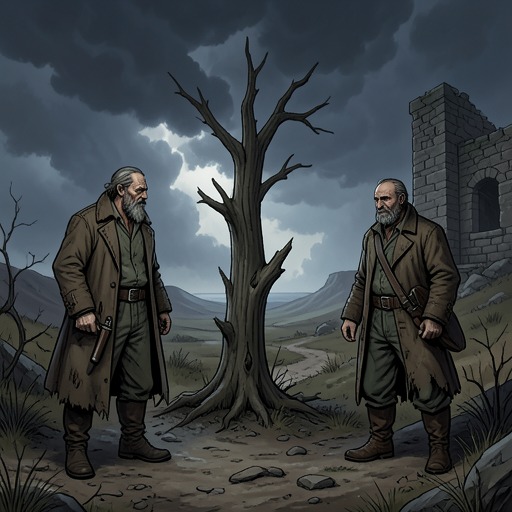
That settlement was challenged when Louis de Castelmont returned from America. He had left France during the Revolution, while Charles remained in Europe and later recovered the family’s properties during the Bourbon Restoration. Louis claimed a right of primogeniture because he had been born a few minutes before his twin. In this dispute, seniority is measured not by years or social standing but by the small difference in time recorded at the twins’ birth.
A Right Weakened by Absence and Power
Louis’s claim exposes the gap between a hereditary principle and its practical enforcement. After years away, he appeared in France as a stranger whose identity and rights had to be established. Charles, by contrast, had already secured political support and control of the estate. He refused to meet Louis, called him an impostor, and repeatedly tried to have him killed. Louis survived through his physical strength and skill with sword and pistol, but his efforts to obtain recognition through legal and political channels came up against Charles’s entrenched influence.
The conflict therefore does not turn on birth order alone. Louis can invoke the older twin’s precedence, but Charles possesses the resources to make his own claim effective. The rule supplies a language of entitlement; family connections, political alliances, and control of the property determine whose entitlement carries force.
Adoption and the Uncertain Line of Descent
The D’Anjou family history complicates the idea that inheritance rests on an uncomplicated biological line. The family’s ancestor, Élie D’Anjou, was adopted as an infant after being found in the snow. A record of his baptism gives the name Éloi, but the handwriting leaves room for Élie, the name by which he later became known. His adoptive family gave him a place in its history, while the circumstances of his birth and the origins of a valuable cameo remained concealed.
Élie himself reportedly told Marthe that he had been adopted and knew nothing of his birth family. He kept a stone of value in his safe, feared it as a malign object, and eventually hid it in his scapular, asking to be buried with it and for the matter to remain unspoken. That private account makes descent more than a matter of names on a family tree: adoption establishes family belonging, while hidden origins leave open questions about ancestry and the inheritance of family secrets.
Narrative Significance
By placing the Castelmont twins’ rival claims beside the D’Anjou history of adoption and concealed origins, the novel distinguishes formal succession from the broader making of kinship. The Castelmont case turns birth order into a weapon in a struggle over property; the D’Anjou history shows that a family line may also be built through adoption and obscured by incomplete records. Male primogeniture appears as a forceful organizing rule, but not as a guarantee that ancestry, identity, and inheritance will align neatly.