Jesuits
ShōgunThe Jesuits are a Catholic missionary order whose influence in Japan rests not only on religious conversion but on their place in the machinery of Asian trade. By providing interpreters and negotiators between Japanese and Chinese speakers, they help sustain an exchange on which Japanese society depends. Their privileged access brings political reach and financial opportunity, but the novel also shows that such access cannot guarantee practical aid when Toranaga faces war.
Trade, Language, and Toleration
The order’s position grows from a commercial history that Yabu considers with resentment. China’s refusal to trade directly with Japan leaves Japanese buyers dependent on Portuguese intermediaries for Chinese silk, a costly necessity in the country’s long, hot, humid summers. About sixty years before the events of the novel, the Chinese emperor granted the Portuguese a small permanent base at Macao and authorized an exchange of silk for Japanese silver. The resulting trade flourished, enriching Portugal and making the priests who served its commercial network increasingly difficult for Japanese rulers to exclude.
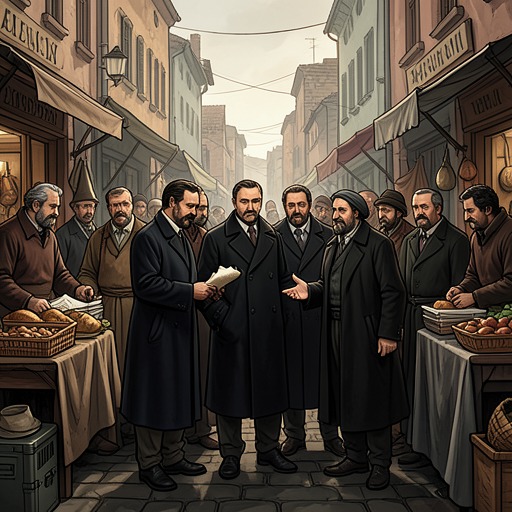
The priests’ linguistic work is central to that arrangement. They are the people able to speak both Chinese and Japanese, and so act as negotiators and interpreters. As trade expands, their services become more important; the yearly commerce grows large enough to touch the lives of samurai throughout Japan. Yabu sees the consequence as a political constraint: priests and Portuguese traders must be tolerated, along with the spread of their religion, lest the foreigners withdraw and trade cease. This is not religious acceptance freely separated from material interest. It is accommodation enforced by dependence on a commercial channel the Japanese do not control.
That channel also shapes the geography of Christianity. Yabu recognizes a number of powerful Christian daimyos and hundreds of thousands of converts, most concentrated in Kyushu, the southern island nearest China and home to the Portuguese port of Nagasaki. The order’s religious presence is thus tied to trade routes, port access, and local political power. Yabu distinguishes these established Portuguese from the newly arrived foreign sailors, whom he considers pirates and outside the edict naming Portuguese foreigners. His distinction reveals a system of selective toleration: the Jesuits are protected by the usefulness of the network they serve, while other foreigners may be treated as enemies.
Access to Power and Wealth
Father Martin Alvito’s position demonstrates how far the order’s influence can reach. He has become the Taikō’s confidant and one of only four people ever admitted to all of the ruler’s personal treasure rooms; he is the only foreigner among them. The rooms contain gold, silver, silks, pottery, swords, and armor, guarded inside Osaka Castle’s formidable fortifications. Alvito estimates the fortune at fifty million ducats, more than a year’s revenue for the Spanish Empire, the Portuguese Empire, and Europe combined.
For Alvito, this wealth is at once political power and a possible resource for the Church. He imagines that a fraction of it could build a cathedral in every city, a church in every town, and a mission in every village. The passage presents this as his own aspiration, not as a transfer of the treasure or a project already completed. The difference matters: access lets him envision the conversion of immense political wealth into religious infrastructure, but does not mean that the order controls that wealth.
Alvito and Alessandro dell’Aqua also use commercial negotiation to pursue their interests. In a proposal to Captain-General Spillbergen, Alvito offers to arrange the investment of ten thousand ducats of Toranaga’s gold in the gold market at Goa through the Jesuits’ usual contacts. Toranaga is to receive half the profit, while the captain is told he could clear four thousand ducats. The plan is explicitly uncertain: Alvito and dell’Aqua expect that, by the Black Ship’s return in six months, Toranaga will either have recovered his position as president of the regents or be dead. Their offer therefore joins religious institutions, Portuguese shipping, Asian finance, and Japanese political instability in one calculation. The order’s influence operates through money and access as well as preaching.
Mission Authority and Political Limits
The Jesuit mission appears as an organized presence with its own gates and personnel. When Blackthorne is led toward the mission, Brother Michael enters alone to inform the Father-Visitor and asks Blackthorne to wait outside. Alessandro dell’Aqua then emerges in his Jesuit robe and directs Michael to remain behind. The encounter places dell’Aqua in a position of authority at the mission, while Blackthorne, expecting an Inquisition and trial, reads the setting through his fear of Portuguese and Catholic power. His expectation is not itself proof that a trial will occur; the scene instead shows how the mission’s institutional presence shapes the danger he anticipates.
The order’s political usefulness is put directly to the test when Toranaga asks what practical help its chief Christian priest can provide. Alvito urges Toranaga sincerely to put his trust in God. Toranaga answers that his greater trust is in himself and points to the forces gathering against him: Ishido, Kiyama, Onoshi, and Zataki have assembled armies, with Ishido’s field force estimated at three or four hundred thousand. Alvito’s counsel expresses personal faith, but it does not supply the concrete assistance Toranaga is demanding. The scene marks a limit to the order’s leverage: religious connections and commercial brokerage can open doors, yet they do not automatically resolve a military crisis.
Narrative Significance
The Jesuits connect intimate political encounters to a much wider economic system. Silk, silver, interpretation, conversion, treasure, and investment are not separate strands: each helps explain why Japanese rulers tolerate an order whose religion they may not share. Through Yabu’s hostile account and Alvito’s calculations, the same institution appears in sharply different lights—as a necessary bridge for trade, a foreign presence sustained by that trade, and a potential beneficiary of Japanese wealth.
The order’s position is consequently powerful but conditional. Its priests can negotiate across languages, advise rulers, and arrange financial ventures; their access can bring them close to the Taikō and to Toranaga. Yet their influence depends on interests that may change, and spiritual persuasion cannot substitute for the armies gathering around Japan’s political factions. The Jesuits stand at a crossroads of faith and commerce, but the novel leaves that crossroads under pressure from the very conflicts their connections cannot control.