Alice Pagett and Einor's connection
ShrineAlice Pagett and Einor are connected by the field associated with both Alice’s conception and Einor’s execution, and by Monsignor Delgard’s theory that Einor’s extraordinary psychic power later acted through the child. The connection binds a sixteenth-century killing to the modern miracles: Delgard suspects that Alice became the catalyst through which a power able to survive death could gather force, though he cannot decide whether this means possession, reincarnation, or something beyond his understanding.
The Historical Link
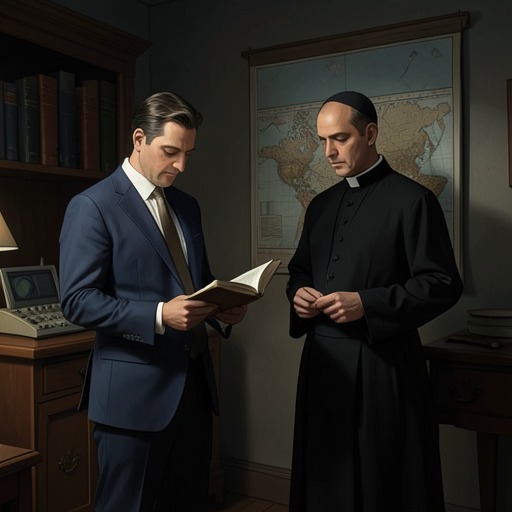
Delgard finds the link in a Latin manuscript written by a sixteenth-century cleric. Its account suggests that the priest understood something of psychical forces even in an age shaped by superstition, but exploited other people’s mistaken beliefs about witchcraft and thereby invoked a power he could not control. Under the authority and incitement of Mary Tudor, the people of the period believed they had destroyed a witch. Delgard’s reading is darker: they had killed Einor, a woman whose mental powers could transcend death and might, under the right conditions, restore her physical presence.
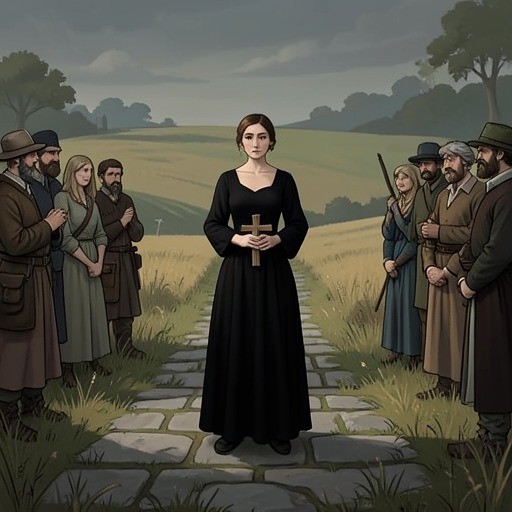
The location makes the connection more than a resemblance between two lives. Alice was conceived in the same field where Einor had been butchered and burned nearly five centuries earlier. Delgard identifies that shared ground as part of the mechanism linking them: the field carries the history of violence, while the religious fervor associated with it supplies another element in the chain. In his reconstruction, witchcraft, Mary Tudor’s name, and energy released by religious devotion are intrinsic ingredients; the cleric who sinned and the child conceived in sin are catalysts. Alice, he concludes, has the most important role in the transformation.
Alice as the Possible Medium
Delgard’s hypothesis draws on the course of Alice’s life as well as its place of origin. Alice grew up guided by her mother and devoted to the Church. At four, she developed a severe disability that doctors could not satisfactorily explain; seven years later, she was released from it just as inexplicably. Her recovery and the cures of others appeared miraculous, but Delgard questions whether they were psychically induced rather than supernatural interventions of the kind they seemed to be.
He also remembers that Alice spoke in an unfamiliar tongue, with a mature voice and words in Old English whose content struck him as disturbed and lustful. These signs do not settle what happened to her. Instead, they sharpen the alternatives confronting him: Einor might possess Alice, or Alice might be Einor reincarnated. As a Catholic priest, Delgard finds the second idea religiously unacceptable, yet cannot dismiss it. The force of the connection lies partly in this uncertainty: Alice’s childhood, recovery, and speech can be read as clues to an identity reaching across centuries, but none gives Delgard a stable explanation.
Psychic Power and the Miracles
Delgard’s later reasoning supplies a model for how Einor’s power could operate through Alice. He believes Einor possessed an ability rare enough to be scarcely perceptible to other people: she could draw together their wills, energies, and beliefs into a collective force that exceeded ordinary human power. On this account, Einor did not cure the sick herself. The sick cured themselves, while Einor acted as a psychic director, focusing what other people brought to the gathering.
That power, Delgard thinks, is now working through Alice with greater potency than it had during Einor’s lifetime. He wonders whether death freed Einor’s mental energy from physical restrictions and increased its reach in a spiritual realm. He had earlier considered Father Andrew Hagan and Molly Pagett possible catalysts for the terrors; he now adds the possibility that Einor’s spirit needed centuries in the other world to develop its powers. These are Delgard’s attempts to explain the miracles and their mounting danger, not a secure account of a process he can observe or control.
An Unresolved Identity
The relationship remains unsettled even as Delgard’s fear becomes more definite. He can imagine a soul migrating at death into another body, or a dead presence exerting power through a living child, but he does not know whether either has happened. His question about the purpose of the apparent return has no answer. What he does recognize is the possibility of imminent disaster and the inadequacy of his own understanding; he intends to seek help through the Church and to pray for divine aid.
As a literary connection, Alice and Einor bring together separate historical moments without making their identities straightforwardly interchangeable. The shared field, the echoes in Alice’s speech, and the apparent passage of psychic force turn place and inherited religious energy into links across time. Yet Delgard’s competing explanations preserve a troubling gap between evidence and interpretation. Alice may be the medium of Einor’s power, its reincarnation, or the focus through which other people’s gathered belief becomes effective; the uncertainty is itself central to the connection, because it leaves Delgard confronting a force whose reach seems clearer than its nature.