Banfield's economic decline
ShrineBanfield's economic decline is the material crisis that George Southworth and Rodney Tucker try to answer by turning the village into a destination. At first, the problem is described as a slow loss of local trade and opportunity, made worse by wider economic pressures. The Banfield Miracles then deliver a sudden influx of attention and visitors. That reversal brings activity and investment prospects, but it also makes the village's religious life inseparable from tourism, publicity, and the sale of devotional goods.
A village losing its economic footing
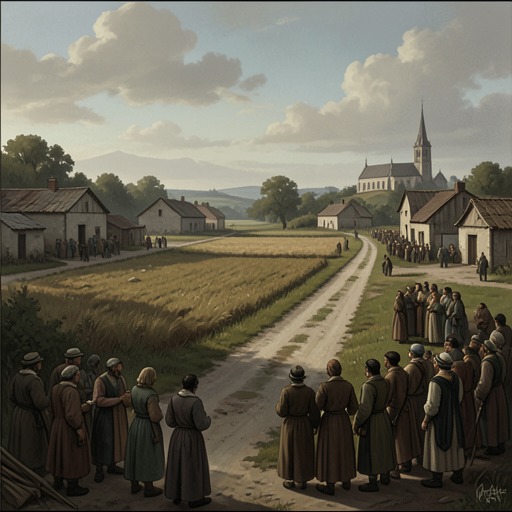
Southworth frames Banfield's difficulties as part of a global recession whose consequences fall on individuals and small communities. In his account, economic decisions made at a national scale leave villages and small towns bearing the costs: local industries and businesses receive no comparable support because their losses seem insignificant beside those of large combines or nationalized industries. He describes Banfield as slowly dying, while allowing that he may be overstating the situation to make his case. His warning is prospective rather than a claim that the village has already collapsed: without a change, he argues, its condition will worsen over the next few years.
The problem is therefore more than an abstract downturn. Banfield has little to offer visitors, Southworth says, and the summer guests who stay at his hotel mostly use it as a base for trips around the Sussex countryside or visits to Brighton and other south-coast resorts. Their presence produces only a minimal benefit for the village itself. Southworth says he would invest more if he expected a reasonable return; Rodney Tucker shares that reluctance to risk money without a viable prospect. Their concern is local stagnation: visitors pass through, while businesses and the wider community lack a reason to grow.
Tourism as a proposed remedy
Southworth and Tucker see investment and development as a way to keep spending in Banfield. Their ideas include more places to eat, including inexpensive restaurants suited to families on day trips. Southworth points to land available for development and imagines the village spreading outward and becoming a real town. Gerry Fenn recognizes the financial interest behind the proposal: growth could benefit Southworth and his associates as well as the community. The plan is presented as both a response to decline and an opportunity for private gain, not as disinterested civic renewal.
That commercial ambition shapes the men’s interest in the reported events at St. Joseph’s Church. Southworth has described the Banfield event as a miracle and wants to speak to Fenn directly rather than pass information through the newspaper’s editor. Fenn begins to understand the connection: a religious event might draw the visitors and investment that ordinary attractions have failed to bring. In this scheme, belief, publicity, and economic development are not separate concerns. The prospect of a pilgrimage makes the village more visible, while that visibility appears to offer a market for new businesses and local development.
The miracle changes the village’s prospects
After the Sunday at St. Joseph’s Church, the claimed cures and reports that Alice Pagett levitated transform the scale of that possibility. Southworth had witnessed the cures and treats them as genuine: he notes that the five people who recovered had documented illnesses confirmed by their doctors and hospital records. Most of their conditions had disappeared completely. Two recoveries remained incomplete: the man whose cataracts had cleared still lacked perfect vision, though his sight was improving, while a boy with a crippled leg still had difficulty walking unaided and was expected to improve as his muscles strengthened.
By Tuesday morning, the story has become worldwide news, and press, television, and magazine reporters have arrived in Banfield. Southworth contrasts the village's former stagnation with its new activity: residents are bewildered by the attention but, in his view, are also responding to and thriving on it. At the parish council meeting, members who had rarely seemed so active listen to expansion plans. Southworth expects St. Joseph’s to become a shrine whether or not the Catholic Church formally recognizes it as one. He anticipates thousands of pilgrims, tourists, and curious visitors; one councillor even estimates millions, a figure that draws laughter but is not wholly dismissed. Bishop Caines is receptive to cooperation with the council, though Southworth understands that church involvement must not become cheap exploitation or compromise religious dignity.
Pilgrimage, commerce, and the cost of attention
The later pilgrimage scenes show how quickly visitors become a visible feature of Banfield. Crowds approach the church on a cold, damp Sunday, and Gerry Fenn sees unusually heavy traffic as people converge on the grounds. At a later open-air service, the field is already filling well before Mass, with visitors seeking seats near the altar or hoping to be close to the Miracle Girl. Wheelchairs struggle over earth churned by the crowd; ushers consider setting aside an area for invalids at future services. The gathering is at once a religious occasion, a spectacle, and a logistical burden on the place receiving it.
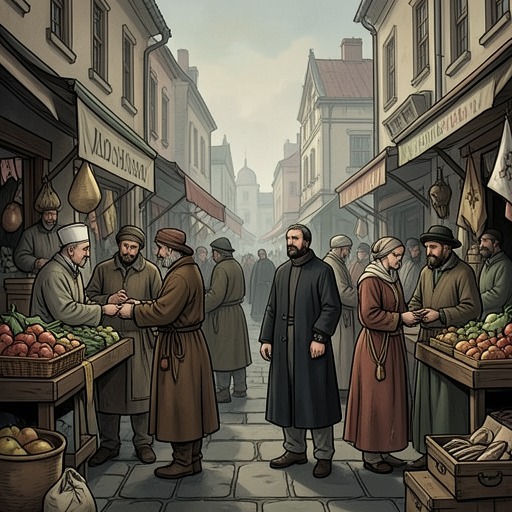
Commerce makes the change still more concrete. Stalls beside the road display small religious statues, trinkets, and posters, while a Mr. Whippy van draws a busy queue. Fenn and Nancy Shelbeck later see containers presented as holding holy soil, a plastic shrine with a newspaper photograph of Alice, a lighted grotto, and a doll that imitates a child's voice. These objects turn the reported sacred events into portable souvenirs and offer visitors a way to take part in the attraction through purchases. A broadcast describing the procession reports thousands of participants, from Banfield and farther afield, and names the field as a place many call the Field of the Holy Virgin.
Significance
The economic story moves from gradual decline to sudden exposure. Southworth's proposal treats tourism as a means of redirecting visitors' spending toward the village; the miracle supplies an attraction on a scale no ordinary local business could provide. Yet the resulting prosperity depends on the same attention that makes the sacred site consumable. Crowds, broadcasts, stalls, devotional novelties, and plans for expansion show Banfield becoming both a place of pilgrimage and a tourist destination. The village's revival is therefore real as increased activity and public notice, but it is also precarious: economic hope is built around an event whose religious meaning cannot be reduced to the commercial uses made of it.