Black Sunday
ShrineBlack Sunday marks the catastrophic end of Banfield’s pilgrimage spectacle: a day when a field presented as a sacred gathering place became the scene of mass death, confusion, and the collapse of the healing hopes attached to Alice Pagett. The day’s movement from damp village Sunday to crowded open-air ceremony makes the disaster inseparable from the faith, expectation, and public attention that had gathered around the child.
From an ordinary Sunday to a pilgrimage
The day began under cold, drizzling, miserable weather, but the village’s streets were unusually busy. Traffic thickened on the High Street as people headed toward St. Joseph’s Church. Gerry Fenn noticed that the excitement was palpable before he reached the grounds; Sue had anticipated the atmosphere, while Ben, usually quiet in the car, watched ahead with open expectation.
At the church entrance, a dense crowd pressed toward the grounds. Pilgrims, believers, and curious visitors gathered together, and the queue extended to the church doorway. Some came with sick relatives: Gerry Fenn saw a teenage girl whose involuntary movements suggested chorea, and a boy in a wheelchair whose family looked to the day with hope. Their presence made the crowd’s anticipation more than a desire to witness a spectacle; for many, the gathering carried the possibility of relief.
The field becomes a sacred gathering place
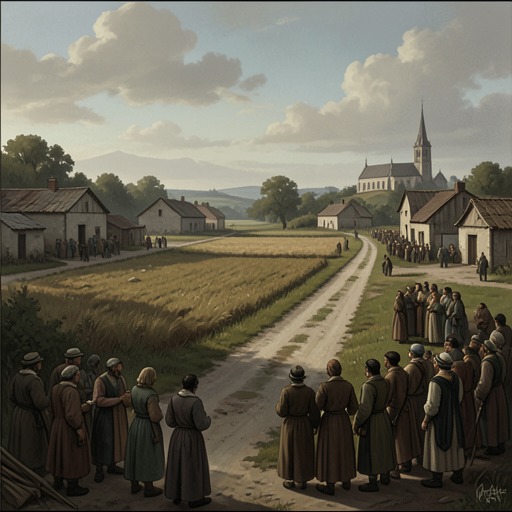
By the time of the later open-air Mass, the field had been reorganized to receive a vast congregation. Benches near the scaffolded centerpiece and altar filled first, while some seating was reserved for Church and civic dignitaries and religious associations. Two hours before the service, people were already entering through the newly constructed gate, seeking either a close view of the altar and Alice Pagett or a place where they believed her holiness might reach them. The soft, churned earth hindered wheelchairs, and the stewards recognized that invalids would need a designated area at future gatherings.
The scale of the crowd transformed the field into what participants and organizers treated as an open-air temple. Monsignor Delgard saw thousands of expectant faces, including sick and disabled people looking toward him with hope. He feared that the gathering’s expectations would end in disappointment and privately wished the service would put an end to the claims of miracles. Yet the emotional force of the congregation unsettled his certainty: he had witnessed what had happened before, and he wondered whether his own doubts reflected a failure of faith. Alice, meanwhile, watched past him toward the oak as he began the service.
As evening approached, a procession led by Bishop Caines of Arundel, followed by priests, nuns, and Alice, was due to enter the field. The lights were dimmed, and a broadcast report described thousands joining the march, some from Banfield and others from farther away. The reporter framed the gathering as a sign of faith amid a troubled world, but static interrupted the transmission. The scene thus joined religious ceremony to public spectacle even as the communications system began to falter.
Disaster and the collapse of certainty
More than twenty thousand pilgrims had arrived at the shrine by the time the panic unfolded. The disaster killed 158 people: some were crushed in the crowd, others died from heart attacks or fatal fits, some near the central altar were killed by fire, and others died in accidents while fleeing. Many more were seriously injured, and some invalids’ conditions deteriorated. The scale of the gathering, the crowded field, and the pressure of shared expectation became part of the setting for a catastrophe that overwhelmed the organized ceremony.
The event’s cause remained disputed. One leading explanation blamed an electrical storm, which was also said to have disrupted film, radio, television, and police communications; other accounts proposed unknown paranormal powers associated with Alice Pagett, an underground eruption, or a bomb beneath the shrine. The underground-eruption theory lacked supporting seismographic evidence, while the other explanations likewise remained conjectural. Conflicting accounts, damaged communications, and the confusion of witnesses left no settled explanation for what had happened.
Aftermath and significance
The disaster did not merely end the gathering. Those whom Alice Pagett had previously cured found their illnesses and infirmities returning, as though her death had brought the apparent miracles to an end. The reversal made Black Sunday a decisive break in the pilgrimage’s promise: the crowd had assembled in the hope of approaching healing, but the day concluded with loss, renewed illness, and uncertainty about the power they had come to witness.
Witnesses, including clerics and nuns, reported that the ground had torn open, but their accounts remained confused weeks later, and their mental state was described as unstable. The event therefore survives in the narrative not as a single, securely explained supernatural occurrence, but as a collision between a mass religious gathering and a calamity whose causes could not be established. Its name condenses that reversal: the Sunday that Banfield treated as sacred became the day on which the shrine’s promise and its human cost could no longer be separated.