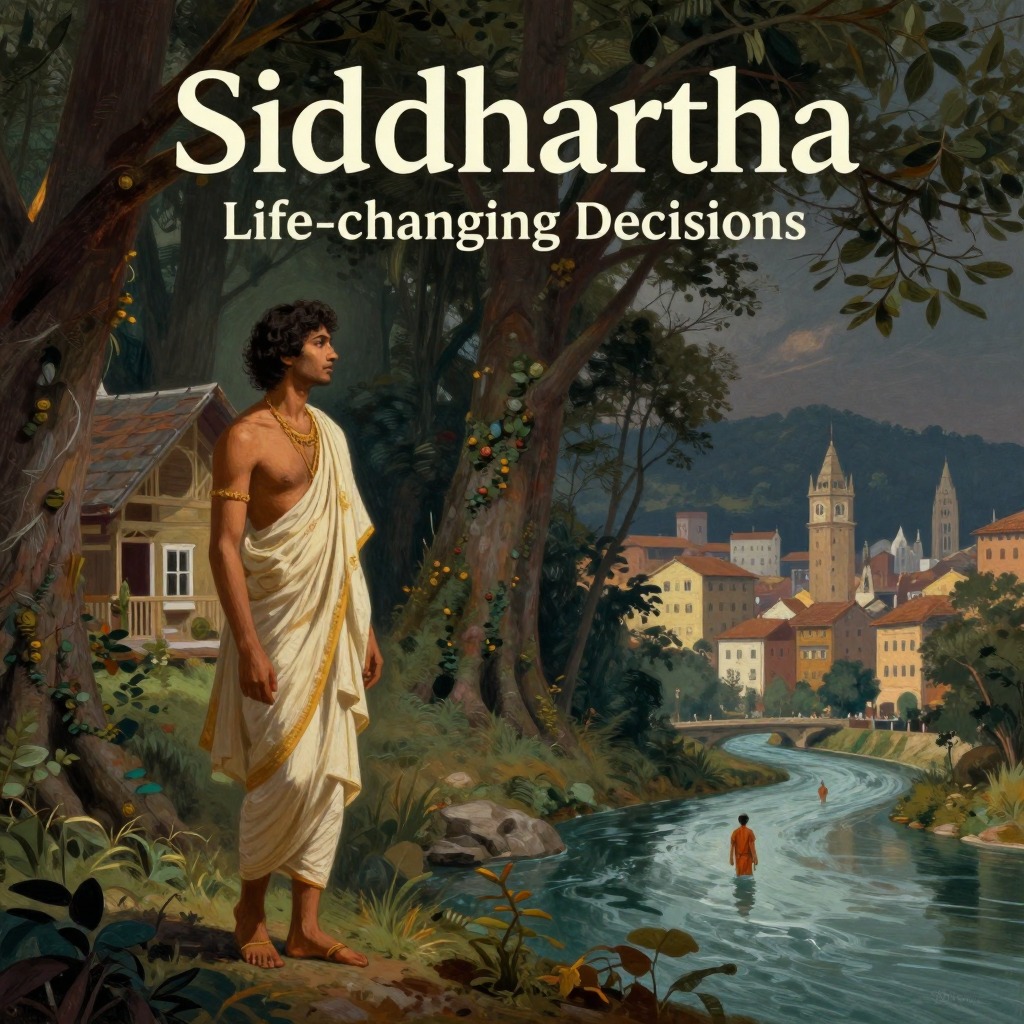
Decision to enter worldly life
SiddharthaThe Decision to enter worldly life is the moment when Siddhartha, having left the grove of Gotama the Buddha and undergone a profound awakening to the inadequacy of all teachings, deliberately turns toward the city and the life of the senses. It is a conscious rejection of his past as a Brahman and a Samana, and an embrace of the world he had previously scorned. This decision sets in motion a long cycle of experience—commerce, love, gambling, and disgust—that ultimately proves necessary for his final realization of oneness.
Causes and Background
Siddhartha's decision did not arise from a sudden whim but from a long-developing crisis. As a young Brahman, he had felt that the love of his father, mother, and friend Govinda could not satisfy him, and that the teachings of the wise men left his vessel unfilled . After years as a Samana, he concluded that ascetic practices were merely a temporary numbing of the self, no different from a drunkard's escape . His encounter with Gotama deepened this conviction: he realized that the Buddha's enlightenment could not be transmitted through teachings, and that he must find his own path . In the grove of Jetavana, Siddhartha understood that he had been fleeing from himself, searching for Atman in abstractions while losing sight of his own being . This awakening—the realization that he must learn from himself, not from teachers—was the intellectual foundation for his entry into the world .
What Happens: Entering the City and the World of Commerce
After leaving the grove, Siddhartha walked toward the large city, his heart enchanted by the transformed world he now saw with new eyes . He had his beard shaved and his hair cut by a barber's assistant, bathed in the river, and put on fine clothes . His first goal was Kamala, the famous courtesan, whom he had seen carried in a sedan-chair and whose beauty struck him as a charming omen . To win her, he needed money, clothes, and shoes—the very things he had renounced as a Samana. Through Kamala's introduction, he entered the service of Kamaswami, the richest merchant in the city . Siddhartha quickly learned the trade, writing contracts and discussing business, but he never let the work touch his heart; he treated it as a game whose rules he learned precisely but whose contents did not move him . His soul was not with the trade—it was merely a means to provide money for Kamala and to satisfy his curiosity about people .
Life in the World: Pleasures, Gambling, and Spiritual Decline
Over the years, Siddhartha became rich, owned a house and a garden, and learned to eat tenderly prepared food, drink wine, play dice, and watch dancing girls . He learned the art of love from Kamala, who taught him that pleasure cannot be taken without giving pleasure, and that every gesture and touch had its secret . Yet even as he indulged, he remained a Samana at heart, watching the childlike people with mockery and disdain . Slowly, however, the world captured him. He began to gamble with increasing passion, losing and winning thousands, hating himself and mocking himself through the game . Greed, which he had once despised as the most foolish of vices, became a shackle and a burden . The bright, reliable voice inside him—the voice that had guided him in his best times—grew silent . He lost his calmness, his patience, his kindness toward beggars, and began to dream about money at night . The three noble feats he had once boasted of to Kamala—fasting, waiting, thinking—abandoned him .
Consequences and Aftermath
The decision to enter worldly life led Siddhartha to the brink of self-destruction. After a dream of a dead singing bird in a golden cage, he felt that the game was over and that something inside him had died . He left the city, walked to the river where he had once been ferried as a young Samana, and stood on the bank, filled with the wish to drown himself . Only the sound of the holy Om, rising from the depths of his soul, stopped him and brought him to a deep, dreamless sleep . When he woke, he felt like a new man, and he recognized that his descent into the world had been necessary: he had to become a fool, to sin, to experience despair, in order to find Atman in himself again . The decision to enter worldly life was thus not a detour from his path but an essential part of it—a long, painful loop that led him back to the river, to Vasudeva, and finally to the realization that the world is perfect in every moment, and that love is the most important thing of all .