Siddhartha's Suicide Attempt and the Sound of Om
SiddharthaSiddhartha's Suicide Attempt and the Sound of Om is the climactic crisis of Hermann Hesse's novel, the moment when the protagonist, having sunk into the deepest disgust with his own life of wealth, lust, and gambling, stands on the brink of self-annihilation only to be pulled back by the involuntary utterance of the sacred syllable Om. This event is not merely a failed suicide but a hierophany—a breakthrough of the sacred into the profane—that shatters Siddhartha's despair and initiates a radical rebirth. It is the necessary death of the old, weary, and corrupted self, without which the new Siddhartha, the ferryman who learns to love the world, could never be born.
The Descent into Absolute Despair
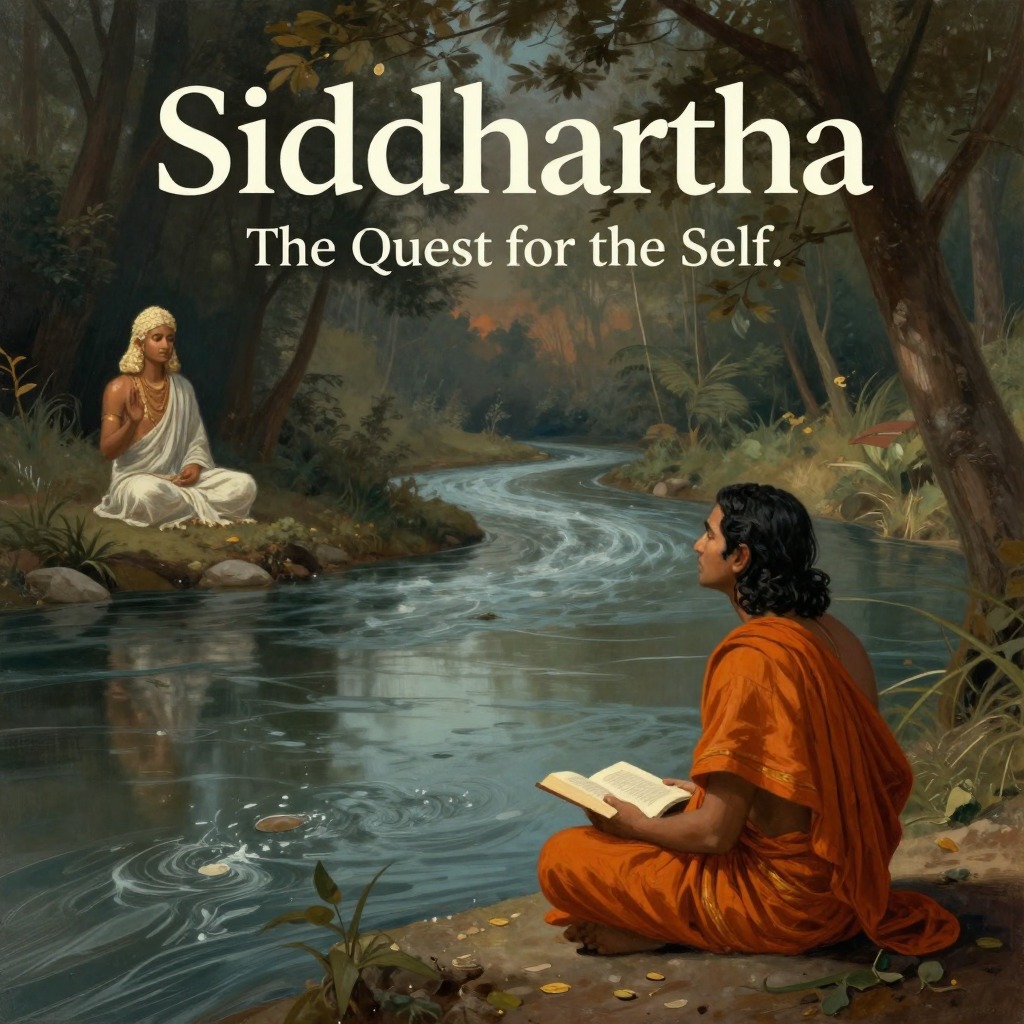
After years of living as a wealthy merchant in the city, indulging in sensual pleasures, gambling with dice, and growing increasingly hollow, Siddhartha reaches a state of utter spiritual bankruptcy. He has lost the bright, reliable inner voice that once guided him; his life has become a pointless cycle of lust, greed, and disgust. The dream of Kamala's rare singing bird lying dead in its golden cage has filled him with a deep, premonitory sadness. Leaving the city and his pleasure-garden behind, he walks through the forest until he reaches the large river—the same river a ferryman had once carried him across when he was a young Samana. There, by the bank, he stops, weakened by hunger and exhaustion. He leans against a coconut-tree, embraces its trunk with one arm, and stares down into the green water that runs endlessly beneath him. A frightening emptiness is reflected back at him, answering the terrible emptiness in his soul. He feels that he has reached the end: there is nothing left for him but to annihilate himself, to smash the failure of his life and throw it away before the feet of mockingly laughing gods. He wishes for a lightning-bolt to strike him dead, for a tiger to devour him, for any poison that would bring forgetfulness and sleep without awakening. With a distorted face, he spits at his own reflection in the water. In deep tiredness, he takes his arm away from the tree trunk and turns to let himself fall straight down, to finally drown.
The Involuntary Utterance of Om
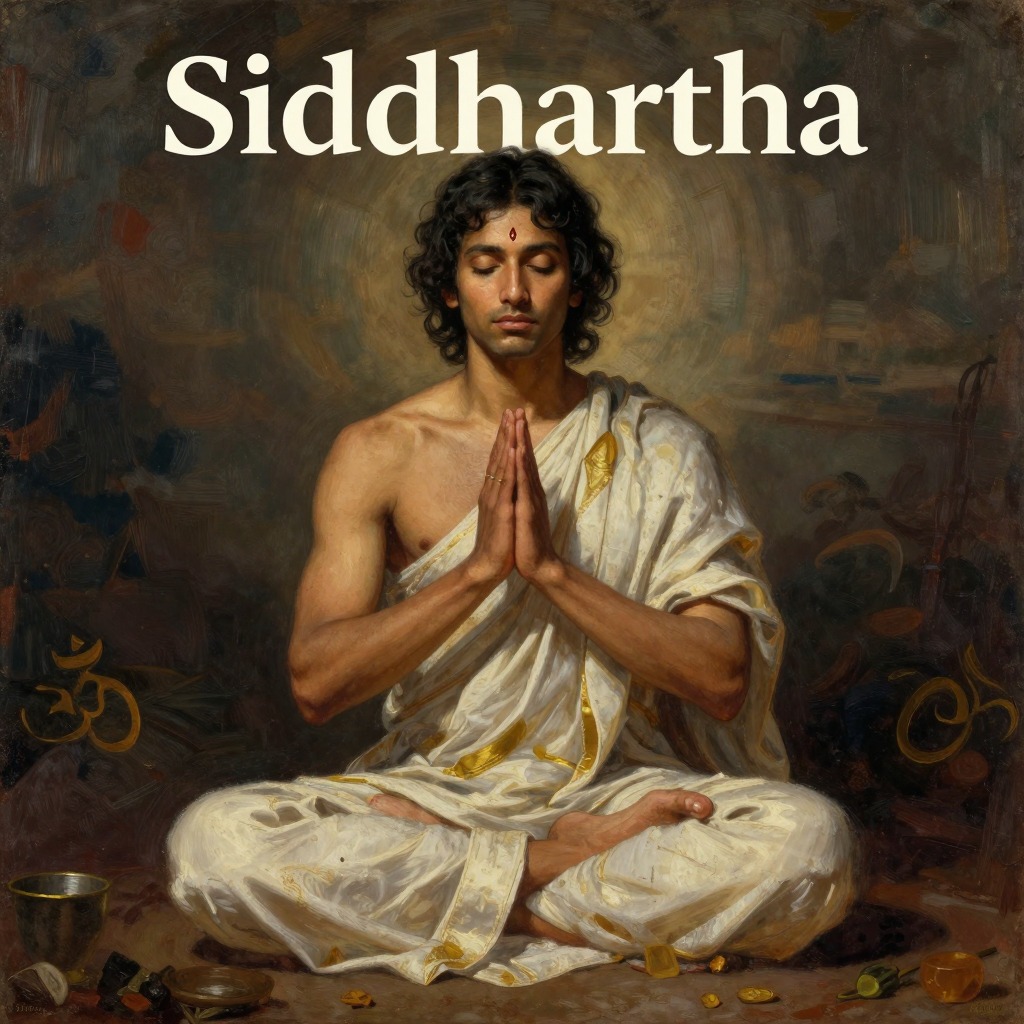
At the very moment Siddhartha slips toward death, a sound stirs from the remote areas of his soul, from past times of his now weary life. Without thinking, with a slurred voice, he speaks the old word that is the beginning and end of all prayers of the Brahmans: the holy "Om," which roughly means "that which is perfect" or "the completion." The moment the sound of Om touches his ear, his dormant spirit suddenly wakes up and realizes the foolishness of his actions. He is deeply shocked. He understands how doomed he had become, how lost and forsaken by all knowledge, that he could have sought death—a wish of a child. All the agony of recent times, all sobering realizations, all desperation had not brought about what this single moment accomplishes: he becomes aware of himself in his misery and in his error. He speaks Om again, and again he knows about Brahman, about the indestructibility of life, about all that is divine, which he had forgotten. Then, struck down by tiredness, he collapses at the foot of the coconut-tree, mumbling Om, places his head on the root of the tree, and falls into a deep, dreamless sleep.
The Deep Sleep and Rebirth
Siddhartha's sleep is profound and without dreams—a sleep such as he has not known for a long time. When he wakes after many hours, he feels as if ten years have passed. He hears the water quietly flowing, does not know where he is or who brought him there, and opens his eyes to see trees and the sky above him. Slowly, he remembers where he is and how he got here, but the past seems infinitely distant, covered by a veil, like a very old, previous incarnation. He knows only that his previous life has been abandoned by him, that he had intended to throw his life away, but that by the river, under the coconut-tree, he came to his senses with the holy word Om on his lips, fell asleep, and has now woken up looking at the world as a new man. He feels wonderfully refreshed, renewed, rejuvenated—as if he had really died, drowned, and been reborn in a new body. He knows himself, knows his hand and feet, knows the place where he lies, knows this self in his chest, but this Siddhartha is transformed, strangely well rested, awake, joyful, and curious.
The Encounter with Govinda and the New Beginning
As Siddhartha straightens up, he sees a person sitting opposite him: a monk in a yellow robe with a shaven head, sitting in the position of pondering. He recognizes the monk as Govinda, the friend of his youth, who had taken refuge with the exalted Buddha. Govinda, aged but still bearing the same features of zeal and faithfulness, does not recognize him at first. He explains that he found Siddhartha sleeping in a dangerous place and stayed to guard him, but fell asleep himself. When Siddhartha calls him by name, Govinda is astonished and overjoyed to recognize his old friend. Siddhartha, wearing the rich man's clothes he has not yet shed, tells Govinda that he is on a pilgrimage, that he was a rich man and is no longer, and that he does not know what he will be tomorrow. Govinda, puzzled by Siddhartha's appearance and words, gives him the salutation one would use on a gentleman and goes on his way. Siddhartha watches him leave with a smiling face, loving him still, and feeling full of joyful love for everything he sees. He realizes that this enchantment—the ability to love—is precisely what had been his sickness before: he had not been able to love anybody or anything.
The River as Teacher and the Decision to Stay
After Govinda leaves, Siddhartha reflects on his situation. He thinks about the three noble feats he had once boasted of to Kamala: fasting, waiting, and thinking. Now, he feels, all three have abandoned him, given up for the most wretched things—sensual lust, the good life, riches. He laughs at himself, at how his fate has gone downhill, and as he laughs, he glances at the river and sees it also going downhill, always moving on, singing and being happy through it all. He likes this well and smiles at the river. He remembers that this is the same river where he had intended to drown himself, and he feels joy rolling like waves in his chest. He decides that he wants to stay by this river, the same one he had crossed long ago on his way to the childlike people. The friendly ferryman who had guided him then is the one he wants to go to now. He feels a deep love for the rushing water and decides not to leave it very soon. He wants to learn from it, to listen to it, believing that whoever understands this water and its secrets will also understand many other things, all secrets. He sees that the water runs and runs incessantly, yet is always there, always the same and yet new in every moment. This insight touches his soul. He rises, the workings of hunger in his body becoming unbearable, and walks up the path by the bank until he reaches the ferry, where the same ferryman, Vasudeva, stands in the boat. Siddhartha asks to be ferried across, and when Vasudeva recognizes him, he welcomes him and invites him to stay. Siddhartha accepts, and so begins his life as a ferryman, learning from the river and from Vasudeva, the master of listening.
The Significance of the Event
Siddhartha's suicide attempt and the sound of Om constitute the most radical reversal in the novel. It is the moment of peripeteia, where the protagonist's long descent into the profane world of Sansara reaches its absolute bottom and, through the grace of a sacred syllable, transforms into the beginning of ascent. The event is a death and a rebirth: the old Siddhartha—the greedy merchant, the dice-gambler, the drunkard, the man who hated himself—dies by the river, and a new Siddhartha, a childlike, joyful, and loving being, is born. The river, which was to be his grave, becomes his teacher and his home. The Om, which he had learned as a Brahman's son and then forgotten, returns to him in his darkest hour as the key to his salvation. This event is the necessary precondition for everything that follows: his friendship with Vasudeva, his learning to listen to the river's thousand voices, his encounter with his son, and his final, wordless teaching to Govinda. It is the moment when Siddhartha stops fighting his fate and begins to flow with the current of life, ultimately achieving the smile of the perfected ones.