Ernie Block's fear of darkness
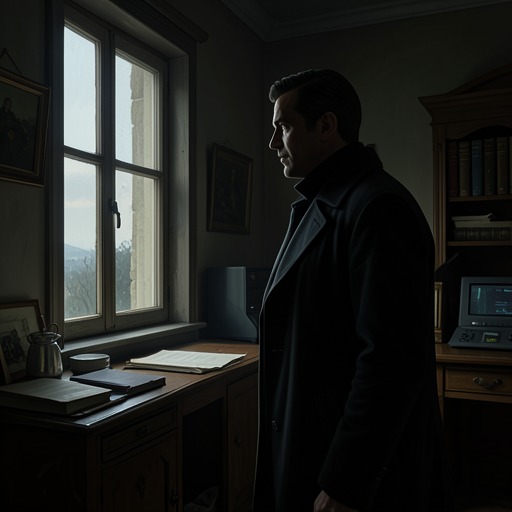
StrangersErnie Block’s fear of darkness begins as a secret he can manage only by arranging his life around light, then becomes a force that governs his movements and threatens his sense of himself. Its first major eruption on the highway is especially striking because Ernie has survived enemy fire in Vietnam and believed he already knew the limits of fear. At the Tranquility Motel, the darkness is not merely an absence of illumination: in moments of panic, it seems to reach for him, while he struggles to understand what is happening without surrendering his identity as a dependable husband.
A New Fear in a Veteran’s Life
Ernie measures his terror against the danger he encountered during his service with Marine Intelligence in Vietnam. Driving a Jeep through supposedly friendly territory, he came under enemy fire; shells threw up dirt and pavement near the vehicle, mortar fragments struck him, explosions temporarily deafened him, and he had to control the Jeep on four flat tires. Having survived that episode, he thought he had experienced fear as profound as it could get. The drive back from Elko unsettles that conviction. Whatever its cause, this new fear is not something he can dismiss by reminding himself that he has endured worse.
The circumstances of the drive make the fear harder to avoid. Ernie has gone to Elko in the Dodge van to collect lighting fixtures for the motel, expecting to make the round trip before twilight. A flat tire delays him, and repairing it in Elko costs him nearly another hour. He has no spare and does not want to set out without one, but by the time he leaves, the sun is close to the far edge of the Great Basin. The practical errand has turned into a race against night.
The Interstate Panic
Ernie drives west on Interstate 80 with the accelerator nearly to the floor, passing other traffic because he cannot bear the thought of being stranded after dark. His mind supplies a dreadful future: people would find him the next morning still in the van, driven mad by hours spent contemplating the black landscape. Against that imagined fate, even the motel’s distant neon sign becomes a promise of safety. The blue and green lights are already shining when he sees the building, the only one in the immense landscape, from a mile away.
Yet the strange pull of a place near the highway interrupts his return. Once there, Ernie finds himself unable to understand why it had seemed special; the ground appears ordinary, and he feels foolish for having hurried toward it. Then he notices how little daylight remains. The shift is instantaneous: the attraction that had drawn him there gives way to the darkness approaching from the east.
Ernie bolts across the highway without checking for traffic. A horn sounds as he runs in front of a motor home, but he does not stop. He falls into the shallow gully dividing the lanes, gets back up, and runs across the westbound lanes toward the van. In his terror, darkness seems to rise from the hollows and reach from beneath the vehicle to seize his feet. He yanks open the door, climbs into the cab, slams it, and locks it. The image of darkness as something that can clutch and devour him gives physical shape to a fear he cannot control by reasoning with himself.
The van is close enough to the Tranquility Motel that he can make it home, but Ernie still cannot trust himself to merge back into traffic. He drives along the shoulder to the exit ramp, where sodium lamps provide a pool of yellow light. Although he is tempted to stop there, he forces himself onward, leaving the lights and turning onto the county road. Two hundred yards later, he reaches the motel and parks outside the office. The short remaining distance does not make the journey easy; it only makes it possible.
Concealment and the Nighttime Escape Plan
In the two and a half weeks since Thanksgiving, Ernie has hidden the fear from Faye. After she returns from visiting Wisconsin, he finds it harder to sleep without a lamp: while she was away, he had allowed himself the comfort of a night-light. He uses Murine each morning to clear his bloodshot eyes, and he is relieved that Faye has not suggested driving to Elko for a movie after dark. Even a brief walk from the motel office to the adjoining Tranquility Grille, lit by outdoor lamps and signs, can leave him feeling fragile and vulnerable. He keeps these signs to himself, treating concealment as part of his responsibility to his wife.
Three days after his frightening highway experience, on a Friday night in Elko County, Ernie cannot sleep. As darkness closes in, his nerves tighten until he fears he will start screaming and be unable to stop. He slips out of bed while Faye sleeps, checks that her breathing has not changed, and shuts himself in the bathroom. There, with the light on, he sits on the closed toilet for fifteen minutes, savoring the brightness before he knows he must return to the bedroom without making her suspicious.
After flushing the toilet as a cover, Ernie washes his hands. His attention fixes on the small frosted window above the bathtub. Though the opaque glass gives him no view of the night, he experiences a sudden sequence of urgent thoughts: the window could let him out; the utility-room roof below it would make the drop manageable; from there he could flee through the arroyo and hills and seek help at a ranch. As these thoughts vanish, he realizes that he has stepped from the sink to the bathtub without remembering the movement. Darkness has become linked not only with panic but with an imagined escape from the motel and the life he is trying to protect from suspicion.
When Ernie looks toward the window again, the vast darkness beyond the motel overwhelms him. He gasps, drops back into the tub, and turns away. Faye tells him to close the window. Squeezing his eyes shut, he fumbles for it and pulls it shut so hard he nearly breaks the pane, then struggles to secure the latch. The ordinary act of closing a window has become a defensive action against a night he cannot bear to see.
Faye’s Interpretation and Ernie’s Fear of Dependence
Ernie interprets the changes as possible premature senility or Alzheimer’s disease. At fifty-two, he is frightened by the prospect but can at least imagine it as an explanation. More deeply, he fears what the diagnosis would mean for his marriage: Faye depends on him, and he cannot accept becoming mentally incapacitated or a burden. His sense of duty is bound up with the Block family code that men must not let their womenfolk down. The fear is therefore double: Ernie is terrified of darkness itself and of losing the dependable role by which he understands his worth.
When he finally tells Faye what has happened, she listens over coffee in the kitchen, with the blinds tightly closed and all the lights on. She takes his hand and argues that the episodes sound unlike Alzheimer’s and more like a phobia. She draws on what she has read and on her experience of her father, and reminds Ernie that phobias can arise later in life. Her account does not erase the terror or establish a cure; it gives him a different explanation from the one he fears most. Ernie admits that a phobia would be preferable to senility, even as he protests that he does not want to spend the rest of his life afraid of the dark. Faye reassures him that phobias can be overcome. The exchange turns his hidden struggle into something shared: for the first time, the fear is no longer only an ordeal he must conceal to avoid failing his wife.