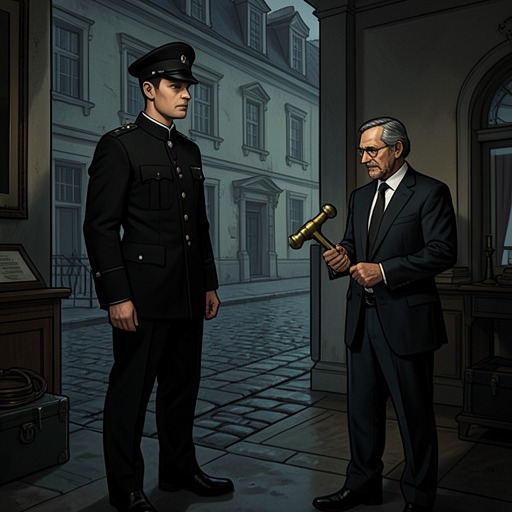
Leland Falkirk's Paranoia and Risk of Losing Control
StrangersLeland Falkirk’s paranoia is not a loss of control so much as a system built to prevent it: he disciplines himself, commands others, and treats uncertainty as a danger that must be mastered. When the secret at Thunder Hill seems to exceed his command, that system turns catastrophic. Convinced that humanity faces extinction through alien infection, he is prepared to destroy the Thunder Hill Depository, its occupants, and himself rather than risk what he regards as surrender.
The Making of Control
Falkirk’s governing principle is control in every sphere: his desires, his thoughts, his fear, his subordinates, and the assignment entrusted to him. His parents, intensely religious, had taught him early that self-command was necessary to resist vice and destruction. But the religious environment that furnished this lesson also became a source of revulsion. At Pentecostal services, he watched his parents fall to the floor, scream, and thrash in what they claimed was the spirit of God; he came to regard such displays as irrational hysteria. The result is a deep contradiction: a discipline partly forged through his upbringing coexists with contempt for the religious claims associated with it.
Violence at home sharpened that discipline. His parents beat and punished him while insisting that the devil had to be driven out of him. Falkirk learned to conquer his fear of them, and he came to treat exposure to pain as training: if pain could be endured, he reasoned, it need not be feared. That lesson did not simply produce toughness. It joined self-control to suffering so closely that pain became both a test of mastery and, eventually, a source of gratification.
The Profile Beneath the Command
Miles Bennell’s examination of DERO files supplies a more clinical account of Falkirk’s volatility. Bennell considers him a controlled paranoid: a man whose paranoia has been shaped into the outward appearance of a smoothly functioning military officer. He concludes that the colonel’s need to dominate his environment reflects an ongoing inward struggle to contain rage and paranoid fear. While working with him, Bennell adopts coolness and grudging respect rather than easy familiarity or flattery, believing that Falkirk would interpret excessive friendliness as evidence of concealment.
Bennell identifies several pressures that make the Thunder Hill assignment especially dangerous. Falkirk fears and despises religion, while the secret operation carries mystical associations capable of provoking an intense negative reaction. He also has persistent claustrophobia, most acute underground; in retrospect, Bennell sees his growing suspicion of the people at Thunder Hill as bound up with that subterranean setting. Most disturbing to Bennell is Falkirk’s controlled masochism. The colonel subjects himself to physical ordeals under the pretext of maintaining military fitness, but Bennell suspects he enjoys the suffering. Because pain does not reliably deter him, the possibility of his own death may not restrain him either.
From Uncertainty to an Existential Threat
Falkirk’s language of control becomes most dangerous when the meaning of the Thunder Hill events is disputed. Foster Polnichev argues that the extraordinary power appearing in people such as Emmy Halbourg may be the only thing within them, and that the events could be humanity’s greatest opportunity rather than a threat. Falkirk rejects that interpretation as the enemy’s preferred deception: to believe accommodation is a blessing, he argues, would be to surrender without fighting. In his view, secrecy has ceased to be the main issue. If the government goes public and then uses violence to contain what he calls an infection, politicians and public opinion will interfere, and humanity may lose the war.
The disagreement reveals how Falkirk’s security reasoning closes around itself. Evidence that might support a less catastrophic reading becomes, to him, another possible part of the danger; the possibility of error cannot be allowed to outweigh the species’ survival. The proposal to eliminate people, including the Halbourgs, the Tolks, and Nevada witnesses, is presented by his opponents as a moral cost too high for containment. Falkirk instead treats restraint as the greater risk. His conviction does not make the threat objectively established; it makes his response increasingly absolute.
The Plan to Destroy Thunder Hill
When a conference call ends in humiliation and he realizes that his preferred policy has lost support, Falkirk does not accept the rebuke as a limit on his authority. He decides to close Interstate 80 under the pretense of a toxic spill, isolate the Tranquility Motel, take the witnesses into custody, and transport them to the Thunder Hill Depository. Once they are sealed underground behind the facility’s massive blast doors, he intends to use two five-megaton backpack nuclear weapons to destroy the Depository and everyone inside it.
His plan extends beyond the people already at Thunder Hill. Falkirk expects the Tolk family, the Halbourg family, and other witnesses to remain possible sources of contamination. He imagines that his example of self-sacrifice will shame General Riddenhour into eliminating those remaining risks as well. The decision makes his personal logic a program of mass violence: the colonel who insists that control is essential proposes an action that would erase not only the alleged enemy but the people and evidence needed to understand what has happened.
Falkirk experiences this plan not as panic but as a restoration of command. He trembles with pride at the prospect of being chosen to fight what he believes is history’s greatest battle. He anticipates the nuclear blast and imagines enduring its pain; the suffering that Bennell feared might make mass death easier to contemplate becomes, for Falkirk, part of the sacrifice’s appeal. He feels serene because his decision has converted an uncontrollable crisis into a terrible course of action that he can command.
Collapse of the Control System
That serenity is the culmination of a much earlier fracture. As events around the Halbourgs, the Mendozas, and the Sharkle house outpace the cover-up, Falkirk feels the situation flying apart and struggles to breathe. He has spent his life treating control as the condition of sanity, yet his response to losing control is to widen the emergency until it authorizes the destruction of everyone he considers a risk. The gap between his self-image as a rational commander and his readiness to act on an unverified fear becomes the central danger of his paranoia.
The plan brings the witnesses to the entrance of the Thunder Hill Depository under armed guard. Lieutenant Horner’s machine gun discourages escape or resistance, while Falkirk orders the other DERO men back to Shenkfield and leaves the prisoners under the control of Horner and himself. His actions show how private conviction becomes institutional force: the witnesses are not debating the threat but are being transported and confined by a military operation built around Falkirk’s judgment. The episode’s emphasis on the locked-down facility and the threat of the weapons makes the colonel’s inner demand for mastery concrete as a danger to lives.
Falkirk’s paranoia therefore functions both as a personal condition and as a political mechanism. His history helps explain why uncertainty, religion, confinement, and pain converge in his thinking, but it does not make his decisions inevitable or excuse them. The novel sets his insistence on control against competing interpretations of the new powers: Father Stefan Wycazik sees a possible Presence behind the events and connects Brendan to more than one miraculous occurrence, while the children at St. Joseph’s Hospital retain faith despite severe suffering. Falkirk reads the unknown as an enemy to be eradicated; others remain capable of interpreting it through care, faith, or the possibility of a gift. That contrast exposes the peril of a security logic in which fear is treated as proof and total control as the only safeguard.