SYLO–Retro Air Force
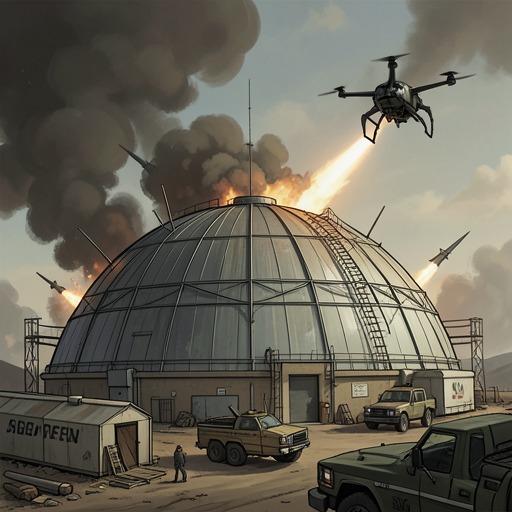
StrikeSYLO–Retro Air Force is an unequal civil war between SYLO and the Retros, who control the air force and possess weapons far beyond SYLO’s capabilities. The conflict begins as resistance to a military regime and becomes a fight over whether the past will be invaded and colonized; along the way, its participants must confront how easily self-defense can merge with retaliation.
The Military Divide
The conflict is not simply between two evenly matched forces. SYLO and the air force are branches of the same national military, but the Retros’ technology gives them a major advantage. Their weapons strike with invisible bursts of energy, producing destructive effects without conventional missiles. During one flight, Captain Granger orders the helicopter to evade while Cutter struggles to keep it under control. The scene makes the imbalance tangible: SYLO’s people can recognize the attack and try to survive it, but cannot answer it with equivalent weapons.
The political geography of the fighting reflects that split. Pemberwick Island, Tucker Pierce’s home, has been occupied by SYLO soldiers and quarantined on the false grounds of a virus. SYLO has established a base there to resist the air force under Retro control and to protect the island from the wider campaign. In the story’s account, that campaign has already killed three quarters of the world’s population. The scale of the threat explains why SYLO’s presence is presented as defense, but it also places its operations among a population whose home has been taken over in the name of protection.
A War That Replenishes Itself
The destruction of the Retro fleet at Area 51 does not end the air war. After a Retro craft emerges from the enormous structure in the Mojave Desert, Tucker recognizes that the force has survived and is rebuilding. The desert below is strewn with hundreds of SYLO fighter wrecks, evidence of an earlier attempt to destroy the structure that was defeated by drones and antiaircraft guns. The attack has cost SYLO heavily without removing the enemy’s capacity to fight.
That lesson is repeated when SYLO launches another aerial assault. Prisoners at a camp see SYLO aircraft arrive, but the attack is directed at the structure rather than at their immediate rescue. Four more SYLO jets fire missiles toward it; Retro drones intercept most of the missiles before they can reach their target. The defenders also keep aircraft hovering around the structure while other craft attack the incoming force. Beyond the camp, SYLO fighters seek an opening, facing three or four Retro drones for each of their own jets. The comparison with Fenway Park, where the unfinished structure lacked Retro defenses, underlines the difference between an exposed target and this heavily protected stronghold.
The battle also corrects any assumption that the Area 51 victory settled the balance. Only days after a thousand Retro machines had been destroyed, the Retros can field a renewed force. Their resources and production capacity appear deep enough to replace losses, while SYLO must keep attempting to penetrate the defenses. For the people watching from the camp, the aerial engagement is not an abstract contest: they are caught in the line of fire, without the soldiers’ assigned shelters or knowledge of where to go.
The Invasion Behind the War
The military conflict has roots in the future from which the Retros come. Olivia Kinsey describes an Earth altered by climate change, with polar ice melt flooding low-lying regions, major cities partly or wholly lost, and Pemberwick Island no longer existing. Population growth has continued as livable space and farmland have shrunk. Government-controlled housing and buildings made from recycled waste are among the conditions of that future. These details establish a material crisis, but they do not make the invasion inevitable or morally justified.
According to Olivia Kinsey, people from the past had been shown what was coming, yet efforts to change course failed. Alternative fuels were not developed at the necessary scale; climate policy did not overcome disbelief and resistance; fossil-fuel consumption and population growth continued as the food supply dwindled. The two eras’ governments spent nearly seventy years in diplomacy, but did not avert the disaster. A 1952 bomb test offered a chance to alter the future, and that chance was not taken. The resulting grievance becomes part of the rationale used by the future government to mobilize its population against the past.
The stated humanitarian justification conceals a more brutal strategic purpose. Once changing the past no longer seemed able to rescue the billions of diseased and starving people of the future, invasion became an option: the past offered land for expansion where off-world colonies did not exist. The campaign was planned by the military and the United States government, with the goal of replacing the twenty-first-century population with people from the twenty-fourth century. SYLO’s war against the Retros is therefore not only a defense against aircraft and weapons; it is resistance to a project of conquest and population replacement.
Resistance and Moral Complicity
The conflict repeatedly tests the distinction between resisting the Retros and becoming like them. Tori Sleeper challenges Tucker Pierce after he accepts the death of an enemy as an unavoidable cost. She connects that moment to the earlier sabotage of the Retro fleet, in which she herself shot people, and questions whether SYLO’s fighters can condemn disregard for human life while accepting it whenever it serves their own goals. Her objection turns the war’s moral argument inward: the fact that SYLO did not begin the conflict does not make every choice within it innocent.
Tucker Pierce’s own account of his conduct makes the danger more explicit. Over the weeks of fighting, he has moved from fearing the handgun Tori Sleeper kept in a car to firing a pulser at anyone he considers a threat. He describes acting without hesitation and feeling little guilt because he sees his side as the good one. Survival and the defense of the planet are real stakes, but so is his admitted desire for revenge—for someone to suffer for what has been done. His response after reflecting on that history is to say that the killing must stop somewhere and to move toward Feit rather than simply accepting another death. That choice marks a turn in his understanding of what victory would demand.
The question of collective punishment gives this ethical conflict its starkest form. Tori Sleeper asks Tucker Pierce whether he would press a button that ended the invasion and protected survivors if doing so also wiped out the entire population of 2324. The question refuses the easy division between the people of the past as victims and the people of the future as aggressors: ending the threat by destroying an entire population would reproduce the logic the resistance opposes. The novel thus presents SYLO’s struggle as necessary defense while refusing to treat necessity as a blank check.
Consequences and Narrative Significance
The war’s military and moral outcomes do not fit neatly into a conventional victory narrative. After the events return the survivors to 1952, the Army interrogates them separately for days, testing their accounts of an experience that sounds impossible. Tucker Pierce makes sure the interrogators hear Feit’s role in the genocide that preceded the invasion, yet he also recognizes that Feit cannot be punished for crimes that, in this altered historical context, have not happened and cannot be proved. The distinction between responsibility and evidence becomes part of the aftermath rather than a problem solved by defeating an enemy in battle.
SYLO–Retro Air Force therefore links two forms of conflict: the visible contest between aircraft and the less visible contest over historical responsibility. The Retros’ environmental catastrophe helps explain their desperation, but their decision to replace another era’s population makes that desperation an instrument of domination. SYLO’s resistance opposes that project, while the fighters’ resort to vengeance threatens to carry the same disregard for individual lives into the society they hope to save. The relationship between the forces is consequently defined by more than who controls the sky. It asks whether stopping an invasion can also mean stopping the cycle of violence that made collective destruction seem acceptable.