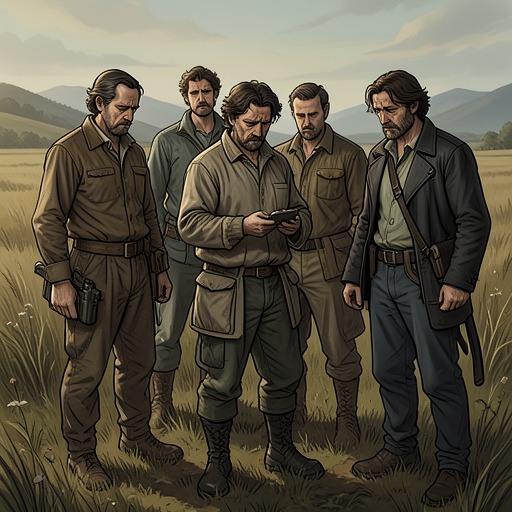
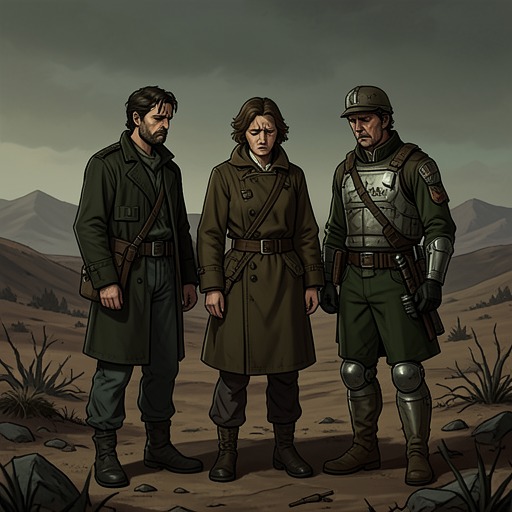
Tucker Pierce and Quinn Carr
StrikeTucker Pierce and Quinn Carr are linked by a difference in ambition that Tucker understands only in retrospect. Quinn wanted to leave Pemberwick Island and make a difference; Tucker once thought that a quiet life on the island was enough. After the two have failed to get the future they wanted, Tucker sees their shared isolation as a reason to act, not a refuge from responsibility. Quinn’s remembered purpose helps turn Tucker’s knowledge of catastrophe into a commitment to prevent it.
A Difference Tucker Understands Later
Tucker recalls Quinn while considering what the survivors should do with what they learned in 2324. The memory begins with a contrast between their original hopes: Quinn had plans beyond Pemberwick Island, while Tucker could imagine no better life than living quietly on a beautiful island. Tucker admits that he did not understand Quinn’s ambition at the time. The reflection therefore marks a change in Tucker as much as it records Quinn’s character: what once looked like an unnecessary departure from a satisfying life now appears to have been a desire to matter beyond oneself.
Their circumstances have since converged in an unwelcome way. Tucker says that neither of them got what they wanted and compares their present situation to living on their own little islands, hidden from the world. The image turns the island from a cherished home into a figure for isolation. Yet the survivors possess knowledge that could change the future, and Tucker argues that they can still make a difference. Quinn’s aspiration supplies a human measure for that choice: the question is not simply whether intervention is dangerous, but whether knowing what may happen can be reconciled with doing nothing.
Quinn’s Influence on Tucker’s Decision
Tucker’s appeal meets resistance. Kent Berringer warns that people would treat the group as freaks, while Olivia Kinsey fears that interfering could produce something worse. Tucker acknowledges that the risk may be real, but sets it against what they saw in 2324 and asks whether they should watch the world fall apart again. The others exchange nervous glances; Tori Sleeper then asks what Tucker wants to do. In this conversation, Tucker does not present Quinn’s old ambition as a ready-made plan. Instead, remembering Quinn helps him articulate why passivity is no longer acceptable, even when the consequences of action cannot be guaranteed.
The memory also keeps Tucker’s decision from being framed as confidence that he can control history. He concedes Olivia may be right about the danger. His resolve comes from comparing that uncertainty with the devastation the group has witnessed. Quinn’s example, as Tucker now understands it, is a call to accept responsibility for trying—not proof that any attempt will succeed. The distinction gives the relationship its continuing force: Quinn’s influence persists in the difficult choice Tucker makes, rather than in a promise that the future can be safely mastered.
A Bond Carried into the New Timeline
Quinn remains present in the survivors’ life after the crisis as someone whose judgment Tucker still imagines. Tucker says he tries not to let the memory haunt him, then concludes that Quinn would have been proud. The statement places pride and grief alongside one another without diminishing either. Quinn is absent from the future gatherings Tucker describes, but Tucker continues to measure their shared work against what Quinn wanted to accomplish.
That work belongs to a close group, not to Tucker alone. Tucker, Kent, Olivia, and Tori have remained closely connected through their energy company and the bond formed years earlier; Tucker describes them as family, united by the goal of preventing the world from crumbling. He believes that, in their own small way, they succeeded. His thought of Quinn follows directly from this account of collective purpose: the group’s effort can be understood as carrying forward the ambition Tucker once failed to recognize.
Education and the Next Generation
The group’s later actions extend that purpose to the young people growing up in a different reality. Tucker, Kent, Olivia, and Tori attend the graduation of Tucker’s younger self, who has reached the end of Greenwich High School in a world without the Bridge, the threat, or the Retros. They have also attended Kent’s graduation from Arbortown High and, the week before, the graduation of Tori and Quinn. For the older survivors, these ceremonies are satisfying but also sad, and they attend not only to celebrate their younger selves’ achievements but on business.
Quinn’s next steps are part of the future the group is considering: young Kent is in his second year at Cornell, Quinn has received early admission to MIT, and Tori wants to attend NYU. Tucker’s group sees these five young people as possible leaders for the next generation of visionaries who will run their company. The plan is to bring forward people with new ideas and a way of thinking like theirs. Quinn thus matters both as the person whose ambition once challenged Tucker’s contentment and as one of the young people whom the survivors hope will help shape what comes next. Tucker’s closing belief that Quinn would have been proud joins private remembrance to public responsibility: the future they work toward is also an answer to the aspiration he once did not understand.