Separate Histories and Timelines
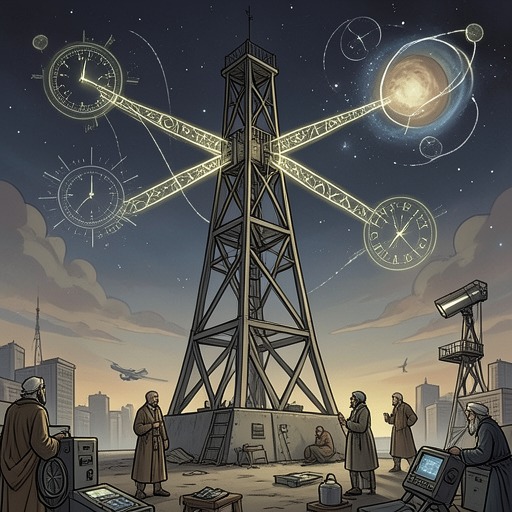
StrikeSeparate Histories and Timelines is the account Olivia gives of why the past cannot be changed to repair the future that sent the travelers there. The bomb that opened the Bridge in 1952 began a new existence, but did not erase the old one. Crossing the Bridge therefore means entering another history, not revising the history from which the travelers came.
The Rule of Unchangeable History
The idea emerges when Kent considers whether people in the past could make even small changes and thereby transform the future. He invokes the Butterfly Effect: if the past shifted, different people might be born, and those who came from the future might disappear. His concern is not merely that their actions could produce unexpected consequences, but that the people trying to save their future might erase themselves in the process.
Olivia answers with what she says were experiments conducted in her time. Time capsules planted in the past could not be found when people later searched for them in her present. Newspaper articles placed in major publications in the 1950s and 1960s likewise no longer appeared in the archives of her time. These examples distinguish an attempted intervention from a changed history: the interventions left no trace in the future the experimenters inhabited. Olivia says they concluded that an event, once it happens, cannot be altered, and that the two eras exist separately.
Kent tentatively reframes this separation as two dimensions. The comparison gives a name to the difficulty of the rule: the past and future are not successive parts of one shared history that can be freely edited. In Olivia's explanation, each belongs to a distinct existence. The account answers Kent's fear of the Butterfly Effect by rejecting its premise for these travelers: changes attempted in the past do not remake the future from which they came.
The Bridge and the Two Existences
Olivia makes the rule concrete at the control panel. She reaches toward its keyboard and offers to show Tucker the history of her time. In her account, the bomb's opening of the Bridge in 1952 started the clock on an entirely new existence, but the previous existence did not disappear. The travelers are still in that older existence at this point in the explanation; the Bridge offers passage to another one, rather than a route by which to alter the one already underway.
That distinction changes what “going back” means. Olivia describes the return journey through the Bridge not simply as travel into an earlier date, but as entry into a different existence. The future of that existence, unlike the already established history of the world they occupy, has not yet been written. The Bridge thus connects histories without merging them into a single mutable timeline. Its significance lies not only in crossing between times, but in crossing between realities whose histories do not overwrite one another.
The Histories Compared
Olivia gives the distinction personal weight by listing outcomes from her history. In that history, Tucker grew up and died; Tori's father lived to old age; Marty Wiggins played for USC; Kent's father did not die from an overdose of Ruby; and Quinn was not killed on the boat. Olivia says she looked these outcomes up. The examples span the travelers' families, acquaintances, and their own lives, turning an abstract rule into a catalogue of different biographical outcomes.
The list does not mean that these outcomes will simply replace what the travelers know when they return. Olivia identifies them as part of the history that led to the world she comes from, then distinguishes that history from the new existence awaiting them across the Bridge. Her examples make the separation legible through contrasts in who survived, how lives unfolded, and what happened to Tucker himself. She offers to show him the day he died, but the passage does not give that date; the threatened knowledge remains an offer rather than a revealed fact.
Knowledge, Choice, and the Plan
The rule also unsettles the stated purpose of the intervention. After hearing that the future cannot be altered, Tucker asks why people from that future tried to persuade people in the past to change anything. Olivia reports that the explanation was that it served mankind and represented the noble thing to do, even though the future would not benefit. She then says that explanation was a lie and that the effort was part of a plan. The passage exposes the claimed moral justification as deceptive, without yet specifying the plan's full purpose.
Kent's preference for the old existence, despite Olivia's sharply posed challenge about how that world turned out, leaves the comparison unresolved in personal terms. The concept establishes a boundary, not an easy judgment about which history is better. Its dramatic force comes from placing knowledge beside that boundary: Olivia can describe another version of the travelers' lives, but the existence they inhabit is not thereby rewritten. The Bridge makes another future reachable, while the old history remains what it was.