Environmental and Resource Collapse
StrikeEnvironmental and Resource Collapse is the slow-moving crisis behind the ruined future depicted in the novel and the political conflict that grows out of it. Rising seas, shrinking habitable and agricultural land, pollution, exhausted fossil fuels, and the dangerous rush to nuclear power transform everyday life into a struggle for survival. The collapse is not a single disaster but an accumulation of damage: its costs fall across generations, while the future’s rulers turn the suffering it causes into a justification for invading the past.
A damaged world made visible
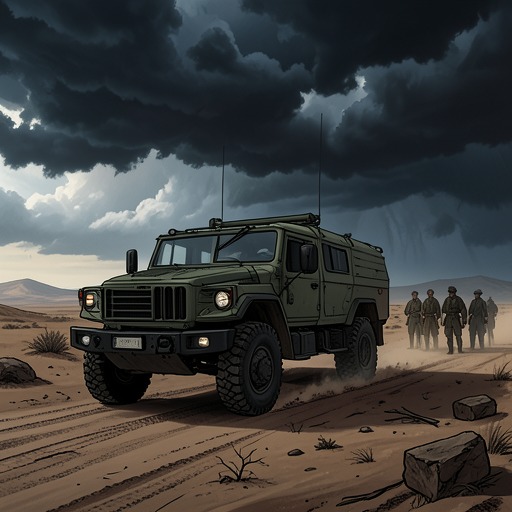
When Tucker Pierce, Tori Sleeper, and Kent Berringer arrive in the future city, the first evidence of environmental degradation is physical and immediate. A chemical smell leads them toward distant factories, where stacks release dark, colorful smoke that gathers into immense clouds over the city. Tori is stunned by the sight and by the acid rain; Kent’s description of the place as a gate to hell captures the shock of encountering a landscape that seems to embody catastrophe. A giant steel dome stands out against the crowded, filthy city, while the characters infer that the factories may be connected to the production of aircraft for the invasion.
Olivia Kinsey’s later account places this polluted city within a planetary transformation. Climate change has melted the polar ice caps and flooded low-lying areas around the world. Lower Manhattan and much of Los Angeles are underwater, New Orleans has disappeared, and Pemberwick Island no longer exists. At the same time, the population has continued to grow as livable space and farmland contract. The disaster therefore reaches beyond damaged scenery: it reduces the land available for homes and food while increasing the number of people who must live on what remains.
Scarcity and the costs of adaptation
The future’s cities respond to crowding through dense, controlled housing rather than private homes. Olivia describes urban life as confinement in a crowded colony, with government control extending to the places people live. Even the impressive buildings occupied by the characters are made from recycled plastic and other waste. The material that keeps the city standing is also evidence of the world’s depleted resources: waste has become an ordinary building supply, not an exceptional substitute.
The exhaustion of fossil fuels deepens the crisis. Natural gas, oil, and coal have all been spent, and their disappearance throws the world into chaos. The Middle East descends into anarchy as oil wealth vanishes; conventional commerce collapses along with the stock market, and the world comes close to losing its power supply. The scarcity is not presented as an unforeseeable surprise. Olivia stresses that people saw the danger approaching, but private industry did not develop practical alternative energy because it was too expensive. The gap between recognized need and profitable action leaves society without a safe transition when the old fuels run out.
Nuclear power becomes the practical answer under emergency conditions. It supplies the energy needed for the lights to stay on and powers the future’s planes, cars, weapons, and computers. But the speed of its development leaves precautions behind. Radiation from billions of nuclear-powered devices raises cancer cases a thousandfold. A technological solution preserves energy while multiplying another kind of bodily harm: adaptation prevents one immediate collapse, but it does not restore health or undo the choices that made the emergency so severe.
Food, health, and diminished daily life
The future’s medical advances offer only partial protection against its wider conditions. The miracle medicine can regenerate tissue and help people recover from injury, but it cannot cure disease. People may be stronger and more athletic, yet average life expectancy in the United States is just forty-two years for men and forty-three for women. The contrast makes clear that individual physical repair cannot compensate for a society whose environmental and technological conditions expose its population to pervasive illness.
Food scarcity gives the loss of farmland a daily measure. Feeding the growing population has become nearly impossible, and the available diet consists mostly of beans and rice. Meanwhile, the dominant public concern is survival; art, music, and literature have little recognized value. Olivia describes people as living from day to day, waiting for another disaster. Tori recognizes this as mass depression, and Olivia confirms that diagnosis. Environmental damage thus registers not only in flooded coastlines and polluted skies but in shortened lives, restricted diets, and a social order with little room for pleasure or creative life.
From environmental damage to political violence
The ecological crisis is also the ground on which the future’s conflict over responsibility is built. Olivia explains that people of the past had glimpsed what was coming, yet failed to secure safe alternative fuels, confront climate change effectively, or curb population growth as the food supply dwindled. Nearly seventy years of diplomacy between governments from different eras did not avert the disaster. The future’s people therefore look backward at a society they believe had warning and an opportunity to change course, but did not act decisively.
That accusation becomes part of the rationale for invasion. Olivia describes the official claim that the plan was for humanity’s good as a lie: once leaders concluded that changing the past would not improve the lives of the billions already suffering in the future, conquest became an option. With no colonies on other planets, the past offered territory into which the future’s people could expand. Their continued efforts to persuade earlier generations to change were no longer intended to save the future; they were meant to secure a more favorable future after conquest. The environmental emergency explains the pressure behind this policy, but it does not make mass murder or colonization morally necessary. Feit’s appeal to the past’s responsibility likewise turns a real history of inaction into an argument for retaliatory violence.
The scale of scarcity is reflected in Feit’s account of a world divided into seven countries, all fighting over space, water, energy, and life. He describes the struggle as one of survival rather than wealth or prestige. In this setting, resource insecurity becomes an international condition as well as a domestic one: environmental decline helps produce conflict between states, while the invasion carries that competition across time and assigns blame to an entire earlier society.
Recurrence and the warning carried forward
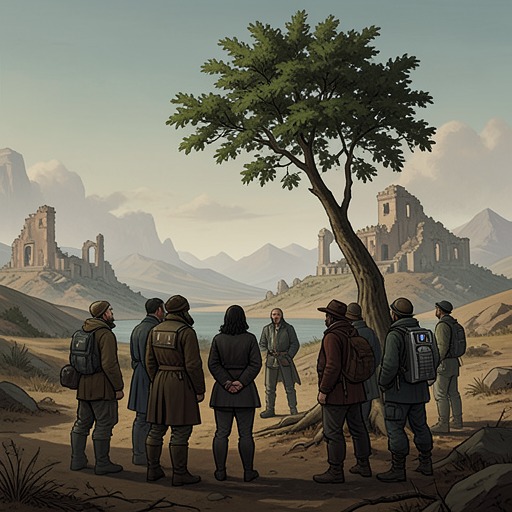
After the conflict, the four time travelers’ weekend meetings at Manhattan Beach shift from recounting their pasts toward considering a future not yet written. Tori warns that history is repeating itself: the emerging world appears to be following the same path that led to Olivia Kinsey’s devastated future, while only a handful of people know what may be coming and others may not believe the warning. This later concern gives Environmental and Resource Collapse a second temporal significance. The ruined future is not only an explanation for the war already fought; it is also a possible outcome against which the survivors measure the choices of the new world.
The novel’s account therefore links gradual environmental damage to visible political and personal consequences without treating those consequences as automatic. Flooding, pollution, energy depletion, illness, and food scarcity accumulate over time, while decisions about investment, policy, and responsibility shape how societies respond. The Retros make the past answer for the future’s suffering, but the beach conversation returns attention to the danger of repeating the same failures. The collapse’s lasting significance lies in that uneasy connection between ecological warning and human choice: knowing the disaster is possible does not, by itself, prevent it.