Three concurrent timelines
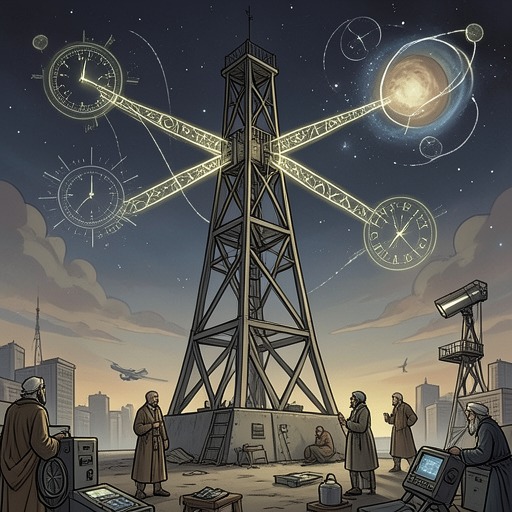
StrikeThree concurrent timelines are the explanation Olivia and Tucker Pierce give for a past that cannot be rewritten and a future that still exists. The Bridge connected distinct realities rather than making them successive versions of one mutable history; after the travelers stopped the bomb test, they understood themselves to be living in a new timeline, separate from both the future Olivia knew and the early-twenty-first-century world from which Tucker Pierce’s group came.
The Rule of Temporal Separation
Olivia states the governing rule plainly: once something has happened, it cannot be made not to have happened. Her insistence that everything did happen answers Kent Berringer’s frustrated belief that stopping the Bridge from opening should have prevented the events they experienced. In Olivia’s account, preventing an event in one reality does not erase the reality in which it already occurred. The past is not a draft that can be corrected; events remain part of the history to which they belong.
That rule also changes what the Bridge means. Olivia describes the twenty-fourth-century existence she knew and the twenty-first-century existence Kent and Tori Sleeper came from as different timelines connected by the Bridge. The connection allowed the characters to encounter one another across eras, but it did not collapse their histories into a single sequence that could be revised from the other end. Tori proposes that the realities resemble parallel dimensions. Olivia accepts the comparison provisionally, while admitting that she never fully understood the theory and doubting that even the supposed experts necessarily did.
Three Realities
Tucker Pierce applies Olivia’s rule to the group’s own situation. If the past cannot be changed, then stopping the bomb test cannot simply restore the history they came from. Instead, he reasons, their actions have started another timeline. Olivia confirms the essential distinction: as far as they know, three realities now exist, not one history with a single altered ending.
The first is the twenty-fourth-century reality in which Olivia was born. The second is the early-twenty-first-century reality from which Tucker Pierce’s group came. The third is the new timeline that began on January 24, 1952, when the bomb test was stopped. Tucker Pierce identifies their present as that third reality, and its defining difference is the absence of a Bridge to the future. The date marks more than a changed outcome: it is the starting point of a separate history.
The characters’ dialogue gives this explanation its provisional quality. Olivia can affirm that the timelines are distinct, but neither she nor Tucker Pierce presents a complete scientific account of how they work. Tori reaches for the familiar image of parallel dimensions; Olivia answers with uncertainty rather than authority. The model is therefore a practical way to understand what has happened, not a claim that every mechanism has been solved. Its central certainty is narrower and more consequential: the original histories persist, while the travelers now occupy another.
A New Timeline Without the Bridge
The third reality is distinguished not only by its starting date but by what it lacks. Because there is no Bridge to the future, Tucker Pierce concludes that this timeline will not be invaded by the Retros. The absence of the connection therefore has immediate stakes: it separates this new world from the route through which the future’s conflict could reach it. The characters’ intervention does not erase the other timelines or undo their experiences; it creates a reality in which that invasion will not take place.
This outcome makes the protection of the new timeline inseparable from the travelers’ displacement. Their action has a consequence beyond their own circumstances, but the safer future it opens is not automatically the reality from which they came. Kent Berringer’s question about how the group can return to its own time, or its own reality, exposes the cost contained in Tucker Pierce’s explanation. Distinguishing three timelines clarifies why the past remains intact; it does not supply a passage home.
Uncertainty and Separation
The explanation leaves the characters facing an unresolved practical problem. After Kent Berringer asks how they can get back, the group exchanges anxious looks; nobody wants to voice the obvious, and Tucker Pierce takes the initiative. The scene stops short of providing a solution. The new timeline is established as their present, but whether they can reach either of the other realities remains uncertain.
That unresolved question keeps the three-timeline model from functioning as a neat escape from the consequences of time travel. It offers a way to reconcile the survival of the future with the creation of a different past, while preserving the separation between them. Olivia’s confidence in the irreversibility of events stands beside her uncertainty about the theory, and Tucker Pierce’s clear naming of the third reality stands beside the group’s fear of being stranded in it. The result is an intelligible map of their predicament, not reassurance that its boundaries can be crossed again.