Tucker Pierce and Captain Granger's shift from conflict to cooperation
StrikeTucker Pierce and Captain Granger’s relationship shifts from a record of near-fatal conflict to a hard-won working alliance. Its change is measured not by an apology or a sudden intimacy, but by a sequence of decisions: Granger listens to Tucker’s account, chooses to trust the young people’s warning, and ultimately lets Tucker join a dangerous mission. By the time they separate in the field, the former adversary can acknowledge Tucker’s contribution and entrust him with the urgent task of finding his mother.
A History of Danger
Their history reaches the meeting already burdened by the violence on Pemberwick Island. Granger acknowledges that his methods there were ruthless, explaining that he had been trying to protect the ark after the battle had lasted more than a week and the defenders recognized that their position was hopeless. Once the arks were activated, SYLO landed at Pemberwick Island, Catalina, Fort Knox, and other locations, but the plan was compromised by Retro spies inside them. Tucker’s recollection of how close Granger had come to causing his death makes their exchange personal as well as strategic: he answers Granger’s regret by pointing out that the danger had arisen about a dozen times. Their new cooperation therefore does not erase what came before; it begins with both men aware of the cost of their earlier conflict.
The meeting itself opens with a reversal of expectations. Tucker has been confined to a room, trying to expend his energy and waiting for an explanation, when Captain Granger enters and addresses him formally as Mr. Pierce. Tucker is startled enough to register his shock physically. He asks what happened to Granger after the crash, and Granger, reading from an iPad, explains that he was unconscious and knows the events only through what others told him. Another Skyhawk arrived to rescue survivors, came under heavy fire, and had time to extract only one person. The account gives Tucker information about Granger’s survival while also placing them together as men whose fates have been shaped by the same battle.
Trust and a Shared Objective
The decisive change is Granger’s willingness to treat Tucker and his friends as credible witnesses. After hearing what they have learned, he says he believes Tucker and also believes Sleeper and Berringer. He asks whether they know for certain that the Retros are preparing a second-wave invasion. The question places the relationship at a threshold: Granger is no longer merely the officer whose past actions endangered Tucker, but a commander weighing whether to act on information supplied by the people he once opposed.
The warning matters because Granger’s forces have not known that the Sounders might help bring the Retro forces down. He says they had suspicions and hopes, but no conclusive evidence until Tucker and his friends supplied it. Tucker asks directly whether Granger will attack. Granger’s response conveys the burden of command: he considers how a superior officer would judge sending troops into danger on information brought by children, and acknowledges that such a decision could invite removal, a court-martial, and questions about his fitness. His hesitation is not a rejection of Tucker personally; it shows the distance between believing a report and accepting responsibility for a military operation. The trust he has expressed must still survive the consequences of acting on it.
Earning a Place in the Mission
Tucker refuses to let belief in his information become a reason to exclude him from the operation. When he says he is going too, Granger quickly answers that there is no place for him on the mission. Tucker counters that without him and his friends there would be no mission, and asks for his Pulser back and transportation into the operation, rather than asking Granger to take responsibility for him. His insistence reframes their connection: Tucker is not simply seeking protection or recognition, but arguing that the risks and knowledge he has already contributed entitle him to participate.
Richard E. Neff resolves the immediate dispute in Tucker’s favor. When Tucker says that he and his friends believe they have earned the opportunity, the president notes that the others made the same case. He then tells Granger that they have earned it, repeating the judgment forcefully when Granger begins to object. The decision gives formal backing to a trust that Granger has already begun to show, while making clear that Tucker’s inclusion is not simply the result of the two men reaching a private understanding. Granger’s earlier resistance remains visible, but the mission now recognizes the young group’s contribution.
Cooperation in the Field
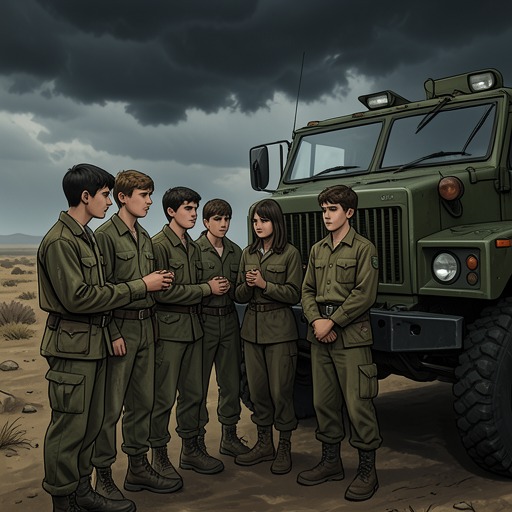
The relationship’s change becomes clearest when the convoy stops and Granger orders the soldiers to continue on foot. The SYLO troops jump from their vehicles and unload their equipment; Granger surveys them, turns to Tucker and his companions, and says that this is where they part. He already knows Tucker will not stay behind, so he does not pretend that another order to wait would settle the matter. Tucker thanks him, a small exchange that registers how far they have moved from the hostility and danger associated with their earlier encounters.
Kent Berringer answers Granger’s caution with sarcasm, and Granger responds with a sideways look and a smile. He then praises the group for doing well and directs Tucker to go find his mother before hurrying after his men. The instruction joins professional recognition to Tucker’s immediate personal objective: Granger can commend the young people’s work and still acknowledge what Tucker must do next. Kent calls after him to be careful. Granger does not remain with Tucker, and the story does not turn their cooperation into reconciliation without qualification. Instead, their parting makes the shift tangible: the commander who once represented danger now recognizes Tucker’s agency, relies on the group’s contribution, and leaves him to carry out the search that matters most to him.