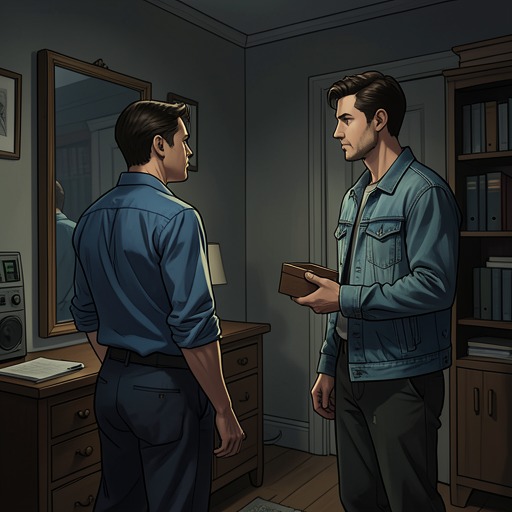
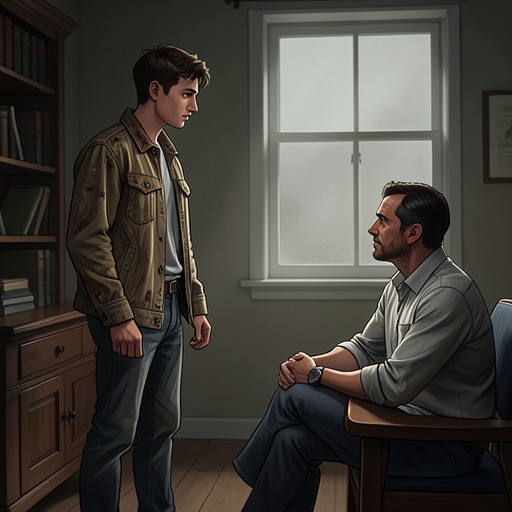
Colton confided his experience to Amit
TemptationColton Davidson’s disclosure to Amit is an early turning point in Colton’s recovery: after reaching a group home and beginning therapy, he finds a listener with whom he can begin to describe the abuse connected to his sexuality. The conversation does not extract a complete account at once. Its significance lies in the conditions that make speech possible: Amit offers recognition rather than diagnosis, and Colton arrives at the decision to speak in his own time.
Setting and First Contact
Colton meets Amit before his transfer from the group home. He has expected an older, gruff therapist, but Amit is younger in appearance and dressed in jeans and a T-shirt that reveals tattoos on his biceps. His styled hair, bright blue hearing aids, friendly smile, and badge on a lanyard make him seem unlike the authority figure Colton had imagined. That difference helps unsettle Colton’s expectation of what a therapy session will be.
Amit asks whether he may call him Colton, explaining that the caseworker said Colton preferred not to be called Mr. Davidson. Colton in turn asks whether he may use Amit’s first name. His upbringing tells him that an adult in authority should be addressed formally, but he is trying to undo what his parents taught him. He first tests the more formal “Dr. Amit?” and learns that Amit is not yet a doctor: he is a student completing an internship, and Colton is one of his first patients. The small negotiation over names makes the encounter less rigid without concealing the difference in their roles.
Amit’s Self-Disclosure
When Colton calls himself messed up, Amit rejects that judgment without denying that suffering can leave lasting marks. He speaks of his own childhood trauma and then explains that he grew up Deaf in a hearing family that did not want to acknowledge his deafness. He also grew up queer in a household where he had been led to believe queerness was sinful. His mother and one sister still struggle with sign language, which Amit describes as demanding work that many people are unwilling to undertake.
Colton begins to raise his hands, then lets them fall: he knows only a few letters of the alphabet and “thank you” from a song he learned in elementary school. Amit reassures him that signing is welcome if Colton ever wants to learn, but that his hearing aids and the quiet room are enough for them to communicate. The exchange makes accommodation practical rather than ceremonial: Amit does not require Colton to prove care through a skill he does not have.
Amit also gives Colton language for queer identity without demanding that he adopt it. He says he identifies as bisexual, notes that some people prefer pansexual, and explains that for him love is about the person rather than gender. He is engaged to Miguel, a tattoo artist who also paints. Amit describes having stayed closeted for years because he feared losing his family; most relatives came to accept Miguel, though one sister remains a lasting point of disagreement. His disclosure is personal and imperfect, not a claim that acceptance is guaranteed. Colton notices that Amit seems to be holding something back, but understands that Amit is trying to relate and create a safe space rather than make the session about himself.
Colton Begins to Speak
Amit’s openness changes the meaning of the word queer for Colton. He has heard it used as a vicious insult, and hesitates over it when asking whether Amit is queer. Hearing Amit use the term with ease and pride makes it possible for Colton to encounter it differently, though he is not yet ready to name his own identity. The pause matters: the conversation offers a vocabulary, but does not treat vocabulary as a substitute for the risks Colton faces.
Colton describes himself as Mormon, then immediately revises the claim: he doubts the church would want him “not like this.” He gestures at his own body, says he does not know what he is, and contrasts himself with a family he calls normal. He had always known he was different and tried to hide it; after he was caught, things became ugly. His voice cracks, and he hates how young the sound makes him feel. Even so, he looks at Amit and finds enough bravery to continue.
Amit asks whether Colton wants to tell him about it. Colton nods and says that he thinks he does. The answer is not a polished account of what happened; it is consent to begin one. The scene gives Colton control over whether to speak, while Amit’s question and patient response make room for an account that Colton has previously been unable to offer safely.
Later Disclosures and the Shape of the Account
The conversation with Amit opens an arc that the novel unfolds through later, separate tellings. When Marcel asks why Colton’s veterinary-school financial aid has been denied, Colton eventually explains that his parents sent him to a conversion camp run by Father Benson after they realized he was gay. He struggles to speak, and Marcel responds by saying that he knows what such camps are, so Colton will not feel compelled to supply greater detail. Colton then says he ran away because the camp’s efforts to change him caused increasing pain and he feared Father Benson might kill him. After living on the streets, he was arrested for vagrancy and sent to Ted House.
That later account clarifies what the first session leaves unnamed. Colton’s family had not lost custody through child-protection intervention; they had sent him to the camp. He also says that his therapist and Sage did not want him involved in whatever happened when the police considered pursuing the camp for child abuse, and that he was grateful to be able to move on. The initial disclosure to Amit is therefore a beginning, not a complete testimony or a demand that Colton revisit every consequence at once.
Much later, Colton explains to Marcel that the camp left him with nerve damage. When Marcel touches scarred skin and Colton flinches, Marcel draws back and asks whether he hurt him. Colton takes Marcel’s wrist and guides his hand back to the scars before describing how some areas are sensitive and others numb, and that Father Benson used electricity to try to cure his supposed affliction. This physical detail deepens the earlier account of things becoming ugly: what Colton first approaches through hesitation and implication is eventually named as lasting bodily injury.
Significance
The disclosure is shaped as an act of being heard rather than a moment of instant resolution. Colton’s pauses, dropped hands, cracked voice, and careful revisions convey how difficult it is to speak when the language available to him has been bound up with insult, religious rejection, and fear. Amit’s own experience offers a point of connection, but he does not claim their histories are identical or press Colton to disclose more than he is ready to share.
The scene also gives Colton’s later disclosures a narrative foundation. His words to Marcel about Father Benson, the camp, and the risk that drove him to run away are not a sudden revelation detached from prior care; they follow an earlier encounter in which Colton first chooses to tell a therapist that something happened. The difference between the two conversations is one of depth and circumstance: with Amit, Colton agrees to begin; with Marcel, he names the camp and its consequences; later still, he describes the injury through his body. Across these stages, the account becomes more concrete without making disclosure a condition of being believed or cared for.