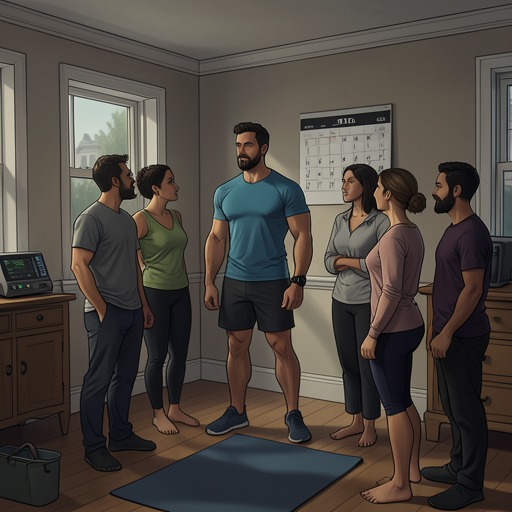
Colton's Apartment Flood
TemptationColton’s Apartment Flood is a compound crisis: after a university denies Colton financial aid for veterinary school, water bursts into his apartment and strips away much of what he has. With his housing and educational plans suddenly uncertain, he has little choice but to take Marcel’s offer of shelter. The flood thus transforms a precarious offer into immediate dependence, while the shared refuge brings the men closer amid Marcel’s own upheaval after discovering Brad’s infidelity.
Causes and Background
The day had already been difficult before the water began. Colton arrived late at Masala, where an oven started smoking because of fried wiring, ruining the pastry selection. Will did not blame him, but the disruption left Colton shaken; raised voices and sharp tones could trigger a visceral response, and Will was too stressed to notice his distress. Aaron recognized what was happening and persuaded Will to let Colton leave a few hours early.
At home, Colton opened the university’s financial-aid award letter. He learned that he had been denied independent status because, although he had spent the last year in foster care, his parents had never legally lost custody. The school therefore counted his parents’ income when assessing his eligibility. Their income was too high for the aid he needed, and the school was out of state, leaving Colton staring at a daunting cost with no time to make sense of possible alternatives. The rejection made Marcel’s offer of help difficult to refuse: Colton was grieving the loss of what he could call his own and had no backup.
What Happens
After the letter, water first trickled from the ceiling’s edge. Then the walls burst, and the apartment flooded. Colton managed to save his laptop, phone, file folder, and backpack, but little else. He had one set of dry clothes, which he habitually kept for emergencies, a remnant of street life he had never been able to leave behind. With those belongings and a general direction, he set out on foot.
The flood also closes off the possibility of returning to Marcel’s home as a simple solution. Marcel is dealing with migraines from his glaucoma, but what keeps him from going home is not only the pain: Brad had slept with another man in the shared bed. To Marcel, the sheets and home have been tainted by infidelity and lies. He had wanted to be wrong, and the discovery sharpens a more intimate wound: the fear that he is never worth someone staying and loving only him.
Shelter and Conversation
Marcel offers Colton a place to stay, but the offer feels almost casual to him at first; Colton’s reaction makes clear that it is not something he can simply accept or decline. He needs the shelter. In the aftermath, Marcel eases onto the sofa and thanks Colton when he turns off the lights to help with the migraine. Colton then puts a soft crocheted afghan across Marcel’s lap, explaining that Sage made it. These small acts of care establish the tenderness of their shared refuge without erasing either man’s crisis.
Their conversation turns to Marcel’s childhood interest in butterflies. His father, a wildlife biologist, moved the family frequently for environmental projects. When Marcel was eight, a three-month project in Mexico studying shrimp brought the family to a beach in an RV. A migration of orange-and-black butterflies filled the roads; after the family reached the campground, crushed wings covered the car’s grill. Marcel remembered the sight as tragic and beautiful: the delicate wings moved in the wind as if alive, then fell apart when touched. The experience drew him toward lepidopterology, and his father let him spend time with researchers collecting samples.
That early ambition ended when colleges rejected Marcel’s applications to biology programs. They cited inconsistent grades, which he connected to the family’s constant moves, but a counselor told him plainly that his blindness was also a reason: universities were reluctant to provide accommodations for a science major involving observational work. Colton stiffened at the news and called the discrimination unfair. Marcel explained that he had grown tired of being expected to do something grand to prove blindness could not stop him. He wanted the ordinary experience of pursuing a goal for the same effort as anyone else, rather than having his education turned into an overcoming-disability story. Colton takes Marcel’s hand and acknowledges how painful that was.
Consequences and Significance
The immediate consequence is displacement: the flood leaves Colton with only a few saved possessions and makes Marcel’s shelter essential. But the crisis is not presented as an isolated accident. The denial letter exposes the way the dependency-status rules can count the income of parents who have not provided Colton a secure home, while the flood makes the vulnerability of his housing literal. His dry clothes, kept from earlier days on the street, carry that instability into the present.
For Marcel, the crisis takes place in a home he no longer feels able to inhabit after Brad’s betrayal. His grief over the relationship and his frustration with the expectations placed on him as a blind person emerge in conversation with Colton, whose response offers recognition rather than a demand that Marcel turn hardship into inspiration. The flood therefore creates a precarious domestic arrangement that is also a turning point in their closeness: care moves in both directions, and the shelter gives them room to disclose what each has lost.