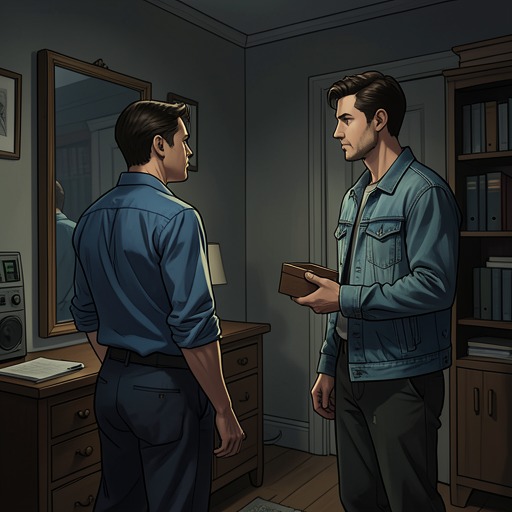
Marcel and Colton confessed to each other
TemptationMarcel and Colton’s mutual declaration of love at the hospital is the emotional resolution of a crisis that could have left Marcel isolated and Colton uncertain whether he would reach him in time. After Marcel refuses to leave with Brad, Colton arrives, explains how he uncovered the sabotage behind the apparent accident, and tells Marcel he loves him. Marcel answers in kind, and the scene ends with their decision to go home together: not merely an escape from the waiting room, but a choice of the life and future they have been building together.
Causes and Background
The reunion follows a deliberate effort by Brad and Jason to manipulate events through a fake accident and damage to a car. Marcel is left at the hospital with Brad, who warns that he will regret rejecting him. Marcel is exhausted by the conflict and makes his position plain: he is done, and Brad needs to go. The choice is consequential because Brad is not simply asking for another conversation; Marcel is refusing to resume a relationship that has become a source of coercion and uncertainty.
Marcel’s decision to stay put is also a test of whether he can choose his own direction rather than be pulled back into Brad’s life. He tells Brad that he would wait outside for the rest of his life rather than leave anywhere with him. The line makes the immediate stake stark: the alternative to remaining at the hospital is not a neutral journey, but renewed dependence on the person Marcel has just rejected. Brad’s warning that Marcel will regret his choice fails to unsettle that resolve.
Colton’s Arrival
Marcel recognizes Colton before he has fully described the rescue. A familiar squeaking brake, the LED headlamp complained about by the men at the shop, and the rumble of tires announce that Colton has come. The sounds transform waiting into recognition: Marcel knows who is arriving and trusts that Colton has come for him. The moment’s force depends on that certainty arriving before explanation.
Colton steps out and reports what happened in brisk, almost ordinary detail: the rain has stopped, he has dealt with an “asshole,” and the car has been fixed. He adds that Brad pulled the spark plugs, a basic trick Colton recognizes because James taught him about it. The explanation makes the apparent accident legible as sabotage rather than bad luck. Jason, Colton says, admitted almost immediately what he had done to the car and described the fake accident; Jason had thought the scheme was merely retaliation against Marcel for leaving Brad, and did not know what Brad was actually planning. Brad had also texted while Marcel was on his way, but Marcel does not claim sympathy for him.
The reunion is physical before it becomes a full exchange of explanations. Marcel takes the steps two at a time, stumbles at the end, and does not care: Colton is only feet away, with warm arms and reaching hands waiting for him. Marcel kisses him first, with a desperation that the narration connects to embracing the life and future he has risked choosing. The kiss is both relief at Colton’s arrival and an active return to the relationship that Brad’s manipulation had threatened to interrupt.
The Mutual Declaration
After they part, Colton runs a hand through Marcel’s hair. Marcel laughs, and Colton thanks him for showing up; Marcel answers that he would not leave him there. This brief exchange frames the rescue as reciprocal commitment rather than a one-sided act of protection. Colton has reached Marcel, while Marcel meets him openly and lets the reunion become an expression of love.
Colton then touches Marcel’s cheek. Marcel understands that Colton is about to speak, but does not stop him. Colton says that he loves Marcel. The permission matters: the words are not forced out of Marcel by the crisis, nor does he evade them when the moment arrives. Marcel bows his head, noses along Colton’s face, and kisses him before saying that he loves him too, repeating the declaration with greater emphasis. The exchange makes their feelings mutual in explicit language, while the gesture of the kiss carries the answer into physical closeness.
The scene’s emotional movement is from threat to recognition and then to affirmation. At first Marcel is still beside Brad, defending his refusal while Brad predicts regret. Colton’s arrival gives that refusal a future beyond the hospital: someone has come to meet him, and Marcel can move toward that person. Their declaration does not erase the danger that brought them there, but it replaces Brad’s attempt to define Marcel’s future with a choice the two men make together.
Going Home and the Future
Colton asks whether Marcel is ready to go home. Marcel says yes, and insists that he has never been more ready for anything. The exchange turns the love declaration into a concrete decision: they will leave together, rather than let Brad determine where Marcel goes or whom he trusts. “Home” carries particular weight as the destination they can choose together; the scene presents it as the next step in their shared life, not as a guarantee that every difficulty is finished.
The narration holds the smallness of the moment against the scale of what lies ahead. A question, an answer, and a kiss are modest actions, but Marcel understands them as the beginning of a future that his decision to stay in Fairfield and invest in this relationship has made possible. That contrast gives the ending its force: after a manufactured crisis, the future is not secured by grand promises or by Brad’s approval, but by Colton’s arrival, two reciprocal declarations, and their willingness to go home together.
Narrative Significance
The scene closes the immediate conflict with Brad while confirming the central relationship through action as well as speech. Marcel has already refused to leave with his ex; Colton’s arrival demonstrates that the relationship he chose is present when it matters, and their mutual confession makes that commitment unmistakable. The event therefore functions as both reunion and turning point: the danger is exposed, Marcel’s boundary holds, and the couple’s next movement is toward a shared home and future.
Its resolution also depends on the distinction between rescue and agency. Colton comes to Marcel and helps him understand how the car was sabotaged, but Marcel has already made his own decision to reject Brad. The final question gives Marcel the chance to choose what happens next, and his immediate answer confirms that going with Colton is what he wants. The declaration of love matters not as a substitute for that choice, but as its emotional recognition: each man is present by willingness, and each names the bond the other has chosen.