Fairfield
TemptationFairfield is a small town near Denver where Marcel arrives with Brad and gradually makes a life of his own. Its narrow streets, bus access, and closely connected local businesses establish a setting in which Marcel’s independence is tested by everyday barriers—and in which a circle of neighbors offers alternatives to returning to his family or remaining dependent on Brad.
Setting and Marcel’s Arrival
Brad leases a townhouse just outside Denver in Fairfield, a town Marcel remembers only dimly from an earlier family visit to Colorado. The place has an old-world feel: narrow streets, thick grass beside the pavement, six steps to the front door, and another ten to the living room. A main bus route connects it to central Denver and the city’s outskirts, while the distance from the traffic leaves the upstairs balcony quiet enough for Marcel’s morning coffee.
The house takes Marcel weeks to learn. In the meantime, plates and coffee mugs break, and Brad complains about the dark mugs he leaves on dark countertops, where Marcel cannot see them. Marcel is tired of apologizing for a difficulty Brad could help prevent, but he does not think the argument is worth the energy. This small domestic pattern gives the move a sharper edge: the town may be new, but Marcel is still expected to absorb the cost of other people’s failure to accommodate him.
Work, Access, and Community
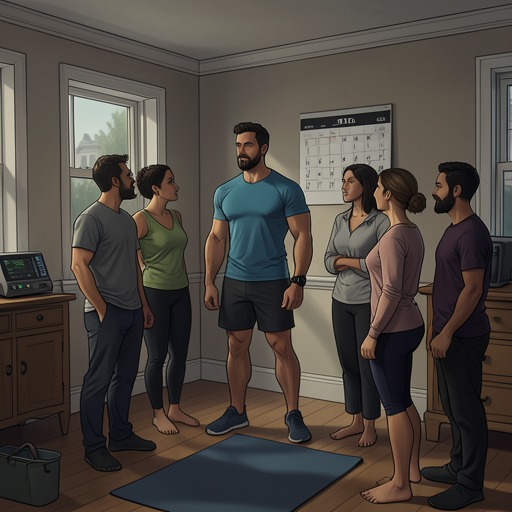
In Fairfield, Marcel rents a studio from a gym to teach classes. The owners hesitate when they see his white cane, but he secures the space and begins with twenty students; sixteen remain by the second week. The income contributes to the household bills without requiring him to draw on the trust his mother insists he keep, and it also gives him a reason to spend less time at home. The studio is modest, but the work offers a foothold independent of Brad.
A local man who uses a wheelchair approaches Marcel after class and invites him to a Saturday park class for people with disabilities. Marcel reacts with both resistance and openness. His parents raised him outside the disabled community, so he has never felt that he belongs within it; his partial sight also exposes him to ignorant treatment, including suspicion when people see him using his phone instead of navigating an ATM by its Braille buttons. He admits that he is awkward with people when he is not teaching, then asks whether he is intruding. The encounter brings the possibility of community close without pretending that belonging comes easily.
The town’s social connections become clearer through Robbie, who describes a network of familiar local places: a Greek restaurant, a tattoo studio, and Sam’s Saturday yoga classes, sometimes accompanied by baby goats. Will runs Masala, the coffee house across the street; the flower shop that once stood beside it closed when its owner, Basil, became a stay-at-home father. Basil’s husband does tattoos, and he and his brother run one of the group homes in town. The details map a web of ordinary local support rather than a single institution, and Marcel begins to recognize that staying in Fairfield could mean having people and places to turn to if his relationship with Brad fails.
A Possible Home Beyond Brad
Marcel has reasons to leave. He could return to his parents and brother, find work at his old studio, and resume the unsatisfying pattern of brief relationships and casual hookups. But going back would also feel like admitting that his family had been right to doubt his ability to make a life on his own. Marcel knows they love him, yet wants them to accept that he is content with what he chooses and does not need to be pushed toward some greater version of himself.
When Colton asks whether he will return, Marcel says he does not mind being in Fairfield and wonders whether it would be so bad to stay. Colton relaxes against him, and Marcel holds him close, even as he recognizes that intimacy is taking him near a boundary he has been trying not to cross. Fairfield’s significance shifts with this decision: it is not merely the place Brad brought Marcel, but a possible home Marcel can choose for himself, with work, local ties, and a growing connection to Colton.
The Town’s Network and Its Consequences
Fairfield’s community becomes consequential when Brad’s deception draws Marcel into a hospital encounter. The following day, Colton goes to the coffee house and quits his job after Jason fails to appear and Colton explains what happened to Will. Will responds by shutting himself in his office; Sage sits with Colton for about half an hour, helps him calm down, and eventually coaxes Will back out. Their response shows how the town’s personal ties can provide immediate care when harm reaches beyond the couple.
Brad does not remain in Fairfield long. The men of Irons and Works dog his steps, and Marcel feels no sympathy for his departure. With Colton in his arms and a future ahead of him, Marcel’s relationship to the town has changed: Fairfield is no longer simply the setting of his move with Brad, but the place where a community has helped make staying possible and where Marcel and Colton can look forward together.