Marcel's glaucoma and low vision
TemptationMarcel's glaucoma and low vision are lifelong, changing conditions that shape how he navigates the world without defining the full measure of his life. From childhood medical treatments and a reckless relationship with his white cane to adult work, intimacy, and travel, his experience exposes the difference between vision loss itself and the barriers created by people and places that assume everyone can see in the same way.
Condition and Early Experience
Marcel's eyes had been failing him from birth, unlike the gradual loss of sight commonly associated with old age. His parents repeatedly had to explain why a toddler with glaucoma was moving around playgrounds with a white cane; people treated the diagnosis as surprising because they thought of glaucoma as an old person's disease. Marcel was not totally blind, and doctors told his parents that he might become so someday but that treatments were available.
Those treatments were demanding rather than restorative. Marcel underwent surgeries that left his eyes feeling as though they contained sand for weeks, used drops that made the already bright sun seem brighter, and wore thick, coke-bottle glasses. He also took medication. The narrative does not present these interventions as a simple path toward normal sight: despite the effort, Marcel did not perceive a clear difference, and his vision continued to change.
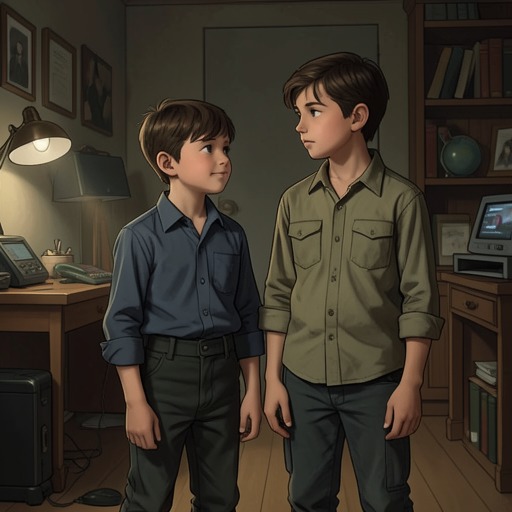
His parents' response was shaped by their refusal to treat him differently from his twin brother, Antoine. They expected Marcel to do what Antoine did and often ignored the fact that he was blind or had low vision. That approach gave Marcel latitude to test boundaries, but it also meant that his disability was not always acknowledged as a practical difference requiring accommodation. The family moved frequently, while Marcel's recurring doctor visits remained a constant.
How Marcel Sees
Marcel's sight is partial and uneven, not an uncomplicated absence of vision. As a child he learned to read at four using giant letters displayed on a CCTV, tracing the shapes with his finger and connecting them to sounds. He learned braille the following year but struggled to stay patient with the practice; Antoine took to it more readily, while Marcel had barely worked out elevator buttons. The contrast shows that visual and nonvisual skills did not fall into a simple hierarchy of ability between the brothers.
In one remembered moment, Marcel lies on a porch and peers through its slats with his stronger right eye. The ground below resolves only into blurs and shapes, and the dark fog at the edges of his vision has grown thicker. When he puts on his glasses, the blurred center becomes as clear as it can, but the lenses cannot make the world whole. Later, while talking about the Rocky Mountains, he describes being able to see pieces of the landscape as though a photograph had been cut up and handed to him, without being able to take in the entire view. He also says he has never seen stars, though others assume that fact must trouble him more than it does.
These descriptions make low vision a specific sensory experience rather than a metaphor for ignorance or emotional lack. Marcel has some usable sight, and its reach varies with his stronger eye, glasses, lighting, and the situation. The novel preserves what he can perceive as well as what he cannot; it does not treat his partial sight as a puzzle that other characters must solve for him.
Work, Access, and Everyday Barriers
Marcel's efforts to build a working life repeatedly meet institutional limits. He had hoped to study biology, but universities rejected him, citing inconsistent grades affected by his family's frequent moves. A counselor eventually told him bluntly that his blindness was also a reason: accommodating him would require effort, particularly in a science program involving observation. Marcel was exhausted by the prospect of having to make his ambitions into a public demonstration that disability could be overcome. He wanted a life that did not require him to serve as someone else's inspiration.
Yoga offered a different route. Marcel had practiced since he could walk, in part because doctors said he would have trouble with balance. When his instructor suggested that he could teach, he pursued affordable certification and excelled in his teaching hours. He took afternoon classes at the school, when his vision was best and the sun brightest. In Fairfield, he later rented studio space in a gym. The owners were initially reluctant when they saw his white cane, but he established a small teaching practice: twenty students at first, then sixteen by the second week, enough to contribute to the bills without drawing on the trust his mother had insisted he keep.
Other settings show how ordinary design assumptions can turn low vision into an obstacle. At a restaurant where Brad arranged to meet him, Marcel encountered dim lighting, a noisy room, and an all-print menu. A frightened server escorted him in, and Marcel had to use his phone's flashlight and camera zoom to read a few entrees. His eyes tired and a headache throbbed by the time Brad arrived. The difficulty arose not simply from his eyesight but from a venue that offered no accessible menu and a setting that made orientation harder.
Housing and daily navigation also required practical adjustment. After moving to Fairfield, Marcel took weeks to learn the townhouse, with its six steps to the front door and ten more to the living room. He broke plates and mugs while learning the space, while Brad continued leaving dark mugs on dark counters where Marcel could not see them. Marcel was tired of apologizing for accidents that better habits from Brad could have prevented, even when the energy of repeatedly arguing about access felt beyond him. At home, independence depended both on Marcel learning the layout and on the people sharing it recognizing what he could not see.
Social Meaning and Relationships
Marcel rejects the assumption that blindness makes him a symbol for other people's moral improvement. He resents being treated as an inspiration by white, middle-class new mothers at his Wednesday classes, and he is explicit that he is neither a miracle nor a lesson: he is a person with a genetic condition who wants something ordinary. His brother Antoine's refrain that normality is subjective and overrated irritates him, because Marcel does not want to stand out or continually apologize for being himself. The tension is not that Marcel believes he is lesser; it is that others make ordinary participation feel exceptional.
He also has a complicated relationship with disability community. In Fairfield, a wheelchair-using teacher invites him to a Saturday park class for people with disabilities. Marcel bristles, then softens, unsure how to respond. His parents had raised him far outside the disabled community, and he had never felt that he fit within it. Partial sight adds to that unsettled position: some people treat his ability to look at a phone as suspicious because they expect a blind person to stumble or use braille at an ATM. The invitation presents connection as possible without suggesting that Marcel must already feel at home in a community others assume will automatically be his.
His relationship with Brad makes the consequences of access barriers painfully intimate. Brad has watched Marcel lose employment opportunities despite being qualified because businesses did not know how to accommodate him. He has also seen studios cut Marcel's teaching hours until he had only one class a week because students were uncomfortable with his blindness. Yet Brad resents the difficulties Marcel faces, despite knowing their source. His knowledge does not translate into reliable support: after their move, the dark mugs remain on the counter, and Marcel carries the burden of deciding whether to challenge him again.
Marcel's account of low vision also makes room for care without pity. When he develops a migraine, he explains that it is related to his glaucoma, and Colton asks whether glaucoma is an old person's disease. Marcel laughs at the familiar misunderstanding rather than treating the question as a revelation. In a later conversation, Colton worries about the age difference between them and describes himself as nervous, young, and working in a cafe. Marcel answers by naming him as he is, including his love of stray dogs and habit of folding socks. Their exchange places Marcel's vision among the facts of a person who can love, work, joke, and make choices, rather than making it the sole subject of intimacy.
Narrative Significance
The novel repeatedly distinguishes bodily condition from social obstruction. Marcel does need glasses, a cane, medical care, and adjustments to his routines; at the same time, inaccessible menus, unaccommodating employers, dim spaces, and other people's expectations narrow his choices. His failed applications and lost teaching hours do not mean that he lacks interest or ability. They show how institutions can turn access into a condition that the individual is expected to overcome alone.
The narrative also refuses two familiar simplifications: that disability is only a medical problem awaiting correction, and that a disabled person exists to inspire others by defeating it. Marcel receives treatment and describes its costs, yet the story does not make restored vision the measure of a successful life. He wants to teach, to live without apologizing, and to experience ordinary relationships on his own terms. His low vision remains consequential, but it is one part of a fuller existence—sometimes frustrating, sometimes simply present, and never a substitute for Marcel himself.