Marcel’s visual impairment
TemptationMarcel’s visual impairment is a continuing condition of perception and access, not a simple absence of sight or a plot device that reduces him to helplessness. He can sometimes make out shapes and fragments, but dimness, visual contrast, distance, and clutter change what is available to him from one place to another. Across restaurants, housing, work, and the landscape, his experience reveals how much daily independence depends not only on vision but on environments being usable and on other people respecting his agency.
Identity and Everyday Perception
Marcel’s sight is partial and inconsistent: he can perceive some parts of a scene without assembling them into a whole. Recalling childhood lessons about mountain climbing, he explains that he could see pieces of the Rocky Mountains as though a photograph had been cut up and handed to him, but could not comprehend the range as a complete image. He had never seen stars, either, and tells Colton that other people assume this troubles him more than it does. His account resists the presumption that a particular visual experience must produce grief simply because sighted people imagine it as a loss.
His perception also changes with the conditions around him. At the restaurant where Brad has arranged to meet him, Marcel arrives with his cane in an unfamiliar, dim, noisy room. The server escorts him, but gives him a print-only menu; Marcel uses his phone’s flashlight and camera zoom to read several entrees while waiting. The effort tires his eyes and leaves him with a headache. The scene makes access a matter of practical design: the obstacle is not only Marcel’s low vision, but a setting that offers no usable menu and little orientation, at a moment when the noise and lighting compound one another.
In his home, unfamiliarity and contrast have their own costs. The townhouse Brad leases outside Denver has six steps to the front door and ten more to the living room. It takes Marcel weeks to learn the space, during which he breaks plates and coffee mugs. Brad continues leaving dark mugs on dark countertops, a preventable contrast problem that Marcel cannot see; he grows tired of apologizing for consequences Brad could help avoid. These details distinguish impairment from incapacity: the household can be made easier to navigate, but Brad’s habits leave Marcel carrying the burden of adaptation.
Access, Mobility, and Independence
Marcel’s cane is a practical tool for movement and orientation, not evidence that he cannot act independently. When he returns to the townhouse with Holland, he follows the familiar steps by the cane’s taps against each curved stone and the handle’s feel in his palm. Inside, the dim stairway makes his glasses useless, so he pushes them onto his forehead and listens for signs that Brad is there. He reaches for the keys, opens the lock, and enters; Holland accompanies him and offers information about the unlit, apparently undisturbed rooms, but Marcel remains the person navigating his home and deciding what to do.
The emergency room presents a different access problem. Marcel can follow the uneven, curving path through the sliding doors because there is enough light outside, but the crowded interior becomes a field of grey and dark heads, with coughing and groaning around him and no clear sense of where the desk is. He accepts an older man’s offer to guide him, specifying that he can follow with his cane and asking only to be led. The man’s dark coat against the light floor gives him a visible guide to the registration window. Marcel seeks assistance as a chosen, bounded accommodation: he directs what help he needs and retains control of his movement.
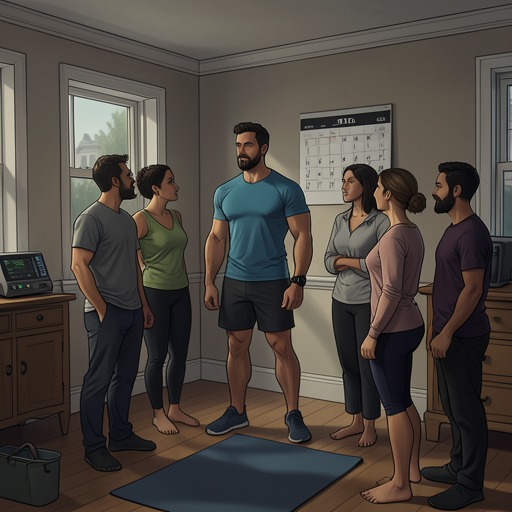
His work likewise shows independence built through negotiation rather than through the removal of disability. Marcel rents a studio from a gym to teach yoga. The owners are initially reluctant when they see his white cane, but he secures the space and finds that teaching a few hours a week is manageable. He starts with twenty students, sixteen of whom remain by his second week; the income helps pay bills without drawing on the trust his mother wants him to preserve. The studio’s initial hesitation exposes an assumption about disability and fitness, while Marcel’s actual work contradicts it. His teaching is not framed as a miraculous overcoming: it is paid work that fits into his life and contributes to his financial independence.
Relationships and the Politics of Care
Brad’s conduct makes the distinction between assistance and care especially sharp. In the restaurant, his choice of a dim, unfamiliar place with a print menu puts Marcel at a disadvantage before the breakup conversation even begins. At home, Brad’s repeated failure to change a simple habit—leaving dark objects on dark surfaces—turns an avoidable access issue into a recurring source of apology and friction. Marcel recognizes the distance growing between them, but does not treat his visual impairment as a reason Brad should be excused for neglect or unkindness.
The hospital encounter brings that conflict into the open. Brad tells Marcel that he was not meant to discover the affair, implicitly treating blindness as a reason Marcel could not know what was happening. Marcel answers that he is blind, not stupid: he had recognized that Brad was sleeping with another man in their bed and understood that it was not the first time. The confrontation identifies a social prejudice embedded in Brad’s betrayal: he mistakes limited sight for limited judgment. Marcel’s knowledge and anger undo that assumption, even as the encounter leaves him far from Colton and the support network he wishes he had nearby.
With Colton, Marcel can discuss the limits of what he sees without being required to turn them into a tragedy. During the drive to the cabin, Colton wonders how much of the mountains Marcel can see. Marcel describes the fragmented view and explains that he does not feel bad about never having seen stars. The exchange leaves room for Colton’s uncertainty without making Marcel responsible for reassuring him that his life is worthwhile. Later, Marcel watches Colton’s shape through trees and shadows, with fuzzy edges because he is not wearing his glasses. His affection is expressed through this specific, partial perception: he does not need a complete visual picture to recognize or love the person beside him.
Narrative Significance
The novel repeatedly places Marcel in environments organized around sighted expectations: print-only menus, low light, dark objects on dark counters, a visually confusing emergency room, and a home whose layout must be learned through repeated use. These barriers are concrete and cumulative. They affect fatigue, orientation, safety, and the amount of labor Marcel must perform, yet none makes him passive. He uses a phone camera, glasses, a cane, touch, listening, and requested assistance according to circumstance; he teaches, works, travels, and decides what help to accept.
His accounts also challenge the idea that blindness has one universal emotional meaning. Marcel can describe what he cannot see, including the stars, without presenting the absence as a wound that others are entitled to mourn on his behalf. At the same time, the narrative does not pretend that partial sight makes access automatic: the headache after straining over the menu, the broken dishes, and the disorientation in the emergency room remain real consequences. The result is a portrayal grounded in everyday sensory experience, where independence is neither solitary self-sufficiency nor an inspirational exception, but the ability to make choices in a world that does not always accommodate him.