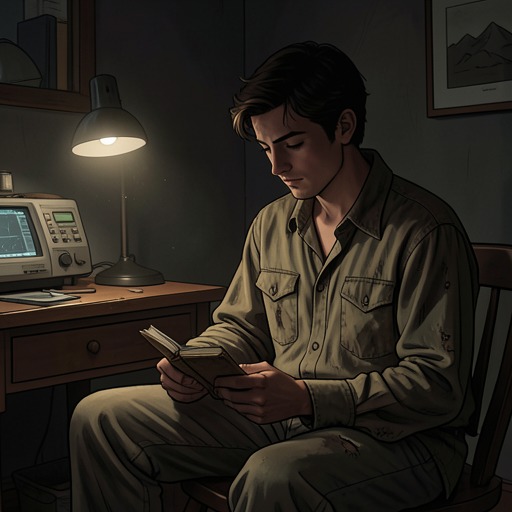
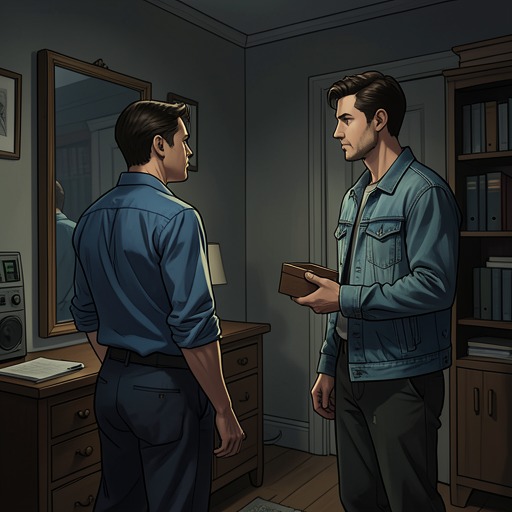
Colton’s trauma and recovery from abuse
TemptationColton’s trauma and recovery from abuse are central to his struggle to claim a life beyond the rejection and violence imposed on him for being gay. The damage begins in a home where he is treated as a burden, becomes extreme at Father Benson’s conversion camp, and continues after escape through nightmares, physical effects, and fear of abandonment. Recovery is neither a return to his family’s faith nor a simple erasure of the past: it develops through being heard, accepted, and allowed to make choices about his own future.
Identity and Background
Colton’s early distress is presented as the consequence of a home without dependable affection. He remembers his parents repeatedly making him and his siblings feel like burdens, and describes a household where love seemed unable to enter. He does not initially understand his experience through the category of abuse: he compares it against familiar public descriptions and concludes that he does not fit them. That distinction does not make his misery less real; instead, it shows how he struggles to name harm when it does not match the examples he has been taught to recognize.
His fear of marriage grows from watching his parents’ relationship. Terrified of becoming like his father, he tries to suppress sexual desire in the hope that he will never marry or repeat the pattern he sees at home. After his family discovers he is gay, Colton describes himself to Amit as Mormon but unsure whether his family or faith still want him. He says he tried to hide being different and that things became ugly after he was found out. His halting disclosure marks an early step toward telling the story in his own words, to a listener who invites him to continue rather than forcing him to explain.
Camp, Escape, and Lasting Effects
Colton’s parents send him to Father Benson’s conversion camp. After being left alone in his room, he is taken away in a van; he recalls the first three days as a period of isolation, uncertainty, and restricted food and basic needs. The camp frames gay identity as sin and presents its treatment as a chance at salvation. Colton’s experience there, however, is not spiritual care but sustained abuse: Father Benson describes him as a problem child while Colton is restrained and subjected to electrical punishment. He is kept in conditions that leave him cold, exhausted, and disoriented, and the camp’s repeated attempts to test or change his sexuality continue despite his distress.
The camp’s violence has physical consequences as well as psychological ones. When Colton is found after escaping, his injuries include marks from the camp’s methods; later, he explains to Marcel that he has nerve damage, with some areas unusually sensitive and others numb. The effects remain visible in scars on his body, but they are not only reminders of past injury: they shape what touch feels like and require those close to him to attend to his comfort and boundaries.
Colton eventually realizes that remaining at the camp may mean he will not survive. He runs across its chain-link fence in the middle of winter, without shoes, because escape seems less dangerous than staying. The decision is made without knowing what awaits outside. It is an act of self-preservation under conditions of abandonment, not a confident belief that safety is assured.
Recovery, Trust, and Disclosure
Escape does not end the trauma. Colton later experiences night terrors that leave him feeling trapped in memories of drowning, burning, and freezing. He also recalls punishments involving confinement and prolonged restraint. At Ted House, the possibility of a transfer frightens him because he expects another supposedly helpful setting to become restrictive or hostile. His suspicion has a history: Father Benson once appeared kind to him, so reassurance alone cannot immediately establish trust.
Therapeutic conversation gives Colton a setting in which disclosure can proceed at his pace. When Amit asks whether he wants to talk, Colton chooses to begin, acknowledging that his family reacted badly after learning he was gay. Years later, he tells Marcel more directly that his parents sent him to a camp run by Father Benson, that its purpose was to make him stop being gay, and that he ran because he feared he would be killed. Marcel responds by recognizing the kind of institution Colton means and does not demand further detail. When Colton says he does not know what happened to Father Benson and would rather move on, Marcel respects that limit rather than assigning him another task.
A later disclosure takes place in their shared bedroom, when Marcel notices Colton flinch and asks whether he has hurt him. Colton takes Marcel’s wrist and guides his hand back, explaining the nerve damage and its uneven effects before naming the camp’s use of electricity. The exchange makes an important contrast with the coercive treatment that caused the injury: Colton directs the contact and controls what he explains, while Marcel checks for harm and draws back when he thinks he may have caused it. The past is spoken about, but Colton is not made to surrender control of his body or his account.
Belonging, Faith, and Self-Definition
At Ted House, Colton’s sense of security remains complicated by the institution’s age limit. As his eighteenth birthday and high-school graduation approach, he fears that the place he has come to depend on will stop being home. Staff member Sage assures him he will not simply be abandoned with his belongings, but Colton still struggles to believe that family-like care can last when it is tied to a temporary placement. James helps him confront the coming transition by acknowledging his own religious wounds and telling Colton that faith need not require accepting the rejection of a child for being born as he is. He also makes clear that Colton’s caseworker must see that he can manage after leaving, connecting emotional reassurance to the practical demands of aging out.
The support around Colton allows vulnerability without making it his permanent identity. When he worries about the rescued dogs, Sage explains that Will has arranged food and support for them; the conversation also brings Colton’s own past into the open. He recognizes that he no longer has to conceal his fragility from the people around him, and that he can work toward becoming an adult without apologizing for who he is. He has lost his faith and family, but the narrative presents that loss alongside a developing sense of self and the possibility of chosen support.
The effects of trauma meet other constraints in Colton’s adult life. His financial-aid application for veterinary school is denied because his parents have not legally lost custody, so their income is counted despite his time in foster care. The decision compounds his economic insecurity rather than reflecting a lack of ambition or effort. When Marcel asks why the denial does not recognize Colton’s foster-care status and low-wage work, Colton explains the gap between his lived circumstances and the rules used to assess him. His plans therefore unfold under pressures created both by past abuse and by systems that do not readily account for his situation.
Continuing Change
Colton’s recovery is shown as gradual and relational, not as proof that the harm has disappeared. His fear of being unwanted recurs around institutional transitions, financial setbacks, and the age difference between himself and Marcel. At one point he describes himself as nervous, hyper, much younger, and only a café worker, revealing how readily he can turn those circumstances into reasons to expect rejection. Marcel answers by affirming that he wants Colton as he is, including the qualities Colton has just framed as liabilities. This reassurance does not undo the history behind his self-doubt; it offers a different response to it.
The central change is that Colton increasingly gets to decide what his experiences mean and when they are shared. He runs when staying at the camp seems fatal, chooses to tell Amit and Marcel what happened, sets limits on how much he wants to revisit, and accepts care without treating his vulnerability as something for which he must apologize. The scars, nightmares, and institutional obstacles remain part of his life, but they no longer define the only available future. His recovery lies in surviving, being believed, and building relationships in which his identity is accepted rather than treated as a problem to be corrected.