At the opening
The Speaking Log
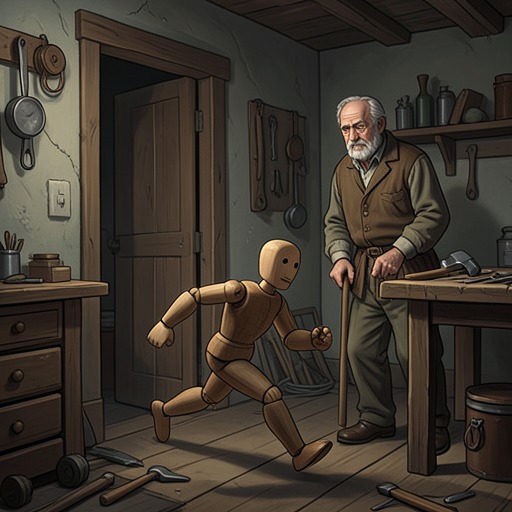
A common block of firewood arrives in [Mastro Antonio](entity:character-recall-character-mastro-antonio-97002507fcde)’s workshop. When he tries to shape it, a tiny voice begs him to be careful; the wood cries out again when he strikes and planes it.
The impossible voice unsettles Mastro Antonio and reveals that the log is no ordinary material. It will become the source of the story’s central child and its first test of patience.
Shortly afterward
Geppetto Claims the Wood
[Geppetto](entity:character-recall-character-geppetto-10785dca0792) visits [Mastro Antonio](entity:character-recall-character-mastro-antonio-97002507fcde) and explains that he wants wood for a remarkable Marionette who can dance, fence, and turn somersaults. The log calls Geppetto by his teasing nickname, provoking an argument and then a scuffle between the two old men.
After they reconcile, Mastro Antonio gives him the troublesome wood. It slips from his hands and knocks Geppetto’s legs, though neither craftsman admits responsibility.
That day
Pinocchio Takes Shape
At home, [Geppetto](entity:character-recall-character-geppetto-10785dca0792) carves the wood and names the Marionette [Pinocchio](entity:character-recall-character-pinocchio-0358f4ba4ca8). The puppet’s eyes move, his nose lengthens, and his mouth laughs at his maker; once his hands are finished, he snatches Geppetto’s wig.
When Geppetto completes his legs and teaches him to walk, Pinocchio immediately runs from the house. His lively independence arrives before any understanding of responsibility.
Immediately after Pinocchio’s first escape
Geppetto Is Arrested
A Carabineer catches [Pinocchio](entity:character-recall-character-pinocchio-0358f4ba4ca8) by his long nose and returns him to [Geppetto](entity:character-recall-character-geppetto-10785dca0792). The puppet refuses to go home, and bystanders accuse Geppetto of cruelty, though they have misunderstood the scene.
The officer releases Pinocchio and takes Geppetto to prison instead. Geppetto weeps that his attempt to make a well-behaved son has ended in punishment.
After Geppetto’s arrest
The Cricket’s Warning
Back at the house, [Pinocchio](entity:character-recall-character-pinocchio-0358f4ba4ca8) meets the [Talking Cricket](entity:character-recall-character-talking-cricket-32aabd93de8e), who urges him to obey his parents, attend school, and learn a trade. Pinocchio rejects work and study, insisting that he wants only to eat, sleep, play, and wander.
When the Cricket calls him foolish and warns that idleness leads to prison or a hospital, Pinocchio hurls a hammer at him. The Cricket dies, leaving Pinocchio alone with the consequences of his anger.
That evening
The Escaping Chick
[Pinocchio](entity:character-recall-character-pinocchio-0358f4ba4ca8)’s hunger drives him to a painted cooking pot, which offers no food at all. He searches the house and finds an egg, delighted at the prospect of a meal.
When he cracks it over the fire, a chick pops out, thanks him, and flies away. Pinocchio recognizes that the [Talking Cricket](entity:character-recall-character-talking-cricket-32aabd93de8e)’s warnings had been sound, but remorse does not feed him.
That night
Burned Wooden Feet
In a violent storm, [Pinocchio](entity:character-recall-character-pinocchio-0358f4ba4ca8) runs into the village asking for bread. A man at a window answers his plea by pouring cold water over him.
Exhausted and hungry, Pinocchio returns home and falls asleep with his feet against the stove. By morning they have burned to ashes, leaving him unable to stand when [Geppetto](entity:character-recall-character-geppetto-10785dca0792) knocks.
The following morning
Geppetto’s Pears
[Geppetto](entity:character-recall-character-geppetto-10785dca0792) climbs through a window and finds [Pinocchio](entity:character-recall-character-pinocchio-0358f4ba4ca8) lying on the floor without feet. Pinocchio recounts the night’s disasters in a confused rush, including the death of the Cricket and the chick’s escape.
Understanding that his son is hungry, Geppetto gives him the three pears he had saved for breakfast. Pinocchio insists on having them peeled, then eventually eats the skins and cores as well.
Later that day
A New Pair of Feet
[Pinocchio](entity:character-recall-character-pinocchio-0358f4ba4ca8) begs [Geppetto](entity:character-recall-character-geppetto-10785dca0792) to make him new feet and promises to go to school. Geppetto hesitates, suspecting that the promise is only meant to secure a favor, but his compassion finally overcomes his sternness.
He carves and attaches a pair of nimble wooden feet. Pinocchio celebrates by jumping about and renews his promise to become a good son and a useful man.
Before Pinocchio’s first school day
The Schoolbook Bought at a Cost
[Geppetto](entity:character-recall-character-geppetto-10785dca0792) makes [Pinocchio](entity:character-recall-character-pinocchio-0358f4ba4ca8) a suit from flowered paper, bark, and dough, but the boy also needs an [A-B-C book](entity:object-recall-object-a-b-c-book-ec85072c2470). Neither of them has money to buy one.
Geppetto sells his only coat for the book, returning home in the cold without it. Pinocchio understands the sacrifice and embraces and kisses his father.
On the way to school
The Book Sold for a Show
As [Pinocchio](entity:character-recall-character-pinocchio-0358f4ba4ca8) walks with his new book, music from a nearby theater distracts him. He tells himself he can go to school the next day and sells the [A-B-C book](entity:object-recall-object-a-b-c-book-ec85072c2470) to a ragpicker for the entrance fee.
The choice betrays [Geppetto](entity:character-recall-character-geppetto-10785dca0792)’s sacrifice before Pinocchio has even begun his lessons. With the money, he hurries into the [Great Marionette Theater](entity:location-recall-location-great-marionette-the-4939165dbf13).
At the theater performance
The Marionettes Welcome Pinocchio
Onstage, [Harlequin](entity:character-recall-character-harlequin-99d0b5ab0308) and Pulcinella recognize [Pinocchio](entity:character-recall-character-pinocchio-0358f4ba4ca8) in the audience and stop the performance. The other [Marionettes](entity:creature-recall-creature-marionettes-73c89721565e) rush out to greet their wooden brother, lifting him onto the stage amid embraces and celebration.
The audience grows angry at the interruption, but the commotion brings the theater’s terrifying Director, [Fire Eater](entity:character-recall-character-fire-eater-5e0ba6ee8ee2), into the open. Pinocchio’s joy has placed him in danger.
After the performance
Fire Eater Chooses His Fuel
[Fire Eater](entity:character-recall-character-fire-eater-5e0ba6ee8ee2) decides to burn [Pinocchio](entity:character-recall-character-pinocchio-0358f4ba4ca8) as firewood for his roast lamb. [Harlequin](entity:character-recall-character-harlequin-99d0b5ab0308) and Pulcinella bring the struggling puppet to the kitchen, while Pinocchio cries out for his father.
Though frightening in appearance, Fire Eater is moved by the Marionette’s fear and by the thought of [Geppetto](entity:character-recall-character-geppetto-10785dca0792) suffering. His compassion first appears in a series of sneezes that the puppets recognize as a sign of pity.
That night
Pinocchio Saves Harlequin
[Fire Eater](entity:character-recall-character-fire-eater-5e0ba6ee8ee2) decides to burn [Harlequin](entity:character-recall-character-harlequin-99d0b5ab0308) in [Pinocchio](entity:character-recall-character-pinocchio-0358f4ba4ca8)’s place so the lamb can finish cooking. Pinocchio pleads for his friend and, when Fire Eater refuses, offers himself instead.
The self-sacrifice moves Fire Eater to pardon both [Marionettes](entity:creature-recall-creature-marionettes-73c89721565e). The company celebrates its reprieve through the night, and Pinocchio’s brave choice earns him a reward.
The next day
Five Gold Pieces
[Fire Eater](entity:character-recall-character-fire-eater-5e0ba6ee8ee2) asks about [Geppetto](entity:character-recall-character-geppetto-10785dca0792) and learns that the old man sold his coat to buy [Pinocchio](entity:character-recall-character-pinocchio-0358f4ba4ca8) a schoolbook. Feeling sorry for Geppetto, he gives Pinocchio five gold pieces to take home.
Pinocchio sets out pleased with the money and determined to help his father. On the road, he meets a lame Fox and a supposedly blind Cat, who quickly become interested in his coins.
On the road home
The Fox and Cat’s Promise
[The Fox](entity:character-recall-character-the-fox-3d52978803c3) and the Cat tell [Pinocchio](entity:character-recall-character-pinocchio-0358f4ba4ca8) that they know [Geppetto](entity:character-recall-character-geppetto-10785dca0792) and mock the idea that he would spend money on school. They claim that study cost them a paw and their sight, then urge Pinocchio to multiply his coins instead.
A Blackbird warns Pinocchio not to trust them, but the Cat eats the bird. The Fox promises that buried gold will grow into a fortune in the [Field of Wonders](entity:location-recall-location-field-of-wonders-ea99b7930c3b), and Pinocchio agrees to go with them.
That evening
The Inn’s Unpaid Supper
The three travelers stop at the [Inn of the Red Lobster](entity:location-recall-location-inn-of-the-red-lobst-e3b07e529a2a), where the Fox and the Cat eat extravagantly while [Pinocchio](entity:character-recall-character-pinocchio-0358f4ba4ca8) barely touches his food. The innkeeper agrees to wake them at midnight.
When Pinocchio wakes, he learns that his companions have already left and left him the bill. He pays with one gold piece and continues alone toward the promised field.
Near midnight
The Cricket’s Ghost
On the dark road, [Pinocchio](entity:character-recall-character-pinocchio-0358f4ba4ca8) sees a faintly glowing insect and recognizes the ghost of the [Talking Cricket](entity:character-recall-character-talking-cricket-32aabd93de8e). The Cricket urges him to return home and give his remaining coins to his grieving father.
Pinocchio insists that the coins will soon become a fortune. The Cricket warns him of swindlers and danger, but Pinocchio continues into the night despite the advice he has already learned to regret.
That night
The Assassins’ Pursuit
Two black-clad Assassins attack [Pinocchio](entity:character-recall-character-pinocchio-0358f4ba4ca8) and demand his money. He hides the coins beneath his tongue, and when one tries to force his mouth open, Pinocchio bites off what turns out to be a cat’s paw.
He escapes across the fields, climbs a pine tree, and flees again when his pursuers set the tree alight. A muddy pool briefly slows the Assassins, but they keep chasing him.
Toward dawn
Hanging at the Giant Oak
[Pinocchio](entity:character-recall-character-pinocchio-0358f4ba4ca8) reaches a white cottage and begs the girl at its window to let him in. She tells him that no one lives there and that she, too, is dead; before he can get help, the Assassins seize him.
Unable to pry the coins from his mouth, they hang him from the [Giant Oak Tree](entity:location-recall-location-giant-oak-tree-d0fcac66876c) and leave him there. As the noose tightens, Pinocchio thinks of [Geppetto](entity:character-recall-character-geppetto-10785dca0792) and calls for his father before losing consciousness.
After Pinocchio has hung for several hours
The Fairy’s Rescue
The girl at the cottage, who is in fact the Fairy, takes pity on [Pinocchio](entity:character-recall-character-pinocchio-0358f4ba4ca8) and sends a Falcon to cut him down. Her Poodle, Medoro, carries the nearly lifeless puppet to her home.
The Fairy calls in a Crow, an Owl, and the [Talking Cricket](entity:character-recall-character-talking-cricket-32aabd93de8e) to decide whether Pinocchio is alive. Their absurd medical pronouncements give way when Pinocchio begins crying, which they take as a sign of life.
During Pinocchio’s recovery
The Bitter Medicine
The Fairy offers [Pinocchio](entity:character-recall-character-pinocchio-0358f4ba4ca8) bitter medicine, but he refuses it despite her patience and promises of sugar. He changes his mind only when four black Rabbits arrive carrying a coffin and tell him that he will soon die without treatment.
Pinocchio drinks the medicine and quickly recovers. His fear of death has finally made him accept a remedy he had rejected for childish reasons.
Soon after he recovers
Lies Lengthen Pinocchio’s Nose
Asked what happened to the gold pieces, [Pinocchio](entity:character-recall-character-pinocchio-0358f4ba4ca8) lies that he lost them, then gives another false account of where they went. Each lie makes his already long nose grow.
When he claims that he swallowed the coins with the medicine, his nose becomes so large that he cannot turn around or get through the door. The Fairy explains that lies may have short legs or long noses, making his dishonesty physically impossible to hide.
After the nose is shortened
A Promise to the Fairy
The Fairy summons a thousand woodpeckers, which peck [Pinocchio](entity:character-recall-character-pinocchio-0358f4ba4ca8)’s nose back to its usual size. She offers to keep him as her little brother, and Pinocchio says he wants to stay with her but still hopes to find [Geppetto](entity:character-recall-character-geppetto-10785dca0792).
The Fairy tells him that Geppetto has been sent for. Pinocchio asks to go and meet his father, but first promises to return home and not lose his way.
Later that day
The Gold Pieces Are Buried
On his way to meet [Geppetto](entity:character-recall-character-geppetto-10785dca0792), [Pinocchio](entity:character-recall-character-pinocchio-0358f4ba4ca8) encounters the Fox and the Cat again. They invent a story to explain the Cat’s injured paw and persuade Pinocchio that the [Field of Wonders](entity:location-recall-location-field-of-wonders-ea99b7930c3b) will soon close to visitors.
Though he remembers the Fairy, his father, and the Cricket’s warnings, Pinocchio agrees to bury his four remaining coins. He waters the spot as instructed and leaves, expecting a fortune to grow overnight.
Twenty minutes later
The Field’s Empty Promise
[Pinocchio](entity:character-recall-character-pinocchio-0358f4ba4ca8) returns to the field expecting a tree laden with gold, but finds no coins. A Parrot explains that the Fox and the Cat have stolen them while Pinocchio was away.
Pinocchio digs up the earth and confirms that the money is gone. The discovery exposes the fraud but does not yet bring him justice or his savings back.
That day
Prison for the Robbed
[Pinocchio](entity:character-recall-character-pinocchio-0358f4ba4ca8) reports the theft to the magistrate in the [City of Simple Simons](entity:location-recall-location-city-of-simple-simon-7a7974fc059e), giving the robbers’ descriptions and asking for justice. The Judge listens sympathetically, then orders that the robbed Marionette be imprisoned.
Pinocchio spends four months in jail. He is freed only when a victory celebration opens the prison doors, and he tells the jailer that he, too, is a thief so that he will not be left behind.
After four months in prison
The Smoking-Tailed Serpent
Freed from jail, [Pinocchio](entity:character-recall-character-pinocchio-0358f4ba4ca8) hurries toward the Fairy’s home, reflecting that his stubbornness has brought him trouble. An enormous green Serpent blocks the road, its eyes glowing and its tail smoking.
The Serpent remains still until Pinocchio tries to step over it, then springs up and sends him tumbling headfirst into the mud. The Serpent laughs so hard at the sight that it bursts an artery and dies.
On the road after the Serpent
Caught in the Farmer’s Trap
Hungry and tempted by grapes, [Pinocchio](entity:character-recall-character-pinocchio-0358f4ba4ca8) enters a field and is caught in a trap set for [Weasels](entity:creature-recall-creature-weasels-e57896d5d913). A Glowworm questions him about taking what belongs to someone else, and Pinocchio admits that hunger does not excuse stealing.
The Farmer arrives, mistakes him for a chicken thief, and takes him home. Since his watchdog has died, the Farmer chains Pinocchio beside the henhouse to guard it through the night.
That night
Pinocchio Guards the Henhouse
Four [Weasels](entity:creature-recall-creature-weasels-e57896d5d913) visit [Pinocchio](entity:character-recall-character-pinocchio-0358f4ba4ca8) and offer him a chicken if he will let them rob the coop without barking. They reveal that the dead watchdog Melampo had accepted the same bargain.
Pinocchio tricks the Weasels inside, blocks the coop door, and raises the alarm. The Farmer catches them and frees Pinocchio, who refuses to accuse the dead dog and instead explains that he could not be bribed.
After Pinocchio is freed
The Fairy’s Supposed Death
[Pinocchio](entity:character-recall-character-pinocchio-0358f4ba4ca8) runs to the Fairy’s house but finds no house at the place where it stood. A marble slab says that the Fairy died of grief after Pinocchio abandoned her.
He kisses the stone and weeps through the night, blaming himself and asking where [Geppetto](entity:character-recall-character-geppetto-10785dca0792) is. His grief marks a new depth of feeling for the people who have cared for him.
The following morning
The Pigeon’s News
A large Pigeon finds [Pinocchio](entity:character-recall-character-pinocchio-0358f4ba4ca8) mourning and asks whether he knows [Geppetto](entity:character-recall-character-geppetto-10785dca0792). The Marionette identifies himself and learns that his father has spent months searching for him.
The Pigeon says Geppetto is building a little boat to cross the ocean in search of his son. Pinocchio begs to be taken to the shore, and the bird carries him on its back.
The next morning at the seashore
The Boat Disappears
After a night’s flight, the Pigeon brings [Pinocchio](entity:character-recall-character-pinocchio-0358f4ba4ca8) to a shore crowded with people watching a tiny boat in a dangerous sea. Pinocchio recognizes [Geppetto](entity:character-recall-character-geppetto-10785dca0792) aboard it and waves to him; Geppetto waves back but cannot row against the waves.
A great wave swallows the boat. Pinocchio throws himself into the sea to save his father, swimming away from the shore until he vanishes from sight.
After swimming through the night
Landfall on Busy Bee Island
[Pinocchio](entity:character-recall-character-pinocchio-0358f4ba4ca8) swims through a storm and is eventually cast onto an island. A polite Dolphin tells him that [Geppetto](entity:character-recall-character-geppetto-10785dca0792)’s boat was likely swallowed by the Terrible [Shark](entity:character-recall-character-shark-c5f3f4446d1c), a monster said to be enormous.
The news frightens Pinocchio, but he follows the path toward the settlement. He has no proof that his father is lost, and hope keeps him moving.
That day on the island
Hunger and Honest Work
In the Land of the Busy Bees, everyone is working. [Pinocchio](entity:character-recall-character-pinocchio-0358f4ba4ca8) asks a coal man and a bricklayer for money but refuses their offers of work, preferring hunger to labor.
After begging unsuccessfully from several people, he asks a woman for water. She offers food in exchange for help carrying her jugs, and Pinocchio finally agrees to work for his meal.
After Pinocchio carries the water
The Fairy Reveals Herself
The woman feeds [Pinocchio](entity:character-recall-character-pinocchio-0358f4ba4ca8) bread, cauliflower, and cake. As he eats, he recognizes her azure hair, eyes, and voice and realizes that she is the Fairy he believed dead.
The Fairy confirms her identity and tells him that she is now old enough to be his mother. Pinocchio rejoices at having found her again and asks to call her Mother.
After the reunion
A Pledge to Change
[Pinocchio](entity:character-recall-character-pinocchio-0358f4ba4ca8) tells the Fairy that he is tired of being a Marionette and wants to become a real boy. She says that he must deserve the change by being obedient, truthful, industrious, and willing to study.
He admits that he has been lazy and disobedient, then promises to attend school, work, and obey her. His wish now depends on sustained conduct rather than another easy promise.
The following morning
Pinocchio Enters School
[Pinocchio](entity:character-recall-character-pinocchio-0358f4ba4ca8) goes to school, where the other boys mock his wooden body and try to make him dance. He responds sharply when they torment him, and his hard feet and elbows earn him their admiration.
As the weeks pass, he becomes attentive and diligent, pleasing his teacher and the Fairy. His main weakness is his friendship with troublesome classmates who dislike study.
After several weeks at school
The False Shark Excursion
[Pinocchio](entity:character-recall-character-pinocchio-0358f4ba4ca8)’s classmates tell him that a [Shark](entity:character-recall-character-shark-c5f3f4446d1c) has appeared near the shore and invite him to see it. He initially refuses because he must go to school, but the boys insist that school can wait.
Pinocchio agrees to go after lessons; his companions mock the idea of waiting and race toward the beach. He joins them, abandoning his promise to the Fairy and his newly formed habits of study.
That afternoon
The Fight at the Seashore
At the shore, [Pinocchio](entity:character-recall-character-pinocchio-0358f4ba4ca8) discovers that there is no [Shark](entity:character-recall-character-shark-c5f3f4446d1c) and that the boys tricked him into missing school. They taunt him for studying, and the argument turns into a fight between Pinocchio and the group.
The boys throw books at him, and one of the books strikes Eugene, leaving him unconscious. Pinocchio rushes to help his classmate and insists that he did not throw the book that hit him.
Immediately after the fight
Pinocchio Is Arrested
Carabineers find [Pinocchio](entity:character-recall-character-pinocchio-0358f4ba4ca8) beside the injured Eugene and see his own arithmetic book near the boy. They arrest him despite his protests that he is innocent, while fishermen are asked to carry Eugene home.
As the officers escort him through the village, Pinocchio asks to retrieve his cap and uses the chance to flee toward the sea. The police send the Mastiff [Alidoro](entity:character-recall-character-alidoro-6cfce8e14c45) after him.
During the pursuit
Pinocchio Saves Alidoro
[Alidoro](entity:character-recall-character-alidoro-6cfce8e14c45) nearly catches [Pinocchio](entity:character-recall-character-pinocchio-0358f4ba4ca8), but both reach the water and fall in. The Mastiff cannot swim and cries for help as he begins to drown.
Remembering that a kind deed is never lost, Pinocchio turns back and drags Alidoro to shore. He swims away again, but the rescue creates a debt that will later be repaid.
Shortly afterward
The Green Fisherman’s Net
Seeking a place to dry his clothes, [Pinocchio](entity:character-recall-character-pinocchio-0358f4ba4ca8) approaches a smoky cave near the shore. A net lifts him from the water along with a catch of fish, and the Green Fisherman mistakes the puppet for an unfamiliar kind of fish.
Pinocchio explains that he is a Marionette, but the Fisherman decides to fry him anyway. He ties Pinocchio up, coats him in flour, and prepares to put him in the hot oil.
At the Green Fisherman’s cave
Alidoro Repays the Rescue
As [Pinocchio](entity:character-recall-character-pinocchio-0358f4ba4ca8) is about to be fried, [Alidoro](entity:character-recall-character-alidoro-6cfce8e14c45) runs into the cave, drawn by the smell of fish. Pinocchio calls to the dog, who recognizes his voice and snatches him from the Fisherman.
Alidoro carries Pinocchio to safety and reminds him that he is returning a kindness. Their earlier rescue has now saved Pinocchio from being cooked alive.
That rainy night
The Snail’s Slow Arrival
[Pinocchio](entity:character-recall-character-pinocchio-0358f4ba4ca8) reaches the Fairy’s house in the rain, but the [Snail](entity:character-recall-character-snail-9e24415d9d1b) takes hours to descend and open the door. Pinocchio’s attempt to kick the door leaves his leg stuck fast in it.
The Snail eventually brings him a meal made of chalk, cardboard, and alabaster. Pinocchio faints from hunger and exhaustion; when he wakes, the Fairy has forgiven him and taken him in.
The remainder of the school year
A Year of Study
[Pinocchio](entity:character-recall-character-pinocchio-0358f4ba4ca8) promises again to study and behave, and this time he keeps his word. He works steadily through the year and finishes first in his examinations.
The Fairy tells him that his wish will come true the next day: he will cease to be a Marionette and become a real boy. Pinocchio is delighted and imagines a celebration with his friends.
The day before Pinocchio expects to become a boy
Lamp-Wick’s Invitation
The Fairy allows [Pinocchio](entity:character-recall-character-pinocchio-0358f4ba4ca8) to invite his friends to a celebration, but warns him to come home before dark. Pinocchio goes looking for his favorite companion, [Lamp-Wick](entity:character-recall-character-lamp-wick-eec3b51571af), and finds him preparing to leave at midnight.
Lamp-Wick describes the [Land of Toys](entity:location-recall-location-land-of-toys-11aa7d96ac3a) as a place without schools, teachers, or books. Pinocchio resists at first, but the vision of endless play begins to weaken his resolve.
That night
Departure for the Land of Toys
[Pinocchio](entity:character-recall-character-pinocchio-0358f4ba4ca8) says goodbye to [Lamp-Wick](entity:character-recall-character-lamp-wick-eec3b51571af), but keeps asking about the [Land of Toys](entity:location-recall-location-land-of-toys-11aa7d96ac3a) and its freedom from study. When the wagon arrives, Lamp-Wick climbs aboard, and Pinocchio finally gives up his intention to return to the Fairy.
[The Little Man](entity:character-recall-character-the-little-man-0686bb9294f7) offers him a place and even lets him ride as the coachman. A donkey kicks Pinocchio before he mounts it, while the Little Man’s kindly manner hides his exploitative purpose.
During the wagon journey
The Donkey’s Warning
As the wagon travels toward the [Land of Toys](entity:location-recall-location-land-of-toys-11aa7d96ac3a), [Pinocchio](entity:character-recall-character-pinocchio-0358f4ba4ca8) hears a faint warning that boys who abandon books and teachers will come to grief. He discovers that the voice comes from the donkey he is riding.
The donkey is weeping like a boy, but the Little Man dismisses the strange sight and urges the journey onward. Pinocchio reaches the Land of Toys with the other runaways.
The next five months
Five Months of Play
The [Land of Toys](entity:location-recall-location-land-of-toys-11aa7d96ac3a) is populated by boys who spend their days playing, shouting, and staging games. [Pinocchio](entity:character-recall-character-pinocchio-0358f4ba4ca8) and [Lamp-Wick](entity:character-recall-character-lamp-wick-eec3b51571af) enjoy themselves and congratulate each other on escaping school.
For five months Pinocchio sees no books, desks, or teachers. Their pleasure seems complete, but the neglected education and work they rejected are about to exact a physical price.
After five months in the Land of Toys
Donkey Ears Appear
One morning [Pinocchio](entity:character-recall-character-pinocchio-0358f4ba4ca8) discovers that his ears have grown long and hairy like a donkey’s. A Dormouse tells him that he has the donkey fever and will soon become a real donkey because he chose play over study.
Pinocchio blames [Lamp-Wick](entity:character-recall-character-lamp-wick-eec3b51571af), but also admits that he followed the advice because he was heedless. He covers his ears with a bag and goes to confront his friend.
That same morning
The Boys Become Donkeys
[Pinocchio](entity:character-recall-character-pinocchio-0358f4ba4ca8) finds [Lamp-Wick](entity:character-recall-character-lamp-wick-eec3b51571af) wearing a bag over his own head, and both boys pretend that nothing is wrong. When they finally remove their coverings, they see each other’s donkey ears and laugh.
Their laughter abruptly turns to panic as their arms and faces change, their bodies grow gray hair, and tails appear. They can only bray as the Little Man arrives to claim his transformed boys.
After the transformation
Sold to the Circus
[The Little Man](entity:character-recall-character-the-little-man-0686bb9294f7) grooms [Pinocchio](entity:character-recall-character-pinocchio-0358f4ba4ca8) and [Lamp-Wick](entity:character-recall-character-lamp-wick-eec3b51571af) and takes them to market. Lamp-Wick is sold to a farmer, while Pinocchio is bought by a circus owner who hopes to train him for performances.
Pinocchio’s new master gives him straw and hay and punishes him when he refuses the unfamiliar food. Hunger forces him to eat, and he regrets the schooling and work he had rejected.
During the months after his sale
Training the Donkey
The circus owner forces [Pinocchio](entity:character-recall-character-pinocchio-0358f4ba4ca8) to learn jumps, bows, dances, and other tricks. Training takes three months and brings repeated beatings before the owner considers him ready.
Pinocchio reflects that a different life might have brought him bread and butter instead of hay. His labor is now imposed on him, a sharp contrast with the work he once refused.
At his first public circus performance
Pinocchio Sees the Fairy
At a crowded performance, [Pinocchio](entity:character-recall-character-pinocchio-0358f4ba4ca8) appears dressed for the ring and carries out the circus owner’s commands. In a box he recognizes the Fairy by her portrait medallion and tries to call to her.
His only response is a donkey’s bray, which makes the audience laugh. Pinocchio’s grief grows when the Fairy disappears, and he fails to perform a jump cleanly, injuring his leg.
The morning after the injury
Sold for a Drumhead
A veterinary declares that [Pinocchio](entity:character-recall-character-pinocchio-0358f4ba4ca8) will remain lame. The circus owner sells him at the market, where a buyer pays only a few cents because he wants the donkey’s hide for a drumhead.
The buyer ties a stone to Pinocchio and throws him into the sea. He waits above the water for the donkey to drown so he can take the skin.
After fifty minutes underwater
Pinocchio Returns to Wood
When the buyer pulls up the rope, he finds a living wooden Marionette instead of a dead donkey. [Pinocchio](entity:character-recall-character-pinocchio-0358f4ba4ca8) explains that fish ate the donkey’s coat but could not digest the wood underneath.
The buyer still demands his money and threatens to sell Pinocchio as firewood. Pinocchio dives back into the sea and swims away, once more himself but far from safety.
Later in the same swim
The Shark Attacks
Far out at sea, [Pinocchio](entity:character-recall-character-pinocchio-0358f4ba4ca8) sees a blue-coated Goat on a white rock, calling him toward safety. Before he can reach her, a monstrous [Shark](entity:character-recall-character-shark-c5f3f4446d1c) rises from the water and bears down on him.
The Goat urges Pinocchio to hurry, but the Shark overtakes him and swallows him in a single gulp. The Fairy’s apparent warning and rescue cannot keep him from the monster’s body.
Inside the Shark
The Tunny in the Darkness
[Pinocchio](entity:character-recall-character-pinocchio-0358f4ba4ca8) wakes in darkness inside the [Shark](entity:character-recall-character-shark-c5f3f4446d1c) and meets a [Tunny](entity:character-recall-character-tunny-0d1ac7490425) that was swallowed at the same time. The fish expects them to be digested, while Pinocchio searches for a way out.
In the distance, Pinocchio notices a faint light. He leaves the Tunny behind and follows it, hoping that someone there may know how to escape.
Inside the Shark, after Pinocchio follows the light
Reunion with Geppetto
The light leads [Pinocchio](entity:character-recall-character-pinocchio-0358f4ba4ca8) to a candlelit table and an old man eating live fish. Pinocchio recognizes [Geppetto](entity:character-recall-character-geppetto-10785dca0792) and embraces him; Geppetto, who has been trapped inside the [Shark](entity:character-recall-character-shark-c5f3f4446d1c) for two years, is overjoyed to find his son.
They recount how each was swallowed: Geppetto’s boat was overturned in the sea, while Pinocchio was swallowed after the fish ate his donkey hide. Their reunion restores the story’s central bond after a long separation.
That night inside the Shark
The Failed Escape
Giapetto explained that a large ship swallowed by him provided him with food, candles, and matches, but these supplies were nearly exhausted. [Pinocchio](entity:character-recall-character-pinocchio-0358f4ba4ca8) proposed to escape from the monster's mouth and promised to carry his father. While the big shark was asleep, they crawled toward its mouth, but
A little later that night
Escape from the Shark
[Pinocchio](entity:character-recall-character-pinocchio-0358f4ba4ca8) again crawled toward the mouth of the great shark that had swallowed him. This time, he carried his father on his shoulders, crossed over the monster's tongue, and dove into the calm sea when it was asleep
Before dawn
The Tunny’s Rescue
[Pinocchio](entity:character-recall-character-pinocchio-0358f4ba4ca8) gradually lost strength while swimming with [Geppetto](entity:character-recall-character-geppetto-10785dca0792) and called for help. The tuna also followed Pinocchio's example and escaped. Hearing their calls, the tuna offered to take them to shore. The father and son climbed onto the back of the tuna and safely reached land. Pinoc
At dawn on the shore
Pinocchio Rejects the Swindlers
[Pinocchio](entity:character-recall-character-pinocchio-0358f4ba4ca8) and [Geppetto](entity:character-recall-character-geppetto-10785dca0792) met a poor fox and a cat. The cat was indeed blind, and the fox had sold his tail; they asked Pinocchio for alms. Pinocchio remembered their previous scam and refused to help them. He recalled a few proverbs about unjust wealth
That morning
Shelter with the Cricket
A small thatched hut provided shelter for [Pinocchio](entity:character-recall-character-pinocchio-0358f4ba4ca8) and [Geppetto](entity:character-recall-character-geppetto-10785dca0792), who found the owner to be a talking cricket. The cricket reminded Pinocchio that he had once thrown a hammer at himself, but offered to help the father and son. The cricket explained that if one is to receive
That morning
Work for Geppetto’s Milk
At john farmer's farm, pinocchio had no copper coins, could not afford milk. john farmer offered that as long as pinocchio carried one hundred buckets of water, he would give him a cup of milk; although the work was tiring, pinocchio agreed. he found that
Over the next five months
Five Months of Honest Work
for the next five months, pinocchio got up before dawn to fetch water for john the farmer, and the milk he earned helped jepetto recover gradually. he also learned to make reed baskets and sold them to support the family. every night, he studied by the light, teaching himself
After five months of work
The Fairy Needs Help
After saving fifty copper coins, [Pinocchio](entity:character-recall-character-pinocchio-0358f4ba4ca8) intended to buy a new set of clothes. On the way, he met a snail. The snail said that the blue-haired fairy was sick in the hospital and had no money to buy food. Pinocchio gave all his savings to the sn
That night
The Fairy’s Forgiveness
[Pinocchio](entity:character-recall-character-pinocchio-0358f4ba4ca8) worked late, making twice as many baskets as usual. Afterwards, he dreamed that the blue-haired fairy forgave him. She praised him for taking care of his parents, even though he was not always obedient and did not always behave well
The following morning
A Real Boy at Last
[Pinocchio](entity:character-recall-character-pinocchio-0358f4ba4ca8) awoke in a beautifully furnished room and found himself transformed into a real boy. A new set of clothes, a hat, and a pair of shoes were waiting for him, along with a purse containing fifty gold coins, which the blue-haired fairy had returned to him