from youth
Musashi’s Early Calling
[Miyamoto Musashi](entity:character-recall-character-miyamoto-musashi-a7dc0631948a) says that from an early age his heart was inclined toward the Way of Strategy. He presents that calling as the beginning of a life spent testing what victory means, rather than merely collecting techniques.
His account frames strategy as a discipline for both warriors and commanders, rooted in overcoming opponents but extending beyond swordsmanship into judgment, conduct, and the ordering of life.
age thirteen
The First Duel
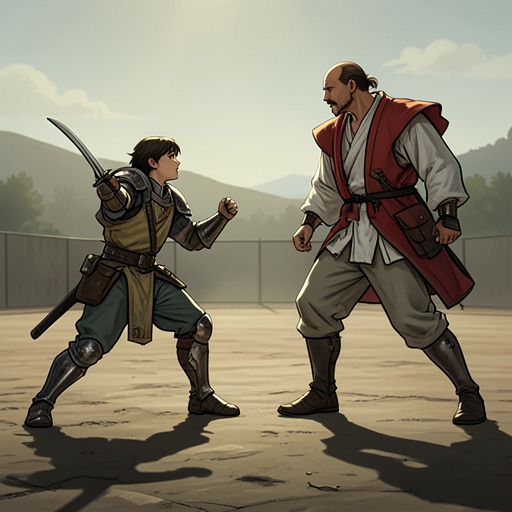
At thirteen, [Miyamoto Musashi](entity:character-recall-character-miyamoto-musashi-a7dc0631948a) fought and struck down Arima Kihei, a strategist of the Shinto school. The encounter was his first duel and an early proof of his willingness to stake his life on combat.
He later counted the victory as part of a long record of contests, while also cautioning that youthful success did not necessarily mean he had understood the true principle of strategy.
age sixteen
The Second Duel
At sixteen, [Miyamoto Musashi](entity:character-recall-character-miyamoto-musashi-a7dc0631948a) defeated Tadashima Akiyama, whom he describes as an able strategist. The victory strengthened the course he had chosen and preceded his departure to test himself more widely.
In retrospect, Musashi did not treat these early wins as final proof of mastery. He later questioned whether natural ability, heaven, or the weakness of rival schools had accounted for them.
age twenty-one
The Capital Contests
At twenty-one, [Miyamoto Musashi](entity:character-recall-character-miyamoto-musashi-a7dc0631948a) went to the capital and met strategists of many kinds. He says he never failed to win in the contests he entered there.
The encounters widened his experience beyond the earlier duels and began a period of testing himself against practitioners from different traditions.
between ages twenty-one and twenty-eight or twenty-nine
Years of Wandering Duels
After leaving the capital, [Miyamoto Musashi](entity:character-recall-character-miyamoto-musashi-a7dc0631948a) traveled from province to province, dueling strategists of various schools. He records as many as sixty encounters during this period and says he did not lose one.
The victories made his reputation, but they did not settle his understanding. Looking back at around thirty, he recognized that winning alone could not establish whether he had mastered the Way.
around age thirty
Doubt at Thirty
At about thirty, [Miyamoto Musashi](entity:character-recall-character-miyamoto-musashi-a7dc0631948a) reconsidered the victories of his youth. He could not be sure that they came from a true grasp of strategy, and considered other explanations: natural ability, the order of heaven, or the inferiority of his opponents’ schools.
This doubt turned achievement into a question. Rather than resting on his record, he began a deeper search for the principle behind victory.
from around age thirty to fifty
The Long Study
[Miyamoto Musashi](entity:character-recall-character-miyamoto-musashi-a7dc0631948a) studied morning and evening, searching for the principle of strategy. He describes the inquiry as a sustained discipline, not a sudden revelation or a doctrine received from a single teacher.
He says he realized the Way of Strategy at fifty. From then on, he lived without following any one particular Way, practicing many arts and abilities through the understanding he had cultivated.
during Musashi’s mature teaching
The Twofold Way
[Miyamoto Musashi](entity:character-recall-character-miyamoto-musashi-a7dc0631948a) presents the warrior’s path as the Twofold Way of Pen and Sword. A warrior should cultivate both, while recognizing that strategy itself rests on accepting the possibility of death and learning how to overcome opponents.
He distinguishes this disciplined purpose from mere readiness to die for duty or shame. In his account, strategy joins combat effectiveness to judgment and the ability to command on a wider scale.
during the Ground Book’s instruction
The Carpenter’s Analogy
To explain strategy, [Miyamoto Musashi](entity:character-recall-character-miyamoto-musashi-a7dc0631948a) compares it with carpentry. A commander resembles a master carpenter who understands plans, materials, the rules of a house, and the abilities of the workers entrusted to him.
The analogy makes strategy a practical craft of assessing people and assigning work well. Just as sound construction depends on choosing suitable timber and coordinating skilled labor, command depends on knowing subordinates and using their strengths without unreasonable demands.
during the composition of the treatise
The Five Books
[Miyamoto Musashi](entity:character-recall-character-miyamoto-musashi-a7dc0631948a) organizes his teaching into five books: Ground, Water, Fire, Wind, and Void. Each presents a different aspect of strategy, from its foundations and methods to combat, rival traditions, and the nature of understanding.
The structure is meant to lead the reader from broad principles toward practical application and a clearer perception of the Way. Musashi warns that the writing must be studied and absorbed, not merely memorized or imitated.
during the Ground Book’s teaching
One Thing and Ten Thousand
[Miyamoto Musashi](entity:character-recall-character-miyamoto-musashi-a7dc0631948a) argues that mastering one principle should open the way to understanding countless others. He compares the strategist’s ability to enlarge small insights with the work of building a great image from a small model.
This idea links individual combat to large-scale command: the same underlying principle can be applied across different weapons, opponents, and circumstances. The book’s examples are therefore invitations to generalize rather than isolated tricks.
during the Ground Book’s discussion of weapons
The Two-Sword Method
[Miyamoto Musashi](entity:character-recall-character-miyamoto-musashi-a7dc0631948a) explains why warriors carry both the [Long sword](entity:object-recall-object-long-sword-562f71e081a9) and the [Companion sword](entity:object-recall-object-companion-sword-6955c638cf9c) and argues that each should be trained in either hand. He rejects the idea that a sword must always be held in both hands, since circumstances such as running, uneven ground, or carrying another weapon can make that grip impractical.
The method is not an end in itself: the point is to use whatever weapon is available to win. Musashi says the swords have different roles, with the Long sword suited to broader action and the Companion sword to close or confined fighting.
during the Ground Book’s survey of arms
The Uses of Weapons
[Miyamoto Musashi](entity:character-recall-character-miyamoto-musashi-a7dc0631948a) compares the uses of the [Spear](entity:object-recall-object-spear-043ed1b90e4b), [Halberd](entity:object-recall-object-halberd-4174d055bf70), [Bow](entity:object-recall-object-bow-cbaedc294189), and [Gun](entity:object-recall-object-gun-7ea6699b63ea) with those of the swords. He assigns each a context: the Bow can be valuable at the beginning of a field battle, the Gun before ranks meet, and the Spear or Halberd in open ground, while several are poor choices in confined spaces.
He rejects decorative preference and warns against becoming over-attached to one weapon. Sound judgment means knowing what an instrument can do, choosing according to the situation, and avoiding the narrowness that follows from liking or disliking a particular arm.
at the close of the Ground Book
The Nine Principles
[Miyamoto Musashi](entity:character-recall-character-miyamoto-musashi-a7dc0631948a) sets out nine principles for those who want to learn his strategy: honesty, training, acquaintance with the arts and professions, discrimination between gain and loss, intuitive judgment, perception of what cannot be seen, attention to trifles, and avoidance of useless acts.
He presents these as a foundation to be held in the heart and practiced persistently. Their purpose is not merely to win a duel but to broaden a student’s spirit until strategy can serve both personal mastery and the work of command.
after the Ground Book
The Water Book’s Discipline
In the Water Book, [Miyamoto Musashi](entity:character-recall-character-miyamoto-musashi-a7dc0631948a) shifts from broad foundations to the embodied practice of sword strategy. He insists that reading alone cannot produce understanding; the student must absorb the principles through sustained training until they shape the body.
Water supplies the book’s governing image because it changes form to suit its vessel while retaining its nature. Musashi uses that quality to describe a strategist who adapts without losing the central purpose of victory.
during the Water Book’s instruction
A Settled Bearing
[Miyamoto Musashi](entity:character-recall-character-miyamoto-musashi-a7dc0631948a) teaches that a warrior’s bearing in combat should not differ from his bearing in ordinary life. He calls for a spirit that is calm but determined, neither tense nor reckless, and warns against allowing the body and spirit to weaken or dominate one another.
The instruction makes composure a practiced condition rather than a pose reserved for battle. A warrior must meet changing circumstances without displaying an unsettled spirit for the enemy to exploit.
during the Water Book’s instruction
Perception and Sight
[Miyamoto Musashi](entity:character-recall-character-miyamoto-musashi-a7dc0631948a) distinguishes Perception from Sight. The strategist’s gaze should be broad: it must register the enemy’s whole condition without becoming trapped by the movement of a blade or other insignificant detail.
He calls for seeing distant things as though they were close and taking a distanced view of what is near. The same discipline applies in single combat and in the command of large forces, where a narrow gaze can obscure the decisive change.
during the Water Book’s instruction
The Living Grip
[Miyamoto Musashi](entity:character-recall-character-miyamoto-musashi-a7dc0631948a) describes a grip on the [Long sword](entity:object-recall-object-long-sword-562f71e081a9) that is firm without becoming fixed. The hands should carry intent to cut, but they must remain responsive when the sword is used to deflect, strike, or control an opponent’s blade.
He calls fixedness a dead hand and pliability a living one. The distinction reflects a broader warning against treating a particular hold or stance as an unchanging formula.
during the Water Book’s instruction
Walking Footwork
[Miyamoto Musashi](entity:character-recall-character-miyamoto-musashi-a7dc0631948a) rejects jumping, floating, and fixed-step forms of movement, urging the student to move as in ordinary walking. He also describes Yin-Yang footwork: the feet should alternate rather than allowing one to become the habitual leading foot.
The principle keeps movement adaptable and grounded across cutting, retreating, and warding. For Musashi, the body should not be hurried into an artificial rhythm that an opponent can read or that difficult terrain can disrupt.
during the Water Book’s instruction
The Five Attitudes
[Miyamoto Musashi](entity:character-recall-character-miyamoto-musashi-a7dc0631948a) identifies five sword attitudes: Upper, Middle, Lower, Right Side, and Left Side. Their differences serve a single purpose—cutting the enemy—and should be chosen according to the circumstances rather than treated as ends in themselves.
He gives the Middle attitude a central place, comparing it to the commander’s seat in a battle array. The other attitudes remain available as the situation demands, especially when an obstruction makes a direct position unsuitable.
during the Water Book’s instruction
The Five Approaches
[Miyamoto Musashi](entity:character-recall-character-miyamoto-musashi-a7dc0631948a) lays out five approaches to using the [Long sword](entity:object-recall-object-long-sword-562f71e081a9), each beginning from a different attitude and responding to the enemy’s attack. Their actions include striking or deflecting the opponent’s weapon and following through against the arms or body as the attack develops.
He presents the approaches as material for repeated practice, not as a complete catalogue of fixed answers. By learning their timing and spirit, the student should become able to control varied attacks rather than depend on a single technique.
during the Water Book’s instruction
Attitude Without Fixity
[Miyamoto Musashi](entity:character-recall-character-miyamoto-musashi-a7dc0631948a) explains [Attitude-No-Attitude](entity:expression-recall-expression-attitude-no-attitu-fc5148750d57) as freedom from attachment to any one sword position. The five attitudes remain useful, but the student should move between them according to the situation, the place, and the relation to the enemy.
The decisive intention is always to cut, whether the sword is parrying, striking, or touching the opponent’s blade. A movement that stops at mere contact has lost its purpose; the technique must carry through toward victory.
during the Water Book’s instruction
The One-Timing Strike
[Miyamoto Musashi](entity:character-recall-character-miyamoto-musashi-a7dc0631948a) describes the One-[Timing](entity:concept-recall-concept-f75dcb7d1dc1) strike as an immediate attack delivered when the enemy is still undecided. The warrior should close and strike directly without pausing to settle the body or spirit.
The method depends on recognizing the instant before the opponent chooses to withdraw, break, or attack. Musashi presents it as a timing that must be developed through training rather than summoned by force of will alone.
during the Water Book’s instruction
The Two-Timing Strike
[Miyamoto Musashi](entity:character-recall-character-miyamoto-musashi-a7dc0631948a) describes another timing for an opponent who retreats quickly from an attack. The warrior feints a cut as the opponent tenses, then follows with a real strike when the opponent relaxes.
The method exploits a change in the enemy’s state rather than relying on speed. Musashi says that its principle is difficult to gain from reading alone and becomes clearer through instruction and practice.
during the Water Book’s instruction
The Unintended Cut
In the [No Design, No Conception](entity:expression-recall-expression-no-design-no-conce-82e5646a1016) cut, [Miyamoto Musashi](entity:character-recall-character-miyamoto-musashi-a7dc0631948a) describes answering an enemy’s attack with the whole body, spirit, and hands at once. The action is driven forward without a contrived plan that delays the response.
He calls it one of the most important methods and says it requires hard training. Its force comes from the unity of the response, not from a sequence of conscious, disconnected movements.
during the Water Book’s instruction
Cuts Beyond the Standoff
[Miyamoto Musashi](entity:character-recall-character-miyamoto-musashi-a7dc0631948a) describes several ways to keep pressure on an opponent after the first exchange: a flowing cut that follows a withdrawing enemy, a continuous cut aimed through several openings, and a forceful clash that does not waste time raising the sword before striking.
These teachings reject the idea that an attack ends when the blades meet or the opponent retreats. Each movement should preserve initiative and carry the warrior toward a decisive result.
during the Water Book’s instruction
Closing with the Body
[Miyamoto Musashi](entity:character-recall-character-miyamoto-musashi-a7dc0631948a) teaches that the body can close against an enemy before the sword completes its work. He describes entering without stretching the arms, staying close rather than leaving a gap, and using the body to disrupt the opponent’s balance.
The methods make physical proximity part of strategy, not a mere prelude to swordplay. Musashi urges the student to coordinate the body with the weapon and to understand when contact can create the opening for a decisive cut.
during the Water Book’s instruction
Cutting Rather Than Slashing
[Miyamoto Musashi](entity:character-recall-character-miyamoto-musashi-a7dc0631948a) distinguishes a decisive cut from a slash that merely touches the opponent, even if that contact is forceful. The difference lies in the warrior’s resolved intention to finish the action rather than settle for a superficial blow.
He says that a slash to the hands or legs must be followed by a committed cut. The distinction turns a question of technique into one of purpose: the warrior must know whether an action has truly carried through.
during the Water Book’s instruction
The Three Parries
[Miyamoto Musashi](entity:character-recall-character-miyamoto-musashi-a7dc0631948a) gives three ways to meet an enemy’s cut, including redirecting the [Long sword](entity:object-recall-object-long-sword-562f71e081a9) and closing quickly when the opponent’s reach or weapon makes a conventional parry unsuitable. He also notes that the left hand can be used to strike the enemy’s face while entering.
The examples reinforce his insistence that defense should create an immediate opportunity to win. A parry that merely stops an attack, without carrying the warrior into a useful action, is incomplete.
during the Water Book’s instruction
The Many-Enemy Encounter
For a fight against many opponents, [Miyamoto Musashi](entity:character-recall-character-miyamoto-musashi-a7dc0631948a) advises taking a broad stance with both swords and watching the order in which enemies attack. He rejects waiting passively and instead calls for meeting the attackers, moving from side to side, and cutting as they advance.
The aim is to bring opponents together and deny them room to surround or recover. Musashi treats the encounter as a problem of position and rhythm as much as individual sword skill.
at the close of the Water Book
One Cut
[Miyamoto Musashi](entity:character-recall-character-miyamoto-musashi-a7dc0631948a) names [One Cut](entity:expression-recall-expression-one-cut-25c8efba0b1e) as a way to win with certainty, while warning that it cannot be attained without learning strategy deeply. The student must train until the principle arises from within rather than remain an instruction applied from outside.
He closes the book by urging patient study, repeated practice, and progress from one level of difficulty to the next. Victory over oneself on one day becomes preparation to face more skillful opponents later.
after the Water Book
The Fire Book’s Battlefield
In the Fire Book, [Miyamoto Musashi](entity:character-recall-character-miyamoto-musashi-a7dc0631948a) broadens the discussion from single combat to the scale of battles. He argues that strategy is not a collection of small tricks with the hands and feet but a discipline for fighting through danger, judging strength, and understanding how an opponent’s forces work.
The book applies the same principles to individuals and armies. Musashi insists that training with a sword can teach a warrior to grasp the logic of large-scale conflict, even when he cannot assemble an army for practice.
during the Fire Book’s instruction
Choosing the Ground
[Miyamoto Musashi](entity:character-recall-character-miyamoto-musashi-a7dc0631948a) teaches the warrior to examine the place before a fight, taking account of the sun, entrances, obstacles, and clear space. He recommends arranging the position so the rear is unobstructed and pressing the enemy toward awkward ground or impediments.
The terrain should actively shape the contest. By making the opponent face a disadvantageous position, the warrior can turn the environment into part of his strategy rather than treating it as a neutral backdrop.
during the Fire Book’s instruction
The Three Initiatives
[Miyamoto Musashi](entity:character-recall-character-miyamoto-musashi-a7dc0631948a) identifies three ways to forestall an opponent: attack first, take the initiative as the opponent attacks, or meet an attack with a simultaneous attack. He names these as distinct situations requiring different judgments, not as a rule to always strike first.
Their shared purpose is to gain the lead and govern the encounter. A warrior who understands the opponent’s spirit can make even an enemy’s first move part of his own initiative.
during the Fire Book’s instruction
Holding Down a Pillow
[Miyamoto Musashi](entity:character-recall-character-miyamoto-musashi-a7dc0631948a) calls the suppression of an enemy’s intended action Holding Down a Pillow. The warrior should recognize an attack, thrust, or attempt to grapple as it begins and prevent it from developing into a useful move.
The principle is not simply defensive. Musashi says the warrior should suppress the enemy’s effective actions while allowing ineffective ones, then use that control to command the fight directly.
during the Fire Book’s instruction
Crossing at a Ford
[Miyamoto Musashi](entity:character-recall-character-miyamoto-musashi-a7dc0631948a) compares strategic decision-making to choosing a crossing across water. A captain must know the route, the ship, and the conditions, then set sail when the opportunity is favorable and continue by other means if circumstances change.
Applied to combat and everyday life, the image teaches the importance of identifying the best point of passage. A warrior should understand both his own strengths and the enemy’s capabilities, then cross where advantage is greatest.
during the Fire Book’s instruction
Knowing the Times
[Miyamoto Musashi](entity:character-recall-character-miyamoto-musashi-a7dc0631948a) defines knowing the times as reading whether an enemy’s spirit is rising or declining and adjusting one’s forces or actions accordingly. In a duel, it means recognizing the opponent’s school, quality, strong points, and weaknesses before choosing when to attack.
The insight depends on seeing intention behind movement. The better a warrior understands strategy, Musashi argues, the more readily he will recognize opportunities that others fail to notice.
during the Fire Book’s instruction
Treading Down the Sword
[Miyamoto Musashi](entity:character-recall-character-miyamoto-musashi-a7dc0631948a) teaches that a warrior should not answer an enemy’s attack with a delayed exchange of blows. He should tread down the attack at its beginning, denying the enemy the chance to rise and attack again.
The word “treading” includes the feet, body, spirit, and [Long sword](entity:object-recall-object-long-sword-562f71e081a9). Its purpose is to forestall in a complete sense: once the warrior has reached the enemy, he should continue pressing rather than stopping at the first strike.
during the Fire Book’s instruction
Exploiting Collapse
[Miyamoto Musashi](entity:character-recall-character-miyamoto-musashi-a7dc0631948a) warns that an enemy whose rhythm has broken can recover if the opportunity is allowed to pass. In a large battle or a duel, the warrior must recognize the collapse and pursue it with a strong, decisive attack.
The principle makes victory depend on what follows an advantage. A temporary loss of balance is not enough; the enemy must be prevented from regaining position and spirit.
during the Fire Book’s instruction
Becoming the Enemy
[Miyamoto Musashi](entity:character-recall-character-miyamoto-musashi-a7dc0631948a) asks the warrior to imagine himself in the enemy’s position. What appears to be a powerful, secure adversary may in fact feel trapped and without escape when viewed from within.
This change of perspective counters fear and mistaken assumptions about the enemy’s strength. Musashi applies it to both large-scale strategy and single combat, where overestimating an opponent can surrender the initiative before the fight begins.
during the Fire Book’s instruction
Breaking a Deadlock
When neither side can resolve a contest, [Miyamoto Musashi](entity:character-recall-character-miyamoto-musashi-a7dc0631948a) advises abandoning the spirit of the deadlock and winning by an unexpected alternative. Continuing to press the same effort simply preserves the stalemate.
The lesson applies to armies and individual fighters alike. A change of method can restore initiative when both sides have become locked into the same intention.
during the Fire Book’s instruction
Shifting the Enemy’s Spirit
[Miyamoto Musashi](entity:character-recall-character-miyamoto-musashi-a7dc0631948a) describes ways to draw out an enemy whose intention is hidden and to suppress one whose attacking spirit is visible. A feint can make the concealed opponent reveal his weapon or purpose, while a show of suppression can force an attacker to change his plan.
Both methods turn information into initiative. The warrior should not guess blindly about the enemy’s spirit but create circumstances that make it legible and then act on what is revealed.
during the Fire Book’s instruction
Passing On a State
[Miyamoto Musashi](entity:character-recall-character-miyamoto-musashi-a7dc0631948a) observes that states such as sleepiness, yawning, and agitation can pass from one person to another. In a contest, a warrior can answer an enemy’s agitation with apparent calm and wait for that calm to alter the enemy’s own spirit.
When the opponent relaxes, the warrior can attack quickly and strongly. The method makes emotional composure active: the warrior’s bearing can influence the rhythm of the encounter rather than merely withstand it.
during the Fire Book’s instruction
Causing Loss of Balance
[Miyamoto Musashi](entity:character-recall-character-miyamoto-musashi-a7dc0631948a) identifies danger, hardship, and surprise as causes of lost balance. A warrior can attack where the enemy does not expect it, then follow the moment of indecision before the opponent recovers.
In single combat, a deliberate appearance of slowness can make a sudden attack more disruptive. The key is to seize the opening created by the enemy’s unsettled spirit and leave no space for recovery.
during the Fire Book’s instruction
Frightening the Opponent
[Miyamoto Musashi](entity:character-recall-character-miyamoto-musashi-a7dc0631948a) treats fear as a rhythm that can be provoked by what an enemy sees or hears. In a battle, a shout, a small force made to appear larger, or an unexpected threat from the flank can unsettle the opposing side.
A warrior can also use the body, sword, or voice to surprise an individual opponent. The advantage comes from acting on the disturbance before the enemy regains composure.
during the Fire Book’s instruction
Entering the Entanglement
When a close struggle cannot advance, [Miyamoto Musashi](entity:character-recall-character-miyamoto-musashi-a7dc0631948a) advises becoming one with the enemy rather than drawing apart. The warrior should enter the entanglement and apply a suitable technique while the two remain engaged.
The advice applies to encounters of both small and large scale. Breaking contact can surrender an opportunity; staying with the opponent may allow the warrior to turn the very struggle that seems to obstruct progress into a decisive advantage.
during the Fire Book’s instruction
Striking the Corners
[Miyamoto Musashi](entity:character-recall-character-miyamoto-musashi-a7dc0631948a) argues that strong things are difficult to move by pushing directly, so the warrior should injure their corners. Against an army, weakening a part can overturn the spirit of the whole; against an individual, damaging a vulnerable point can bring the enemy’s body and resolve down.
The principle replaces a frontal contest of strength with an attack on the structure that sustains it. Once the corner falls, the warrior must follow the advantage through.
during the Fire Book’s instruction
Confusing the Rhythm
[Miyamoto Musashi](entity:character-recall-character-miyamoto-musashi-a7dc0631948a) teaches that a warrior can confuse an enemy’s resolve by making the opponent wonder whether an attack will come here or there, slowly or quickly. In a duel, feints and changes of approach can unsettle the enemy until a genuine opening appears.
The confusion matters because it breaks the opponent’s ability to choose and sustain a rhythm. Musashi treats control of that rhythm as central to victory rather than as a decorative trick.
during the Fire Book’s instruction
The Three Shouts
[Miyamoto Musashi](entity:character-recall-character-miyamoto-musashi-a7dc0631948a) divides the warrior’s shouts into those before, during, and after a contest. The voice can announce energy, unsettle an enemy, and mark the moment of victory, but it should follow the needs of the encounter rather than accompany every sword movement.
In single combat, a shout can disturb the opponent before a cut; after the cut, it can proclaim the result. In large-scale battle, the voice changes with the stages of engagement, from the opening call to the shout of victory.
during the Fire Book’s instruction
Pressing Through the Fight
[Miyamoto Musashi](entity:character-recall-character-miyamoto-musashi-a7dc0631948a) describes changing points of attack while staying engaged with the enemy. After a strong point has been beaten back, the warrior can separate briefly to strike another vulnerable area, or move among several opponents as circumstances permit.
The method is not retreat. Musashi emphasizes advancing into the encounter and refusing to surrender ground, while adapting the direction of attack to the enemy’s condition.
during the Fire Book’s instruction
Crushing a Weakened Enemy
When an opponent’s force is small, disordered, or less skillful, [Miyamoto Musashi](entity:character-recall-character-miyamoto-musashi-a7dc0631948a) urges the warrior to crush him completely. A half-hearted advantage gives the enemy room to recover and reorganize.
The principle requires a decisive continuation once weakness is recognized. Musashi applies it to armies and duels, insisting that the winner should not grant a defeated opponent space to regain his position.
during the Fire Book’s instruction
Changing Mountain for Sea
[Miyamoto Musashi](entity:character-recall-character-miyamoto-musashi-a7dc0631948a) warns against repeating the same attack after it has failed. If the enemy expects a mountain-like attack, the warrior should become like the sea; if the enemy prepares for the sea, the warrior should answer like a mountain.
The teaching turns adaptation into a practical discipline: a failed method should prompt a change of approach, not stubborn repetition. Musashi allows that an action may sometimes be tried twice but rejects making a third attempt in the same way.
during the Fire Book’s instruction
Penetrating the Depths
[Miyamoto Musashi](entity:character-recall-character-miyamoto-musashi-a7dc0631948a) distinguishes an opponent’s outward defeat from the destruction of his fighting spirit. An enemy may lose on the surface yet remain ready to recover unless the warrior presses deeper and changes the spirit of the engagement.
Penetration can come through the [Long sword](entity:object-recall-object-long-sword-562f71e081a9), the body, or the spirit. Musashi treats the lesson as difficult to reduce to one formula, requiring training in both duels and large-scale strategy.
during the Fire Book’s instruction
Renewing a Deadlocked Spirit
When an entangled contest has no apparent resolution, [Miyamoto Musashi](entity:character-recall-character-miyamoto-musashi-a7dc0631948a) advises renewing the spirit rather than continuing in the same exhausted rhythm. The circumstances may remain unchanged, but the warrior can find a new technique by seeing them afresh.
The idea gives a way forward when effort alone cannot break a deadlock. Musashi asks the reader to consider how the same renewal applies to the movement of armies and the choices of command.
during the Fire Book’s instruction
Changing Scale
[Miyamoto Musashi](entity:character-recall-character-miyamoto-musashi-a7dc0631948a) uses the image of the rat’s head and the ox’s neck to describe switching between small and large concerns. When a warrior becomes absorbed in details during an entangled contest, he should suddenly recover a wider strategic view.
The change works in both directions: broad command must also be able to address small particulars. Musashi presents this ability to move between scales as an essential habit in ordinary life as well as combat.
during the Fire Book’s instruction
The Commander and the Troops
[Miyamoto Musashi](entity:character-recall-character-miyamoto-musashi-a7dc0631948a) explains that a strategist should understand the enemy as if he were managing his own troops. By adopting the commander’s point of view, the warrior can anticipate how the opponent may be moved and direct the encounter accordingly.
The principle joins individual combat to large-scale command. The strategist who can read and govern the enemy’s actions gains the advantage of making the opponent respond to his own design.
at the close of the Fire Book
The Body of a Rock
[Miyamoto Musashi](entity:character-recall-character-miyamoto-musashi-a7dc0631948a) concludes the Fire Book with the image of the Body of a Rock. Once the Way of Strategy is mastered, the warrior’s spirit can become unmoved by the disturbances that would otherwise alter his judgment.
The image summarizes the book’s demand for steadiness amid change. It is not a rejection of adaptation but the composure that allows the warrior to adapt without being carried away by the enemy’s pressure.
after the Fire Book
The Survey of Other Schools
In the Wind Book, [Miyamoto Musashi](entity:character-recall-character-miyamoto-musashi-a7dc0631948a) examines the habits of other schools to clarify how his own differs. He criticizes traditions that make a livelihood from display, narrow their training to sword flourishes, or turn particular weapons and formal positions into the whole of strategy.
The survey is not a catalogue of named rivals. Musashi offers broad tendencies instead, arguing that a warrior must understand other Ways well enough to recognize their limits and avoid mistaking surface accomplishment for the principle of victory.
during the Wind Book’s discussion of rival schools
The Long-Sword Dispute
[Miyamoto Musashi](entity:character-recall-character-miyamoto-musashi-a7dc0631948a) challenges schools that rely on extra-long swords, arguing that length cannot substitute for strategy and may become a burden at close quarters. He also rejects the opposite fixation on a shorter [Long sword](entity:object-recall-object-long-sword-562f71e081a9) as a way to slip inside an opponent’s defense.
He does not condemn either weapon outright. His objection is to dependence on a preferred length or a preconceived tactic, since real victory must remain possible in confined spaces, against many enemies, and with whatever weapon the situation permits.
during the Wind Book’s discussion of rival schools
Strength Without Coarseness
[Miyamoto Musashi](entity:character-recall-character-miyamoto-musashi-a7dc0631948a) rejects the belief that a strong sword or strong hand guarantees victory. Trying to cut with excessive force can make a stroke coarse, carry the warrior’s own weapon off line, or turn the encounter into a contest of strength.
The true aim is to cut and defeat the enemy, not to prove the power of the weapon. Musashi extends the criticism to armies: strength without the correct principle can leave both sides locked in a costly struggle.
during the Wind Book’s discussion of rival schools
Beyond Fixed Attitudes
[Miyamoto Musashi](entity:character-recall-character-miyamoto-musashi-a7dc0631948a) argues that formal attitudes have their place in such settings as garrisoning a castle or arranging troops, but they should not govern a duel. In combat, a warrior must take the initiative, unsettle the enemy’s position, and attack where the opponent’s spirit is lax.
His criticism is not that positions have no use, but that attachment to them creates a defensive spirit. He instead insists on an approach in which the warrior’s intention remains directed toward leading the encounter.
during the Wind Book’s discussion of rival schools
A Broad Gaze
[Miyamoto Musashi](entity:character-recall-character-miyamoto-musashi-a7dc0631948a) disputes teachings that fix the eyes on the enemy’s sword, hands, face, or feet. Concentrating on a detail can confuse the spirit and obscure what matters in the larger movement of the fight.
The seasoned warrior sees the enemy’s condition more naturally, reading the spirit behind visible actions. In large-scale strategy, the same discipline means watching the opposing force and the progress of the battle rather than becoming absorbed in isolated details.
during the Wind Book’s discussion of rival schools
Rejecting Artificial Speed
[Miyamoto Musashi](entity:character-recall-character-miyamoto-musashi-a7dc0631948a) argues that apparent speed is not the same as effective timing. A hurried movement can lose rhythm, and a [Long sword](entity:object-recall-object-long-sword-562f71e081a9) cannot always be moved quickly in marshy ground or other difficult terrain.
The strategist should remain deliberate even when an opponent rushes recklessly. What matters is acting in the right rhythm and taking advantage of the enemy’s disorder, not appearing fast for its own sake.
at the close of the Wind Book
No Hidden Interior
[Miyamoto Musashi](entity:character-recall-character-miyamoto-musashi-a7dc0631948a) rejects the division of strategy into a secret interior and a public surface. He says that he teaches through understandable practice and explains deeper principles as a student’s experience grows, rather than relying on written pledges or claims of hidden doctrine.
For him, the Way must be grasped through doing. He criticizes formal boundaries between inner and outer teachings because combat offers no reliable distinction between a surface action and a concealed one.
after the Wind Book
The Book of the Void
In the final book, [Miyamoto Musashi](entity:character-recall-character-miyamoto-musashi-a7dc0631948a) explains that the Void is not simply whatever a person fails to understand. Mistaking confusion for the Void only deepens bewilderment; genuine understanding comes after sustained study and practice have cleared the mind.
He presents the Void as the result of a spirit no longer clouded by false distinctions. The warrior must study other martial arts without departing from the Way, settle the spirit, and sharpen both heart and gaze.
near the end of the treatise
Strategy as Nature
[Miyamoto Musashi](entity:character-recall-character-miyamoto-musashi-a7dc0631948a) says that the Way of Strategy is the Way of nature. When a warrior understands the power of nature and the rhythm of a situation, action can arise without forcing a formula onto the encounter.
The statement brings together the book’s insistence on timing, adaptation, and unclouded perception. [The Void](entity:expression-recall-expression-the-void-cca031f2505b) is not a separate trick or possession, but a way of acting in accord with what the situation requires.
night of the tenth day of the tenth month in the twentieth year of Kan’ei era
The Completion of the Book
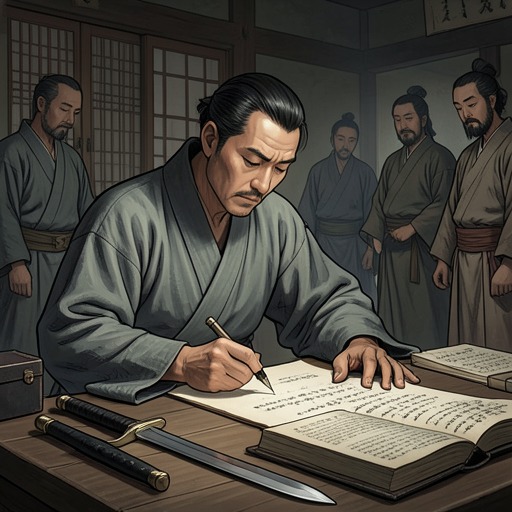
At the opening of his account, [Miyamoto Musashi](entity:character-recall-character-miyamoto-musashi-a7dc0631948a) locates himself on [Mount Iwato](entity:location-recall-location-mount-iwato-b359162e9831) in [Higo Province](entity:location-recall-location-762012447f91), in Kyushu, and says he is writing the teaching for the first time. He presents the work as the outcome of a lifetime spent testing and studying strategy
twelfth day of the fifth month in the second year of Shōhō era
The Dated Colophon
The final colophon gives a later date: the twelfth day of the fifth month in the second year of [Shōhō era](entity:time-recall-time-sh-h-era-4a4cbee6731c). It records the name [Terao Magonojo](entity:character-recall-character-terao-magonojo-0b19d4e537ea) beneath the closing statement of the Book of the Void, followed by [Miyamoto Musashi](entity:character-recall-character-miyamoto-musashi-a7dc0631948a)’s name.
The colophon closes the written transmission of the teaching. Its placement leaves the reader with the book’s final claim: strategy is not complete through words alone, but must be realized through disciplined practice and an unclouded spirit.