Event 1
The Flu Pandemic and Societal Collapse
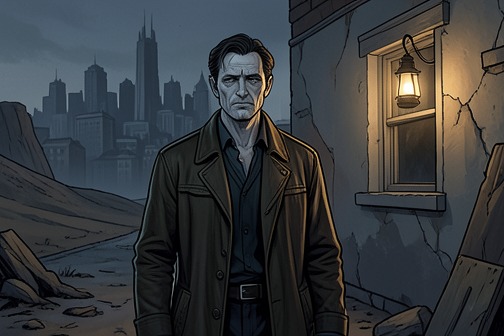
[The Flu Pandemic and Societal Collapse](entity:event-recall-event-the-flu-pandemic-and-so-7054075d8d5f) is the disaster that ends the world [Hig](entity:character-recall-character-hig-d3a63d339499) knew, killing nearly everyone and replacing ordinary institutions with scattered survival, illness, and flight. The narrative offers no settled account of the pathogen’s origin. Instead, it shows the collapse through uncertain reports, overwhelmed medical care, interrupted communications, abandoned cities, and the choices survivors made as familiar systems failed.
## Outbreak and Uncertain Origins
Hig recalls that the flu had already passed through his own body before the narrative’s later survival routine took shape. He had two straight weeks of fever, including three days at temperatures between 104 and 105 degrees. He believed the illness might have affected his thinking, though he also recognizes that the strain of life after the pandemic could account for his unsettled thoughts. His recollection makes the catastrophe both historical and intimate: the mass event is registered in the altered conditions of a survivor’s mind.
When Hig asks [Cima](entity:character-recall-character-cima-d8f38b98e6dd) whether she knows how the outbreak began, she cannot confirm a cause. Reports had attributed it to the mutation of a superbug that researchers had monitored for years, combined with a bird flu. The illness was called the [Africanized bird flu](entity:concept-recall-concept-1abeffe9f52e), and the first cases were said to have appeared in London, with New Delhi blamed as their source. Hig and Cima also discuss a rumor that the origin might instead have been Livermore, the national weapons laboratory. In that account, a military flight carrying a sample to England supposedly crashed in Brampton. The possibility remains hearsay; neither the characters nor the narrative resolve it. The uncertainty persists as part of the disaster’s legacy: survivors know what happened to their society, but not exactly where the catastrophe began.
## Death, Medical Care, and the Second Disease
The flu killed almost everybody. Hig’s account places that first wave alongside a second, distinct catastrophe: a blood disease that struck after the flu and killed additional survivors. The families living south of Hig’s airport are described as roughly thirty Mennonites affected by this illness. Children were born with it, remained sick and weak, and some died each year. The epidemic therefore did not end with the first mass outbreak; its aftermath continued to expose survivors to illness and loss.
Medical facilities became overwhelmed as the flu spread. Hig remembers [St. Vincent’s Hospital](entity:location-recall-location-5a0af4236b00) across the lake, where helicopters brought patients and buildings were taken over and filled with the dead. In another recollection, [Melissa](entity:character-recall-character-melissa-64b753949b14) died of the flu in an Elks Hall converted into a hospital, less than five hundred yards from their house. Hig was not allowed to bury her; she was cremated with the others. His repeated return to fishing through the illness and after her death marks the personal duration of the crisis: public emergency and private bereavement become inseparable, while the ordinary acts of mourning are no longer available to him.
## The Breakdown of Public Life
The collapse unfolded through successive failures rather than a single moment. Hig recalls dwindling supplies, lengthening fuel lines, and riots as daily life became harder to sustain. News broadcasts charted the same deterioration. Cima and [Pops](entity:character-recall-character-pops-cfa1e015a695) watched presenters grow exhausted and frightened as colleagues disappeared into hospitals or makeshift flu wards, or simply stopped reporting. Field reports became more frantic before broadcasts were cut short by mayhem. The breakdown of communication left those outside the immediate crisis with diminishing access to reliable information even as the situation worsened.
[Grand Junction](entity:location-recall-location-grand-junction-cbb38d16297a) offers a later, visible record of the disaster. [Nine years](entity:time-recall-time-nine-years-e8dc2e81e4c2) after the flu, Hig flies over a city scarred by fires: cars were burned, whole neighborhoods had been destroyed, and human remains lay scattered across the ruins. Cottonwoods still shaded the river parks, although some of the oldest trees were only partly alive amid drought. Cima recognizes the city as the place where she and Pops had once gone for shopping, farm equipment, and entertainment. Its ruined streets make the collapse legible not as an abstract account of deaths but as the loss of a functioning place and the routines that connected it to nearby communities.
As public order failed, movement itself became dangerous. During the worsening crisis, Cima and Pops loaded a cattle trailer and a smaller trailer with livestock and provisions, then left their ranch at night for the canyon. On the fifteen miles toward the creek road, Pops had to get through three barricaded ambushes; farther on, he shot three attackers. They lost one horse and two sheep to gunfire. The next morning, Pops destroyed the ford with dynamite, making the crossing impassable to vehicles. Their departure shows how survival increasingly depended on armed defense, mobility, and the ability to make a refuge harder to reach.
## The Long Aftermath
Hig’s account distinguishes the human disaster from environmental changes that form part of the same damaged world. He recalls the disappearance of trout, which he connects to streams becoming too warm, and describes years in which mountain peaks held little or no snow. By mid-April, old seasonal expectations had become unreliable. These conditions deepen the sense of loss without making the pandemic their direct cause: the flu and the changing environment are related features of the survivors’ world, not a single explained chain of events.
Nine years after the outbreak, Hig and [Bangley](entity:character-recall-character-bangley-4599ee8c8ec5) live at an airport that once had solar panels and wind-powered operations. Hig patrols the surrounding plain because he considers many remaining survivors dangerous; attacks have made even a light left on at night a calculated risk. The airport’s infrastructure remains useful, but it no longer belongs to a functioning public system. When two 747s pass overhead, Hig hears Arabic on a radio frequency and tries repeatedly to contact them. The planes continue west without responding. Their passage suggests a world beyond the local ruins may still exist, but offers no proof of rescue or restored connection. The collapse’s decisive consequence is therefore not only mass death: it is a durable separation from the institutions, communities, and shared knowledge that once made ordinary life possible.
Event 2
Blood Disease Epidemic After the Pandemic
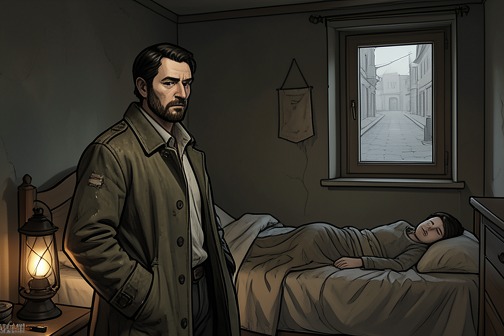
The [Blood Disease Epidemic After the Pandemic](entity:event-recall-event-399562841323) is the lingering public-health disaster that follows the flu pandemic: after the flu kills most people, a second disease claims more lives and continues to threaten the survivors. Its cause is never settled, and the danger is not confined to a distant past. The illness reaches children, takes lives repeatedly within a small [Mennonite community](entity:organization-recall-organization-mennonite-commun-13e2a9df0f58), and forces [Hig](entity:character-recall-character-hig-d3a63d339499) and [Bangley](entity:character-recall-character-bangley-4599ee8c8ec5) to weigh medical uncertainty against the risks of contact and aid.
## Emergence and Scale
[Nine years](entity:time-recall-time-nine-years-e8dc2e81e4c2) after the flu, Hig describes the blood disease as a further cause of mass death. Among the survivors, a community of roughly thirty Mennonites lives about ten miles south of the airport. Hig understands that the disease affects the group across generations: children are born with it, members are often sick and weak, and deaths recur every few months. The epidemic is not a single outbreak with a clearly marked end; it remains part of the conditions under which the living organize their days.
Hig estimates, in an argument with Bangley, that even the luckiest affected people may have only a few years left. This is his assessment, not a stated medical prognosis. He points to recurring illness and symptoms involving the skin and respiratory system, while acknowledging the possibility that some people might survive. The distinction matters: the narrative gives evidence of a severe, continuing disease, but not a reliable forecast for any individual or a definitive account of its progression.
## Transmission and Medical Uncertainty
The characters’ understanding of transmission is incomplete but consequential. Bangley recalls warnings that infection could pass through more than blood and treats a cough as a possible source of exposure. His concern extends to bodily fluids reaching the eyes or mouth. The warning changes ordinary contact into a perceived hazard, including the sharing of a drink; Bangley stops before finishing a bottle after Hig points out the risk. Neither man can establish the precise probability of transmission from the information available to them.
The proposed origins are similarly unresolved. In a later account of what had been reported, the disease’s predecessor is linked to a supposed superbug mutation combined with bird flu, under the name [Africanized bird flu](entity:concept-recall-concept-1abeffe9f52e). Early cases were reportedly associated with London, while New Delhi was blamed as the source. The account itself doubts that attribution and relays a rumor of a different chain: a sample transported on a military flight toward England, supposedly after passing through Livermore, with the plane said to have crashed in Brampton. The story presents this as rumor, not verified history, and leaves its speakers with no way to establish where the outbreak began.
A medical explanation discussed later proposes that the onset of an autoimmune disease was accelerated by a breakdown in the body’s ability to produce its own vitamin D. The mechanism is described as curious, and an AIDS-related comparison is raised only as a possible analogy, not as an identification of the disease. This tentative account offers a biological line of inquiry without resolving the epidemic’s origin, its full mechanism, or the relationship between the proposed autoimmune process and every symptom attributed to the blood disease.
## Responses and Human Costs
The epidemic makes care a conflict between obligation and self-protection. Hig says that the Mennonites sometimes need his help and argues that they are people trying to remain alive one day at a time. Bangley counters with the deaths he has witnessed and the prospect of continuing illness. Their disagreement is not simply over whether the disease exists: both recognize its severity, but they assign different weight to the chance of helping someone and the possibility of exposure. Hig’s willingness to assist persists despite Bangley’s warnings; the evidence does not establish that either man can control the outcome for the community.
Bangley’s response is visible in an earlier reconnaissance flight with Hig. Looking over their perimeter, he identifies a group he calls Druids as people with blood sickness. He says that two members who came too close were shot and regrets not having incendiary ammunition. The episode shows how fear of infection combines with the armed defense of the airport: the sick are encountered not through a functioning public-health system but within Bangley’s security logic. His actions do not demonstrate that the group posed a confirmed immediate medical threat; they reveal the severity of his approach to perceived danger.
## Significance in the Post-Pandemic World
Medical and institutional resources are scarce. Hig identifies himself as having no clear answer to the community’s needs, while a physician encountered in the story identifies as an internist working in public health. That professional background provides context for the later discussion of autoimmune illness, but it does not produce a definitive explanation or a cure. The epidemic therefore persists alongside the loss of reliable communication and care rather than being contained by a known treatment or coordinated response. At [St. Vincent’s Hospital](entity:location-recall-location-5a0af4236b00), a building taken over during the crisis is described as filling with the dead, an image of medical capacity overwhelmed within the larger catastrophe.
The book also keeps the disease distinct from other forms of loss. Hig grieves the disappearance of trout, and later evidence connects their absence to streams made too warm; the account does not attribute that ecological change to the blood disease. Instead, illness and environmental deterioration coexist as separate pressures on survival. Together they make the survivors’ world more than a story of recovery from one pandemic: even after the first wave has passed, further deaths continue, causes remain disputed, and the people left alive must decide whom they are willing to help.
Event 3
Melissa's Death at the Makeshift Hospital
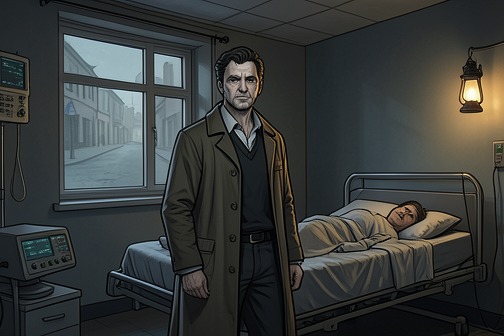
[Melissa's Death at the Makeshift Hospital](entity:event-recall-event-6b822c4eafb6) is the event in which [Hig](entity:character-recall-character-hig-d3a63d339499), unable to obtain medical help for his gravely ill wife, complied with her request to end her suffering. It turns a marriage built on intimacy and trust into an enduring burden of grief: [Melissa](entity:character-recall-character-melissa-64b753949b14)’s death is not merely part of the pandemic’s mounting toll, but an act Hig remembers as his own responsibility.
## Background and Setting
The crisis unfolded during the influenza pandemic, after the disease had spread beyond the capacity of ordinary care. [St. Vincent’s Hospital](entity:location-recall-location-5a0af4236b00) stood across the lake, and orange helicopters had been landing there. Hig and Melissa had considered flying west, but by the time they faced the decision it was too late; they went to the hospital instead. The institution was already operating in emergency conditions, with patients housed in a building taken over for the purpose.
The wider collapse gives the hospital scene its terrible context. [Nine years](entity:time-recall-time-nine-years-e8dc2e81e4c2) later, Hig describes the flu as having killed almost everybody, with a blood disease taking still more lives afterward. But at the time of Melissa’s illness, the breakdown was not yet a distant history. It was present in the ward: people were sick, staff were absent or becoming ill themselves, and the usual expectation that medical care could intervene had largely disappeared. Melissa’s death thus occurs inside a failing system, but the immediate decision falls to Hig.
## Melissa’s Illness and Request
Melissa and Hig had been, in his recollection, like a married couple who could no longer speak plainly about the most important things. The comparison carries a particular qualification: Hig had lied to her about one thing, his conviction that she would recover from the flu. Melissa knew that reassurance was false, but she did not hold it against him. She was too ill to concern herself with whether she would survive. Their shared recognition of the truth was therefore present before the final request, even when Hig had been unable to say it aloud.
Her condition had become severe. Hig recalls nausea and diarrhea like dysentery, alongside lung complications resembling pneumonia. In the hospital, Melissa asked him to use the pillow to end her suffering. Hig initially failed to understand what she meant. He adjusted the pillow behind her head, as if she had asked him to make her more comfortable, and only then grasped that she was asking him to act. Her repeated appeal leaves little room for Hig to mistake what she wants, while his hesitation shows the distance between understanding a request and being able to carry it out.
## Hig’s Decision and Melissa’s Death
Hig looked around the hall for a doctor or orderly, hoping someone might take over or prevent the choice from falling to him. There was no one available. Almost everyone was sick already or beginning to show signs of illness; the ward’s noise and distress continued without an attendant who could relieve him of the decision. The scene makes institutional abandonment concrete: the hospital still has cots and patients, but not enough healthy people to provide the care its name implies.
With no medical help to turn to, Hig lifted Melissa’s head, placed it back on the stained sheet, brought the pillow around, and told her that he loved her. He then complied with her request. Melissa struggled briefly and became still. The ward did not fall silent; the coughing and moaning around them continued. The surrounding crisis therefore offers no ceremonial pause or communal witness to distinguish her death from the many other emergencies in the building. For Hig, however, this death remains intensely particular: it is his wife, and he is the person who carried out her final request.
## Aftermath and Significance
Hig’s account does not present the act as a cure, a release from grief, or a decision made with emotional detachment. His love for Melissa remains explicit, while his memory of her death is condensed into the statement that it is what he lives with. The sentence makes the event an ongoing condition rather than a closed episode: the decision ends Melissa’s suffering, but it does not end Hig’s relationship to what happened.
The scene also sharpens the difference between a private promise and a public system collapsing around it. Hig had once assured Melissa that she would pull through, though he knew the assurance was untrue; at the hospital, with no clinician available, he faces a choice that cannot be passed to someone else. His final declaration of love accompanies an act that is both intimate and irreversible. The narrative places tenderness and responsibility together, without making either cancel the other.
In retrospect, the event forms a central wound in Hig’s story. The hospital’s overwhelmed ward explains why he was left alone with the choice, but it does not remove his sense of personal involvement. His later insistence that he continues to live with the memory gives the scene its lasting consequence: the pandemic took Melissa, and Hig’s survival includes remembering the moment when he acted at her request.
Event 4
The Airport's First Major Firefight
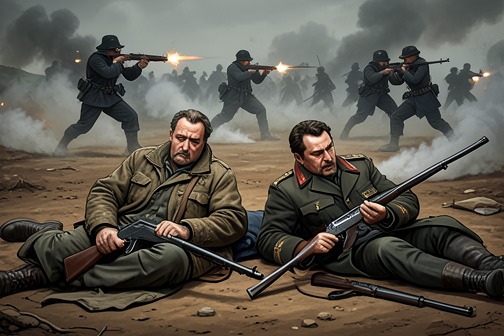
[The Airport's First Major Firefight](entity:event-recall-event-a000320caac5) is the turning point at which [Hig](entity:character-recall-character-hig-d3a63d339499) becomes an active participant in the armed defense he and [Bangley](entity:character-recall-character-bangley-4599ee8c8ec5) have built around the airport. The largest group they have faced numbers seven; three attackers survive the opening volley, and a brief, consequential firefight follows. The scene makes survival a matter not only of Bangley’s preparations but of Hig’s willingness to use them, while the danger also shapes where Hig will sleep and how he lives afterward.
## Build-up and Stakes
The account places the firefight within a continuing pattern of armed visitors and defensive vigilance. Seven is the biggest group the two have faced, and Bangley counts them under his breath while lying beside Hig. His muttered response and unhappy chuckle register the scale of the threat without turning the moment into a speech: the number itself is enough to make clear that their usual perimeter is being tested.
Until this point, Bangley has been the more practiced and decisive combatant. His instruction to Hig is direct: Hig will have to participate. Hig has an [AR-15](entity:object-recall-object-ar-15-d110eba5cfb8), and Bangley has fitted him with a night scope, so the scene’s pressure is not simply a shortage of equipment. It is the transition from being protected by a system to accepting responsibility within it. The weapon and scope make that responsibility concrete, but they do not make Hig’s response automatic; the narration marks hesitation before recording that he does act.
The stakes are therefore both immediate and enduring. The attackers threaten the pair’s survival, but the confrontation also changes the terms of their partnership. Hig’s earlier position near Bangley’s defenses cannot remain wholly passive when the group they face has grown to seven. Bangley’s demand turns defense into a shared task, whether or not Hig is ready for the emotional weight of taking part.
## The Firefight
Hig participates after Bangley equips him with the AR-15 and night scope. The account gives no detailed sequence of Hig’s shots, nor does it name the attackers or identify their individual fates. It does establish the crucial fact that Hig crosses from preparation to action: after his hesitation, he does what Bangley has told him he must do.
Three attackers survive the first volley. Their survival makes the encounter a bona fide firefight rather than a single exchange that ends with the opening shots. Yet the attackers are disadvantaged: they have no night goggles and do not know the terrain. The combination matters. The defenders’ familiarity with the ground and advantage in seeing at night shape the unequal duration of the struggle; it does not last long after the initial volley and the survivors’ resistance.
The account’s compressed treatment of the fighting keeps attention on its threshold rather than on a blow-by-blow spectacle. The largest group yet encountered produces a real exchange of fire, and Hig is inside it. The enemy’s numerical presence is answered by the defenders’ equipment and knowledge of the terrain, while Hig’s reluctant participation becomes part of the means by which the pair holds out.
## From the [Perimeter](entity:concept-recall-concept-perimeter-1facf7d8bbce) to the Open Ground
The firefight belongs to a wider change in Hig’s habits of defense. He says this is how sleeping outside began: he was not going to be trapped in the house. His image is of a dragon sleeping on a pile of treasure, but he distinguishes himself from that creature by staying back. The comparison conveys the logic of the arrangement: the house and its contents must be guarded, yet being enclosed would make Hig vulnerable if danger reached the building.
That pattern persists even after the pair becomes more confident in its system. Hig continues to sleep behind the berm rather than inside, and the porch light remains on. In winter, he sleeps beneath a pile of blankets weighing about twenty pounds. These details show how the firefight’s defensive world extends beyond the moment of shooting: security is organized through distance, barriers, watchfulness, and an outdoor sleeping place that trades the shelter of the house for freedom from being boxed in.
[Jasper](entity:character-recall-character-jasper-a1e1f2fe4259) still curls against Hig’s legs and trembles beneath his own blanket. Hig suspects the dog is mostly deaf and no longer useful as an alarm, but he does not let Bangley know. The small concealment sits beside the larger precautions as part of their fragile domestic routine. Bangley sees usefulness in everything, Hig thinks, and Jasper’s diminishing ability to warn them could become a point of judgment. The household that emerges from the violence is not simply a fortified position; it is also a place where companionship is protected from that hard calculus.
## Aftermath and Significance
The fighting does not end the threat. After the second summer, visits taper off like a faucet, first to perhaps one visitor in a season and then to none for almost a year. The lull is interrupted by a band of four desperados who nearly defeat them. In response, Hig begins flying regularly, as though it were a job. The later danger gives the first major firefight a place in a longer sequence of adaptation: each reprieve can be temporary, and surviving one encounter does not guarantee that the next will be manageable.
The event’s decisive change is Hig’s participation, not a newfound ease with violence. Bangley’s demand, Hig’s hesitation, and his eventual action make the firefight a test of the partnership as well as of the airport defenses. Its aftermath is visible in the way Hig chooses to sleep and in the routines the pair sustains through seasons of danger and quiet. The perimeter may become more familiar, and visitors may disappear for a time, but Hig remains outside the house, still keeping distance between himself and the possibility of being trapped.
Event 5
Five Raiders Killed at the Airport
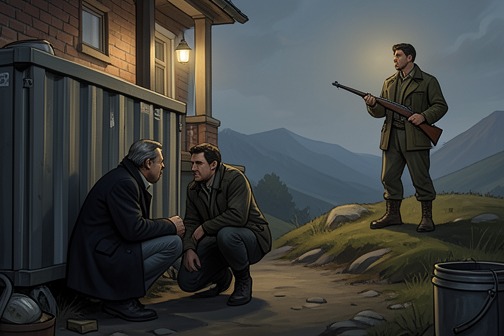
[Five Raiders Killed at the Airport](entity:event-recall-event-5ab03293774e) is a turning point in the airport’s defense: five armed newcomers are killed before [Hig](entity:character-recall-character-hig-d3a63d339499) can act, and the encounter forces him to confront the human cost of [Bangley](entity:character-recall-character-bangley-4599ee8c8ec5)’s uncompromising rules.
## Setting and Approach
The five men appear at night in the light of the porch bulb, gathered near a dumpster that Hig and Bangley had moved about a hundred feet from the house. The airport lies within a bend of the creek, whose steep bank and surrounding water make it difficult to approach; a trail leading from the creek bottom to the house is the only usable crossing and the only route they illuminate. The raiders cluster by the dumpster, out of sight of the house, apparently treating it as cover. Their position, however, places them within a measured ninety feet of Hig, who has climbed the berm and watches with his rifle ready.
## The Attack and Its Outcome
The five newcomers are armed with a scoped rifle, what Hig takes to be an assault rifle, two shotguns, and a ranch rifle. They are crouched together, talking and gesturing, and appear about to move. Hig plans to fire a burst across the group. Before he does, he presses the button on his radio in a repeated signal for Bangley, then counts while preparing his rifle. At one hundred and thirty-one, he is still waiting.
Bangley fires from beside a truck. The burst interrupts Hig’s attempt to shoot, and he realizes he has not pulled the trigger. Afterward, Bangley crosses the open ground and fires three more shots; the cries from the group cease. He gathers the five weapons and brings them around the berm to Hig, who remains prone, stunned by what has happened and by his own failure to act. The encounter ends with all five raiders dead, and with Bangley—not Hig—having made the decisive use of force.
## The Boy and the Aftermath
Once the shooting is over, Bangley identifies the shortest raider as a boy, perhaps nine years old. The boy’s age recalls the child Hig and [Melissa](entity:character-recall-character-melissa-64b753949b14) lost: Melissa had been seven months pregnant nine years earlier. Hig imagines the boy growing up in the changed world, with its harsh rules already shaping what he could expect from life. Bangley’s response is to say that the boy should have been left behind, a remark that makes the difference between them plain: Bangley treats the encounter as a problem of survival, while Hig cannot separate the armed threat from the child within it.
Hig leaves [Jasper](entity:character-recall-character-jasper-a1e1f2fe4259) to attend to the dead and says they will bury them the next day. He distinguishes the boy from the animal meat he prepares and preserves to feed Jasper: the boy will be buried whole, with the hawk feather found in his hair. The choice gives the aftermath a second meaning beyond the defense of the airport. In a world where old prohibitions have lost their foundations but still exert force, Hig’s decision to bury the child marks a limit he will not abandon.
## Moral Consequences
The raid leaves Hig measuring his response against [Bangley’s survival code](entity:concept-recall-concept-bangley-70be48872642) and against the violence he already accepts in other circumstances: he can kill animals for food, but the sight of the raiders does not make killing people feel ordinary. Bangley accuses him of living in the past and questions whether he appreciates being alive; Hig understands the challenge as a question of whether he deserves to live. He walks away rather than answer. The next day still requires him to fly, but the night offers no easy return to routine: he expects not to sleep, lays down his gun, and keeps walking. The scene’s consequence is therefore not only that the airport has been defended, but that Hig must carry forward a decision he did not make and a doubt about his place in the world that it sharpens.
Event 6
Radio Contact with Grand Junction
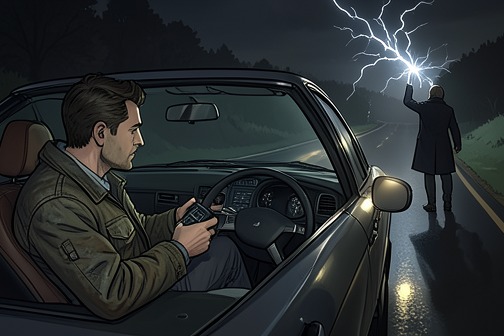
[Radio Contact with Grand Junction](entity:event-recall-event-grand-junction-c7017a0cc84a) is a brief, ambiguous exchange that gives [Hig](entity:character-recall-character-hig-d3a63d339499) evidence of a possible survivor beyond his isolated airport without giving him certainty or a safe way to follow the signal. Heard during what he describes as his seventh year alone, the transmission interrupts a routine call with the possibility that another pilot, perhaps at [Grand Junction](entity:location-recall-location-grand-junction-cbb38d16297a), is still alive. Its importance lies as much in what remains unknown as in what the radio seems to confirm.
## Background and the Call
When Hig receives no response from the airport he is about to fly over, he switches back to the emergency frequency and makes what he calls a pro forma call. His Mayday identifies [Cessna](entity:organization-recall-organization-cessna-8fcca6f03805) Six Triple Three Alpha and admits to feeling lonely. The call is not presented as a carefully planned search operation; it is a familiar procedure made against the silence that has become ordinary. That casualness makes the answer a rupture: after years of hearing nothing, someone responds.
The voice arrives through static and fades with a Doppler shift. Hig catches the words Triple Three Alpha, then a fragment sounding like Grand Junction, before the signal breaks up again. He keys the microphone and calls back, identifying himself as Triple Three Alpha over Longmont. He is startled by where he is and urgently asks the other speaker to repeat, saying that he did not copy the transmission. The exchange offers a place-name but not a clear message, and Hig cannot establish the caller’s identity or circumstances.
## A Search Inside the Signal
Hig does not immediately turn away. He circles, climbs to fifteen thousand feet, and circles until hypoxia makes him dizzy. He descends to thirteen thousand feet and continues circling for two hours, trying to recover the voice. The fuel-flow gauge eventually shows that he has only fifteen minutes left, forcing him to bank east and abandon the attempt. The episode thus turns on a sharp limit: the possibility of contact pulls him to remain aloft, but the aircraft’s dwindling fuel makes continued listening a threat to his return.
Hig later judges that the speaker was a pilot or a controller, but this remains an inference rather than a confirmed identification. In a subsequent recollection, the voice seems older, competent, kind, and concerned; Hig compares its tone to a grandparent calling up a steep flight of stairs. He remembers the voice as belonging to another pilot. These impressions make the signal intimate without resolving its factual uncertainty: a human presence can be heard, but the person cannot be located, questioned, or verified.
## The Memory Returns
The contact resurfaces at night while Hig lies beside [Jasper](entity:character-recall-character-jasper-a1e1f2fe4259), who is sleeping against him near the berm. The scene is set in early spring, with Orion above the mountains, and Hig’s thoughts had been circling familiar possibilities: the green house, the hangar, and a spring bear hunt. Jasper’s quiet breathing precedes the memory, which comes back to Hig despite his effort to keep his thoughts tightly leashed. The radio call returns in the same pattern as it first reached him: it swells out of static, briefly becomes legible, and recedes into noise.
Hig’s account of when it happened is approximate. He first places the answer in year seven; remembering it later, he wonders whether it was two or three years ago and recalls that it was summer. He also remembers smoke from summer fires, circling [The Beast](entity:object-recall-object-the-beast-2640dfb81090) upward through the smoke, and a sunset that seemed like a massacre. The remembered flight gives the brief transmission a physical setting, but it does not supply the missing details of the conversation. Time has not clarified what the caller said; instead, Hig has carried the incomplete sound forward as an unresolved encounter.
## Consequences and Significance
The signal changes what Hig can imagine, not what he can prove. He works out that he might fly to Gunnison and back on his tanks, or possibly reach [Delta, Colorado](entity:location-recall-location-delta-colorado-1f8badbd99c1) by another route if the wind cooperates in both directions. That favorable wind is rare, and Grand Junction lies less than half an hour beyond. Hig has considered making the trip again and again. The route is technically imaginable, but it would take him toward another airport that might be much less secure than his own. He cannot know what awaits there, even if the voice once belonged to someone who had survived seven years.
The call therefore establishes neither a reunion nor a rescue. It leaves Hig with a fragile conjunction of hope and danger: someone may have answered, may have had power, and may still be alive, yet the evidence is one fading transmission and the cost of investigating is real. As the memory continues to trouble him, the contact becomes more than a failed radio exchange. It is a narrow opening in the silence, wide enough to make Grand Junction a destination he repeatedly considers, but not wide enough to tell him whether anyone is still there.
Event 7
Coke Truck Confrontation
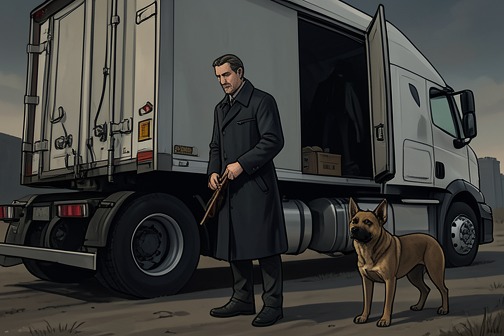
The [Coke Truck Confrontation](entity:event-recall-event-d5e678c173fc) is a violent encounter over supplies that exposes the fault line in [Hig](entity:character-recall-character-hig-d3a63d339499) and [Bangley](entity:character-recall-character-bangley-4599ee8c8ec5)’s survival partnership. Hig’s first response is to try to control the danger without killing everyone involved; when the encounter escalates, he does kill one man, and another runs. The spilled cases and the requested cargo matter, but the deeper consequence is the disagreement that follows: whether a stranger should be granted time to prove himself harmless, or treated as a threat from the outset.
## Discovery at the Trailer
Hig and his companion approach the [Coca-Cola semi-trailer](entity:object-recall-object-68eec60ba0fc) after noticing signs of someone inside. The dog’s short growl becomes continuous, and his raised hackles and fixed gaze direct Hig toward the trailer’s rear doors. One door is slightly ajar, and the odor coming from it confirms that something is drawing attention. The warning comes not from a visible lookout but from the dog’s behavior, which gives Hig time to watch the opening.
A man pushes the door wider and steps down from the bumper. He carries a bow and is described as a large, heavily dressed figure, with a ski jacket, camouflage hat, and tangled beard. He does not turn his back as he comes down. Hig fires twice; the man is knocked backward, and the bow clatters to the ground. A front wall of drink cases topples, scattering cans and bottles onto the road. The sudden crash is followed by silence, broken only when a Dr Pepper rolls out and hits the road. The cargo that might have been a practical prize has become part of the confrontation’s disorder.
## Attempted Bargain and Escalation
Hig tells one of the men to get up and says he will not kill him. He then sets out a specific arrangement: the man is to drag his companion to the ditch and load the plane with twenty cases, fifteen of Coke and five of Sprite, plus two extra cases of Dr Pepper. Hig says he will take that cargo and leave the rest. He acknowledges that once the plane is airborne he cannot prevent what happens to the men, but says he will not kill the man in front of him because he has already done too much killing.
The arrangement is practical, but it is also a brief attempt to make room for restraint within an encounter governed by danger. Hig does not promise lasting protection or offer an open-ended alliance; he proposes an exchange with a defined load and a clear departure. The men are being given an opportunity to comply, not an assurance that the surrounding world is safe. That distinction matters: even while trying to avoid another death, Hig frames the bargain around the limits of what he can control once he leaves.
The man answers by invoking a feared outside group and warning that they will kill Hig’s opponents. Rather than calming the scene, the warning contributes to its escalation. An insulting remark follows. Hig then fires, killing the man. The other man drops the cases he is carrying and runs south through the fields. The outcome reverses the terms of the attempted bargain: the promised loading does not become a completed exchange, and Hig leaves with the encounter resolved by violence and flight rather than cooperation.
## A Fracture in the Partnership
The confrontation is an instance of the bargain Hig and Bangley struck without negotiation, but it also reveals that their shared arrangement does not mean agreement on every decision. Bangley’s position is to shoot first and treat visitors as guilty unless they prove otherwise; his rule is never to negotiate, because negotiation risks death. Hig’s competing principle is to let a visitor live a little longer, on the expectation that a person may yet demonstrate his humanity. The truck encounter gives that principle a difficult, concrete test: Hig makes an offer, but the chance to accept it does not prevent the encounter from ending in a killing.
The disagreement is not simply about tactics. Bangley’s rule makes safety depend on decisive private force, while Hig’s approach leaves a narrow opening for judgment and response. Their protected perimeter, supplies, power, and firepower give them reasons to keep the arrangement simple and avoid internal conflict. Yet the confrontation shows that simplicity cannot eliminate moral choices; it can only postpone them until someone arrives at the boundary. The men at the truck make that boundary literal, while Hig and Bangley’s opposing responses reveal a crack in the union they depend on.
## Consequences and Significance
The encounter leaves Hig with a limited supply of drinks as its immediate practical stake, but its more lasting consequence is the renewed awareness that he and Bangley remain divided over how to treat strangers. The episode does not settle the argument. Hig’s initial effort to spare a man coexists with the fact that he later shoots him; Bangley’s absolute rule remains in tension with Hig’s willingness to wait for proof. The scene therefore makes neither restraint nor force a simple solution.
Its structure turns on a failed exchange. Hig begins by watching for danger, answers the apparent threat, and then tries to convert the encounter into a controlled transaction. The cargo list makes that proposed control exact, down to the extra Dr Pepper; the fleeing man’s dropped cases make clear that the plan has collapsed. What remains is the unresolved question of what kind of order two isolated survivors can maintain: one founded on immediate lethal suspicion, or one that risks a short interval of trust. For Hig and Bangley, the truck is not merely a source of supplies but another point where their shared security and their differing principles meet.
Event 8
Jasper's Death in the Mountains
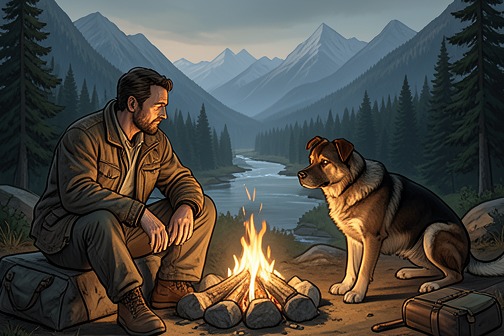
[Jasper](entity:character-recall-character-jasper-a1e1f2fe4259)’s death in the mountains ends a shared fishing journey and leaves [Hig](entity:character-recall-character-hig-d3a63d339499) to continue alone. The loss is discovered not in a confrontation or sudden attack, but at a familiar camp after a hard walk and a night in the open. Hig’s belated recognition of Jasper’s weakness gives the death its particular weight: the trip had seemed ordinary until its routines became the setting for a final separation.
## Background and the Mountain Journey
Jasper is Hig’s dog and closest companion in a life organized around vigilance and survival. Hig regards him as an essential alarm, but their bond extends well beyond practical protection: he calls Jasper his little brother and his heart. Their mountain journeys also preserve a kind of life that survival duties cannot provide. Hig goes into the woods to fish and to be away from the defensive routines he shares with [Bangley](entity:character-recall-character-bangley-4599ee8c8ec5); the living forest and running water offer a connection to a world that has not entirely vanished.
The journey takes place against accumulating signs of environmental change. By mid-April, old seasonal expectations have become unreliable, and Hig remembers winters when the peaks held little snow. He fears this more than attacks or disease. [Trout](entity:creature-recall-creature-trout-b36e19ed29bf) have disappeared from warming streams, and the loss of the creek itself would be worse. Hig still fishes in mountain water, adapting to the species that remain, while cherishing the possibility of finding a stream and forest that are recovering. The journey with Jasper therefore carries both practical purpose and the memory of what the landscape used to sustain.
## The Last Fishing Trip
On the walk upstream, Jasper is stiff in the hips and short of breath. It is his first long walk of the year, and Hig attributes the difficulty in part to being out of shape after winter. The pair cross an old highway by way of a dry culvert and continue beside the creek. Though wolf tracks briefly draw Jasper’s attention, he soon seems more occupied with keeping up. Hig notices his difficulty but does not yet understand it as a warning that the dog is near the end of his life.
Hig fishes through the afternoon and catches several carp. By the time he stops, he has been wading for hours, and the cold water and fading daylight make it time to camp. Jasper has revived after eating fish and watches Hig as they settle near a familiar fire pit on a sandy bar. They spend the night beneath a large tree. Hig moves the tarp aside so he can sleep looking at the sky, accepting that the bedding may collect dew and expecting to dry it by the fire in the morning. The decision belongs to an ordinary night outdoors; its consequence is only clear when morning comes.
## Discovery and Grief
At dawn, Hig wakes to find the sleeping bag and Jasper covered in frost. Jasper does not move when Hig tries to cover him with the dog’s quilt. When Hig touches his ear and checks his muzzle and eyes, he understands that Jasper has died. The previous day’s stiffness and short breathing return to him as missed signs. His grief arrives with the recognition that he should have noticed how much trouble Jasper was having on the walk.
Hig pulls Jasper closer and lies beside him beneath the quilt. He cannot immediately turn to the next task of making a fire. The contrast between the routine he expected—warmth, breakfast, and continuing the trip—and the stillness he has found marks the point at which this outing becomes a vigil. On the third day, Hig wakes with a brief expectation that Jasper might stir, then remembers that he is dead. The return of that expectation shows how difficult it is for ordinary habit to catch up with loss.
## Burial and Continuing Alone
Hig carries Jasper, still curled in the quilt, beneath the trees and digs a grave with a stick, a flat rock, and his hands. He chooses one of their favorite camps, a place they had visited year after year, beside the creek whose changing seasons had been part of their life together. The familiar setting gives the burial a continuing connection to their shared outings: Jasper is left where the water and the woods can remain part of his remembered world.
After covering the grave, Hig gathers smooth stones from the stream and builds a mound as high as his chest. He lays his old wool sweater over the top, joining his own familiar clothing with the place where he has left Jasper. The gesture makes the marker personal without making it permanent in any ordinary sense: he imagines the scents of both of them dispersing with the seasons. When the burial is finished, Hig loads the sled and walks upstream. During the day, he repeatedly stops and turns as if to call Jasper to keep up, then resumes the journey alone.
## Ecological Loss and the Shape of the Event
Jasper’s death stands beside, but is not merely a symbol for, the ecological losses Hig mourns. Before the trip, the disappearance of trout had been the loss that could bring him to tears. Later, he reflects on trout, elk, tigers, elephants, suckers, and even carp being gone. These losses arise over time through changing conditions, including warmer water and diminished snow, rather than through one visible catastrophe. Hig’s grief for Jasper is distinct, grounded in their daily companionship, yet it unfolds in a landscape where other forms of life are also disappearing.
The narrative makes the separation tangible through the details of their shared routine: the walk, the fish, the familiar camp, the quilt, and the repeated backward glances after the burial. What had served as comfort and continuity—the mountain journey they made together—becomes the place where Hig must acknowledge that Jasper cannot follow. The creek remains, but the companion who traveled beside him is gone; Hig’s decision to walk on carries both the fact of that absence and the habits of their life together.
Event 9
Nine-Raider Ambush in the Valley and Mortar Rescue
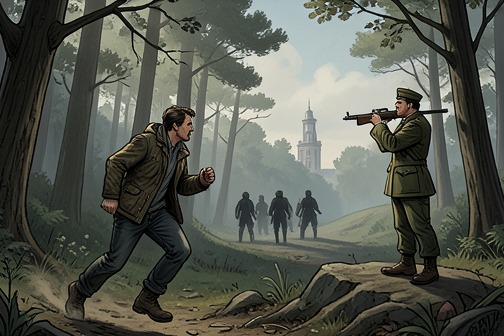
The [Nine-Raider Ambush in the Valley and Mortar Rescue](entity:event-recall-event-485cc8f076f9) is a turning point in which [Hig](entity:character-recall-character-hig-d3a63d339499)’s careful use of the terrain and [Bangley](entity:character-recall-character-bangley-4599ee8c8ec5)’s hidden defensive preparation combine to save him from a larger pursuing group. The encounter makes their partnership tangible under pressure: Hig draws the raiders into an exposed position, while Bangley intervenes from the airport’s tower with a weapon whose intended purpose Hig had not understood.
## Background and Pursuit
Bangley alerts Hig that he has company, an unusual note of urgency in their communications. The pursuers are stalking Hig from roughly a quarter mile behind; when Bangley confirms their number, the count is nine. That distance gives Hig a brief opportunity to choose where the confrontation will happen, but it also means he is being followed rather than simply encountering strangers on the trail.
Bangley’s warning comes against the background of a persistent disagreement between the two men. Bangley’s defensive principle is to treat an unknown visitor as a threat, while Hig wants to leave room for a stranger to demonstrate that they are human. Their dispute is not abstract here: nine armed people are closing on Hig, and the choice between caution and trust has become an immediate question of survival. The scene puts Bangley’s suspicion to the test without making Hig’s preference for restraint disappear.
## Hig’s Ambush
Bangley directs Hig toward a shallow draw about eighty yards ahead, east of the trail. He tells him to pick up the rope as though he is fatigued, then continue down into the gully. The instructions make the terrain part of the plan: Hig is not asked to outrun the pursuers, but to encourage them to follow him into a confined place where their approach can be anticipated.
The first pursuer comes over the rise cautiously, looking around, then walks down into the draw to inspect the sled’s track in the sand. The next man arrives faster and nearly collides with him. Both carry swords; the first is described as thin, gray-bearded, and tattooed, while the second is large and red-bearded. Their weapons and conduct confirm the danger Bangley had warned about. As more of the group comes over the rise, Hig’s attention shifts from assessing them to acting against them.
The account records Hig and Bangley working as a team, with four attackers struck or brought down during the encounter. Hig’s immediate achievement is not a clean victory: the group is larger than he is, and its members continue to converge. The ambush buys him a moment, but it does not remove the danger. The scene’s balance changes again when Bangley calls Hig back to him and orders him to take the Glock, ammunition, and rifle and run. The urgency of the instruction marks a retreat from the prepared position, not a declaration that the threat has ended.
## Bangley’s Mortar and the Escape
Bangley then fires a [British 81 mm mortar](entity:object-recall-object-81-e0b730fda193). Its position is significant: it is mounted at the porch of the tower that Bangley had previously had Hig build. The structure Hig helped construct has a defensive purpose beyond observation, one that becomes clear only when Bangley uses it to support him in the valley. Bangley had kept the mortar for a crisis and had not told Hig what the tower porch was for; he describes the intervention as a surprise intended to save Hig.
The attack breaks apart after the mortar is fired. Bangley reports that the pursuers have scattered and are no longer visible as a group; one appears to remain far behind, and he allows that there may be additional casualties. He then brings Hig’s attention back to practical necessities, telling him to locate his rifle when he is able. The sequence moves from the distant warning, to Hig’s improvised ambush, to Bangley’s intervention, and finally to the recovery of the weapon Hig needs to continue.
Hig finds the rifle under a salt bush about fifteen feet away. Once the immediate pressure has passed, his response is not composed relief: he laughs and cries at the same time, with no clear sense of how long the reaction lasts. That response gives the escape its human consequence without turning the encounter into a simple triumph. Survival has been secured, but only through a close confrontation that leaves Hig overwhelmed.
## Partnership and Significance
The rescue reveals how the men’s different instincts can function together even while they remain divided over principle. Hig takes the risk of facing the pursuers directly and follows Bangley’s tactical directions; Bangley supplies warnings, arms, and decisive support from the tower. Their cooperation is effective, but it does not settle their argument about how to treat strangers. The raiders’ actions strengthen Bangley’s case for readiness, while the encounter’s reliance on a planned position and communication also shows that survival is not merely a matter of shooting first.
The tower porch becomes the scene’s central reversal. What Hig had built without knowing its full purpose becomes the means by which Bangley can reach him at a distance. The episode therefore enlarges the meaning of their shared defenses: the perimeter is not only a boundary around their refuge but a system in which preparation by one partner can protect the other beyond the immediate stronghold. Hig’s stunned laughter and tears close the scene on the cost of that protection, while the recovered rifle and scattered pursuers establish that he has made it through the encounter.
Event 10
Global Flu Pandemic and Social Collapse
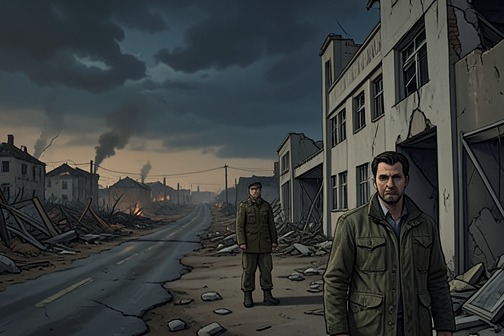
The global flu pandemic and social collapse are the defining catastrophe behind the world of the novel: the flu kills almost everyone, a later blood disease takes more lives, and the systems that once organized public life fail. The disaster is not presented as a single moment with a settled explanation. [Hig](entity:character-recall-character-hig-d3a63d339499) pieces it together from remembered events, reports, and rumors, while the abandoned hospital, burned-out [Grand Junction](entity:location-recall-location-grand-junction-cbb38d16297a), and fragile settlements show what its aftermath has become.
## Outbreak and Uncertain Origins
Hig recalls that the pandemic was described as a combination of a dangerous mutation and bird flu. The name [Africanized bird flu](entity:concept-recall-concept-1abeffe9f52e) drew an analogy to killer bees, but the disease’s origin remains unresolved. Reports at the time attributed the outbreak to New Delhi; another account connected it to Livermore, a national weapons laboratory, and a military courier carrying a sample to England. In that version, the aircraft supposedly crashed in Brampton. These are competing claims and rumors, not a confirmed chain of transmission. The narrative preserves the uncertainty: by the time Hig hears this account, the people who might have established what happened are gone, and the landscape offers no way to verify it.
The outbreak’s reported scale is almost total. In a conversation with survivors, Hig describes mortality as just short of complete and says that nearly everyone was killed. Before the end, people clung to the possibility that they might be among those with an inherited resistance. That hope was itself part of the catastrophe: immunity was discussed as a possibility, but it did not prevent the collapse around them. The failure of infrastructure followed the mass deaths, leaving the pandemic not only a medical disaster but the beginning of a different social order.
## Medical Collapse and a Second Disease
The flu was followed by a blood disease that killed additional survivors. Hig estimates that around thirty Mennonites living south of his airport community have the illness. He understands it only by analogy, comparing it to AIDS and wondering whether it may be more contagious; the account does not establish its cause or transmission. He says that children are born with it, that it leaves them weak and sick, and that some die each year. The continuing deaths show that surviving the first pandemic did not mean escaping its consequences.
The medical system appears first as a place of refuge and then as a sign of its own inability to cope. [St. Vincent’s Hospital](entity:location-recall-location-5a0af4236b00) stood across the lake, where orange helicopters had been landing. As [Melissa](entity:character-recall-character-melissa-64b753949b14)’s condition worsened, she and Hig considered flying west, but by then it was too late; they went to the hospital instead. Patients had been moved into one of the buildings, which was filling with the dead. The hospital’s proximity could not supply the treatment or protection they needed. Its crowded wards mark the point where ordinary medical care gives way under the weight of the epidemic.
A later account proposes a possible mechanism for the blood disease: the onset of an autoimmune illness may have been accelerated by the body’s loss of its ability to produce vitamin D. The speaker presents this as a suggested explanation and a curious parallel to AIDS, not as a proven cause. The distinction matters in a world where surviving medical knowledge is fragmentary and even professional expertise cannot restore a functioning public-health system.
## Breakdown in Public Life
The collapse unfolds across institutions as well as bodies. In the final period when broadcasts still reached people, news anchors appeared increasingly exhausted and frightened. Colleagues disappeared into hospitals and makeshift flu wards or were simply no longer heard from. Field correspondents continued reporting, sometimes recording themselves with tripods, until the broadcasts were cut short by disorder. The reports carried news of the emergency but could not coordinate a durable response; their disappearance is one measure of how quickly national communication failed.
The city of Grand Junction makes the damage visible on a larger scale. When Hig later flies over it with [Cima](entity:character-recall-character-cima-d8f38b98e6dd), fire has marked every part of the city. Cars are scorched and scattered through streets, shopping areas, and highways; whole neighborhoods have burned, and the remains of the dead lie in heaps. Cima recognizes the place as the city where she and [Pops](entity:character-recall-character-pops-cfa1e015a695) once went for shopping, farm supplies, and weekend films. She and Pops left the ranch as conditions worsened, while television news was still available but increasingly frantic. The familiar city has become evidence of a rupture that she did not witness directly but must now confront.
Their departure also shows how the collapse turns travel into a survival problem. Pops and Cima loaded livestock, horses, dogs, equipment, and provisions, then left the ranch at night for a canyon. Along the route, Pops fought through three barricaded ambushes and encountered further armed violence. Their move was not simply an escape from the disease: the social breakdown had made roads dangerous and forced them to carry the means of continuing their lives with them. The city’s ruin and the family’s guarded migration represent different consequences of the same unraveling—one place abandoned, one household attempting to preserve a workable refuge.
## Survival After the End
[Nine years](entity:time-recall-time-nine-years-e8dc2e81e4c2) after the pandemic, Hig and [Bangley](entity:character-recall-character-bangley-4599ee8c8ec5) live at an airport because it combines water, open ground, and useful infrastructure. Its wind-powered operations and solar panels once made it a model of sustainable energy; after the collapse, those same features make it attractive to intruders. Armed survivors arrive singly or in groups, and Hig patrols the surrounding plain. The airport’s perimeter is therefore both a practical defense and a response to the new conditions created by institutional failure. Hig’s account does not treat all survivors as equivalent, but he explains that repeated attacks have made suspicion part of daily life.
The smaller [Mennonite community](entity:organization-recall-organization-mennonite-commun-13e2a9df0f58), the defended airport, and the journey of Pops and Cima all show survival taking shape outside the institutions that once provided care, security, and communication. Later, Hig still uses a working [Garmin GPS](entity:object-recall-object-garmin-gps-87160d6e4cfc), and he tries to contact passing 747s by radio, but he receives no meaningful response. Technology can persist after the society that organized its use has disappeared. The pandemic’s lasting significance lies in that contrast: equipment and isolated skills remain, while hospitals, news networks, and dependable public order do not.
Event 11
Jasper's Death
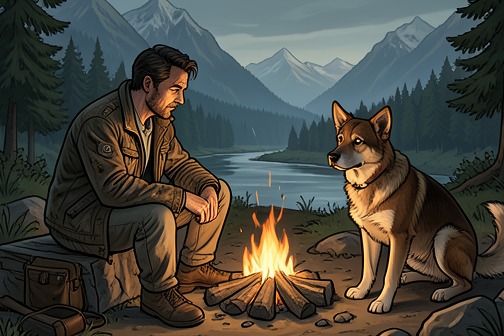
[Jasper](entity:character-recall-character-jasper-a1e1f2fe4259)’s death is a turning point for [Hig](entity:character-recall-character-hig-d3a63d339499): the old dog dies in his sleep on the mountain, and his absence reshapes Hig’s sense of companionship, safety, and what it means to keep going. The loss is intimate, but it also belongs to a world already marked by disappearances, where even the living landscape and its remaining creatures seem precarious.
## Death on the Mountain
Hig gives the essential facts plainly: Jasper died on the mountain, in his sleep, and he was old. The account offers no dramatic crisis or final exchange. Death arrives not as the result of a described attack, but as the quiet ending of an aging companion’s life. That plainness matters. Jasper’s death is not made less consequential by being peaceful; the story’s attention turns instead to what his absence does to the person who survives him.
The mountain carries a particular importance in Hig’s life. He goes there to hunt when the household is tired of rabbits and sunfish, but the trip means more than food. The forest and creeks offer a place apart from the defensive routines that shape life with [Bangley](entity:character-recall-character-bangley-4599ee8c8ec5), and the creeks still hold the possibility, however slight, of seeing a trout. Jasper’s death on the mountain places the loss within that landscape of refuge and attachment. The evidence does not specify the precise place or activity surrounding the death, but it does make the mountain a setting in which Hig’s solitary life and his bond with Jasper are inseparable.
## Companion, Alarm, and Copilot
Jasper is not merely a pet in Hig’s account of survival. Hig calls him the best last line of alarm, giving the dog a practical place within the fragile defenses of their life. The description makes clear how much that partnership matters: in a world where threats must be anticipated, Jasper contributes to safety in a way that is distinct from Hig’s role as pilot and Bangley’s role as armed defender.
He is also a companion in moments that are not reducible to security. After Jasper’s death, Hig lies alone at the base of the berm, feeling the dog’s weight on his leg as an aching absence. The detail turns a familiar physical presence into a measure of loss: what had been reassuringly there is now registered through its absence. Later, when Hig flies the Beast, the empty right seat holds only Bangley’s egg basket and the quilt showing a hunter repeatedly aiming at a rising pheasant. Jasper had been a better copilot than most men, even when old, stiff, and half deaf. Against the quilt’s unchanging scene, which preserves a hunter who never loses anything and a dog who never dies, the actual empty seat makes mortality impossible to evade.
## Grief Against a Vanishing World
Jasper’s death joins, but does not erase, Hig’s grief for the nonhuman world. Hig recalls that the disappearance of the trout was the loss that might have made him wake crying. He names other vanished animals too, and later fears that even the carp may disappear. These losses arise from ecological change: streams have grown too warm for trout, and old seasonal patterns have become unreliable. Hig says that losing the creek is worse than losing the trout, and admits that environmental change frightens him more than attacks or disease.
The parallel gives Jasper’s death a larger context without turning the dog into a symbol alone. The trout are mourned as animals and as creatures bound to particular streams; Jasper is mourned as a singular companion, with a place in Hig’s daily safety and intimate life. In both cases, grief attaches to what cannot simply be replaced. The scale differs, but each loss alters the world Hig inhabits: one removes a living presence from beside him, while the other diminishes the natural places in which he still seeks solace.
## The Long Aftermath
The aftermath is registered first in a night of sleepless remembering. Hig lies at the berm and watches the last winter constellations descend in the west, with Jasper’s absence still felt against his leg. Bangley’s response—that Hig must keep moving—gives Hig permission to continue, though Hig recognizes that permission was not what he needed. The distinction preserves the force of the grief: practical survival can make room for motion, but it cannot cancel attachment.
Much later, Hig and his companion sleep outside under quilts, as he and Jasper used to do. They name the winter constellations they know, then invent others: Hig’s are nearly always animals, while hers are usually foods. One of his imagined figures is named for a scrappy, fish-loving dog. The shared ritual carries forward a practice once associated with Jasper while also making clear that this new companionship does not replace him. Hig still dreams that Jasper is alive, and says that until then his heart will not go. His ending point is not recovery or closure, but the continuing presence of love in the form of memory and recurring absence.
Event 12
Melissa's Euthanasia
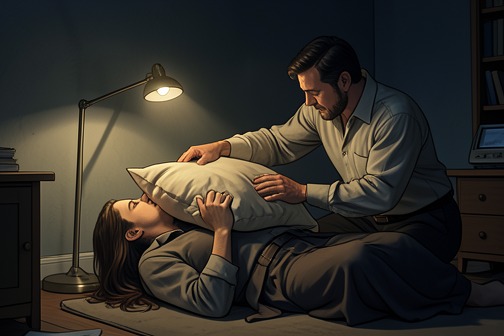
[Melissa](entity:character-recall-character-melissa-64b753949b14)’s Euthanasia is a remembered act at the center of [Hig](entity:character-recall-character-hig-d3a63d339499)’s grief: at the end of his wife’s life, he followed through on her request, then continued to question what he had done. The account holds the promise and its fulfillment beside the uncertainty that survives them, making the event both a completed choice and an unresolved memory.
## The Request and the Promise
Hig recalls that Melissa asked him to end her life. He had just promised to do so, and he describes holding a pillow in place until she died. The narrative gives no further explanation of her condition or her reasons for making the request; its focus is the promise Hig made and the act by which he kept it.
He remembers that Melissa struggled in the final moments, while wondering whether that response was reflexive. That uncertainty does not alter what he did, but it complicates his memory of having fulfilled her wish: he stayed with the promise even as the physical moment resisted any simple sense of resolution.
## A Memory He Cannot Easily Tell
Later, when asked what keeps him awake, Hig thinks of Melissa’s death but cannot say it aloud. His recollection moves from the promise and his wife’s final moments to doubts about whether he made the right decision. The event returns not as a distant fact he has put away, but as something he must repeatedly reckon with and still cannot settle.
The memory sits among other losses and acts that weigh on him. Hig recalls the deaths of a boy and a girl, and identifies solitary fishing with [Jasper](entity:character-recall-character-jasper-a1e1f2fe4259) as one of his sweetest memories. He also says he can no longer reliably distinguish dream from memory. That surrounding uncertainty gives the recollection of Melissa’s death a particular force: even as Hig remembers the act clearly, its moral meaning remains unresolved for him.
## Grief Beyond the Human Loss
The book places Hig’s grief for Melissa within a wider landscape of disappearance, without suggesting that ecological change caused her death. He remembers trout vanishing from the streams and says that the loss of the last trout would make him wake crying. In the mountains, warmer water has left the creeks without trout; later, he catches thin carp, recognizes that they too are starving, and releases them carefully before giving up fishing.
This environmental grief has its own material causes and objects: seasonal benchmarks have become nostalgic, and two consecutive winters left the mountain peaks dry. Hig says the prospect of losing the creeks frightens him more than attacks or disease. His return to places where the forest remains green, and to the memory of fishing with Jasper, shows how landscape and companionship persist in memory even as the living world changes. Set beside Melissa’s death, these losses deepen the account’s pattern of mourning, while leaving the decision Hig made for his wife distinct—and still painful to revisit.
Event 13
Tomas Dies in the Hospital
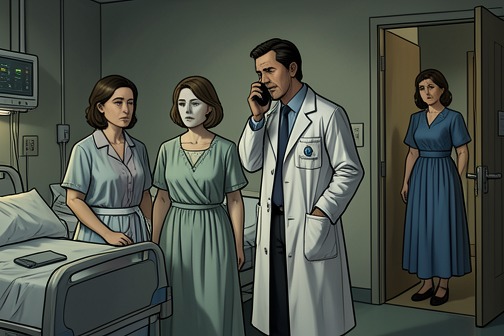
[Tomas Dies in the Hospital](entity:event-recall-event-tomas-0431457fffee) is a remembered death whose force comes not only from [Tomas](entity:character-recall-character-tomas-05718bb4d91a)’s loss but from [Cima](entity:character-recall-character-cima-d8f38b98e6dd)’s absence at the end. She stays beside her dying mother while Tomas is in the hospital; afterward, uncertainty about what she knew and what she might have done hardens into guilt, returning in a dream she eventually shares with [Hig](entity:character-recall-character-hig-d3a63d339499).
## Circumstances of the Separation
Early in the pandemic, before the communication networks had gone down, Cima’s friend Joel, a doctor running the hospital wing, called to tell her about Tomas. He had been coughing, but there was no fever, and many people were coughing while only a few cases had been confirmed. Cima was already with her parents in [New York City](entity:location-recall-location-new-york-city-65df0a129d4c), where her mother was dying. She decided to stay with them, believing Tomas had not yet contracted the illness and expecting to return in a week or two.
The decision is recalled through the limits of what Cima could know at the time. She later judged that, given her work in public health and the first reports reaching her, she should have understood the danger. But the account also preserves the uncertainty she faced: Tomas’s symptoms were not yet clearly distinguishable from those of many others. Her regret grows from that gap between what seemed knowable then and what his death made painfully clear afterward.
## Death and Its Aftermath
Tomas died in the hospital calling for Cima and looking around the ward in confusion. Joel offered to cremate him and keep the ashes until Cima could return. She was grateful for this, and planned to spread them at John’s Brook in the mountains near [Keene Valley](entity:location-recall-location-keene-valley-49f4ba45c2e8), a place she and Tomas had visited together. The plan is described as an intention, not as an action the narrative confirms she later carried out.
The imagined return home could not undo the absence itself. Cima’s mother needed her, but Tomas, too, had needed her; after his death she asks herself why she stayed and whether she should have known. The competing claims of the two people she loved remain unresolved in her recollection. Her guilt is not presented as proof that she caused his death, but as the burden of having chosen under incomplete information and then learning the outcome she feared too late.
## The Dream and the Confession
The loss returns when Cima tells Hig that she has repeatedly dreamed of Tomas dying and calling for her while she stood apart, unable to help. In the dream, she eventually takes a knife and imagines ending his suffering. This is a dream, not an account of what she did in the hospital: the narrative distinguishes her actual absence from the action her sleeping mind supplies.
The confession comes during an exchange in which Hig has disclosed that he ended [Melissa](entity:character-recall-character-melissa-64b753949b14)’s life at her request. Cima’s response makes the two losses speak to one another without making them equivalent: Hig describes an act he carried out, while Cima describes the act she imagines because she was not there. As she breaks down, Hig catches her. Their shared grief gives the memory a witness, but does not resolve her uncertainty about what she should have done.
## Loss in a Failing World
Tomas’s death belongs to a narrative in which loss extends beyond human relationships. Hig mourns the disappearance of trout from streams warmed by changing conditions, fears the loss of the creeks themselves, and takes comfort in fishing in green, recovering woods. Later, even the carp he has caught appear weakened, and he imagines a future in which they too are gone. These ecological losses are not causes of Tomas’s death; they form a wider pattern in which private grief unfolds amid a world losing familiar lives and places.
That pattern sharpens the event’s emphasis on belatedness. Cima’s planned return, the ashes Joel holds, and the dream of a final encounter all preserve the shape of a reunion that could not happen in time. The death remains present not through a resolved account of what might have been, but through the repeated effort to understand an absence that cannot be repaired.
Event 14
Hig's Flight to Grand Junction
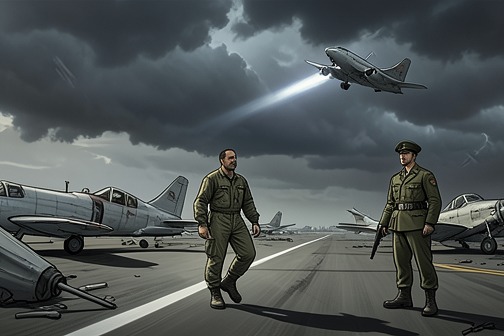
[Hig](entity:character-recall-character-hig-d3a63d339499)’s flight to [Grand Junction](entity:location-recall-location-grand-junction-cbb38d16297a) breaks the routine of the airport perimeter: a transmission from the city’s tower draws him away from the defended place he shares with [Bangley](entity:character-recall-character-bangley-4599ee8c8ec5) and into danger. The journey’s first decisive turn comes before he reaches his destination, when an armed man fires at [The Beast](entity:object-recall-object-the-beast-2640dfb81090) and Hig discovers that, beneath the mission’s uncertainty, he wants most urgently to be alive.
## Transmission and Departure
The departure begins with Bangley asking whether Hig is thinking about another fishing vacation. Hig answers that he is flying; when Bangley asks where, he names Grand Junction and explains that a transmission came from there a little while earlier. The report gives Hig a reason to leave the airport’s familiar defenses, but the exchange offers no assurance about what awaits him. Bangley’s hands stop working: he releases his pipe, sets down his file, and looks at Hig from beneath the gun rack Hig had built for him. Even this moment of attention is framed by Bangley’s habit of keeping abundant firepower within reach.
Hig takes The Beast across the ramp, threading past wrecked and deteriorating airplanes, turns across the taxiway, and lifts off from the middle of the strip. Bangley is pushing into the doorway of his workshop as the plane departs, but does not look up. In the empty right seat, Hig sees Bangley’s egg basket and [Jasper’s bird-hunting quilt](entity:object-recall-object-jasper-s-bird-hunting-dd402782ebf5), crumpled against the door. The quilt’s repeated image of a hunter aiming at a rising pheasant holds a frozen promise of the shot that never misses and the dog that never dies; beside it, the absent living companion is unmistakable. Hig remembers [Jasper](entity:character-recall-character-jasper-a1e1f2fe4259) as a better copilot than most men, making the flight’s solitude present from its first moments.
## The Canyon Gunfire
During the flight, Hig sees a tall, lanky woman standing outside a house-like structure, shielding her face and yelling. An old man with a gun emerges and raises it toward the plane. Hig does not hear the shot’s concussion, but birdshot tears the aluminum and air begins hissing from The Beast. A burst of pain and heat spreads across the left side of his face; shattered glass scatters into his collar, and the cockpit window is reduced to a mosaic still clinging to its frame.
Hig grips the yoke, pulls into a hard climb, and rolls the right wing back over the canyon rim, skimming above low junipers before the people disappear from view. The cockpit roof is peppered with holes, though the shot has not penetrated the metal. Touching his bloody face, he finds four splinters of glass and no vital injury; the engine still purrs and the controls remain tight. The danger makes the purpose of the journey suddenly clear to him: beyond whatever he had expected to find, he had come to feel glad to be alive. He begins to laugh at the narrowness of the escape.
## Emergency Landing and Decision to Continue
With the aircraft still airborne, Hig circles once more to make his approach, raises the flap bar halfway, lowers the nose, and uses a hard rudder slip to drift sideways into a field. The bush landing is a second test of whether The Beast will hold together. He cuts the engine back to idle, straightens the plane just before touchdown, and sets the left wing low into the wind. The left landing gear strikes brush; gusts threaten to push the nose into a ditch, and the right main wheel hits a mound between old wheel tracks, jerking the plane left toward a rut. Sage scrapes and thumps against the aircraft as Hig fights to keep it straight. A clear stretch of low rocks and chewed-down grass lets him stop just short of the piñons without feeling anything break.
After the landing, Hig registers the damage in a telling order: the beautiful paint job is scored with stick marks, and the whole maneuver was too close. He judges the flight reckless, especially because the smoke bomb had been necessary to avoid crashing. The fuel gauge makes the danger concrete: The Beast has only a little more than twelve gallons, less than an hour’s flying time, and the two jugs together hold less than an hour as well. That is nowhere near enough to return. Yet Hig calculates that Grand Junction may still be reachable if he can take off as successfully as he landed. Rather than abandon the destination, he turns the limited fuel into a narrower, more immediate problem: getting the plane ready for another departure.
Before leaving the aircraft, Hig drives in three stakes and ties it down facing the direction of takeoff. He puts two of Bangley’s Eggs of Death in his jacket pockets, slings the AR over his shoulder, and climbs over the wing on the strut to pour the fuel from the jugs into the wing tanks. He also takes the key, deliberately noting that it is in his right jeans pocket in case he later has to move in a hurry. The sequence changes the flight from an impulsive escape into a hazardous onward attempt: wounded and short on fuel, Hig secures the plane, arms himself, refuels it, and keeps Grand Junction as his objective.
## Narrative Function and Unresolved Destination
The flight turns an uncertain radio report into a chain of immediate, physical tests, but this episode ends before Hig reaches Grand Junction. Its movement is therefore not a completed journey so much as a recalibration: the departure begins with an outside signal, while the gunfire strips away any abstraction about the cost of answering it. Hig’s recognition of his own desire to be alive does not make him retreat; after confronting the fuel shortage and securing the aircraft, he prepares to continue. The ending holds these impulses together—newly sharpened awareness of mortal danger and a still-active purpose—leaving the city’s promise unresolved.
Event 15
Armed Standoff Between Hig and Cima's Family in the Canyon
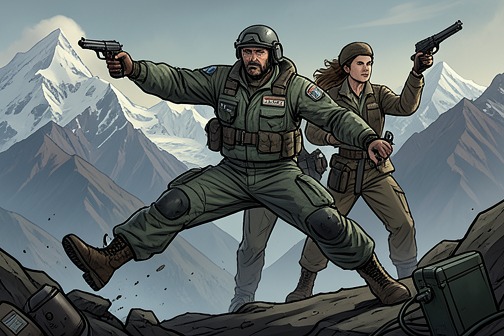
The canyon standoff is a turning point in which an armed encounter becomes an act of conditional trust. [Hig](entity:character-recall-character-hig-d3a63d339499) is fired upon from below and forced to choose between escalating the danger and making himself vulnerable. He signals that he can answer force with force, but ultimately comes down without requiring [Cima](entity:character-recall-character-cima-d8f38b98e6dd) or [Pops](entity:character-recall-character-pops-cfa1e015a695) to surrender their guns; the aftermath is not a victory over them, but a meal and an unnegotiated bargain.
## Background and Stakes
The encounter tests a survival logic Hig already knows from life with [Bangley](entity:character-recall-character-bangley-4599ee8c8ec5). Their airport refuge is defended by a perimeter, water, power, food, and firepower, with mountains nearby if game becomes scarce. Bangley sees this protected arrangement, and the simplicity of relying on just the two of them, as a basis for survival. The canyon brings Hig into contact with a family whose security also depends on being armed, but who cannot be treated as part of his established partnership.
Their difference is not simply whether danger exists, but how to respond to someone whose intentions remain uncertain. Bangley’s principle is to treat a visitor as guilty before evidence can make them safe; Hig favors allowing a visitor time to demonstrate that they are human. The standoff makes that disagreement concrete. Hig is not approaching an unguarded household: the people below have weapons and are prepared to use them, while he must decide whether their readiness makes negotiation impossible or makes restraint more consequential.
## The Encounter Turns
As Hig approaches, birdshot strikes his aircraft. Its left-side window is shattered, and he pulls the plane into a hard climb, passing close to low junipers at the rim before losing sight of the people below. Once he locates the shooters, he can make out a man aiming a rifle and a woman with a shotgun. The positions matter: the threat is deliberate, not a distant or accidental exchange, and Hig understands that he is being watched and targeted from the ground.
Hig answers with a display that combines warning and restraint. He puts out a message conveying that he could use overwhelming force but will not, then takes an [Egg of Death](entity:expression-recall-expression-egg-of-death-eed64904acf8) from his pocket, pulls its stiff pin, and throws it over the edge. The account establishes the action but does not describe its effect. In the sequence, the gesture sits uneasily beside the message: Hig makes the danger of escalation legible while also telling the people below that he is choosing not to attack them.
He then tells them they can keep their guns and that he is coming down. This is a consequential concession. Hig does not ask the armed pair to disarm before he exposes himself to them, and he gives up the immediate advantage of remaining above them. His decision does not erase the danger that prompted the climb or make trust automatic; it changes the terms of the encounter by placing his safety partly in their hands.
## Cima, Pops, and the Change in the Scene
On the ground, Pops orders Hig to stand. Cima intervenes, asking her father to let him up and saying that it is enough. Her request marks a change within the confrontation: the two people who appeared together as armed threats do not act as a single, unchanging force. Cima can challenge her father’s treatment of Hig, and Pops’s response to her intervention opens room for the encounter to move beyond coercion and suspicion.
The next clear change is ordinary but significant. Pops is present as the sun passes over the canyon rim, and Hig eats at a plank table in the shade. The meal is shepherd’s pie with salted ground beef and butter; a steel pitcher of milk has been chilled in the creek, and Hig empties it twice. Cima keeps bringing him food, and he continues eating. These details do not establish that all danger has disappeared. They show, instead, that the person who came down under threat is now being fed at the family’s table, and that the scene’s immediate terms have shifted from armed caution to hospitality.
## Outcome and Significance
The account describes the bargain as struck without even a negotiation. That phrasing gives the encounter its particular shape: neither a formal agreement reached through debate nor a settlement imposed by disarming the other side, it follows a series of visible choices. Hig declines to force the family to surrender its weapons; Cima speaks up for him; and the shared meal follows the standoff. The available evidence does not specify every term of the bargain, so its importance lies in the transition the narrative records rather than in an invented account of its contents.
The episode sets Bangley’s security code against Hig’s willingness to let a stranger’s conduct change his judgment. Its outcome does not prove that caution is unnecessary: Hig has been fired upon, and his first response includes a demonstration of potential force. But the scene refuses to make either suspicion or vulnerability an all-purpose answer. Hig’s choice to descend while the family remains armed allows a dangerous encounter to end, for the moment, in food and agreement rather than continued confrontation.
Event 16
Cima and Her Father Leave the Canyon Ranch
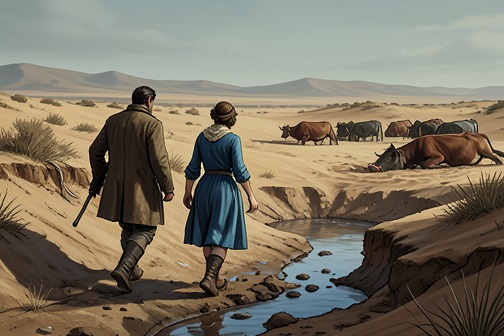
[Cima and Her Father Leave the Canyon Ranch](entity:event-recall-event-cima-8ba58137efee) is the departure forced by drought from a place [Pops](entity:character-recall-character-pops-cfa1e015a695) had devoted his life to preserving. As the creek dwindles and the ranch’s animals die, staying no longer means safety; leaving means risking a journey without reliable water. [Hig](entity:character-recall-character-hig-d3a63d339499)’s plane offers a way out, but only through a difficult evacuation that separates father and daughter briefly before bringing them together again.
## Drought and the Decision to Leave
The immediate cause is the drying landscape. When Hig asks why the family would leave its green canyon, the answer is drought: the previous summer, the creek nearly ran dry, and the family had to dig into its bed to collect enough water for drinking. Half the cattle died. The worsening heat had made the ranch’s apparent refuge increasingly untenable, while the same water shortage raised a larger uncertainty: if the mesa was drying, conditions beyond it might be worse.
The decision had been forming before Hig arrived. Pops and [Cima](entity:character-recall-character-cima-d8f38b98e6dd) expected they would have to leave, probably in spring, but did not know where to go. Their fear was practical rather than abstract: travel without water could be deadly, yet waiting at the ranch meant facing another dry season with fewer animals and less water. The creek and green meadow still offered the appearance of an Eden, but that appearance could not outweigh the losses already underway.
For Hig, environmental decline carries a wider history of disappearance. He remembers trout vanishing as streams grew too warm, and fears the loss of creeks as well as the loss of fish. His memory of surviving green woods and the sensory familiarity of flowing water make the ranch’s drought more than a logistical problem: it belongs to the same unfolding loss of the natural places on which he has relied for sustenance and solace. The departure therefore joins the family’s immediate need to move with the book’s accumulating evidence that familiar environments are changing beyond recovery.
## A Plan Built Around the Plane
Hig proposes taking Cima and Pops to [Grand Junction](entity:location-recall-location-grand-junction-cbb38d16297a) to inspect the tower and airport, obtain aviation fuel, and then fly back to [Bangley](entity:character-recall-character-bangley-4599ee8c8ec5). The plan depends on [The Beast](entity:object-recall-object-the-beast-2640dfb81090), a [Cessna](entity:organization-recall-organization-cessna-8fcca6f03805) 182 whose limited fuel and ability to take off from the meadow shape what can be attempted. Pops has worked out the aircraft’s approximate fuel capacity, consumption, and distances, and recognizes that Hig is near the flight’s return-fuel limit. His calculations do not remove the danger; they establish how narrow the margin is.
The evacuation also has to account for the ranch’s remaining animals. Cima and Hig decide to take two lambs, treating them as essential cargo rather than leaving them behind. They weigh one in a sling made from a shirt against a bucket of water; the balance indicates that the lamb weighs about seventeen pounds. The improvised measurement turns a tender, practical choice into a loading calculation. With Pops not aboard for the first takeoff, Hig judges the plane can manage the load, though the uncertainty remains.
Before departure, Pops leaves the canyon alone, before full light and without ceremony. He looks over the remaining cattle and their calves, the sheep and lambs, takes a light pack and his rifle, latches the gate, and walks downstream through the brush fence. The act is spare, but its cost is explicit: he is leaving the only life he has made for himself, bound to his family’s lineage across generations. The gate closes behind him on a ranch that cannot sustain that inheritance any longer.
## Cima’s First Flight and Pops’s Reunion
Hig loads Cima and the lambs and prepares The Beast on the meadow strip. The takeoff demands more than simply opening the throttle: the plane gathers speed across the cleared track, stays close to the ground to build airspeed, and lifts only near the trees at the end of the meadow. Cima signals readiness with a thumbs-up. Hig’s response is concentrated on the narrow physical demands of getting airborne with the animals aboard; the successful climb carries them out of the canyon, but does not yet reunite the family.
After crossing the river, Hig spots Pops sitting beside the road with his pack and rifle, waiting in the open. He lands across from him and brings the plane to a stop. Pops climbs in behind Cima, acknowledging the lambs as part of their new undertaking. The family is together again, now traveling west toward Grand Junction. This reunion changes the departure from an individual escape into a collective relocation, though their immediate destination remains a reconnaissance and fuel stop rather than a guaranteed permanent home.
## Significance
The sequence turns ecological deterioration into a concrete break with home. Drought first kills cattle and threatens drinking water; then it forces the family to abandon a ranch whose value is measured not only in shelter but in a way of life inherited across generations. Pops’s silent walk out through the gate gives that loss its most direct form, while the later pickup shows that leaving the place need not mean leaving one another.
The Beast’s role is correspondingly double. It is a fragile machine operating at the edge of its fuel and takeoff limits, yet it becomes the means by which Cima, Pops, and two lambs can attempt a future elsewhere. The animal cargo recalls the biblical Ark without making the journey secure: it is a small, improvised effort to carry life out of a failing refuge. The departure offers movement, not certainty, and ends with the family reunited in flight toward Grand Junction.
Event 17
Discovering the Ruins of Grand Junction
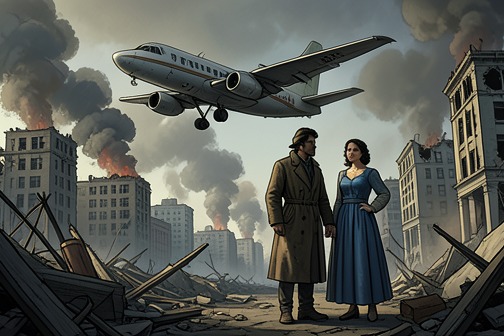
[Discovering the Ruins of Grand Junction](entity:event-recall-event-grand-junction-ad32c5c3f395) is the moment when the catastrophe that [Cima](entity:character-recall-character-cima-d8f38b98e6dd) escaped becomes a visible landscape rather than a receding crisis. Flying west with Cima and [Pops](entity:character-recall-character-pops-cfa1e015a695), [Hig](entity:character-recall-character-hig-d3a63d339499) looks down on a city still threaded with patches of living green but devastated by fire and death. Its ruined streets confront Cima with the destruction of a place she once knew as an ordinary destination, while the scene extends Hig’s private grief for lost species into a broader recognition of environmental and social collapse.
## Approach and Context
The discovery follows the family’s departure from the canyon ranch. Hig has landed near Pops, who boards behind Cima; with the lambs also aboard, the plane takes off west toward [Grand Junction](entity:location-recall-location-grand-junction-cbb38d16297a). The flight brings them from a small, precarious refuge into the remains of a city whose size and familiar infrastructure make the scale of the loss difficult to evade.
Grand Junction had been part of Cima’s ordinary life. She and Pops went there for major shopping, including supplies for their ranch, and sometimes for a weekend movie when the film in Delta did not appeal. The city was not an abstract place on the horizon: it was a practical destination connected to food, equipment, and leisure. From the air, those familiar uses are replaced by the sight of a city transformed.
The route also passes the far cliffs of [Grand Mesa](entity:location-recall-location-grand-mesa-afc5e2503bef), a landmark Hig associates with his earlier life. He and [Melissa](entity:character-recall-character-melissa-64b753949b14) had camped there, including for a week beside a lake far from any road, where trout seemed plentiful. That memory gives the flight a double register: the travelers are approaching a ruined city while crossing a landscape already marked in Hig’s mind by a lost version of the natural world.
## The City from the Air
Grand Junction spreads across the desert hills between two rivers, extending north toward the Book Cliffs. Hig sees its highways, streets, residential developments, cul-de-sacs, commercial roofs, parking lots, industrial area along the [Colorado River](entity:location-recall-location-colorado-river-0fc24e354866), railway lines, and warehouses. The aerial view presents the city as an extensive human system, but its familiar plan no longer signifies a functioning community.
The trees register a more uneven kind of survival. Many street trees that depended on watering are dead and skeletal, while others, rooted deeply enough to endure, remain in scattered green patches along the thoroughfares. Along the river parks, some of the oldest cottonwoods are only half alive, leafy on one side. This partial persistence contrasts with the widespread damage: life remains, but in fragments that cannot restore the city’s former order.
Fire has marked every part of Grand Junction. Cars appear scorched wherever they had been left: in side streets, mall parking lots, and on highways. Some stand in rows; others are scattered without any discernible pattern. Whole neighborhoods have burned down, while other buildings appear charred and melted. The wreckage makes the city look as though fire, rather than the flu, had swept through it, even though the broader disaster had already brought the old society to an end.
## Cima’s Recognition and the Human Remains
Cima had not witnessed the city’s final destruction. She and Pops left when conditions were worsening but broadcasts still carried news of the crisis. Hig recalls a progression from exhausted presenters to frightened and increasingly depleted reporters, as colleagues disappeared into hospitals and makeshift flu wards or were no longer heard from. The reporting grew more frantic before being cut short by disorder. For Cima, the view from the plane fills in an ending she had escaped without seeing.
The clearest evidence of that ending is not a single ruined building but the human remains scattered through the city. Bones lie in heaps and across the ground; Hig observes that scavengers have gathered and dispersed them. Their scale is visible even from the aircraft. The city’s wide roads and industrial districts once organized movement and work; now the remains of its inhabitants register a different, brutal order, in which the dead have been left to scavengers.
Cima is physically overcome by what she sees. Her reaction connects the aerial spectacle to personal recognition: this is the place where she shopped, obtained farm supplies, and went to the movies, not merely an abandoned urban landscape. The scene turns the city’s ruin into an encounter with the destruction of a world she remembers, while Hig’s perspective makes him a witness to what she did not see as it happened.
## Ecological Loss and Narrative Significance
The city’s burned neighborhoods and damaged trees echo losses Hig has already associated with the wider environment. He mourns the disappearance of trout from streams that have become too warm, and he has described the disappearance of other animals as a source of grief. In the mountains he still fishes for carp and suckers, but their presence does not undo the absence of trout. The ruins of Grand Junction broaden that pattern: the signs of survival are real, yet they coexist with irreversible-looking losses.
Hig’s concern about changing seasons sharpens the contrast. In mid-April, a warm spell feels unsettling against older expectations; in some recent winters, the peaks have held almost no snow. He fears the loss of creeks as well as the loss of fish. Grand Junction’s dead street trees and surviving cottonwoods place that anxiety within the city itself: drought and dependence on watering have left some trees dead, while others endure only in patches.
The discovery therefore makes no clean distinction between human ruin and ecological decline. Fire-scarred cars, heaps of bones, skeletal trees, and surviving green canopies occupy the same view. The city remains legible—its roads, parks, shops, and industrial districts can still be recognized—but recognition offers no restoration. For Cima, the flight reveals what happened to a familiar place after she left; for Hig, it joins the visible destruction of human settlement to the losses he has been grieving in the forests and streams.
Event 18
The flu pandemic
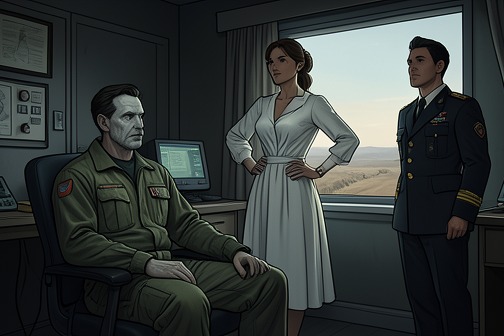
[The flu pandemic](entity:event-recall-event-the-flu-pandemic-6f5ab7d0baf5) is the cataclysm behind the novel’s emptied world, killing nearly everyone and leaving survivors to face a second disease, failed institutions, and a landscape altered by ecological loss. Recounted by [Hig](entity:character-recall-character-hig-d3a63d339499) nine years after the outbreak, it is less a single bounded crisis than the dividing line between the old world and a precarious present whose damage continues to unfold.
## Outbreak and Human Toll
Hig describes the flu as having killed almost everybody. He places his own severe illness within that history: he remembers two straight weeks of fever, including three days at 104 to 105 degrees, and wonders whether it affected his mind. His account conveys survival without claiming full recovery; under stress, his thoughts can feel dislocated and difficult to trust.
The flu was followed by a blood disease that killed more people. Among the survivors Hig knows are about thirty members of a [Mennonite community](entity:organization-recall-organization-mennonite-commun-13e2a9df0f58) ten miles south of his airport. He understands the disease as a slow-burning plague, though he can only compare it tentatively to AIDS and is unsure how contagious it is. Children are born with it, remain sick and weak, and some die each year. The continuing losses make clear that the pandemic’s aftermath is not a clean return to life for those who escaped the initial outbreak.
## Collapse of Care and Communication
The failure of medical care appears in Hig’s recollection of [St. Vincent’s Hospital](entity:location-recall-location-5a0af4236b00) across the lake. Orange helicopters had landed there, but as conditions worsened, Hig and [Melissa](entity:character-recall-character-melissa-64b753949b14) went to a building taken over by the hospital that was filling with the dead. The institution remained a destination, yet could no longer offer a way out of the crisis.
[Cima](entity:character-recall-character-cima-d8f38b98e6dd)’s memories of the final period show how public communication dwindled alongside medical capacity. Television anchors and field correspondents grew exhausted, then frightened, as colleagues disappeared into hospitals and makeshift flu wards or were no longer heard from. The reports became more frantic before they were cut off by mayhem. The broadcasts persisted for a time as evidence of an effort to keep informing people, even as the systems around them failed.
## Flight, Violence, and Survival
As the crisis intensified, [Pops](entity:character-recall-character-pops-cfa1e015a695) and Cima left their ranch at night with livestock, horses, dogs, and supplies. In the fifteen miles toward the creek road, Pops encountered three barricaded ambushes; farther on, he killed three attackers in the cedar hills. One horse and two sheep were shot during the escape. The losses made it harder to disguise their departure as an ordinary seasonal move. Once they reached the canyon, Pops and Cima returned downstream and used dynamite to destroy the ford, making the route impassable to vehicles.
The departure shows how the breakdown of ordinary life turned movement into a dangerous undertaking and self-protection into a necessity. It also records a different kind of response from Hig’s airport partnership with [Bangley](entity:character-recall-character-bangley-4599ee8c8ec5): rather than defend a fixed perimeter, Pops and Cima carried people and animals away from an exposed home and made their route harder to follow. Their choices belong to the same unsettled aftermath, in which safety depends on local judgment rather than dependable public protection.
## Ecological Aftermath and the Long Present
The pandemic’s human toll is set beside losses whose causes are not simply attributed to the flu. Hig mourns the disappearance of every trout he once fished for, and recalls other vanished animals, including tigers, elephants, and several kinds of bird and whale. He connects the loss of trout to streams growing too warm. By mid-April, seasonal expectations have weakened: mountain snow is less reliable, and for two successive years the peaks had held almost none. The prospect of losing the creeks frightens him even more than attacks or disease.
Fishing makes this ecological change personal and specific. Hig still visits mountain streams, but fishes for suckers and carp where trout once lived, learning to eat fish he once disliked. Later he catches five carp and recognizes that they, too, are starving; he releases them carefully and stops fishing. The change is not presented as a recovery of what vanished. It is a small act of care within a diminished environment, where even the species that filled the trout’s former niche are vulnerable.
Hig’s memories of surviving places preserve another measure of what has been lost. In a stretch of forest that has not died or is beginning to return, he sets down his pack, kayak sled, and rifle, assembles the four pieces of the [Sage pack rod](entity:object-recall-object-sage-0ab2cb0dd80a) his father gave him at sixteen, and listens to the creek. Such moments do not undo the pandemic or environmental decline; they show what remains valuable to him amid them. Years later, he hears two 747s pass overhead and calls repeatedly over the radio, but receives no reply. The planes establish that aircraft still cross the sky, not that the old social world has returned. The pandemic’s defining consequence is this unresolved distance between signs of life and the possibility of connection.
Event 19
Hig Flies Beyond His Return-Fuel Limit in Search of Survivors
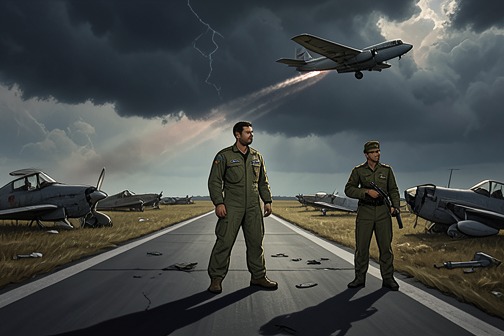
[Hig Flies Beyond His Return-Fuel Limit in Search of Survivors](entity:event-recall-event-hig-76581c236a23) marks a decisive movement from guarded survival toward the possibility of connection. [Hig](entity:character-recall-character-hig-d3a63d339499) risks crossing the aviation threshold beyond which he cannot be sure of enough fuel to get home, looking for someone beyond the people and routines he already knows. The search brings him to a canyon, but its deepest motive remains difficult even for him to explain.
## Background and Stakes
Hig’s flight grows out of an existence organized around survival but not satisfied by it. At the airport, his uneasy alliance with [Bangley](entity:character-recall-character-bangley-4599ee8c8ec5) divides their work: Hig watches the perimeter from the air, while Bangley supplies the force Hig is reluctant to use. Hig also makes regular trips into the high country with [Jasper](entity:character-recall-character-jasper-a1e1f2fe4259), seeking fish and clean air, and helps a nearby [Mennonite community](entity:organization-recall-organization-mennonite-commun-13e2a9df0f58). Those acts show that his attention extends beyond immediate defense; he wants contact with other people and a life not reduced to warding off danger.
The journey carries a distinct risk because the point of no return is a real fuel limit, not merely a figure of speech. Flying beyond it means that the margin for returning is gone. The flight therefore puts Hig’s own safety against the possibility that he may find someone: the very outcome he hopes for cannot be guaranteed, while the cost of searching is immediate.
## The Search and Its Unanswered Motive
Hig flies beyond that limit in search of survivors. The journey brings him to the canyon where [Cima](entity:character-recall-character-cima-d8f38b98e6dd)’s father asks why he came there and why he crossed the return-fuel threshold. Hig cannot find an answer. The silence does not establish a hidden plan or a single conscious motive; instead, it leaves the act suspended between a search for other people and a longing for connection that Hig himself cannot readily put into words.
That uncertainty gives the flight its emotional force. Hig has already shown, through his visits to the Mennonite community and his repeated high-country excursions, that survival alone does not meet his needs. Yet crossing the threshold makes that dissatisfaction consequential: he does not merely wish for a wider human world but exposes himself to danger in the attempt to find one.
## Ecological Loss and the Meaning of Risk
The search takes place against a landscape where familiar forms of life are disappearing. Hig mourns the loss of trout as mountain streams warm, and the changing seasons unsettle the old expectations of snow and thaw. His attention to ecological decline is not separate from his loneliness: the loss of species and places is part of the diminished world in which he is trying to find a reason to keep reaching outward.
The novel does not make the flight a simple triumph or provide Hig with a neat explanation for his decision. Instead, its unresolved motive connects the practical danger of aviation to a wider question: whether a person can continue to live by self-protection alone. Later, Hig takes [Pops](entity:character-recall-character-pops-cfa1e015a695) up in the Beast and points out the tower, river, cutbank, ford, berm, and the distances around their home. That later flight is a concrete use of aviation to share knowledge and orient another person, in contrast to the earlier journey whose purpose Hig cannot fully name.
Event 20
Pops and Cima Flee into the Canyon
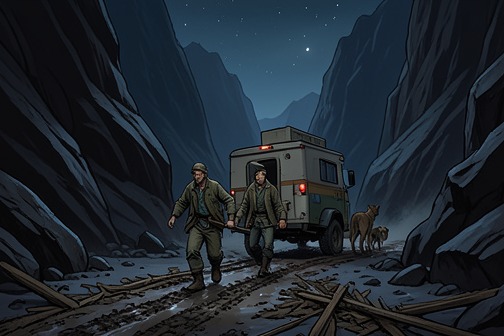
[Pops and Cima Flee into the Canyon](entity:event-recall-event-pops-cima-dffe54a1c727) is their covert departure from the ranch and the beginning of their effort to shelter in the canyon. They moved with a substantial supply of animals and provisions through armed danger, then made the route behind them difficult to follow or use. The escape was not a single dash to safety but a sequence of practical decisions: travel at night, reach the canyon, destroy the ford, conceal their tracks, and let the weather further obscure them.
## Departure Under Threat
Sometime as conditions deteriorated, [Pops](entity:character-recall-character-pops-cfa1e015a695) and [Cima](entity:character-recall-character-cima-d8f38b98e6dd) loaded a gooseneck cattle trailer and towed a smaller trailer for the four-wheeler. They left the ranch in the middle of the night with a dozen cattle, about as many sheep, two saddled horses, two Australian shepherds, and provisions. Their departure carried the necessities of a working ranch into flight: livestock and equipment were not incidental cargo but part of the move they had to protect and manage.
The first fifteen miles to the creek road brought three barricaded ambushes. Pops fought through them, then shot three attackers farther on in the cedar hills. Violence was therefore part of the route rather than a surprise at its end. The danger also exacted a cost: attackers shot one horse and two sheep inside the trailer, making it harder to pass off their journey afterward as an ordinary drive moving cattle to a summer lease.
## The Journey Into the Canyon
After the attack, the pair continued with Pops on horseback and Cima driving the ATV, which pulled a small trailer of gear and supplies. Cima would have preferred riding; she was uncomfortable on four-wheelers. But Pops was skilled at hazing and herding livestock from the saddle, and the dogs were accustomed to taking his orders there. Their different roles answered the immediate demands of the escape: Pops managed the animals while Cima transported equipment and provisions.
They traveled twelve miles into the canyon. The distance marks a transition from exposed road to a more defensible destination, but reaching it did not end their precautions. The following morning, they walked back downstream to alter the route by which they had arrived.
## Concealing Their Route
Pops used dynamite to destroy the one ford across the creek. Afterward, the crossing was impassable except on foot or horseback, and then only when the water was low. This deliberate obstruction made pursuit harder by removing the easiest route through the creek, while leaving only limited ways to cross.
They also swept away their tracks as best they could, thoroughly obliterating them for two miles before leaving the rough road for the creek trail and canyon. The work took all day. Two days later, heavy rain added another layer of concealment. The escape thus extended beyond reaching shelter: Pops and Cima spent time and effort reducing the chance that anyone could follow the trail to them.
Event 21
Wire-Trap Ambush at Grand Junction Airport
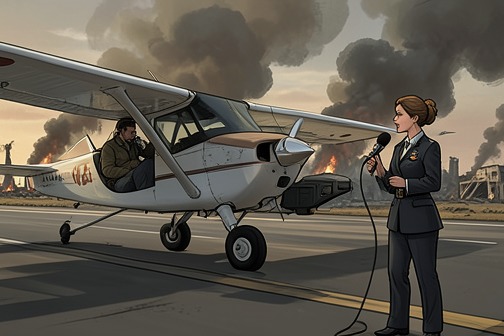
The [Wire-Trap Ambush at Grand Junction Airport](entity:event-recall-event-grand-junction-05058e63d13a) turns [Hig](entity:character-recall-character-hig-d3a63d339499)’s long-awaited return into a test of recognition and survival: the airport first speaks in the reassuring language of normal operations, then reveals that its welcome is bait. The runway trap nearly ends the flight before Hig and his companions can discover who is waiting in the tower and what happened to the people drawn there before them.
## Approach and the False Welcome
Six miles from [Grand Junction](entity:location-recall-location-grand-junction-cbb38d16297a), nine hundred feet above the ground and aiming for the airport, Hig calls the tower on the frequency saved in his GPS. [Three years](entity:time-recall-time-three-years-2c8a8472e317) earlier, that channel had carried the beginning of a message; now, after nine years away, it answers with static and then a woman’s voice. She gives wind information and clears his [Cessna](entity:organization-recall-organization-cessna-8fcca6f03805) to land on runway 29. The exchange is formal and precise, like an ordinary day at the old airport. For Hig, that practiced normality briefly opens an impossible alternative: that his wife and dog are alive, his wife still pregnant, and he is simply returning from a short flight.
The signs below complicate that imagined homecoming. Grand Junction is burned and devastated, though patches of green remain, and the airport’s beacon pulses against the ruined landscape. Hig notices that the light is operating in clear daytime conditions, but the beacon alone does not prove danger: airports such as Erie have power, and some use solar and wind energy. The deeper unease comes from the contrast between the apparently functioning airport and the wrecked city around it. As the plane descends, Hig sees damaged hangars, wrecked aircraft, and a large jet at the far end of the runway. At first, the scene resembles the weather-battered airfields he knows; then the scorched planes register as crash wrecks, not aircraft torn loose by wind.
Only about thirty feet above the ground, Hig abandons the landing flare. He hauls back on the yoke, opens the throttle, and climbs sharply away from the runway. The lambs cry out in the plane as he spots a taut cable rising beneath them, its position suggesting that the wheels missed it by roughly ten feet. The trap confirms that the airport’s welcome was a setup. Hig’s escape is immediate but not secure: the fuel gauge shows only two gallons, at most ten minutes of flight, leaving him little room to avoid the people who laid the cable.
## Forced Landing and the Move Toward the Tower
With almost no margin left, Hig commits to another approach, driven by anger at the betrayal behind the false clearance. He lands fast, touching down about a hundred feet beyond the cable, and follows [Pops](entity:character-recall-character-pops-cfa1e015a695)’s directions to taxi behind the second building west of the tower. The voice on the radio praises the landing, but its tone has changed: it sounds frayed and hard, then breaks into sustained laughter and calls Hig the first. The remark turns the trap into a deliberate ritual of welcome and humiliation, while leaving unclear what happened to earlier arrivals.
Hig shuts the plane down in the cool shadow of [Big River Flight School and Authorized Cessna Service Center](entity:location-recall-location-big-river-flight-sch-06d7dddbfc54), close enough to the wall that the tower occupants cannot see them or aim at them. [Cima](entity:character-recall-character-cima-d8f38b98e6dd) remains buckled in, stunned; when Hig opens her door, he sees her hand pressed against the panel above the oil-pressure gauge and a fresh bruise spreading along her forearm. The danger is no longer an abstract threat on the runway. The burned city, the baited landing, and the unseen people controlling the tower have made the place itself part of the shock.
Hig gives Cima a gun and tells her to shoot anyone approaching who is not him or her father. He takes the [AR-15](entity:object-recall-object-ar-15-d110eba5cfb8) and handheld radio, retrieves [Bangley’s grenades](entity:object-recall-object-bangley-s-grenades-7fbe8d2a57ee) from beneath a lamb, and moves with Pops along the building wall to stay out of the tower’s sightline. Hig recognizes the tension in his own plan: [Bangley](entity:character-recall-character-bangley-4599ee8c8ec5) taught him the value of silence and overwhelming firepower, but he also considers that talking to an enemy can sometimes be useful. Before they cross the exposed ramp toward the brick FBO offices and adjoining hangar, they pause to assess the dark windows and rear metal door.
## The Tower’s Welcome Revealed
Pops leads the ascent in a deliberate room-by-room clearance, checking each of the tower’s five levels while Hig covers the stairwell. At the locked control-room door, Pops shoots the lock and pushes inside. The expected human threat is there, but so are cats: they scatter over radar keyboards and communications panels, bristling and hissing among dark screens. Their panicked movement and the room’s green-tinted light make the control room feel less like an operating airport than a sealed, disturbed world.
An old man lies beneath the cantilevered windows, choking and crying as he holds his spilled entrails. His rifle is nearby; his cap identifies him with the Peoria Jet Center, suggesting that he came west from the heartland seeking safety from the flu and instead helped turn the airport into a trap. Before Hig can make sense of the scene, an old woman cries out for Samuel. [Aunt Bee](entity:character-recall-character-aunt-bee-7274ba94c53b) stands beside a spotting scope, frozen in a lunge toward the wounded man, apparently her husband. Pops shoots her in the forehead. The violence stops her cry, but leaves the old man alive and begging to be finished. When he pleads for Pops to shoot him, Hig refuses; Pops then shoots him.
The bodies answer some questions about the tower while sharpening others. Looking out before fleeing the cats, Hig sees solar panels covering the Jet Center roof, a likely source of power for the water, fuel, radios, and beacon. The nearby gas pumps lie within easy range of the tower, and the arrangement suggests how the occupants could control access to the airport. Hig cannot know exactly what happened to those who approached before him, but recognizes the possibility that they were shot from a distance or lured closer by Aunt Bee’s performance of a concerned, helpful stranger. The landing trap was not an isolated hazard: it belonged to a system designed to exploit the appearance of welcome.
Before leaving the tower, Pops insists that Hig see the third-floor apartment. Inside, the immaculate bedroom and carefully made bed, complete with a plush bear on the pillow, evoke a retiree’s recreational vehicle preserved in miniature. The living room is stranger: its walls display caps from flight schools and aviation-service businesses across the country, alternating with shelves of eyeglasses and crudely stuffed birds. The neat domestic room and the obsessive collection make the tower’s occupants more than anonymous attackers, without softening what they did. Their refuge held traces of an ordinary life, but its beacon and radio voice had become instruments of a lethal ambush.
## The Signal’s Reversal
The ambush reverses the meaning of the signs Hig had trusted. A tower answering its radio, a beacon flashing above the airport, and a controller following standard procedure once seemed to promise that people and ordinary civic life had endured. At Grand Junction, those same signs mask a threat. Even the airport’s practical infrastructure—power, fuel, and communications—serves the people controlling access rather than guaranteeing safe arrival. The welcome is persuasive precisely because it resembles the world Hig has spent years hoping to find.
The apartment’s carefully preserved domestic order sharpens that reversal. A made bed, plush bear, aviation caps, spectacles, and stuffed birds offer tangible traces of lives and interests that persisted within the tower. They do not explain the couple’s actions, but they prevent the site from resolving into a simple opposition between human refuge and monstrous threat: ordinary keepsakes coexist with a runway trap and lethal violence. Hig’s return therefore yields recognition without homecoming. The signal was real, and the airport was functioning, but neither fact meant that the people answering it would receive him in safety.
Event 22
Attack on Bangley's Stronghold
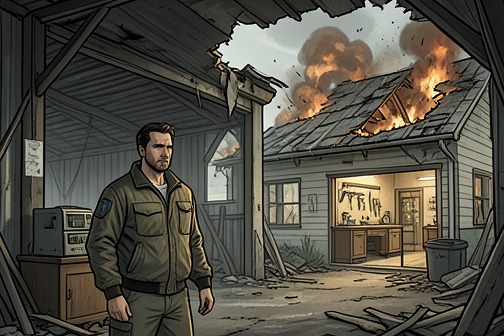
The attack on [Bangley](entity:character-recall-character-bangley-4599ee8c8ec5)’s stronghold is first encountered through its aftermath: [Hig](entity:character-recall-character-hig-d3a63d339499) returns to a damaged Erie and discovers that Bangley has survived a daytime assault only to be left gravely injured. The event changes Hig’s understanding of his companion’s apparent calm. Bangley had not been relaxed because he failed to see danger; from his house, he could survey much of the airfield and assess a threat before moving to meet it.
## Damage and discovery
Hig approaches the runway over the low but still-running river. From the air, he sees burned houses, foundations, and one side of his hangar torn open and burned. The familiar airport perimeter has become a record of an attack. The scale of the damage turns his return into an urgent search for whoever remains, rather than a simple arrival home.
Bangley’s house, about a hundred yards north, is still standing, but it has been hit. Its windows are gone, the dormer on the second floor is splintered, and scorch marks surround it; a large opening breaks the roof beside it. The house is recognizable by the gunsmith shop in its sunken living room and photographs of a blonde family skiing. Those domestic details sit alongside the damage, making the building both a familiar place and evidence of the violence that reached the airport.
Hig runs upstairs, where he has never been before, following the hallway past photographs of the family skiing, sailing, and spending time in a bungalow among palm trees. He stops to orient himself toward the front of the house and opens a partly closed door. The movement through these rooms is also a movement into a perspective he had not previously considered: Bangley’s position upstairs offered a commanding view of the ground he and Hig were trying to defend.
## Reconstructing the assault
From the upper room, Bangley could see across the low berm where Hig slept with [Jasper](entity:character-recall-character-jasper-a1e1f2fe4259), toward the dumpster they had moved away from Hig’s house, along the rusted aircraft, and toward the FBO building and Hig’s hangar. Hig recognizes that the decoy house and the approaches to the hangar were visible from this vantage. The view explains why Bangley chose the room and why he could respond to an alarm with a clearer picture than Hig had imagined.
The attack came during the day, a circumstance Bangley had not expected. The assailants approached from the front. He survived their initial burst and fought them until they retreated; then he went upstairs to gain a better view and angle. Hig estimates that only a couple of the attackers may have been armed, but this is his conjecture, not a confirmed count. Later, when Hig offers a rough estimate of the group, Bangley answers with the numbers fourteen and four. The exchange establishes that Hig had underestimated the assault, while the precise meaning of those two numbers is not clarified in the account.
Hig’s discovery of Bangley’s vantage point also revises earlier encounters. When Hig had used a nighttime intruder alarm, Bangley could have watched the whole scene from upstairs, including the people behind the dumpster and those farther back. Hig now understands that Bangley may have known what was happening before walking out to the berm. His seeming ease was not necessarily indifference or a lack of surprise; it could reflect preparation and a better view of the threat.
## The defense and its cost
Bangley did not remain in the house throughout the fighting. In his later account, he says that he believed the attackers had trapped him there and that he thought he was going to die. He used the grenade launcher against them in the house, then took two more on the way to the hangar. His account identifies a sequence of resistance, withdrawal, and continued defense, but does not establish every movement or the attackers’ losses beyond what he reports.
Hig finds Bangley behind Red Square, the massive red rolling tool chest that he and Bangley had moved together from the service-center hangar. The chest had been given a place of honor against the north wall; now it has shifted away from the wall, and Bangley’s work boot is visible behind it. His grenade launcher lies nearby, the one he had been working on. The familiar workshop object becomes a marker of the attack’s aftermath and of the defensive work carried out there.
Bangley is badly injured and unable to explain what happened when Hig first finds him. He is lying on his favorite rifle, with his left hand over its trigger guard. The scene joins the practical objects of their shared life—the tool chest, the weapon under him, the launcher beside him—to the immediate fact that the person who maintained the stronghold can no longer defend himself. Hig’s discovery turns the defense into a rescue.
## Survival and aftermath
Bangley remains in critical condition for more than two weeks. [Cima](entity:character-recall-character-cima-d8f38b98e6dd) decides not to move him and sets him up on a couch in the hangar. She treats a shattered leg and a wound in his side, and helps him take water and Sprite with a turkey baster. The hangar is hot in the afternoon, though its open door and a hole in the west wall allow some relief. Recovery is slow: it takes four days for Bangley to register Hig’s face, and he lapses into a coma-like state between brief periods of awareness. On the sixth day, he opens his eyes while Cima is feeding him.
Bangley survives. His later recollection supplies information Hig could not obtain from the ruined buildings alone: the assault began in daylight, he fought the attackers from the house, used the launcher, and continued fighting as he made his way to the hangar. The event therefore has two stages in Hig’s understanding. First, wrecked buildings and Bangley’s condition reveal the cost of the attack; only later does Bangley’s account disclose the scale and course of his resistance.
## Significance
The assault exposes both the strength and the limits of the defenses Hig and Bangley have built around the airport. Bangley’s elevated view gave him an advantage, but it could not prevent the attackers from reaching his house or leave him unharmed. The house, hangar, and runway are not secure simply because they have been watched and prepared; their survival depends on constant attention and on people able to act under pressure.
For Hig, the most consequential discovery is not only that Bangley fought, but that he had been observing the perimeter with a precision Hig did not recognize. The attack makes visible a part of their partnership that had been hidden in ordinary routines: Bangley’s strategic watchfulness, and the degree to which Hig had relied on it without understanding its full reach. Yet the outcome also reverses their usual positions. The defender who could cover the airport from above becomes dependent on Cima’s care and Hig’s return. The stronghold survives in damaged form, and Bangley survives within it, but neither result makes the attack a victory without cost.
Event 23
Cima Treats a Mennonite Family
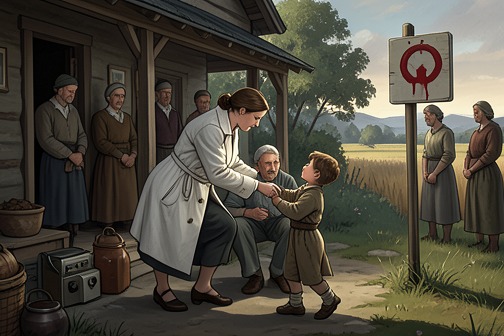
[Cima](entity:character-recall-character-cima-d8f38b98e6dd)’s visit to the Mennonite families turns a line maintained for safety into a place of contact. At [Hig](entity:character-recall-character-hig-d3a63d339499)’s invitation, she crosses the quarantine boundary, introduces herself as a doctor, and treats the sick and injured in an old farmhouse. The encounter brings medical care to people long kept apart, while exposing the tension between the fear that has protected them from attackers and the fear of contagion that has isolated them from help.
## Background and the Quarantine Line
Hig estimates that about thirty Mennonites live south of his airport. They have suffered a blood disease that appeared after the flu pandemic; it affects adults and children, and some members of the community die each year. Hig describes the illness as slow-burning and says that children are born with it, sick and weak. Its presence has made the families vulnerable, but it has also shaped how others approach them: signs warning of blood along the edges of their fields encourage outsiders to stay away.
The families’ isolation is therefore both a response to illness and a defensive barrier in a dangerous landscape. The warning signs frighten off potential attackers, helping preserve the community’s lives even as the disease continues to kill them. Hig and [Bangley](entity:character-recall-character-bangley-4599ee8c8ec5) have treated the families as distant neighbors, keeping their own security perimeter separate from the settlement. That arrangement leaves the Mennonites exposed to illness and in need of care, while making the risks of contact seem uncertain.
Cima has medical expertise: when asked what kind of doctor she is, she identifies herself as an internist in public health. The broader origins of the pandemic remain unsettled in her account. Press reports blamed the outbreak on a superbug mutation combined with bird flu and initially associated its origin with New Delhi; a rumor instead placed its origin at Livermore, where a sample was supposedly being transported to England before a military aircraft crashed in Brampton. These stories do not establish the cause of the families’ later illness, but they place Cima’s work in a world where both disease and reliable knowledge about it have become difficult to separate from rumor.
## Crossing the Boundary
Cima wants to visit the families as soon as she arrives with [Pops](entity:character-recall-character-pops-cfa1e015a695). Hig takes her there, and they land on the drive. People gather along the quarantine line in the yard: some run toward the visitors, while others can barely walk. As Cima approaches, their expressions change from wary attention to surprise. Hig observes their widened eyes and open mouths, then sees the children watching her with curiosity and apprehension.
Cima steps across the [DMZ](entity:expression-recall-expression-dmz-7826cdcd3ce6). The group recoils by half a step, opening space around her, and she raises a hand to reassure them. She tells them she is a doctor, then gives her name. The introduction does not erase the risk they associate with contact; the families have just seen a stranger enter the space they have been taught to guard. But the exchange changes the meaning of the boundary. It is no longer only a line that separates the sick from visitors: it becomes the threshold Cima crosses to offer care.
The children soon approach her. They reach for her skirt, and one young girl clings to her leg. Hig recognizes the significance of the gesture in a community whose members have been treated as untouchable. Cima greets the children and asks their names. Their first contact with her is physical and immediate, preceding any detailed explanation of disease transmission. Hig is worried about the exposure, but he also sees the families’ welcome and considers the sight worth the risk.
## Medical Work in the Farmhouse
Cima establishes herself in a room of the old farmhouse that had once served as a parlor. Wearing latex gloves, she examines the people one at a time, calling the next patient in from the kitchen. Her work is practical and varied: she stitches serious cuts, dresses wounds, and asks for buckets of warm water. She also counsels a young woman who is six or seven months pregnant and consoles an older man whose crying can be heard from outside the screened kitchen door.
The sequence makes her medical role concrete rather than merely declarative. Her medic bag supplies the gloves she needs, and she moves between treatment, advice, and comfort as the patients come to her. Hig watches from the farmhouse and reports that Cima tells him he may cross over and mingle with the families: in her understanding, the danger has been misperceived. She compares transmission to hepatitis C and to the former understanding of HIV, emphasizing fluid and blood rather than ordinary proximity. The account presents this as Cima’s medical explanation, not as a guarantee that the illness poses no risk.
The visit also reveals the cost of the community’s isolation. Their illness is visible in their weakened bodies and exhausted movements, yet the warning signs that deter strangers have made it harder for them to receive help. Cima’s treatment does not cure the disease or undo those losses. It does, however, bring medical attention across a boundary that fear had made seem impassable.
## Aftermath and Significance
Hig and Cima fly back in silence. That night they lie close together outside, watching clouds over the mountains. In the quiet afterward, Cima recalls studies from the end of the pandemic era. They suggested that the autoimmune disease’s onset could be accelerated by a breakdown in the body’s ability to produce vitamin D, a mechanism she describes as curious and only tentatively comparable to AIDS through its effects on T cells. The evidence remains qualified: the studies offered a possible explanation, not a settled account of the disease.
The farmhouse visit thus joins immediate care to the larger uncertainty surrounding the pandemic and its aftermath. Cima can treat wounds and explain what she believes about transmission, but neither she nor Hig can claim complete knowledge of the families’ illness. Her willingness to cross the line nonetheless challenges the assumption that distance is the only form of protection. The encounter’s decisive change is social as well as medical: people who have been marked as dangerous to touch accept Cima’s approach, and Hig witnesses contact replace separation, at least for the duration of the visit.
Event 24
747s Fly Over Erie
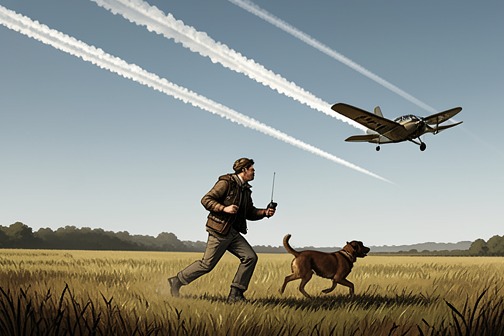
The overflight of two 747s over Erie breaks a silence that [Hig](entity:character-recall-character-hig-d3a63d339499) has come to treat as the world’s condition. He hears the jets while working in the garden, then runs to the Beast and calls them repeatedly on the radio. They never answer. Their later returns turn a startling sight into a pattern, but not into contact: the aircraft offer evidence of a world still moving beyond his horizon, without telling him who is aboard or whether anyone can hear him.
## The First Overflight
On or about July 4, Hig is killing potato bugs in the garden. [Cima](entity:character-recall-character-cima-d8f38b98e6dd) is spending the day with the families, where she is administering a vitamin D infusion for the children. On the porch of Hig’s house, [Bangley](entity:character-recall-character-bangley-4599ee8c8ec5) and [Pops](entity:character-recall-character-pops-cfa1e015a695) are playing chess; Bangley’s cane rests against the rail, and their game has become part of the household’s ordinary rhythm. Then Hig hears a familiar sound. He has heard it so often that he does not look up immediately. Only after realizing how long it has been does he turn toward the sky and see two parallel vapor trails, one following the other, with the sound of engines receding.
Hig runs to the Beast, switches on the radio, and searches frequencies with a Narco scanner. The numbers cycle through static until a voice breaks through. He hears conversation and laughter in Arabic, and gathers that the aircraft are heading west at thirty thousand feet, probably toward California. The voice is not an answer to him: Hig calls out to the two 747s, identifying Erie and repeating his appeal, but receives no reply. From that altitude, he reasons, their airport would be difficult to distinguish from the surrounding decaying infrastructure. The jets disappear, leaving him stunned and uncertain whether their passage is good news or bad.
## Recurrence Without Contact
A week later, at approximately the same time, two more aircraft pass. Another pair follows the next week. By the fourth week, Hig and the others have begun gathering on the porch in the afternoon, waiting for the sight as if it were a scheduled public occasion. That week, nothing comes. The small communal ritual makes the flights feel less like isolated sightings and more like a possible signal, but the missed appearance offers no explanation. In September, two more pass overhead. Hig calls again; they never answer.
The evidence accumulates in a peculiar form: aircraft, voices, direction of travel, and repeated passage, but no exchange. The jets demonstrate that pilots are flying across the region and that their transmissions can sometimes be heard. They do not establish where the planes began, who is on board, or whether their occupants know that anyone is calling from Erie. Hig’s repeated attempts therefore end in the same unresolved gap between hearing and being heard.
## What the Flights Might Mean
The overflights matter because they make survival beyond Erie imaginable, not because they confirm it. Cima proposes that the people aboard may have immunity, or that immunity could belong to a race or clusters of people; she also suggests that an entire tribe might have been spared. Her explanation is a possibility, not information verified by the aircraft. The Arabic conversation supplies a clue to the world the planes traverse, while the unanswered calls prevent that clue from becoming a meeting or a reliable account of life elsewhere.
That uncertainty has particular force in a life shaped by losses that cannot be called back. Hig remembers the trout vanishing from the streams as water grew too warm, and the old seasonal measures becoming little more than nostalgia. He still goes into recovering forest to fish, carrying his [Sage pack rod](entity:object-recall-object-sage-0ab2cb0dd80a), but even the remaining carp are eventually gone. Against this history, the vapor trails are not proof that nature or society has recovered. They are a brief sign of motion above a damaged landscape, and a reminder that the future may contain people Hig cannot reach.
## Narrative Significance
The event is presented through Hig’s practical response: he recognizes the sound, runs to the Beast, works the scanner, and calls until the aircraft are beyond reach. The sequence converts an ordinary afternoon—gardening, medical care among the families, and a porch chess game—into a moment of collective waiting. Later afternoons repeat that expectation, giving the flights a place in the group’s shared calendar without resolving their meaning.
The overflights thus change the scale of Hig’s isolation without ending it. Before the first pair appears, the airport and its nearby relationships form the limits of what he can directly know. Afterward, there is a larger world overhead, communicating at a distance in a language he recognizes but cannot turn into conversation. Each unanswered call confirms both that others may still be out there and that their presence alone cannot make them reachable.