opening
Dick Comes to Stay
Jo, Bessie, and Fanny learn that their cousin Dick is coming to stay because his mother is ill. They prepare a bed and make room for him, eagerly anticipating the chance to introduce him to their secret world.
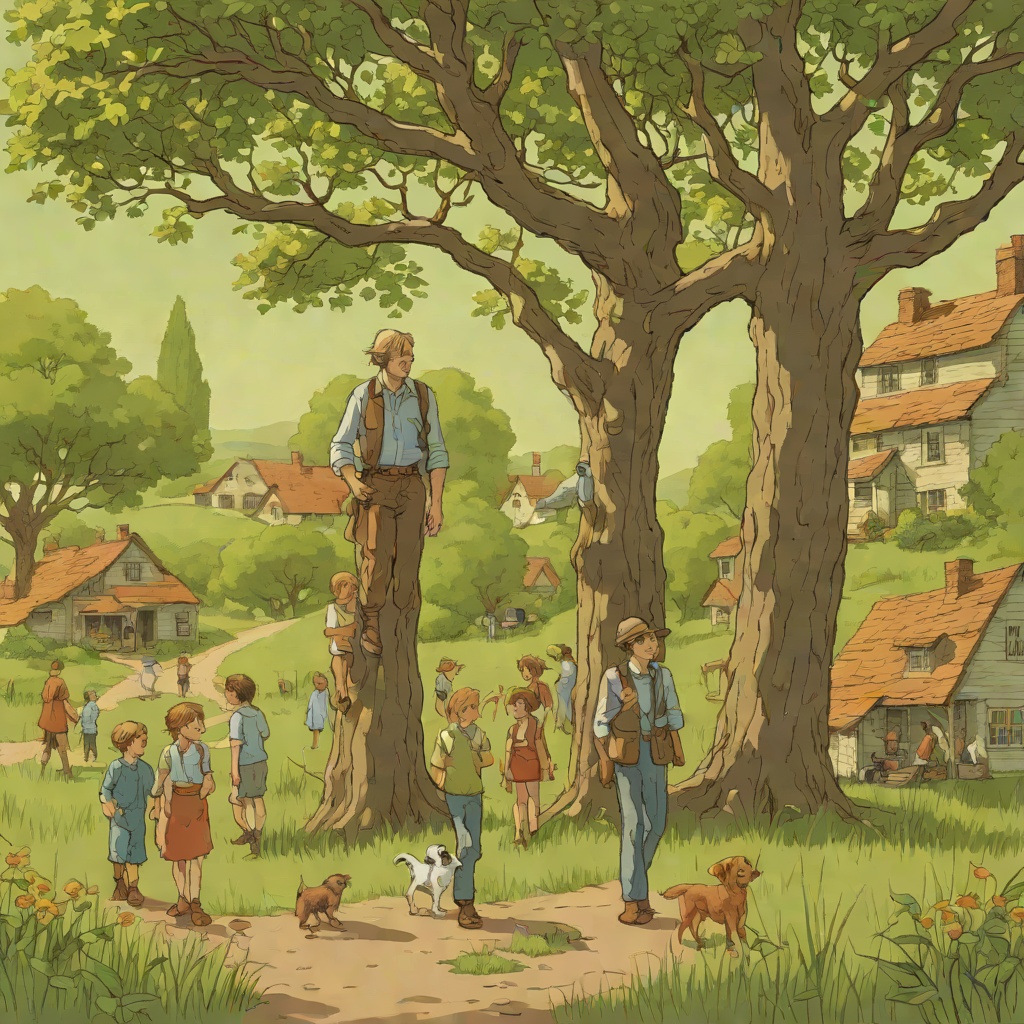
Dick arrives from London and initially expects the countryside to be dull, but the children reveal the Enchanted Wood and [The Faraway Tree](entity:object-recall-object-the-faraway-tree-b31c519e8530). His curiosity quickly turns into excited anticipation of the adventures their friendships may bring.
the next morning
Off to the Enchanted Wood
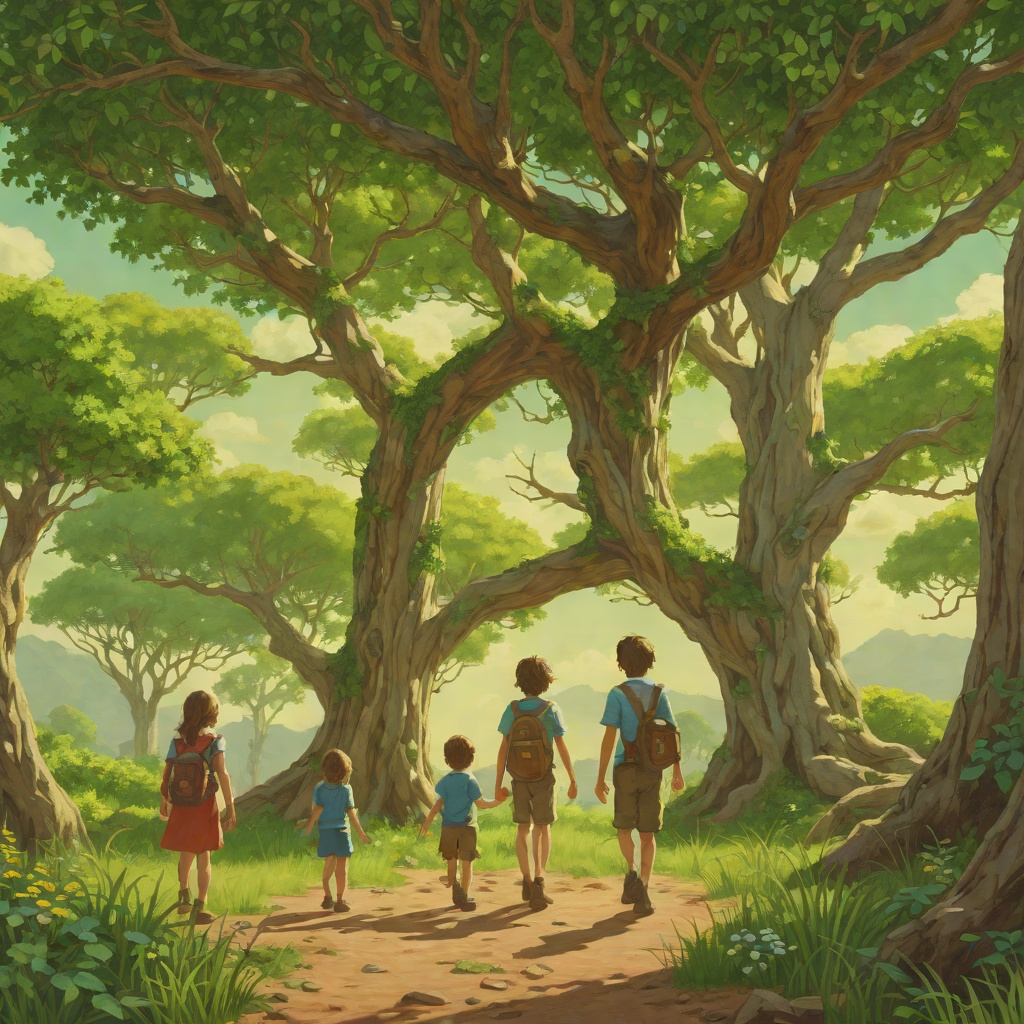
After completing their household work, the four children receive a full day's holiday and set out with sandwiches, cake, biscuits, and apples. They cross the ditch into the Enchanted Wood, where the whispering trees greet them with their secretive [“Wisha, wisha, wisha”](entity:expression-recall-expression-wisha-wisha-wisha-7059e9981547) sound.
They reach [The Faraway Tree](entity:object-recall-object-the-faraway-tree-b31c519e8530) and begin climbing, while Dick discovers that the tree grows changing kinds of fruit and houses a whole hidden community. His first expedition establishes both the wonder of the tree and the risks of entering it.
during the first ascent
Meeting the Tree Folk
Dick peeps into the Angry Pixie's window and is drenched with kettle water, then narrowly avoids being deterred by further warnings about Dame Washalot's descending wash water. The children visit the sleeping Owl and introduce Dick to Silky, whose golden hair immediately enchants him.
They also encounter Mister Watzisname and finally reach Moon-Face's home. There Dick meets the deaf, pan-covered Saucepan Man, whose comic mishearings establish the warm but chaotic friendships at the heart of the tree.
during the first visit
The Land-Shifting Rule
Moon-Face explains that a strange land is currently occupying the summit of [The Faraway Tree](entity:object-recall-object-the-faraway-tree-b31c519e8530) and that the children can reach it through a hole in the permanent cloud. He warns that the lands change and that some may be dangerous or difficult to leave.
This rule becomes the novel's central source of both wonder and danger: every ascent offers a new world, but time and movement can strand anyone who delays.
later that afternoon
Visit to Topsy-Turvy Land
Moon-Face identifies the summit land as the Land of Topsy-Turvy and accompanies the children, Silky, and the Saucepan Man through the cloud. They find houses standing on chimneys, upside-down trees, and inhabitants walking on their hands.
The children explore an inverted house but are driven away by its angry occupant. The world is not merely strange: it operates according to a strict law that everything must remain upside down.
during the Topsy-Turvy visit
Jo’s Topsy-Turvy Curse
A policeman confronts the visitors for failing to obey the land's rule and touches Jo with a magical stick. Jo is instantly forced to stand on his hands, unable to return to an upright position despite everyone's efforts.
The group gets him back through the cloud with great difficulty. Jo must remain with Moon-Face overnight because he cannot climb down while cursed, while the others return home to explain his absence.
the following morning
Jo’s Walking-Spell Cure
The Land of Topsy-Turvy disappears, and the Land of Spells arrives. Moon-Face and Silky help Jo reach a witch's stall, where a [Walking-Spell](entity:concept-recall-concept-walking-spell-c8f2ff8f6668) is rubbed onto the soles of his shoes.
The witch recites the [“Rimminy-Romminy-Reet” spell](entity:expression-recall-expression-rimminy-romminy-re-f141a400b4ac), and Jo is restored to his feet. The cure resolves the immediate danger but encourages the group to remain in the magical marketplace and explore its other temptations.
that morning
Exploring Magic Spells
The visitors watch a cat acquire a singing voice, a broomstick become capable of flight, and numerous spells being sold for curious purposes. Jo secretly pulls the enchanted cat's tail and hears it sing, provoking the servant who owns it.
The marketplace reveals magic as a commercial and unpredictable force. The children are delighted by its possibilities, yet their playful meddling repeatedly brings them close to punishment or disaster.
later that morning
The Enlargement Accident
The Saucepan Man buys a spell that enlarges objects and experiments on a daisy and a bumblebee. He then spills the tin, splashing himself, Jo, Moon-Face, and Silky.
The four friends grow to enormous size, with Silky enlarged even more than the others. They discover that they cannot fit through the hole leading back to [The Faraway Tree](entity:object-recall-object-the-faraway-tree-b31c519e8530), turning a comic mistake into a genuine threat of permanent separation.
shortly afterward
The Shrinking Spell
The enlargement spell is empty, and its maker cannot produce more until the next [full moon](entity:time-recall-time-8339fb641a41). A second goblin offers a shrinking spell instead, allowing Silky and Jo to return to their normal size and then restoring the Saucepan Man as well.
Moon-Face deliberately stops while slightly taller than usual, pleased with the result. Before they can return, the Land of Spells begins to move, forcing the whole group to flee through the darkness.
during the escape from the Land of Spells
Mister Change-About’s Chamber
The travelers descend through the wrong opening and enter a green-lit underground passage. They find Mister Change-About, whose appearance and temperament alter whenever people displease or satisfy him.
After Dick reaches greedily for the largest chocolate, Mister Change-About transforms the chocolates into stones. The Saucepan Man attacks him, eventually shrinking him into a kettle and sealing him inside it, which gives the group both a strange hostage and a new escape problem.
immediately afterward
Escape from the Enchanter’s Tower
The group climbs through a chimney into the cellar of an enchanter, who mistakes them for thieves and orders his imps to capture them. Moon-Face bluffs that he is an enchanter holding Mister Change-About prisoner, forcing their release.
The enchanter instead traps them in a high tower and leaves to fetch Wizard Wily. Jo finds the [Whizz-Away Ointment](entity:object-recall-object-whizz-away-ointment-191dc96d4fab), and when no broomstick can be obtained, the children rub it on a bench and an upside-down table.
the same afternoon
Flying Table Escape
The enchanted table squeezes through the tower window and carries Jo, Dick, Bessie, and Fanny away over the Land of Spells. The bench follows with Moon-Face, Silky, and the Saucepan Man after a chaotic fight erupts between the enchanter, Wizard Wily, and the freed Mister Change-About.
The table successfully finds the children's cottage and lands in their garden. The episode ends with everyone safely home, but the magical ointment is almost exhausted, a fact that later becomes crucial.
after the tower escape
Return to the Tree
The children briefly resolve to avoid further adventures, while Moon-Face and Silky later visit the cottage to make sure they returned safely. They tempt the children back with [Pop Biscuits](entity:object-recall-object-pop-biscuits-dbd17b3aa2da) and [Google Buns](entity:object-recall-object-google-buns-ebf582a24343).
Dick secretly climbs toward the summit despite Jo's warning. When he fails to return, Moon-Face and the Saucepan Man follow him, drawing everyone into another land.
later that afternoon
Rescue in the Land of Dreams
The group enters the Land of Dreams and is made sleepy by the Sandman's sand. Only Silky initially remains awake, so she descends for help from Dame Washalot, Mister Watzisname, and the Angry Pixie.
The sleepers wake briefly amid dreamlike transformations: an ice-cream purchase becomes whistles, policemen become fish, and an aeroplane becomes a bus, ship, rocking-horse, and bear. A walking bed eventually carries the sleepers onward, leaving Silky's rescue party to locate them.
later the same day
Rescue from the Land of Dreams
Silky, Dame Washalot, the Angry Pixie, and Mister Watzisname find the sleeping travelers on the living bed. They disable the Sandman by wetting his sand and throwing dry sand back into his eyes.
Silky discovers the last tiny dab of [Whizz-Away Ointment](entity:object-recall-object-whizz-away-ointment-191dc96d4fab) in Jo's pocket. She applies it to the bed, which carries everyone through the cloud and back toward [The Faraway Tree](entity:object-recall-object-the-faraway-tree-b31c519e8530), where the sleepers awaken as they slide among the branches.
about a week later
The Do-As-You-Please Invitation
After a week without adventures, the children receive a note from Silky and Moon-Face inviting them to the Land of Do-As-You-Please. The note promises that anyone can fulfill their wishes there.
Though Jo worries that Dick will cause trouble, the children's desire overcomes his caution. They secretly leave the cottage shortly before midnight and climb the lantern-lit tree.
after midnight
Visit to Do-As-You-Please
The summit appears as a brightly lit amusement park, where the children join Silky and Moon-Face on a roundabout. Their wishes materialize immediately: Dick rides repeatedly, Bessie receives six ice-creams, and Fanny rides an elephant.
Jo drives a railway engine, initially passing stations and nearly crashing through a level crossing before the runaway train returns to its starting point. The land makes every desire possible, but not every desire safe or manageable.
during the Do-As-You-Please visit
Paddling in the Sea
Fanny's wish for an elephant ride and Dick's wish to paddle in the sea are fulfilled. A signpost leads the group to a warm beach, where everyone paddles happily and Dick deliberately soaks his clothes under the land's permissive rule.
Silky warns that the land is about to move and that they cannot remain there forever. The group returns through the cloud and descends home, leaving the happiest land they have yet visited.
the following week
The Land of Toys
Silky invites the children to the Saucepan Man's planned party, which is meant to gather food from the Land of Goodies. Instead, the Land of Toys arrives, filled with oversized dolls' houses, clockwork animals, dolls, teddy bears, soldiers, and other animated playthings.
The Saucepan Man mistakes the toy sweet shop for a real shop in the Land of Goodies and takes sweets without paying. He is arrested and imprisoned, forcing the children and their friends to mount a rescue.
during the Land of Toys visit
Saucepan Man Rescue
The children locate the Saucepan Man inside a toy fort by following his “Two…” nonsense song. Jo devises a disguise: he and Dick buy soldier uniforms and persuade the fort's guards that they are officers.
They free the Saucepan Man, strip away his kettles, and dress him as a soldier. The deception nearly succeeds, but the sentinel recognizes the escaped prisoner and raises the alarm.
immediately afterward
The Toy Invasion
The rescuers race for the hole in the cloud, pursued by soldiers, golliwogs, teddy bears, and dolls. The toys follow them down into [The Faraway Tree](entity:object-recall-object-the-faraway-tree-b31c519e8530) instead of remaining in their own land.
Moon-Face turns the opening of [The Slippery-Slip](entity:object-recall-object-the-slippery-slip-7622858415a8) into a defensive trap, pushing the invading toys down the slide one by one. The toys eventually climb back toward their land, leaving the tree community safe.
a few days later
The Land of Goodies
The children are initially forbidden to visit the Land of Goodies because their recent behavior has been poor: Jo and Dick break a table, Bessie scorches a cloth, and Fanny tears her dress. After they repair the damage, Aunt Polly permits them to go.
The land is an edible paradise of sugar walls, chocolate chimneys, biscuit trees, jelly flowers, boiled-sweet bushes, sausage-roll machines, named iced cakes, and countless shops. Its governing custom allows visitors to take food freely.
during the Land of Goodies visit
Dick’s Goodies Mishap
Despite Jo's warning, Dick eats a barley-sugar knocker from a house and is confined by its angry owner. Later, the group gathers pies, puddings, and cakes to take home as gifts.
Dick falls while descending from the cloud and knocks all the food down [The Faraway Tree](entity:object-recall-object-the-faraway-tree-b31c519e8530). The falling delicacies strike Watzisname, Dame Washalot, and the Angry Pixie, who chase the friends in fury; Moon-Face is mistaken for the culprit and is spanked.
that evening
Moon-Face at the Cottage
To avoid the angry residents of [The Faraway Tree](entity:object-recall-object-the-faraway-tree-b31c519e8530), Moon-Face and the Saucepan Man spend several days at the children's cottage. Moon-Face works energetically in the garden, while the deaf Saucepan Man repeatedly misunderstands Aunt Polly's requests.
Moon-Face gives Aunt Polly a Toffee Shock, producing a comic but startling demonstration of the tree folk's strange food. Their stay deepens the friendship between the magical visitors and the children's household.
several days later
The Old Woman Takes Moon-Face’s House
Silky arrives with alarming news: the Old Woman Who Lived in a Shoe has left her land and occupied Moon-Face's home. She has nailed boards over [The Slippery-Slip](entity:object-recall-object-the-slippery-slip-7622858415a8) and intends to replace Moon-Face's life with her own orderly authority.
Moon-Face returns with the children and protests, but the Old Woman refuses to surrender the house. The Saucepan Man shouts at her, and Dame Washalot mistakenly identifies the group as the Old Woman's troublesome children and throws them into the land above.
immediately afterward
Escape from the Old Woman’s Land
The visitors find themselves among the Shoe's twenty-five unruly children. Jo devises a plan to make the Old Woman return by telling her that the children are wearing her best clothes and raiding her food.
The plan works, but the children and their friends are caught together and ordered to eat broth without bread before being punished. Dick deliberately accepts the spanking so the others can escape, then slides down the ladder just before the land moves away.
after the Old Woman episode
Mother’s Illness
The children's mother falls ill and worries about unfinished washing. Silky arranges for Dame Washalot to wash and iron it, relieving Aunt Polly of one burden while the children search for a more permanent remedy.
Dame Washalot reveals that the Land of Magic Medicines will soon arrive. The children decide that retrieving medicine for their mother is worth another ascent, even though Fanny must remain behind to care for her.
the following morning
Dick’s Growing-Pills Accident
The group enters the Land of Magic Medicines, a factory where [Goblins](entity:creature-recall-creature-goblins-d72621d6a4b5), [Gnomes](entity:creature-recall-creature-gnomes-4e11db8aaf93), [Pixies](entity:creature-recall-creature-pixies-525cd943d66a), and [Fairies](entity:creature-recall-creature-fairies-e71eaddddb68) manufacture strange remedies. Dick takes three [Growing Pills](entity:object-recall-object-growing-pills-6a9b15b7349c) at once, grows taller than the cottage ceiling, and frightens everyone.
A pixie accidentally throws an entire box of [Go-Away Pills](entity:object-recall-object-go-away-pills-dfe9806334b9) into Dick's mouth. He shrinks below visibility and must hide in a pill box while the medicine makers prepare a special bath to restore him.
during the Magic Medicines visit
Saucepan’s Growing Nose
The Saucepan Man mishears a Goblin's warning about medicine that makes noses grow and believes it will make roses grow. He drinks the entire bottle, causing his nose to lengthen until it reaches his feet.
The Goblin applies disappearing ointment and gradually restores the nose. The incident once again turns the Saucepan Man's deafness into a source of comic danger while showing how potent and hazardous the factory's medicines are.
later that morning
Dick Restored
Dick enters the special bath of steaming yellow medicine while still invisible. The liquid changes color, and his tiny form slowly reappears and grows back to normal size.
The bath itself folds into a winged object and flies away after he leaves it. The children receive a bottle of [Get-Well Medicine](entity:object-recall-object-get-well-medicine-57ddf1602015) and finally depart, determined to return before Dick or the Saucepan Man can cause another accident.
that evening and next day
Mother’s Cure
Jo gives Aunt Polly the [Get-Well Medicine](entity:object-recall-object-get-well-medicine-57ddf1602015), and her headache quickly eases. By the next morning she is eating well, laughing, and returning to her household work.
The cure relieves the children's anxiety and confirms that their dangerous expedition has produced a lasting benefit. The remaining medicine is stored in case illness returns or affects someone else.
about a week later
Watzisname’s Queer News
Mister Watzisname arrives at the cottage at night, deeply worried because Silky, Moon-Face, and the Saucepan Man have vanished. Their houses have been occupied by Sir Stamp-a-Lot and Lady Yell-Around, two bad-tempered strangers from the Land of Tempers.
The children agree to return with Watzisname after breakfast. Their investigation reveals that the newcomers claim the missing friends voluntarily surrendered their homes, a story Watzisname distrusts because Moon-Face had always rejected the Land of Tempers.
the following morning
The Land of Tempers Rule
The children confront Sir Stamp-a-Lot and Lady Yell-Around but learn little beyond their claim that the missing friends entered the Land of Tempers willingly. [The Slippery-Slip](entity:object-recall-object-the-slippery-slip-7622858415a8) is blocked, and the newcomers react violently whenever challenged.
The group enters the Land of Tempers to search for their friends. They learn that anyone who loses their temper there must remain permanently, making emotional self-control the only means of escape.
during the Land of Tempers visit
Keeping Their Tempers
The land provokes the visitors with insults, rough treatment, hair-pulling, and mockery. Jo and Dick repeatedly begin to retaliate but force themselves to smile, while Fanny and Bessie remind them that anger would trap them forever.
Fanny cleverly questions the land's headman and learns that Silky, Moon-Face, and the Saucepan Man have never entered the land. She also reveals that Sir Stamp-a-Lot and Lady Yell-Around escaped from it, giving the headman a reason to pursue them.
after returning from the Land of Tempers
The Hidden Prisoners
Back in [The Faraway Tree](entity:object-recall-object-the-faraway-tree-b31c519e8530), the children hear repeated booming and knocking from inside the trunk. Jo concludes that the sounds are signals from the missing friends, trapped within the blocked Slippery-Slip.
The lower opening is sealed as well as the upper one, and every attempt to pull out the obstruction fails because a spell holds it in place. The mystery becomes a rescue operation requiring a new kind of help.
later that day
Woodpecker Rescue Operation
Jo asks a Woodpecker to peck through the trunk from the Angry Pixie's room into the blocked slide. One bird alone would take days, so it fetches five cousins from another tree.
The six [Woodpeckers](entity:creature-recall-creature-woodpeckers-5b8f78af1296) work together, drilling a passage through the living wood. Their cooperation transforms an apparently magical dead end into a practical rescue route and highlights the wider community supporting the children.
shortly afterward
Rescue from the Slippery-Slip
The widened hole allows Moon-Face, Silky, and the Saucepan Man to climb out of the blocked slide. They have survived because the Saucepan Man secretly packed food, candles, matches, and a rope before they were imprisoned.
Their knocking had guided the children's search, and the woodpeckers' work restores the lost friends to the tree community. The rescue also reveals the full treachery of the two intruders.
immediately afterward
Return of the Tempers Refugees
The headman of the Land of Tempers and several followers descend [The Faraway Tree](entity:object-recall-object-the-faraway-tree-b31c519e8530) and capture Sir Stamp-a-Lot and Lady Yell-Around. Lady Yell-Around is dragged upward by one foot while both fugitives protest that they do not want to return.
With the intruders removed, Moon-Face reclaims his damaged home, the magical blockage disappears, and the friends restore [The Slippery-Slip](entity:object-recall-object-the-slippery-slip-7622858415a8). The central mystery is resolved, and the tree's domestic order returns.
the next day
Invitation to the Land of Presents
Mister Watzisname announces that the Land of Presents will soon arrive. Moon-Face eagerly invites everyone to visit, promising a world where presents can be obtained for others.
The children imagine gifts for themselves, their parents, and one another. The invitation marks a return to pure celebration after the danger and anxiety of the rescue episodes.
the next morning
The Gifting Rule
The Land of Presents is crowded with [Christmas](entity:time-recall-time-0cffe7da2c4d) trees, bran tubs, parcels, and tables of gifts. Dick is refused a box of chocolates for himself because the land permits presents only when they are intended for someone else.
Once the children understand this rule, generosity becomes the mechanism of exchange. Dick gives Fanny a blue necklace, and Fanny obtains the chocolates for him, turning mutual thoughtfulness into the path by which both wishes are fulfilled.
during the Land of Presents visit
Saucepan’s Wrong Presents
The Saucepan Man repeatedly mishears requests. He brings Bessie a grandfather clock instead of a frock and presents Dame Washalot with a lion instead of an iron.
The mistaken gifts are abandoned, while Jo helps Saucepan obtain new kettles and saucepans for himself. The episode reinforces both his comic deafness and the affectionate patience of his friends.
near noon
Gifts for the Family
The children use the Land of Presents to obtain gifts for one another and for their parents. Bessie receives a purse for Aunt Polly, while Jo finds a pipe and tobacco for his father.
Other gifts include a returning toy aeroplane, silver shoes for Silky, a feathered hat for Watzisname, and a toy sweet shop. The scene gathers the novel's themes of family, friendship, and generosity into a final celebratory exchange.
near the ending
The Lion Follows Home
As the Land of Presents begins to move away, the children and their friends descend [The Faraway Tree](entity:object-recall-object-the-faraway-tree-b31c519e8530) carrying their gifts. They leave before the shifting land can strand them.
The lion Saucepan mistakenly obtained appears to have followed them down the ladder, creating one last comic uncertainty for Dame Washalot. The children return through the Enchanted Wood with their presents, while The Faraway Tree remains ready for future adventures.