early in the story, first evening
The Children Arrive at the Professor's House
Four siblings—Peter, Susan, Edmund, and Lucy Pevensie—are evacuated from London during World War II and sent to live with an old Professor in a large country house. They are initially awed by the house's size and the Professor's eccentric appearance. That first night, they discuss their new surroundings, with Peter expressing excitement about exploring the house and grounds, while Edmund is irritable and tired. The children sense that this house will be a place of adventure.
the next morning, during a rainy day
Lucy Discovers the Wardrobe
On a rainy morning, the children decide to explore the house. They wander through many rooms, including a long room with a suit of armor and a library. In a nearly empty room, they find a large wardrobe. The others dismiss it, but Lucy lingers and opens the wardrobe door. Stepping inside among the fur coats, she pushes past them and finds herself not against wood but walking on snow. She emerges into a snowy wood at night, with a lamppost glowing in the distance. This is her first entry into the magical land of Narnia.
immediately after entering Narnia
Lucy Meets Mr. Tumnus
While standing by the lamppost, Lucy hears footsteps and meets a Faun named Mr. Tumnus, who carries an umbrella and parcels. He is startled to see a human girl—a 'Daughter of Eve.' After initial confusion, he introduces himself and invites her to his cave for tea. Lucy accepts, and they walk arm-in-arm through the snowy wood to his cozy cave home, where he serves a wonderful tea and plays enchanting music on a flute.
during tea at Tumnus's cave
Tumnus Confesses His Betrayal
After tea and music, Lucy realizes she must return home. Mr. Tumnus suddenly bursts into tears and confesses that he is in the pay of the White Witch, who has cast an eternal winter over Narnia. He was ordered to kidnap any human he met and hand them over to her. He had intended to lull Lucy to sleep and then report her, but he cannot bring himself to betray her. Lucy forgives him, and he quickly leads her back to the lamppost, warning her of the Witch's spies. She returns through the wardrobe to the spare room.
immediately after returning from Narnia
Lucy Tells the Others About Narnia
Lucy runs out of the wardrobe room and excitedly tells her siblings about her adventure in Narnia, but they do not believe her. They go back to the wardrobe and find only an ordinary wardrobe with coats. Peter and Susan think she is playing a game, but Edmund cruelly mocks her. Lucy is deeply hurt and begins to cry. For the next few days, she is miserable as the others, especially Edmund, continue to tease her about her 'imaginary country.'
a few days later, on another wet day
Edmund Enters Narnia
During a game of hide-and-seek, Lucy hides in the wardrobe to avoid being found, but she does not shut the door properly. Edmund sees her go in and follows, intending to tease her. Inside, he finds himself not in the wardrobe but in the snowy wood of Narnia. He calls for Lucy but gets no answer. He realizes that Lucy was telling the truth and feels a pang of guilt for his earlier behavior. He then hears bells and sees a sledge approaching, driven by a dwarf and carrying a majestic, pale-faced lady.
immediately after entering Narnia
Edmund Meets the White Witch
The sledge stops, and the lady—the White Witch—questions Edmund. She is initially stern and threatening, but then softens, offering him a warm drink and enchanted Turkish Delight. Edmund greedily eats the magical candy, which makes him crave more. The Witch learns that he has a brother and two sisters and that one sister has already visited Narnia. She extracts a promise from Edmund to bring his siblings to her house, promising to make him a prince and give him endless Turkish Delight. She gives him directions and warns him not to tell the others about her.
after returning from Narnia
Edmund Lies to the Others
Edmund meets Lucy in the wood, and they return together through the wardrobe. When they find Peter and Susan, Lucy joyfully announces that Edmund has also seen Narnia. But Edmund, feeling spiteful and wanting to avoid admitting he was wrong, pretends that they were only pretending. He denies the existence of Narnia, leaving Lucy devastated. Peter is furious with Edmund for his cruelty. The older children begin to worry that Lucy might be mentally unwell.
the next morning
The Professor's Logical Counsel
Peter and Susan, concerned about Lucy, decide to tell the Professor everything. To their surprise, the Professor takes Lucy's story seriously. He uses logic to argue that since Lucy is not a liar and not mad, she must be telling the truth. He suggests that Narnia might exist in a separate time, explaining why Lucy was gone for hours while only minutes passed in their world. He advises them to mind their own business and not to dismiss Lucy's account. This conversation leaves Peter and Susan uncertain but more open to possibility.
a few mornings later
The Four Children Enter Narnia Together
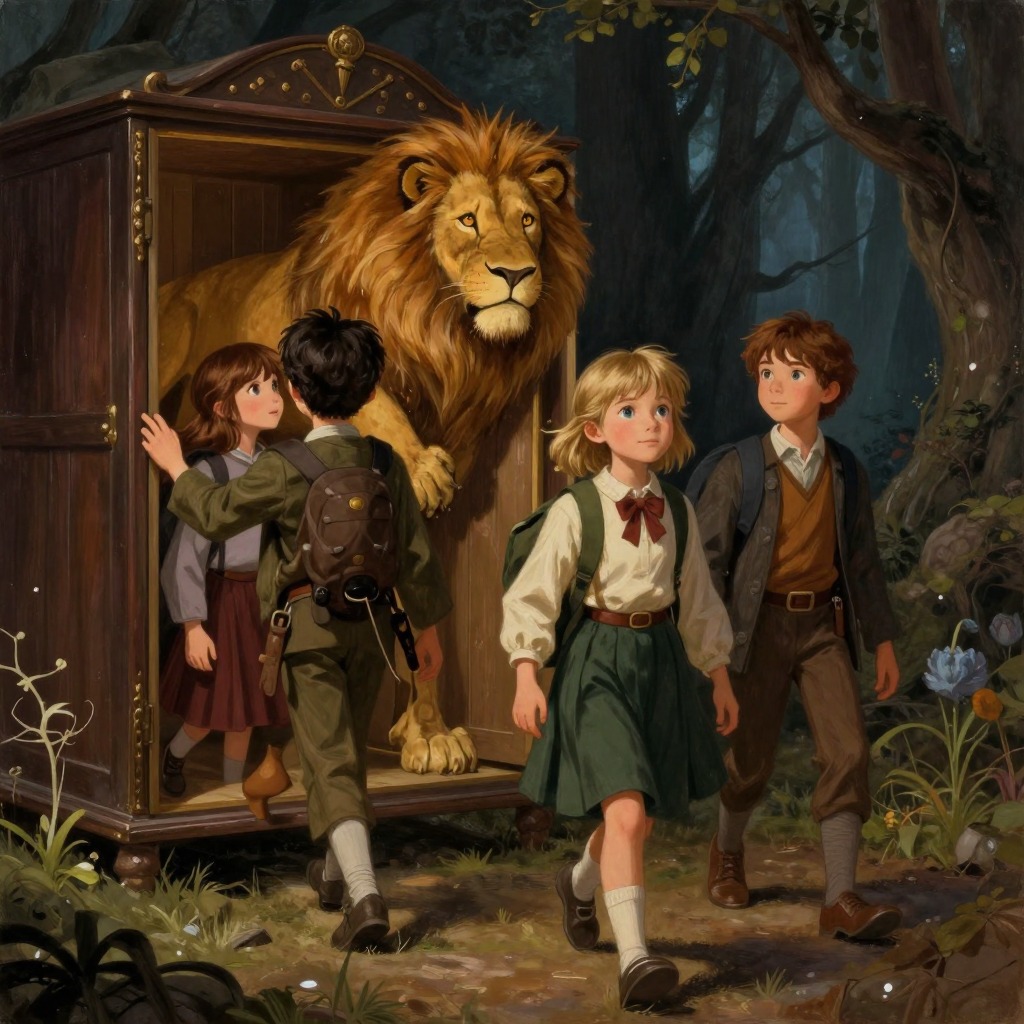
While exploring the house, the children hear Mrs. Macready leading a tour group. To avoid being caught, they all rush into the wardrobe room and bundle inside the wardrobe. As they sit in the dark, they notice it is cold and wet. They realize they are no longer in the wardrobe but standing in a snowy wood. Peter immediately apologizes to Lucy for not believing her. They put on fur coats from the wardrobe for warmth and decide to explore Narnia together.
shortly after entering Narnia
The Discovery of Tumnus's Arrest
Lucy leads the group to Mr. Tumnus's cave, but they find it wrecked: the door is broken, the cave is cold and dark, and belongings are smashed. A notice of arrest is nailed to the floor, signed by Fenris Ulf, Captain of the Secret Police, charging Tumnus with high treason for harboring humans and fraternizing with the Queen's enemies. The children realize that Tumnus has been taken by the White Witch because he helped Lucy. Lucy insists they must rescue him, and the others agree, despite their fear and lack of supplies.
after discovering Tumnus's arrest
Following the Robin
As the children wonder what to do, a robin appears and seems to want them to follow it. They decide to trust the bird, which leads them through the snowy forest. Edmund privately warns Peter that the robin might be leading them into a trap, and he also points out that they have no idea how to get home. Peter dismisses his concerns, but the seeds of doubt and Edmund's growing alignment with the Witch are planted. The robin eventually flies away, leaving them lost.
after the robin disappears
Meeting Mr. and Mrs. Beaver
Lost and frightened, the children see a beaver signaling to them from behind a tree. The beaver, Mr. Beaver, leads them to a secluded spot and reveals that he is a friend of Tumnus, who gave him Lucy's handkerchief as a token. He tells them that Aslan—the great Lion, true King of Narnia—is on the move. The children feel a profound, mysterious emotion at the name. Mr. Beaver leads them to his dam, where Mrs. Beaver welcomes them and prepares a hearty meal of fish and potatoes.
after dinner at the Beavers' house
The Prophecy of the Four Thrones
Over tea, Mr. Beaver explains the situation in Narnia: the White Witch has made it always winter but never Christmas. He tells them about Aslan, the true King, who is not safe but is good. He recites a prophecy that when two Sons of Adam and two Daughters of Eve sit on the four thrones at Cair Paravel, the Witch's reign will end. The children realize they are the prophesied ones. Mr. Beaver plans to lead them to meet Aslan at the Stone Table the next day.
during the conversation at the Beavers' house
Edmund's Betrayal
While the others are absorbed in the prophecy, Edmund slips away unnoticed. He has been secretly resentful and still craves the Witch's Turkish Delight. He decides to go to the White Witch and betray his siblings, hoping to become a prince. He leaves his coat behind and trudges through the snow toward the Witch's house. The others eventually realize he is missing, and Mr. Beaver deduces that Edmund has gone to the Witch, having already met her and eaten her enchanted food. The remaining children are horrified.
that night
Edmund at the White Witch's Castle
Edmund struggles through the snowy landscape and eventually reaches the White Witch's castle. In the courtyard, he sees many stone statues, including a lion he mistakes for Aslan. He defaces the statue with a pencil, jeering at it. He then encounters a live wolf, Fenris Ulf, who guards the entrance. Edmund states his purpose, and the Wolf admits him. Inside, he finds the Witch and tells her that his siblings are at the Beavers' house and that they plan to meet Aslan at the Stone Table. The Witch is furious but pleased, and she orders her sledge prepared without bells.
immediately after Edmund's departure
The Flight from the Beavers' House
Realizing that Edmund has betrayed them and that the Witch will soon attack, Mr. and Mrs. Beaver quickly pack supplies. The group—Peter, Susan, Lucy, and the Beavers—flee into the snowy night. They take a hidden path along the riverbank to avoid the sledge. They eventually take refuge in a small, hidden cave, where they sleep. The next morning, they hear sleigh bells and fear the worst, but Mr. Beaver discovers it is not the Witch's sledge.
the next morning, after the flight
The Arrival of Father Christmas
The group emerges from the cave to find a sledge driven by Father Christmas, not the Witch. He announces that Aslan is on the move and that the Witch's magic is weakening. He gives gifts: a new sewing machine for Mrs. Beaver, a repaired dam for Mr. Beaver, a sword and shield for Peter, a bow and horn for Susan, and a dagger and a bottle of healing cordial for Lucy. He warns that the gifts are tools, not toys, and that the time to use them is near. He then departs, wishing them a Merry Christmas.
the same night and following day
The Witch's Journey with Edmund
The White Witch, with Edmund as her prisoner, sets out on her sledge. She sends Fenris Ulf and other wolves to kill the Beavers and the children, but the fresh snow covers their tracks. Edmund, without a coat, suffers terribly from the cold. The Witch is cruel to him, giving him only stale bread and water. As they travel, the weather begins to change: the snow melts, and signs of spring appear. The sledge becomes stuck in the slush, and the Witch is forced to continue on foot, dragging Edmund with his hands tied.
during the journey
The Witch Destroys a Merry Party
The Witch's sledge stops near a group of woodland creatures—squirrels, satyrs, a dwarf, and a fox—who are celebrating with food and drink given by Father Christmas. Enraged, the Witch turns them all to stone with her wand, despite Edmund's plea for mercy. She strikes Edmund for his interference. This event deepens Edmund's regret and horror at his alliance with the Witch, as he sees the innocent creatures frozen forever.
during the journey, as the thaw continues
The Arrival of Spring
As the Witch and Edmund continue on foot, the winter rapidly gives way to spring. Snow melts, streams flow, flowers bloom, and birds sing. The Dwarf realizes that Aslan's power is breaking the Witch's spell. The Witch is furious and threatens to kill anyone who mentions Aslan's name. The transformation of the landscape symbolizes the weakening of the Witch's hold on Narnia and the approaching hope of liberation.
after the thaw, late in the day
The Children Reach the Stone Table
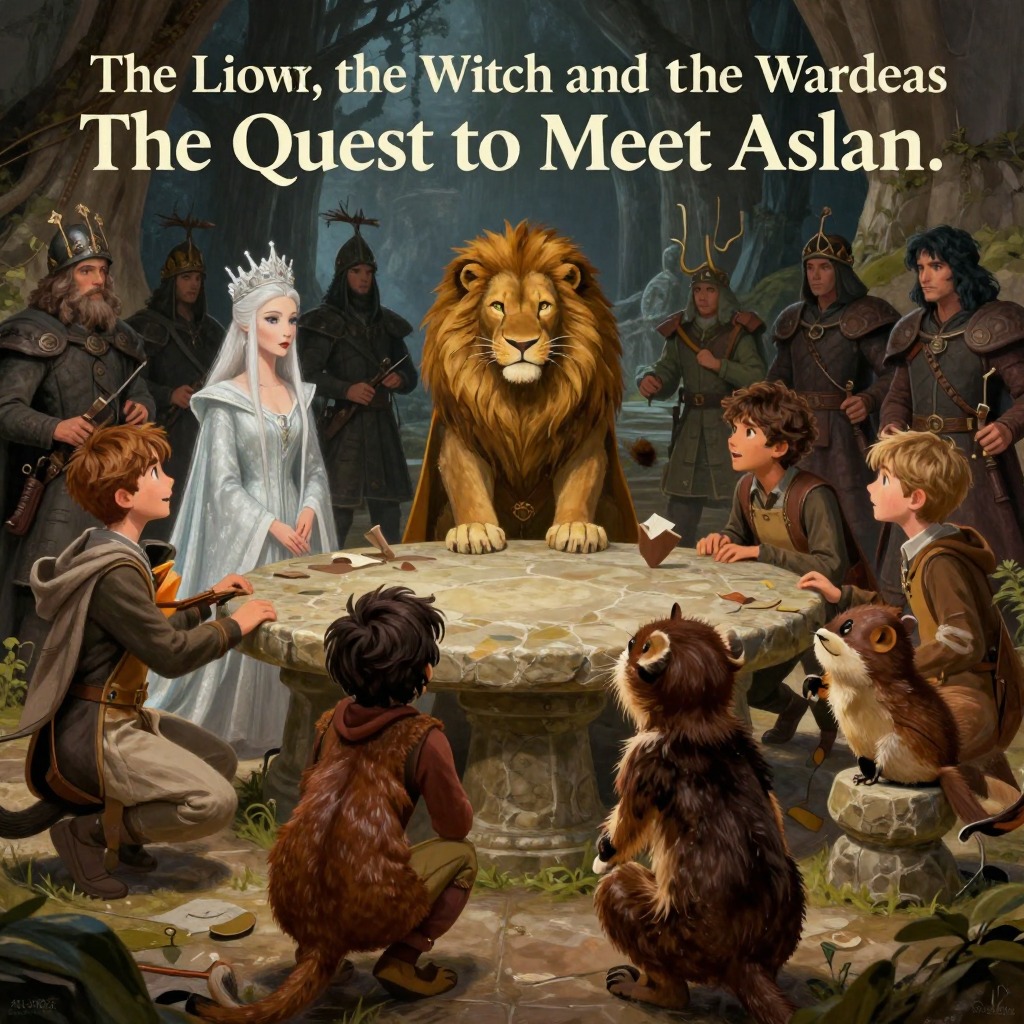
The Beavers and the three children continue their journey through the spring landscape. They climb a hill and see the Stone Table—a great, ancient slab of stone—and a pavilion with a banner bearing a red lion. In the center of a gathering of mythical creatures stands Aslan himself, a magnificent lion. The children are awed and trembling. Peter steps forward and greets Aslan, who welcomes them warmly but asks about the fourth child. Mr. Beaver explains Edmund's betrayal.
at the Stone Table camp, that evening
Peter's First Battle
Aslan shows Peter a vision of Cair Paravel, the castle where he will one day be king. Suddenly, Susan's horn sounds an alarm. A wolf—Fenris Ulf—attacks Susan, who has climbed a tree. Peter rushes to her defense and, after a fierce struggle, kills the wolf with his sword. Aslan knights Peter, giving him the title 'Sir Peter Fenris-Bane.' He then sends centaurs and eagles to pursue another wolf that escaped, hoping it will lead them to the Witch and Edmund.
that same night
The Rescue of Edmund
The Witch prepares to kill Edmund in a dark valley, sharpening her stone knife. Just as she is about to strike, Aslan's rescue party—centaurs, unicorns, eagles, and other creatures—arrives, scattering the Witch's forces. The Witch and her dwarf escape by using magic to disguise themselves as a stump and a boulder. Edmund is rescued, unconscious but alive. He is brought back to the camp and, the next morning, has a private conversation with Aslan, who forgives him and restores him to his family.
the next morning, at the Stone Table camp
The Witch's Claim and the Deep Magic
The White Witch, under a safe conduct, comes to Aslan's camp to claim Edmund as her lawful prey, citing the Deep Magic from the Dawn of Time, which gives her the right to kill every traitor. Aslan acknowledges the law. The Witch argues that unless she has blood, all Narnia will perish. Aslan and the Witch then speak privately. After a tense discussion, Aslan announces that the matter is settled and the Witch has renounced her claim on Edmund's life. The Witch leaves with a look of fierce joy, hinting at a secret agreement.
the following afternoon and night
Aslan's Sadness and the Night Walk
Aslan orders the camp to move to the Fords of Beruna. He seems sad and distant, and he tells Peter that he may not be with them in the coming battle. That night, Susan and Lucy cannot sleep and sense something terrible is about to happen. They see Aslan walking away from the camp and follow him. He allows them to accompany him but asks them to stop and hide when they reach the Hill of the Stone Table. They obey, watching from the bushes as Aslan continues alone.
that night, at the Stone Table
The Sacrifice of Aslan
From their hiding place, Susan and Lucy watch as a mob of evil creatures—ogres, werewolves, hags, and others—surround Aslan at the Stone Table. The White Witch mocks him. Aslan offers no resistance. The creatures shave his mane, muzzle him, and tie him to the Stone Table. The Witch then kills him with her stone knife. The girls are devastated, covering their eyes at the final blow. The Witch and her army leave, believing they have won.
the following dawn
The Resurrection of Aslan
After the Witch's departure, Susan and Lucy approach the Stone Table and remove the muzzle from Aslan's dead face. They weep and stay with him through the night. At dawn, they hear a great cracking sound: the Stone Table has split in two. Aslan is gone. They turn to see him alive, larger and more glorious than before. He explains that there is a Deeper Magic from before the Dawn of Time: when a willing victim who has committed no treachery is killed in a traitor's stead, death itself will work backwards. He is reborn.
immediately after the resurrection
Aslan's Ride to the Witch's Castle
Aslan, full of renewed strength, plays with the girls before declaring they have work to do. He roars mightily, then tells the girls to ride on his back. They hold tight as he races across Narnia at incredible speed, leaping over rivers and through forests. They arrive at the White Witch's castle, and Aslan leaps over the wall in a single bound, landing in the courtyard full of stone statues.
at the White Witch's castle
The Liberation of the Statues
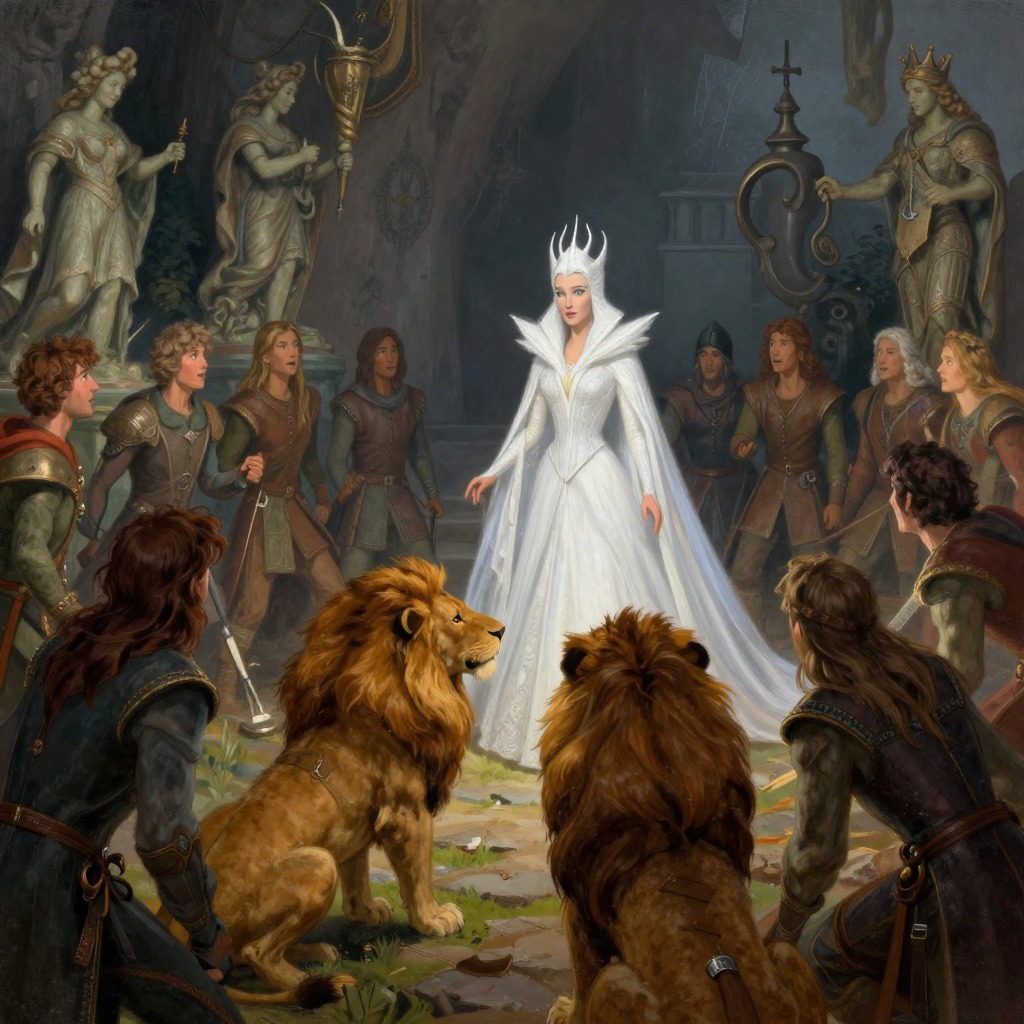
In the courtyard, Aslan breathes on the stone statues, restoring them to life. One by one, the creatures—lions, centaurs, dryads, dwarfs, and even a giant—come alive. The giant, Rumblebuffin, helps by breaking down the castle gates. Inside, Lucy finds Mr. Tumnus, who is overjoyed to be free. The entire liberated army gathers, ready to join the battle against the Witch.
later that day, at the battlefield
The Final Battle with the White Witch
Aslan leads the newly freed army to the battlefield, where Peter and Edmund are fighting desperately against the Witch's forces. The Witch is using her wand to turn Aslan's troops to stone. Edmund, realizing the wand is the key, charges through the enemy and smashes it with his sword, turning the tide. Aslan himself attacks the Witch, killing her. The battle ends swiftly with the Witch's death. Edmund is severely wounded but is healed by Lucy's cordial.
a few days after the battle
The Coronation of the Four
The children and their allies march to Cair Paravel, the castle by the sea. In the Great Hall, Aslan crowns Peter, Susan, Edmund, and Lucy as the Kings and Queens of Narnia. They are hailed as King Peter the Magnificent, Queen Susan the Gentle, King Edmund the Just, and Queen Lucy the Valiant. Aslan then quietly slips away, reminding them that once a king or queen in Narnia, always a king or queen. They rule wisely and happily for many years.
years later, near the end of their reign
The Hunt for the White Stag
One day, Mr. Tumnus brings news that the White Stag, a magical creature that grants wishes, has appeared. The four monarchs ride out to hunt it. They pursue the stag deep into the Western Woods, where their horses cannot follow. They continue on foot and come upon a familiar sight: a lamppost in the middle of a thicket. They realize they are near the wardrobe. Remembering their past, they push through the branches and find themselves tumbling out of the wardrobe into the spare room of the Professor's house.
immediately after leaving Narnia
Return to the Professor's House
The children are back in their old clothes, and no time has passed in England. They explain to the Professor that four coats are missing from the wardrobe. The Professor, understanding, tells them that they will not get back to Narnia through the wardrobe again, but that they will return someday—when they least expect it. He advises them not to try to force the way and to keep their adventures to themselves unless they meet others who have had similar experiences. The story ends with the sense that their Narnian adventures are only beginning.