Event 1
French Revolution
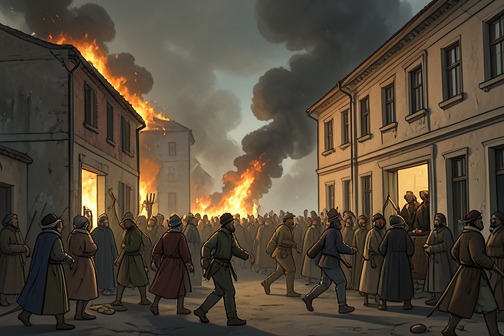
The [French Revolution](entity:event-recall-event-french-revolution-459ad436672d) became both a historical arena in which [Jean-Jacques Rousseau](entity:character-recall-character-jean-jacques-rousse-f0bb31f5666c)’s political ideas were invoked and a source of lasting controversy about what those ideas meant. Revolutionary leaders studied his works closely, but influence did not guarantee agreement or accurate interpretation. The introduction therefore treats the Revolution as part of Rousseau’s reception while insisting that his political theory must be assessed on its own terms: as an inquiry into the principles of legitimate society, not as a ready-made endorsement of particular events or policies.
## Rousseau’s Revolutionary Reputation
More than a century after the publication of *The Social Contract*, Rousseau’s name remained a political watchword claimed by democrats and denounced by opponents. He was widely revered or hated as the writer who had inspired the French Revolution above all others. Such polarized judgments, the introduction argues, often substituted political allegiance for careful reading, accepting or rejecting his doctrines as a whole rather than distinguishing their arguments and limits.
The revolutionary connection was nevertheless substantial. From Robespierre downward, the Revolution’s statesmen were profoundly affected by the study of Rousseau’s works. They had, on the whole, read him with the attention his writing demands, though they often seemed to misunderstand him. The account thus holds two facts together: Rousseau’s ideas mattered to revolutionary politics, and their historical influence cannot by itself settle what his theory says or justifies.
## Political Right, Not a Blueprint of Events
The decisive distinction is between explaining existing political institutions and identifying the principles on which any legitimate society must rest. Rousseau’s project, as the introduction interprets it, differs from Montesquieu’s study of the positive laws and established governments of particular states. Rousseau is not primarily compiling institutional facts or offering a history of political societies; he is asking what can make political association rightful.
That distinction does not make him contemptuous of historical facts. Rather, facts alone cannot establish a right: the fact that a political order exists, or that power has been acquired and exercised, does not prove that it is legitimate. Rousseau seeks to ground society in pure right, thereby giving force both to his criticism of society as it stands and to the possibility of a legitimate alternative. The French Revolution may be approached as a historical document, but the introduction gives *The Social Contract* its lasting importance as a work of political philosophy.
At the centre of that philosophy is a problem of political obligation. A legitimate association must use the common force to defend each member’s person and goods, while allowing each, in joining with all, to obey only himself and remain as free as before. This formulation makes freedom integral to the political bond, rather than something that can simply be measured by the absence of restraint. Shared restrictions can protect people from mutual harm and from the possibility that one will enslave another; the relevant question is whether public power secures freedom under common terms.
## Freedom, Equality, and Revolutionary Rights
The introduction rejects the claim that Rousseau’s theory is incompatible with the revolutionary language of the rights of man merely because the social contract entails the alienation of individual rights. Rousseau’s starting point is human freedom, which the account describes as inalienable and indestructible. The contract is not a warrant for despotism: it rests on freedom and is meant to guarantee its persistence.
If government becomes despotic, it loses any rightful claim over its subjects; the relation then reduces to a question of might, as between master and slave. The appeal to natural freedom is therefore not a contradiction of the contract but a way of expressing its underlying basis. At the same time, the sovereign must treat all members alike. If it turns from general rules to particular favour, treating one person better than another, it ceases to act as sovereign. Equality is built into the terms of the political association, not added afterward as an optional restraint.
Rousseau does not, however, assume that every citizen’s particular interest will always coincide with the general will present in that citizen. He explicitly allows opposition between them. His argument instead concerns the sovereign as a whole: it cannot properly have an interest contrary to the citizens collectively, and the introduction maintains that it cannot have an interest contrary to any individual either, because the sovereign’s power is necessary to preserve the society on which each person’s security depends. The Revolution’s appeal to freedom thus belongs to a demanding account of common political authority, not to a claim that private interests never conflict with public law.
## Institutions, Scale, and the Risk of Political Decay
Rousseau’s political principles are connected to questions of institutional fit. A state has a maximum strength that it can exceed only at the cost of weakening itself: as the social tie stretches, it relaxes. Long distances make administration more difficult and costly, multiplying layers of authority from city and district to province and higher government. These expenses drain the people’s resources without necessarily improving their government, leaving too little strength to meet emergencies and bringing the state nearer to destruction.
The relation between territory and population matters as well. The land must sustain its inhabitants, and its inhabitants must be proportionate to the land. Too much territory is difficult to defend and may generate wars of defence; too little can make a state dependent on neighbours and provoke wars of offence. Fertility, climate, consumption, population growth, and the influence of institutions prevent any single numerical ratio from applying everywhere. The argument makes political capacity a matter of social and material conditions, not merely a choice among abstract constitutional forms.
The same concern with fit informs the account of government. In general, democracy suits small states, aristocracy those of middle size, and monarchy great states, though circumstances can produce exceptions. No form is best in every case. More fundamentally, government carries an inherent tendency to oppose sovereignty: as the government’s particular will presses against the general will, the constitution changes, and the prince may eventually suppress the sovereign and break the social compact. Government contracts from the many to the few, moving from democracy to aristocracy and then monarchy. The Revolution’s political significance, in this framework, lies not in a simple story of liberation secured once and for all, but in the continuing problem of keeping executive power answerable to the sovereign people.
## Revolutionary Reception and the Work of Interpretation
Rousseau’s influence extended beyond immediate political claims. The introduction places him in the transition from inherited political theories rooted in the [Middle Ages](entity:time-recall-time-middle-ages-666e8ea3c3d5) to modern philosophy of the state, and describes his work as a major influence on later thought and events in [Europe](entity:location-recall-location-europe-90be8cc79c46). Revolutionary statesmen made his writing politically consequential, but subsequent generations also invoked him without necessarily knowing him well. A nineteenth-century commentator calls *The Social Contract* the book most talked about and least read.
The renewed study of political philosophy offers a different approach: read Rousseau as a thinker, rather than merely recruit him as an ally or dismiss him as an opponent. That means separating his principles of political right from appeals to his authority in circumstances he could not have contemplated. The Revolution remains central to the history of his influence, but it is not the final measure of his ideas. Its interpretive importance is precisely that it makes clear how easily a theory of freedom, equality, and legitimate common power can become a party emblem unless its arguments are read with historical understanding and discriminating care.
Event 2
光荣革命
The [1688 Revolution](entity:time-recall-time-1688-revolution-e2300550555e) matters here less as a narrated sequence of events than as a turning point in political argument. The [Convention Parliament](entity:organization-recall-organization-convention-parli-9950df4fa53b)’s charge that James II had broken the original contract between king and people made the Revolution a conspicuous example of resistance grounded in a claimed constitutional obligation; [John Locke](entity:character-recall-character-john-locke-a375bbd0ee4b), in turn, used it to argue that government depends on the consent of the governed and that tyrannical rulers may be displaced.
## The Revolution in the history of contract theory
The book distinguishes two broad forms of social-contract theory. In one, the people and government contract with each other; in the other, the individuals who compose the State contract among themselves. The first form, of medieval origin and often supported by biblical references, was taken up by major political writers of the sixteenth century and persisted into the seventeenth. The Convention Parliament’s accusation against James II gave that older model a sharp constitutional application: his conduct was described as a breach of the original agreement between ruler and people.
The charge places the Revolution within a tradition that treats political authority as bound by obligations, rather than as an unconditional power. In this version of the theory, a people’s appeal against a ruler could be expressed as a demand that he observe the terms of the compact. The Revolution thus serves as more than a change of government in the book’s account: it supplies a historical and political occasion for defending the people’s right to resist a ruler who violates the basis of his authority.
## Locke, consent, and the limits of resistance
The account associates the Revolution of 1688 with Locke’s effort to justify the displacement of James II. Locke makes government depend on the consent of the governed not only at its founding but throughout its existence, and he regards rulers as liable to removal if they govern tyrannically. The Revolution therefore helps clarify the political force of consent: it can authorize resistance, rather than merely explain how government began.
But the book also identifies a weakness in Locke’s position. Locke provides no constitutional machinery, short of revolution, through which popular opinion can be expressed; consent consequently remains largely tacit and assumed. His theory places the State’s main purpose in protecting life and property, while his cautious account of popular rights nearly reduces them to nothing. The Revolution marks a powerful justification for resistance, but it does not, in this analysis, solve the problem of how the people can exercise consent continuously and institutionally.
## Contrast with Hobbes and Rousseau
[Thomas Hobbes](entity:character-recall-character-thomas-hobbes-7d6529b456f5) represents a different contract tradition: individuals contract with one another, leaving the government outside the agreement. That move, as the book explains, allows Hobbes to make the government sovereign without subjecting it to contractual obligations. The contrast makes the Convention Parliament’s accusation especially significant. A compact between people and ruler can furnish grounds for holding the ruler to account; Hobbes’s arrangement avoids that mutual obligation and instead supports absolute authority.
Rousseau’s response to the problem of consent goes beyond Locke’s largely tacit model. He substitutes an active agreement, periodically renewed, and insists that popular consent needs constitutional means of expression if it is to be more than a name. The book presents the 1688 Revolution as an important landmark in the older, people-and-government form of contract theory, while Rousseau’s later formulation presses toward a recurring act of popular self-government. Its central significance is therefore conceptual: the Revolution helps expose the difference between consent asserted against a ruler and consent made an ongoing practice of political life.
Event 3
五月花号公约的订立

The [Mayflower](entity:object-recall-object-mayflower-c4184f1cea86) Compact, made by the Pilgrim Fathers aboard the Mayflower in 1620, serves as a concrete instance of society constituted by agreement among the people who compose it. Its declaration of mutual covenant and union into a civil body politic gives a practical form to the social-contract idea; the political significance of that form, however, remains contested, since covenant can imply popular sovereignty or be invoked to defend its alienation.
## The Compact as a Social Contract
The compact appears in an account distinguishing two theories of political contract. In the first, a people is understood to have made an agreement with its rulers, who are consequently obliged to govern according to its terms. In the second—the social-contract theory proper—society originates in, or rests upon, an agreement among the individuals who compose it. The Mayflower declaration is identified as the best-known instance of this second theory’s actual use.
The declaration states, “We do solemnly and mutually, in the presence of God and of one another, covenant and combine ourselves together into a civil body politic.” Its wording emphasizes reciprocal agreement among the participants and the formation of a political community. Rather than describing a contract between subjects and an already constituted government, it presents the people themselves as the parties who combine to establish the civil body.
## Political Meaning and Competing Uses
The account treats popular sovereignty as the natural implication of this contractual form: if individuals establish society by agreement, the people remains the source of political authority. The compact is therefore evidence of a social-contract principle in practical use, not merely an abstract proposition. Its language makes collective constitution the starting point of political order.
That implication was not inevitable in the history of contract theory. Before the theory was developed into Rousseau’s philosophical account, it could support sharply opposed conclusions. [Thomas Hobbes](entity:character-recall-character-thomas-hobbes-7d6529b456f5) likewise understood the original compact as an agreement among individuals, with the government not itself a party to it; but he held that the people thereby invested a ruler or rulers with government and alienated sovereignty wholly and permanently. The Mayflower example thus illustrates the contractual foundation of political society without, by itself, resolving every dispute over where power resides after the agreement.
## Historical and Theoretical Significance
The compact’s importance in the account is both historical and conceptual. It is singled out as the best-known practical use of the people-to-people form of the social contract, and its declaration gives the theory a distinctively mutual and collective expression. The agreement is presented as an example of society being formed by its members, in contrast to arguments that infer a right to rule from established power or from a contract between people and ruler.
The episode also clarifies why the same vocabulary of contract could function as protest or as a defense of authority. A contract between people and government could be appealed to as a limit on royal conduct; a contract among individuals could ground the people’s sovereignty, but could also be read, as by Hobbes, as the people’s irrevocable transfer of it. The Mayflower Compact stands at this hinge: a historical instance of collective agreement whose wording supports the account’s emphasis on the people as the origin of the civil body, while the broader theory leaves open a consequential disagreement about whether sovereignty can be surrendered.
Event 4
推翻罗马王政
The expulsion of the Tarquins marks, in [Jean-Jacques Rousseau](entity:character-recall-character-jean-jacques-rousse-f0bb31f5666c)’s account, a rare political rebirth: [Rome](entity:location-recall-location-f3877a21016f) emerged from the overthrow of its kings with the renewed vigor of a state made young again. The event serves less as a narrated episode than as a hinge in his argument about when a people can regain liberty, how political communities are constituted, and why their institutions remain vulnerable to decay.
## Upheaval and Political Renewal
Rousseau places Rome after the Tarquins among the exceptional states that, following violence and revolution, seemed to rise from their ashes with the strength of youth. The parallel examples are [Sparta](entity:location-recall-location-sparta-6e1c0d10bce2) in the time of Lycurgus, and Holland and [Switzerland](entity:location-recall-location-6e6c25b1c44d) after the expulsion of their tyrants. In this comparison, the overthrow is significant not simply as a change of rulers but as a moment when horror of the past can replace a people’s ordinary forgetfulness and make a new political beginning possible.
That renewal is not a general promise of revolution. Rousseau stresses that such moments are rare and arise from the particular constitution of the state. A people may free itself while it remains politically vigorous, but once its civic impulse has lost force, disturbances may destroy it without restoring liberty. The Roman example therefore illustrates a possibility with strict limits: liberty may be won, but a people cannot assume that it can recover it after its political capacities have faded.
## Rome’s Early Political Organization
Rousseau connects the period after Rome’s foundation to the institutions of the new republic, described as the army of its founder and composed of Albans, Sabines, and foreigners. This population was organized into three tribes; each tribe was divided into ten curiae, and each curia into decuriae. Their leaders bore the titles of curiones and decuriones. The account presents this arrangement as an early structure joining Rome’s military origins to its political organization.
Each tribe also supplied one hundred Equites, or Knights, grouped as a century. Rousseau takes this military feature as evidence that the divisions were initially more suited to an army than to a town. He interprets Rome’s early organization as anticipating the demands of a much greater political future: even while it was a small township, Rome had a system that could serve the capital of a wider world.
## The Tarquins in Rousseau’s Political Argument
Rousseau’s discussion does not recount the circumstances of the Tarquins’ expulsion or identify individual actions within it. Instead, the event functions as a historical marker in an argument about the conditions under which a state can be renewed. He places it beside other rare cases of political recovery, while warning that the same kind of upheaval cannot reliably happen twice to the same people. The event’s importance lies in this tension between the possibility of rebirth and the fragility of the civic conditions that make it possible.
The broader argument also cautions against treating political authority as justified merely because it exists in fact. Rousseau criticizes [Hugo Grotius](entity:character-recall-character-hugo-grotius-37670e84b499) for reasoning from established power to right, a method he considers especially favorable to tyrants. Against that logic, the Roman turning point belongs to a distinction between rulers’ power and a people’s political standing: the removal of kings can exemplify a recovery of liberty, but the historical occurrence of such a change is not, by itself, a complete theory of legitimate government.
## Scale, Government, and the Risk of Decline
The Roman example sits within Rousseau’s larger account of how a state’s form must suit its size and population. He argues that a body politic has a maximum strength it cannot exceed without losing effectiveness: as the social bond extends, it relaxes, and a small state is generally stronger in proportion than a great one. Distance makes administration more burdensome, adding layers of authority and expense that drain the people while leaving fewer resources for emergencies.
Territory and population must also stand in a workable relation. Land must be sufficient to sustain its inhabitants, while the number of inhabitants should not exceed what the land can maintain. Excessive territory is difficult to guard and may provoke defensive wars; insufficient land can make a state dependent on neighbors and draw it toward offensive wars. These claims help frame Rome’s political history as a question of institutional fitness and capacity, rather than as a sequence of rulers alone.
Rousseau further holds that governments tend to contract from the many to the few, moving from democracy to aristocracy and then to monarchy. As the government’s particular will presses continually against the general will, the constitution changes until the ruler may suppress the sovereign people and break the social compact. The expulsion of the Tarquins thus stands at the hopeful end of a political possibility that Rousseau’s wider theory also treats as unstable: a state may recover youthful vigor, but no founding or liberation removes the ongoing danger of government turning against the people.
## Religion and the Foundations of Political Order
Rousseau’s reflections on political origins also distinguish religious forms according to their relation to society. He describes an early condition in which peoples had gods as rulers and theocracy as government; because separate peoples treated themselves as politically distinct, they also developed separate gods, encouraging theological and civil intolerance. He then distinguishes the religion of the individual, centered on inward worship and moral obligations, from the religion of the citizen, which gives a particular nation its gods, rites, and legally prescribed public worship.
This discussion clarifies the difference between explaining the force that can establish institutions and endorsing every means used to secure obedience. Rousseau argues that a legislator may invoke divine authority because a people not yet formed by laws cannot always be moved by abstract reason or by force alone. But the durability of institutions, in his account, depends on wisdom rather than passing tricks or imposture. In the context of Rome’s rebirth, religion and founding authority belong to the larger problem of how a political community acquires cohesion; neither substitutes for the civic conditions that allow liberty to endure.
Event 5
Fall of Constantinople
The [Fall of Constantinople](entity:event-recall-event-fall-of-constantinople-50008e73e4b7) appears in [Jean-Jacques Rousseau](entity:character-recall-character-jean-jacques-rousse-f0bb31f5666c)’s account of [Europe](entity:location-recall-location-europe-90be8cc79c46)’s recovery from intellectual decline as an unexpected turning point: the fall of the throne of Constantine carried relics of ancient Greek learning to [Italy](entity:location-recall-location-125be658b0d0), helping revive letters and, in turn, the sciences. Its significance lies in the paradox that a political catastrophe becomes an immediate cause of cultural renewal elsewhere.
## Background: Europe in Intellectual Decline
Rousseau first describes Europe as having relapsed into a condition worse than ignorance. A scientific jargon had usurped the name of knowledge, obstructing its restoration; returning people to common sense, he argues, required a complete revolution. The recovery that followed came from a source few would have expected, making the event part of a larger reversal in the history of learning.
## The Fall and the Transfer of Learning
The passage identifies the conqueror as the “stupid Mussulman” and the event as the fall of the throne of Constantine. Its stated consequence is the arrival in Italy of relics of ancient Greece. Rousseau then traces their onward movement: [France](entity:location-recall-location-france-f5cafc8a8ad4), too, was enriched by these cultural remains. The account thus connects the fall of [Constantinople](entity:location-recall-location-e1577e31202b) to a transfer of ancient learning across regions, rather than treating the event solely as the end of a political order.
## Cultural Consequences and Rousseau’s Interpretation
Rousseau places literature before the sciences in the sequence of revival: the sciences followed literature, and the art of thinking joined the art of writing. He observes that this order may seem strange but may also be natural. The passage therefore presents intellectual renewal as a developing process, in which the arrival of Greek learning contributes first to literary recovery and then to scientific inquiry.
The event also belongs to Rousseau’s broader, ambivalent account of civilization. The renewed intercourse with the Muses, he says, made people more sociable by encouraging them to seek one another’s approval through worthy performances. Yet elsewhere in the same discussion he warns that arts, literature, and sciences can adorn the chains imposed by government and law, dulling people’s sense of original liberty and teaching them to love their subjection. The Fall of Constantinople is consequently a catalyst for learning, but the cultural flourishing that follows is not presented as an uncomplicated liberation.
Event 6
Greco-Persian Wars
The [Greco-Persian Wars](entity:event-recall-event-greco-persian-wars-d0431e648549) appear in [Jean-Jacques Rousseau](entity:character-recall-character-jean-jacques-rousse-f0bb31f5666c)’s account as a defining contrast between Greece’s earlier courage and its later subjection: the Greeks twice vanquished [Asia](entity:location-recall-location-b6ae5eaf4bb6) before the arts and sciences, in his argument, had corrupted their manners. The victories establish the force of an uncorrupted civic character, while the history that follows turns their achievement into a warning about cultural decline.
## Background and Stakes
Rousseau presents Greece as once peopled by heroes and emphasizes that its letters were still in their infancy when the Greeks twice defeated Asia. In this account, their victories belong to a period before the progress of the sciences had altered the disposition of the inhabitants. The contrast makes the wars more than a record of military success: they mark the strength Greece possessed before the moral change Rousseau associates with learning and refinement.
## Cultural Decline and Conquest
Rousseau links the subsequent progress of the sciences to a dissoluteness of manners and the imposition of the Macedonian yoke. From then on, he says, Greece remained learned and voluptuous but also enslaved, experiencing through its revolutions no more than a change of masters. The passage thus sets the earlier victories against a later political condition in which intellectual distinction does not restore independence.
## Rhetorical Significance
The wars serve as the passage’s initial measure of Greek strength, sharpening its argument that later cultural accomplishment did not preserve freedom. Rousseau completes the contrast by invoking Demosthenes: not even his eloquence could breathe life into a body enervated by luxury and the arts. The image makes the reversal stark: Greece had once defeated Asia, but eloquence could not revive it after the decline Rousseau describes.
Event 7
Cambyses' conquest of Egypt
[Cambyses' conquest of Egypt](entity:event-recall-event-cambyses-conquest-of-eg-8e6a476f7363) is presented by [Jean-Jacques Rousseau](entity:character-recall-character-jean-jacques-rousse-f0bb31f5666c) as the first episode in a sequence of conquests illustrating his claim that the advance of arts and sciences is accompanied by moral decline and political subjection. [Egypt](entity:location-recall-location-2ea1f28344b7)'s passage from celebrated cradle of learning to conquered country makes the episode evidence in a broad, cyclical account of civilization and loss.
## Egypt as a Cradle of Learning
Rousseau introduces Egypt as the first school of mankind, an ancient country renowned for its fertility beneath a brazen sky. Its earlier greatness is also associated with Sesostris, who set out from Egypt to conquer the world. The country thus appears not merely as a place eventually overcome, but as a former center of power and human achievement.
Egypt later became the mother of philosophy and the fine arts. In Rousseau's account, that cultural distinction precedes the country's subjection: the rise of learning is followed by conquest, rather than preserving Egypt's independence. The contrast supplies the historical pattern on which his argument depends.
## Conquest and Successive Subjection
Cambyses conquered Egypt, initiating the sequence of foreign dominations Rousseau names. After Cambyses, the country was conquered in turn by the Greeks, the Romans, the Arabs, and finally the Turks. The brief catalogue moves from one ruling power to another, making Egypt's loss of political independence appear cumulative and recurrent.
The passage does not describe the military campaign, its date, the participants' motives, or the immediate terms of Egyptian surrender. Its focus is the place of the conquest in a historical sequence: Egypt's cultural eminence did not prevent it from being conquered, and Cambyses' victory marks the opening of a long succession of foreign rule.
## Role in Rousseau's Argument
The episode belongs to Rousseau's rebuttal of the idea that the corruption he observes is peculiar to his own age. He argues that the evils associated with vain curiosity are as old as the world, and compares the regular influence of the arts and sciences on a people's morals to the tides' relation to the moon. As their light rises, he says, virtue takes flight; Egypt gives this claim an ancient historical example.
The conquest is therefore not narrated as a self-contained battle or as a story of individual actors. Its significance lies in the contrast between Egypt's status as a source of philosophy and the fine arts and its subsequent history of conquest. In Rousseau's larger indictment, cultural advancement offers no guarantee of civic strength: the country that helped originate learning becomes the first example in a chain of learned civilizations losing their freedom.
Event 8
Macedonian conquest of Greece
[Macedonian conquest of Greece](entity:event-recall-event-macedonian-conquest-of-f3307ceb8acb) is presented by [Jean-Jacques Rousseau](entity:character-recall-character-jean-jacques-rousse-f0bb31f5666c) as the political consequence of a prior moral weakening: as learning and the sciences advanced, Greek manners grew dissipated, and the country came under Macedonian rule. The episode anchors his argument that intellectual and artistic progress does not necessarily strengthen a people; in his historical account, it can leave them less able to preserve their freedom.
## Greece Before Macedonian Rule
Rousseau recalls Greece as a land once inhabited by heroes who had twice defeated [Asia](entity:location-recall-location-b6ae5eaf4bb6). At that earlier point, letters were still in their infancy and, in his telling, had not yet corrupted the inhabitants’ disposition. The contrast establishes a sequence: Greece’s heroic reputation belongs to a period before the cultural development that Rousseau associates with moral decline.
## Learning, Dissipation, and Subjection
The conquest is linked to the progress of the sciences, which Rousseau says produced a dissoluteness of manners. He places this social change before the imposition of the Macedonian yoke, treating cultural decline not as an incidental feature of subjection but as part of the explanation for how Greek independence was lost.
Rousseau describes the ensuing condition as a long continuity of learning, voluptuousness, and enslavement. Greece’s subsequent revolutions, in this account, brought a change of masters rather than a return to liberty. The contrast is stark: a people celebrated for having twice vanquished Asia becomes a people whose political upheavals do not end its subjection.
## Demosthenes and the Limits of Eloquence
Rousseau invokes Demosthenes to mark the limits of political speech once a society has been weakened. He argues that even all of the orator’s eloquence could not restore life to a body already enervated by luxury and the arts. The image makes the conquest more than a military reversal: rhetorical skill cannot, by itself, undo the prior weakening that Rousseau attributes to cultural excess.
## Place in Rousseau’s Historical Argument
The episode is one example in Rousseau’s broader claim that the moral effects of the arts and sciences recur across ages. Greece’s trajectory supplies a compact pattern: early virtue and military strength, followed by cultural development, dissipation, and loss of political independence. Its subsequent changes of masters sharpen his warning that learning may flourish under domination without restoring the freedom that has been lost.
Event 9
Fall of the Roman Republic
The [Fall of the Roman Republic](entity:event-recall-event-fall-of-the-roman-repub-6865d1967b7c) appears in [Jean-Jacques Rousseau](entity:character-recall-character-jean-jacques-rousse-f0bb31f5666c)’s political argument not as a single narrated episode but as the culmination of a wider account of institutional expansion, civic change, and the tendency of government to overcome the sovereignty it is meant to serve. [Rome](entity:location-recall-location-f3877a21016f) begins as a small community with an ordered political structure; its later submission to a form of servitude becomes, for Rousseau, evidence of how a state can lose the qualities that once sustained its freedom.
## Rome’s foundation and early divisions
Rousseau acknowledges that reliable records of Rome’s earliest period are lacking and that many stories about it may be fables. He nevertheless treats established customs and traditions supported by strong authority and evidence as grounds for reconstructing how the Romans exercised supreme power. The origin story therefore comes with an explicit caution: the institutional account is an inquiry assembled from imperfect historical knowledge, not a claim to possess a complete record.
After Rome’s foundation, its new republic consisted of the army of its founder, made up of Albans, Sabines, and foreigners. Rousseau says this population was divided into three tribes, each into ten curiae, and each curia into decuriae, with leaders called curiones and decuriones. Each tribe also supplied a hundred Equites, or Knights, organized as a century. He interprets these divisions as initially military in character, while suggesting that Rome’s early arrangements anticipated the political needs of a future world capital.
The original ethnic divisions produced an imbalance. The Alban and Sabine tribes remained stable, while the foreign Luceres grew as newcomers settled in Rome and eventually became stronger than the other two. [Servius](entity:character-recall-character-e630ce3d6988) addressed the resulting danger by abandoning the racial basis of division and organizing four tribes according to the city’s hills. The inhabitants were also forbidden to move from one quarter to another, keeping the division tied to both persons and place. In Rousseau’s account, the reform corrected an immediate disparity while preparing a more durable arrangement for the city’s growth.
## Scale, population, and political form
Rome’s early history sits within Rousseau’s general claim that a state has limits of size beyond which its strength diminishes. Extending the social bond, he argues, relaxes it; a small state is generally stronger in proportion than a large one. Distance makes administration more burdensome, while layers of local and provincial authority add costs borne by the people. The accumulation of these charges can leave a state with too few resources to meet emergencies, bringing it close to destruction rather than ensuring better government.
Rousseau measures a body politic by both territory and population. Land should be sufficient to sustain its inhabitants, and the population should be proportionate to what the land can maintain. Excessive territory is difficult to guard and may be inadequately cultivated; insufficient territory leaves a state dependent on its neighbours. A people forced to choose between commerce and war is, in his account, insecure and dependent on circumstances. No single numerical ratio can settle the question, because fertility, climate, local products, habits, population growth, and the legislator’s institutions all affect the relation between land and inhabitants.
This question of scale also informs Rousseau’s account of governmental form. He proposes as a general rule that democracy suits small states, aristocracy those of middle size, and monarchy great states, while emphasizing that innumerable circumstances can create exceptions. Rome’s history thus belongs to a comparative argument: political arrangements cannot be judged apart from the number of citizens, the extent of territory, and the conditions under which institutions must operate.
## Government and the dissolution of sovereignty
Rousseau describes an inherent tension in the political body: government’s particular will continually acts against the general will. As that pressure grows, the constitution changes. Because no other corporate will can reliably balance the prince’s will, government may eventually suppress the sovereign and break the social treaty. Rousseau presents this danger as a defect present from the body politic’s birth, analogous to the way age and death ultimately undo a human body.
Government’s degeneration, in this account, can proceed by contraction, as power passes from the many to the few—from democracy to aristocracy and then to royalty—or by dissolution of the state. The contraction from many to few is described as government’s natural tendency; the reverse progression is not, in Rousseau’s formulation, a dependable counter-course. The Fall of the Roman Republic therefore resonates with his structural warning: institutions may change in ways that concentrate power and weaken the sovereign community, until the political compact itself is broken.
## Civic decline and the Roman example
Rousseau places Rome’s decline within a wider critique of the belief that learning and refinement necessarily improve public life. He dates the beginning of Roman degeneration to the period of Ennius and Terence, contrasting the early Rome founded by a shepherd and made illustrious by peasants with a later capital he portrays as a theatre of vice and an object of derision. In his account, Rome’s eventual submission to servitude is especially pointed because the city had imposed its yoke on others: the power that once ruled beyond its borders could not preserve its own freedom.
He also traces a change in Roman public priorities. [Socrates](entity:character-recall-character-0d7843dbcd5a) at [Athens](entity:location-recall-location-athens-829baca0905a) and the elder Cato at Rome had opposed what they regarded as the corrupting influence of Greek culture. Yet philosophers and orators filled Rome; military discipline was neglected, agriculture held in contempt, and citizens joined philosophical sects while forgetting their country. The old public ideals of liberty, disinterestedness, and obedience to law gave way to the names of philosophical schools. Rousseau’s contrast is not simply between ignorance and knowledge: it is between virtue practiced as a civic habit and virtue treated as a subject of study after the habits supporting it have weakened.
The Roman example consequently joins Rousseau’s institutional and moral arguments. The republic’s early divisions show an effort to organize a growing people; his account of political scale explains why size and administration place pressure on a state; and his theory of degeneration identifies the struggle between government and sovereignty as a standing danger. His picture of Rome’s later servitude completes that sequence with a civic reversal: a community remembered for simplicity and public virtue loses the very freedom that had marked its earlier greatness.
Event 10
Fall of the Western Roman Empire
The [Fall of the Western Roman Empire](entity:event-recall-event-fall-of-the-western-rom-947e5da66e5f) is invoked by [Jean-Jacques Rousseau](entity:character-recall-character-jean-jacques-rousse-f0bb31f5666c) as evidence that accumulated wealth does not guarantee a state’s survival. In his contrast between riches and civic strength, [Rome](entity:location-recall-location-f3877a21016f)’s collapse at the height of its material abundance makes poverty and courage—not treasure—the decisive terms of political endurance.
## Place in Rousseau’s Argument
Rousseau places Rome’s fall within a series of historical reversals directed against the claim that wealth makes states powerful. He writes that the Roman empire, after engulfing the riches of the universe, fell prey to peoples who did not even know what riches were. The compressed contrast turns imperial accumulation into a measure of vulnerability rather than security: possession of wealth did not prevent defeat.
## Comparative Examples
The Roman example follows the account of the monarchy of Cyrus, conquered by thirty thousand men led by a prince poorer than the least of the Persian satraps, and of the Scythians, whose poverty did not prevent them from resisting powerful monarchs. Rousseau then compares two republics contending for world dominion: the rich one was subdued by the poor one. Rome’s fate extends this pattern from a contest between republics to the decline of an empire.
The passage continues by naming other victories attributed to courage and poverty rather than riches: the Franks conquered Gaul, the Saxons [England](entity:location-recall-location-edbf4fdebc64), and poor Swiss mountaineers first checked Austria and then crushed the wealthy and formidable house of Burgundy. Finally, the power and resources of the heir of Charles the Fifth, backed by the treasures of the Indies, were overcome by herring-fishers. Together, these examples frame Rome’s fall not as an isolated reversal but as one instance in a recurring challenge to the equation of wealth with strength.
## Political and Moral Significance
Rousseau uses Rome’s collapse to challenge political calculations that value people chiefly by their economic contribution or consumption. The examples support his claim that money cannot buy morals and citizens, and that a state’s brilliance may be momentary while virtue can make it lasting. The fall of a wealthy empire therefore supplies a historical counterpoint to luxury: material abundance may accompany power, but it cannot substitute for the civic qualities on which political endurance depends.
Event 11
Catilinarian conspiracy
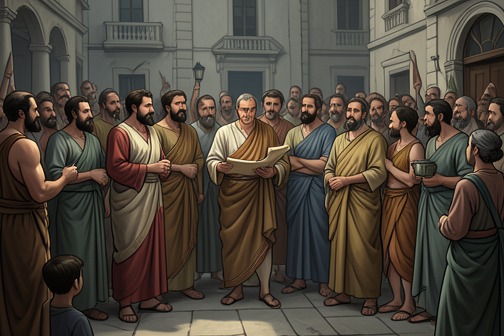
The [Catilinarian conspiracy](entity:event-recall-event-catilinarian-conspiracy-c30810b737cc) is Rousseau’s example of a political emergency mishandled through misplaced caution: the Senate gave its powers to the consuls rather than appointing a dictator, and [Cicero](entity:character-recall-character-a32714dfa17a)’s response exceeded his legal authority. The episode ends in a pointed double judgment: Cicero was honoured as [Rome](entity:location-recall-location-f3877a21016f)’s liberator and later called to account as a lawbreaker, while Rousseau argues that a properly appointed, temporary dictator could have acted lawfully to suppress the conspiracy.
## Political Principle and Historical Method
Rousseau treats the conspiracy not simply as a fact of Roman history but as a test case in political right. His larger inquiry distinguishes the principles that make a society legitimate from descriptions of how existing governments operate. Historical facts can illuminate political arguments, but they cannot by themselves establish a right; the central question is whether power is exercised on a legitimate basis.
That distinction gives the Roman episode its analytical force. The crisis tests how a state may respond to danger without confusing effective action with lawful authority. Rousseau’s account does not present the conspirators’ defeat as sufficient proof that the means used were justified: the legality of the response remains a separate question from its success.
## The Senate’s Decision and Cicero’s Response
Rousseau says the Romans failed to nominate a dictator during the conspiracy. In his judgment, this was a mistake. The danger concerned Rome itself and, at most, a province in [Italy](entity:location-recall-location-125be658b0d0); the extraordinary authority conferred by law on a dictator would therefore have been sufficient to deal with it. Instead, the Senate entrusted its whole power to the consuls.
That choice put Cicero in a difficult position as he sought effective action. On a crucial point, he had to exceed his powers. The conspiracy was suppressed, Rousseau says, through a combination of fortunate circumstances that human prudence had no right to count on. The outcome thus exposed the weakness of relying on luck where the laws already provided a defined emergency office.
Cicero’s position became more complicated after the immediate crisis. His conduct was approved in the first flush of relief, but he was later called to account for the unlawful shedding of citizens’ blood. Rousseau contrasts that legal reproach with the position a dictator would have occupied: action within the authority granted by law would not have invited the same charge.
## Honour, Law, and Emergency Power
Rousseau does not reduce Cicero’s legacy to either triumph or condemnation. Cicero was justly honoured as Rome’s liberator, yet also justly punished as a lawbreaker. His eloquence carried the day, but Rousseau argues that he sought personal glory and the honour of saving the state rather than the most lawful and secure means of doing so. Cicero’s later recall from punishment was an act of pardon, however brilliant that recall may have been.
The contrast makes the episode a warning about emergency leadership. A successful outcome cannot erase a breach of law, and public acclaim in the moment does not settle the question of legitimacy. At the same time, Rousseau’s criticism is directed at the Senate’s failure to use a lawful safeguard, not simply at Cicero’s decision to act. The episode shows how excessive hesitation at the institutional level can leave officials to confront a crisis through powers they do not properly possess.
## The Dictatorship’s Limits
The example supports a carefully bounded defense of dictatorship, not an open-ended license to rule. Rousseau insists that the office’s duration should be fixed at a very brief period and incapable of extension. A crisis either soon passes or the state is soon lost; once the immediate need has ended, dictatorship becomes either tyrannical or idle.
At Rome, dictators held office for six months, and most abdicated before that term expired. Rousseau sets this short tenure against the danger shown by the decemvirs, who were chosen for a year and attempted to prolong their power. The dictator’s restricted time was meant to confine action to the emergency that justified appointment, leaving no interval for further projects. Read alongside the conspiracy, this limit explains Rousseau’s alternative: emergency power could be both forceful and lawful only when its authority and duration were clearly constrained.
Event 12
Crusades
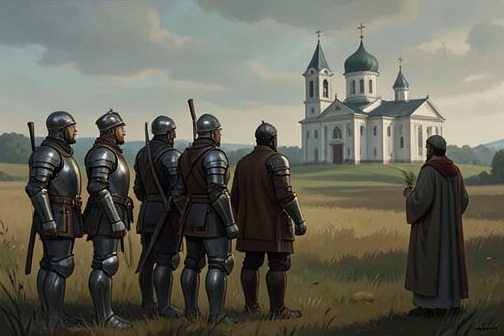
The [Crusades](entity:event-recall-event-crusades-82b7a8524e4b) serve [Jean-Jacques Rousseau](entity:character-recall-character-jean-jacques-rousse-f0bb31f5666c) as a test case in his argument about religion and political allegiance. He rejects them as proof of Christian military virtue: the Crusaders, he says, were soldiers of the priests, fighting for the Church as a temporal power rather than for a Christian republic. Their campaign illustrates his larger claim that Christianity supplies no national religion and therefore cannot make war holy in the civic sense.
## The Crusades as an Argument
Rousseau introduces the Crusades while disputing the assertion that Christian troops are excellent. He refuses to treat their courage as evidence for that claim. Even if the Crusaders displayed valor, he argues, they were not acting as [Christians](entity:character-recall-character-35c9935a1a6e) in the relevant political sense; they were the Church’s soldiery, citizens of an ecclesiastical polity whose spiritual country had somehow been made temporal. The distinction shifts attention from individual bravery to the authority and allegiance organizing the campaign.
The reference is argumentative rather than a narrated account of military events. Rousseau supplies no itinerary, named participants, battles, or chronology for the Crusades in this passage. Instead, he uses the familiar example to distinguish Christian identity from service to a political-religious institution, and to deny that the latter can establish the former.
## Religion and Political Allegiance
The passage belongs to Rousseau’s broader classification of religion by its relation to society. He distinguishes the inward religion of humanity, defined by moral duties and worship of God without temples, rites, or national boundaries, from civic religion, which is tied to one country, its prescribed public worship, and its own gods and patrons. He also identifies a third kind: priestly religion, which gives people two rulers, two legal codes, and two countries, placing religious and civic duties in potential conflict.
The Crusades exemplify that conflict in practice. In Rousseau’s interpretation, the Church’s conversion of a spiritual country into a temporal one gives its adherents a political allegiance distinct from the state. Their fighting therefore does not demonstrate that Christianity, as a religion without national bounds, can authorize a holy war. The episode makes the institutional stakes visible: a campaign presented as religious can draw its force from a competing authority and community.
## The Contrast with Pagan [Rome](entity:location-recall-location-f3877a21016f)
Rousseau sets the Crusaders against Christian soldiers serving under pagan emperors. He accepts the testimony of Christian writers that those earlier soldiers were brave, and explains their courage as honorable emulation of pagan troops. Once the emperors themselves became Christian, he argues, that emulation disappeared; in his sharply framed contrast, when the Cross displaced the eagle, Roman valor vanished.
This comparison is not a separate account of the Crusades’ course or outcome. It is part of Rousseau’s case that military courage depends on civic and political conditions that cannot simply be inferred from religious profession. The Crusaders’ valor, even if granted, belongs to service under the Church’s temporal authority; the earlier soldiers’ courage is attributed instead to emulation within the Roman military order.
## Political Meaning and Limits
Rousseau’s central concern is the relation between the sovereign and its subjects. The social compact, he says, grants the sovereign authority only within the bounds of public expediency. Citizens owe an account of their opinions only insofar as those opinions matter to the community. Religion matters politically because it can encourage people to fulfill their duties, but the state’s concern with religious dogma should extend only to morality and obligations toward others; other beliefs lie beyond its jurisdiction.
Against that standard, the Crusades function as a warning about divided allegiance, not as a full historical narrative. They show how religious institutions can claim a temporal community and mobilize its members in ways that complicate civic unity. Rousseau’s example thus supports his distinction between faith as moral commitment and priestly power as a rival political authority, while leaving the actual campaigns and their consequences undescribed.
Event 13
Battle of Cannae
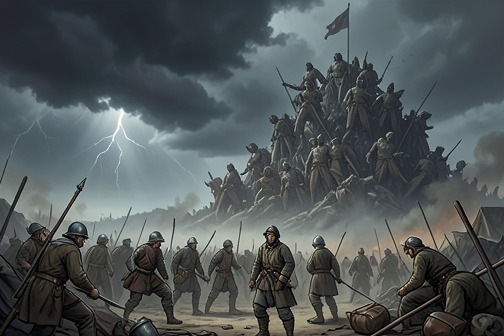
The [Battle of Cannae](entity:event-recall-event-battle-of-cannae-460f3d187b13) is invoked by [Jean-Jacques Rousseau](entity:character-recall-character-jean-jacques-rousse-f0bb31f5666c) as a test of military strength that exposes the limits of modern martial reputation: battlefield courage, he argues, is not the same as the stamina needed to endure a campaign. The battle is part of a pointed comparison between modern soldiers and Hannibal’s forces, whose hardships Rousseau treats as a more demanding measure of military capacity.
## The Battle as a Measure of Courage
Rousseau addresses modern warriors who are confident in their bravery. He grants that they might have triumphed with Hannibal at Cannae, placing their courage in battle beyond doubt. But this concession sets up a sharper distinction: success in a day’s fighting does not prove that soldiers can withstand the hunger, fatigue, weather, and prolonged exertion of war.
## Cannae and the Campaign Beyond It
The battle is paired with Hannibal’s crossing of the Alps. In Rousseau’s comparison, modern troops might have shared the victory at Cannae but would not have managed the arduous passage that preceded it. Cannae thus marks the contrast between conspicuous combat and the less visible physical endurance that makes military operations possible. Its significance in the passage lies not in an account of how the battle unfolded, but in the demanding campaign set against it.
## Place in Rousseau’s Argument
Rousseau uses the example to challenge a culture that prizes cultivated accomplishments while neglecting bodily vigor. A soldier’s courage, he argues, cannot by itself protect him from death or compensate for weakness when cold, illness, and hardship threaten an army. The reference to Cannae therefore serves as a concession and a rebuke at once: modern bravery may be real, but it does not establish the endurance that Rousseau considers essential to military strength.
Event 14
Battle of Lake Trasimene
The [Battle of Lake Trasimene](entity:event-recall-event-battle-of-lake-trasimen-4bc92ad99802) is invoked by [Jean-Jacques Rousseau](entity:character-recall-character-jean-jacques-rousse-f0bb31f5666c) as an example of a victory modern soldiers might have helped Hannibal achieve, but whose larger demands they could not have met. The allusion makes endurance, rather than courage in a single battle, the measure of military capacity: Rousseau argues that the ability to withstand cold, fatigue, difficult terrain, and deprivation matters as much as valor under fire.
## The Battle as a Test of Endurance
Rousseau addresses modern warriors whose bravery he does not doubt. He imagines them triumphing with Hannibal at the [Battle of Cannae](entity:event-recall-event-battle-of-cannae-460f3d187b13) and the Battle of Lake Trasimene, but contrasts those battlefield successes with the demanding campaigns that followed. In his account, they would not have been able to cross the Alps with Hannibal. The distinction is deliberate: winning a battle does not prove that an army can endure the prolonged physical trials on which a campaign may depend.
## Contrast with Other Campaigns
The Battle of Lake Trasimene belongs to a sequence of historical comparisons. Rousseau also imagines the modern soldiers crossing the Rubicon with Julius Caesar, and then asks whether they could have helped him subdue the Gauls, their own ancestors. The examples separate dramatic acts of martial courage from the stamina required for arduous movement and sustained effort. The Lake Trasimene allusion thus supports an argument about the limits of a military culture measured chiefly by performance in a day’s battle.
## Place in Rousseau’s Argument
The battle is not recounted as an independent episode: the passage supplies no description of its tactics, setting, casualties, or outcome. Instead, its name gives historical weight to Rousseau’s contrast between courage and physical strength. He argues that fatigue, harsh weather, and the absence of even a few superfluities can cripple an army, and that the loss of troops to cold or fever matters to the state no less than their deaths by an enemy’s sword. Lake Trasimene therefore functions as one point in a broader critique of military preparation that prizes bravery while neglecting endurance.
Event 15
Hannibal's crossing of the Alps

[Hannibal's crossing of the Alps](entity:event-recall-event-hannibal-s-crossing-of-555be1cf4d73) is invoked as a test of military endurance that, in [Jean-Jacques Rousseau](entity:character-recall-character-jean-jacques-rousse-f0bb31f5666c)'s argument, distinguishes the capacity to withstand hardship from bravery in battle. The episode serves not as a narrated campaign but as a pointed contrast: modern warriors might have fought beside Hannibal at Cannae and Lake Trasimene, Rousseau suggests, yet could not have made the punishing Alpine crossing with him.
## The comparison with modern armies
Rousseau addresses celebrated modern warriors directly, conceding their bravery while questioning whether it equips them for the prolonged physical demands of war. His examples separate feats performed in battle from the ability to endure exposure, fatigue, and deprivation over time. Hannibal's passage across the Alps stands at the center of that distinction: it represents a trial that courage alone cannot meet.
The contrast is sharpened by the nearby examples of Julius Caesar. Rousseau imagines modern soldiers crossing the Rubicon with Caesar and helping him enslave his country, but doubts they could have crossed the Alps with Hannibal or helped Caesar subdue the Gauls. These pairings distinguish political and battlefield success from the endurance required by difficult campaigns.
## Endurance as military capacity
The crossing matters because Rousseau treats an army's resilience as a practical measure of military strength. A soldier may behave intrepidly under fire and still lack the strength and vigor needed for exhausting marches or harsh conditions. In this argument, the Alpine passage condenses those demands into a single historical comparison rather than an account of the crossing's route or circumstances.
Rousseau also broadens the test from individual bravery to the State's interest in preserving its troops. Soldiers who succumb to cold and fever are no less lost to the State than those killed by enemy weapons. Hannibal's crossing thus supports a critique of military standards that praise courage in combat while neglecting the bodily fitness necessary to endure a campaign.
## Role in Rousseau's argument
The episode belongs to a wider criticism of a society whose increasing cultivation of the fine arts, Rousseau argues, coincides with the loss of martial vigor. Against the image of the scientifically trained modern warrior, the Alpine crossing supplies a measure of what military life requires beyond technical preparation or a day's bravery. Its significance lies in the contrast Rousseau draws: the power to win a battle does not prove the capacity to withstand the hardships that make a campaign possible.
Event 16
Caesar's crossing of the Rubicon
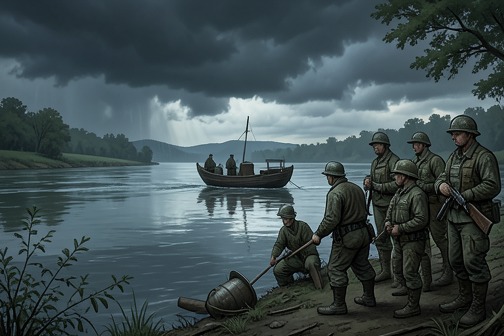
Caesar’s crossing of the Rubicon serves as a pointed contrast between conspicuous battlefield bravery and the sustained physical endurance required for a military campaign. Rousseau imagines modern warriors following Caesar across the river and helping him enslave his country, but argues that they would not have been able to endure the hardships of conquering Gaul.
## Context and Contrast
The episode occurs in an argument that the cultivation of sedentary occupations and the fine arts can weaken the bodily vigor on which military endurance depends. Rousseau distinguishes courage in a battle from the capacity to withstand fatigue, severe weather, hunger, and the other privations of campaigning. The crossing is not presented as a narrated scene with its own chronology; it is invoked as a historical comparison in a critique of modern military preparedness.
## The Crossing and Its Counterfactual
Addressing modern warriors, Rousseau says he has no doubt they would have triumphed with Hannibal at Cannae and Lake Trasimene, and would have crossed the Rubicon with Caesar, enabling him to enslave his country. He then reverses the compliment: their bravery would not, in his view, have carried them across the Alps with Hannibal or enabled them, under Caesar, to subdue their own ancestors, the Gauls. The contrast separates the dramatic act of crossing the river from the prolonged exertion of the conquest that followed.
## Military and Political Significance
Rousseau uses Caesar’s crossing not to recount the event’s circumstances but to sharpen his distinction between victory and generalship, and between courage under fire and the strength needed to survive a campaign. The crossing thus marks the threshold of a political catastrophe in his formulation: Caesar’s action helps enslave his country. Yet the example’s main argumentative force falls on what follows it. A modern army might display bravery at the decisive moment and still fail under the hardships of the Alps and the conquest of Gaul.
Event 17
Caesar's conquest of Gaul

Caesar’s conquest of Gaul appears as a counterfactual test of military endurance: the author grants that modern warriors might have helped Caesar cross the Rubicon and enslave his country, but doubts they could have endured his campaign against the Gauls. The contrast shifts attention from courage in battle to the physical resilience required to sustain a war.
## The Campaign as a Test of Endurance
The passage distinguishes battlefield bravery from the capacity to withstand prolonged hardship. Its imagined modern soldiers could triumph with Hannibal at Cannae and Trasimene, and could accompany Caesar across the Rubicon; those feats, however, would not prove that they could cross the Alps with Hannibal or help Caesar subdue the Gauls. Caesar’s conquest thus represents a more demanding test than a single battle or a dramatic military crossing.
The author places the campaign within a broader criticism of military life made comfortable by modern habits. He argues that hunger, thirst, fatigue, danger, death, harsh seasons, bad weather, and the lack of luxuries expose weaknesses that courage alone cannot remedy. The Gaul campaign matters in this argument as a measure of sustained exertion, not as a narrated sequence of battles or a detailed account of its military course.
## Rhetorical Contrast and Significance
Addressing modern warriors directly, the author acknowledges their bravery before drawing a sharp limit around it: they might have enabled Caesar to enslave his country, but, in his estimate, could not have followed him through the hardships of conquering the Gauls. This pointed concession makes endurance—not a lack of courage—the issue under judgment. The campaign becomes evidence for the author’s larger claim that physical strength and habituation to hardship are essential military qualities, and that fashionable training or bravery displayed in a day’s battle cannot stand in for them.
Event 18
Charles VIII's Italian expedition
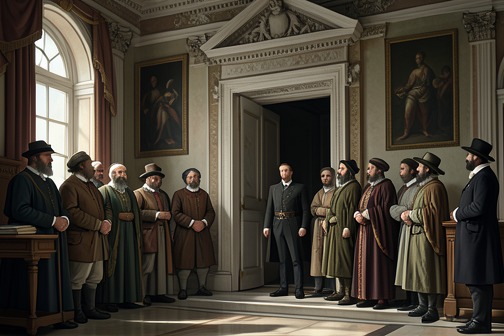
[Charles VIII's Italian expedition](entity:event-recall-event-charles-viii-s-italian-d0827fd84c0c) serves as a historical example in [Jean-Jacques Rousseau](entity:character-recall-character-jean-jacques-rousse-f0bb31f5666c)’s argument that refinement in the sciences and arts can come at the expense of martial strength: Charles VIII became master of Tuscany and the kingdom of Naples almost without drawing his sword, while [Italy](entity:location-recall-location-125be658b0d0)’s princes and nobles were said to have cultivated their intellects more earnestly than active, military pursuits.
## Setting and Context
Rousseau places the episode within a broader contrast between learned refinement and the practical capacities demanded by war. The Italian court’s cultivation of understanding is not presented as a neutral accomplishment: in his account, it had displaced the active and martial pursuits needed to defend political power.
## Course of the Expedition
The decisive feature of the expedition is its ease. Charles VIII found himself master of Tuscany and the kingdom of Naples almost without drawing sword. The account therefore gives the campaign little emphasis as a sequence of battles; its striking fact is the scale of the result relative to the limited fighting described.
## Explanation and Significance
The princes and nobles of Italy attributed Charles’s unexpected success to their own priorities: they had applied themselves more earnestly to cultivating their understanding than to active and martial pursuits. Rousseau frames this explanation as an instance of a wider claim that, in military affairs and comparable activities, application to the sciences tends to make people effeminate and cowardly rather than resolute and vigorous. The expedition thus functions less as a military narrative than as evidence in an argument about the political cost of intellectual and courtly refinement.
## Aftermath in Rousseau’s Argument
Rousseau connects the episode to a longer history of Italy’s changing martial reputation. He argues that the rise of the Medici and the revival of letters had again destroyed the martial reputation that Italy seemed to have recovered in earlier centuries, perhaps for good. Charles VIII’s easy advance consequently stands as one point in a recurring pattern: cultivation and refinement, when they replace strenuous public and military activity, leave states and their elites less capable of resistance.
Event 19
Henry IV's conversion to Catholicism
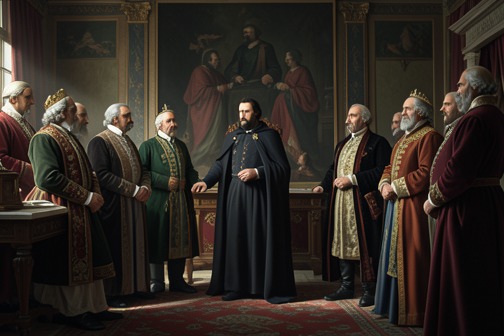
Henry IV's conversion to Roman Catholicism is cited by [Jean-Jacques Rousseau](entity:character-recall-character-jean-jacques-rousse-f0bb31f5666c) as a test of the relation between religious allegiance and political sovereignty. Rather than recounting the conversion as a scene or supplying its circumstances, Rousseau turns the reason attributed to Henry into a warning: a ruler who understands the political danger of religious exclusivity should have reason to leave that religion, not embrace it.
## The conversion as a political example
Rousseau mentions Henry IV near the end of his discussion of civil religion, in an argument about tolerance after the disappearance of exclusive national religions. His reference is brief and pointed. The conversion matters here not as biography but as an instance in which a prince's religious choice can be judged by its consequences for the state.
The text does not state what Henry's reason for converting was. It refers only to the reason said to have led him to embrace the Roman religion, then reverses its implication: whatever that reason may have been, Rousseau says it ought to prompt an honest person to leave the religion, and especially a reasoning prince. The example therefore relies on an attributed motive without narrating or verifying it.
## Religion and political allegiance
The argument rests on Rousseau's distinction between forms of religion in their relation to society. The religion of the citizen binds one country to its own gods, rites, and legally prescribed worship; in Rousseau's account, it treats those outside its altars as foreign or infidel. A separate form, the religion of the priest, gives people two codes, rulers, and countries, setting religious duties against civic ones. Rousseau identifies Roman Christianity with this divided allegiance.
For Rousseau, the political problem is not simply that a ruler has a religious belief. It is that religious authority may claim obedience independently of the state, leaving citizens subject to contradictory obligations. Earlier, he observes that when theological intolerance acquires civil force, the sovereign loses authority in temporal matters and priests become the real masters, with kings reduced to their ministers. Henry's conversion is placed against this larger concern about who ultimately commands political obedience.
## Tolerance and the prince's choice
Rousseau argues that, because there can no longer be an exclusive national religion, the state should tolerate religions that tolerate others, provided their dogmas do not conflict with the duties of citizenship. He makes an exception for the claim that salvation exists only within one church: unless the state itself is that church and its prince its pontiff, such a doctrine should exclude its adherent from the state. In any other political arrangement, Rousseau calls the claim fatal.
The example of Henry sharpens this rule into advice directed especially at princes. A ruler must consider whether religious allegiance sustains the state's independent authority or subordinates it to a rival power. Rousseau's concluding reversal makes the conversion a compact political paradox: the reason said to justify Henry's entry into Roman Catholicism is presented instead as a reason for an honest person—and still more a prince—to leave it.
## Place in Rousseau's argument
The reference belongs to a normative argument, not a chronicle of Henry's life. Rousseau supplies no date, setting, account of the decision, or description of its reception; the conversion is introduced solely through its reported rationale and its force as a warning about religious authority. It should therefore be read as Rousseau's political use of the example, not as independent evidence establishing Henry's motive.
That use connects the episode to the book's broader insistence that political right cannot be founded merely on a fact of power or submission. Rousseau criticizes arguments that infer right from existing domination, including the defense of slavery, because such reasoning favors tyrants. His discussion of the legislator likewise describes appeals to divine authority as a means by which founding institutions can secure obedience when ordinary force or reason cannot do so. Against those founding appeals, the Henry example asks what happens when religious authority competes with civic sovereignty: a prince's conversion becomes a way to expose, rather than resolve, the danger of divided allegiance.
Event 20
Expulsion of the Tarquins
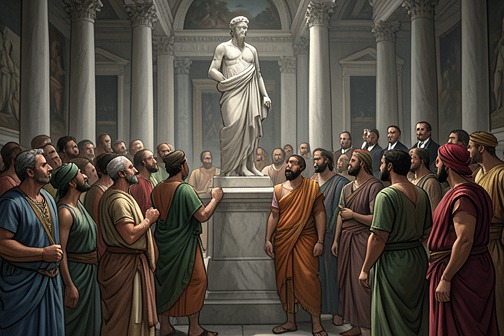
The [Expulsion of the Tarquins](entity:event-recall-event-expulsion-of-the-tarqui-065feacc6b51) is presented by [Jean-Jacques Rousseau](entity:character-recall-character-jean-jacques-rousse-f0bb31f5666c) as the real birth of the Roman Republic, not as the completion of its political settlement. The overthrow of the monarchy opened a new republican period, but the surviving patriciate left the work of establishing a stable popular government unfinished; in Rousseau’s account, the decisive institutional turning point came later with the tribunate.
## From Monarchy to the Republic
Rousseau rejects the claim that the Roman Republic simply followed a smooth course from monarchy to aristocracy and then to democracy. The government first established by [Romulus](entity:character-recall-character-780957485e3a) was mixed, he argues, and soon deteriorated into despotism. The state then died prematurely, before it could reach a mature political form. Against this earlier breakdown, the expulsion of the Tarquins stands as the actual beginning of the Republic.
That beginning did not, however, settle the form of government. The Republic initially lacked a constant political structure because it did not abolish the patriciate. The expulsion ended the royal period, but left an inherited political order in place, so that the change of regime remained incomplete.
## The Patriciate and an Unfinished Settlement
The continued existence of the patriciate set hereditary aristocracy against democracy. Rousseau calls hereditary aristocracy the worst of the legitimate forms of administration: its survival meant that the Republic’s founding change had not yet reconciled the governing structure with popular rule. The historical importance of the expulsion therefore lies partly in what it began and partly in what it failed to resolve.
Rousseau distinguishes this unsettled first phase from the later political arrangement. The change from monarchy did not itself establish a true democracy; the conflict between patrician inheritance and democratic government persisted until a further institution altered the balance of power.
## The Tribunate and Democratic Government
The establishment of the tribunate fixed the form of the Roman government, in Rousseau’s interpretation, and completed the work left unfinished at the Republic’s birth. Only then, he says, was there a true government and a genuine democracy. At that stage the people were not merely sovereign: they also acted as magistrate and judge.
The other offices were correspondingly limited in relation to the people. The senate served as a subordinate tribunal, tempering and concentrating the government. The consuls, despite being patricians and serving as chief magistrates and absolute generals in war, were in [Rome](entity:location-recall-location-f3877a21016f) itself no more than presidents of the people. The passage thus measures republican institutions by their actual political function, not by their titles.
## The Republic’s Later Direction
The democratic settlement did not remain fixed. After the establishment of the tribunate, the government followed what Rousseau calls its natural tendency and inclined strongly toward aristocracy. The patriciate, he says, effectively abolished itself as the location of aristocratic power: that power was found instead in the senate, composed of patricians and plebeians, and even among the tribunes when they began to usurp an active function.
This later development sharpens the meaning of the founding event. Expelling the Tarquins began the Republic, but neither a republican name nor the end of kingship guaranteed continuing popular rule. Rousseau’s account follows political power as it shifts among institutions, insisting that when rulers govern on behalf of the people, the government is aristocratic whatever those rulers are called.
Event 21
罗马保民官制度的建立
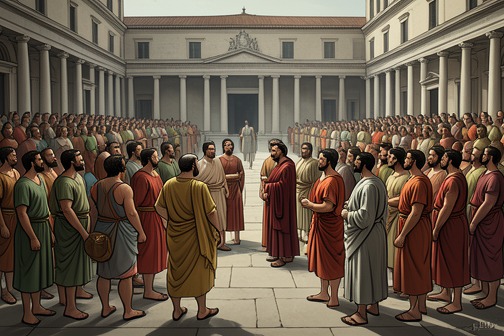
The establishment of the Roman tribunate is presented as the decisive constitutional turning point in [Jean-Jacques Rousseau](entity:character-recall-character-jean-jacques-rousse-f0bb31f5666c)’s account of the Roman Republic. It completed the Republic’s unfinished break with patrician dominance, made the people sovereign as well as magistrate and judge, and gave the government a settled democratic form; yet it did not arrest the government’s later drift toward aristocracy.
## [Rome](entity:location-recall-location-f3877a21016f)’s Early Political Structure
Rousseau places the tribunate within a long institutional development rather than treating it as an isolated reform. After Rome’s foundation, the new republic consisted of the army gathered by [Romulus](entity:character-recall-character-780957485e3a): Albans, Sabines, and foreigners. These groups were divided into three tribes, each tribe into ten curiae, and each curia into decuriae, headed by officials called curiones and decuriones. Each tribe also supplied one hundred Equites, or Knights, forming a century. Rousseau reads these divisions as evidence that the early arrangements were military in origin, even as the small city provided itself with a system suited to future greatness.
The original division soon produced an imbalance. The Alban and Sabine tribes remained stable, while the foreign tribe grew as newcomers settled in Rome and eventually surpassed the others in strength. [Servius](entity:character-recall-character-e630ce3d6988) responded by abolishing the racial basis of division and organizing four tribes by the city’s inhabited quarters, each named after a hill. He also prevented residents from moving between quarters, preserving the separation of the groups. This earlier reorganization illustrates the continuing effort to adapt Rome’s institutions as its population changed; the tribunate would later address a different problem, the Republic’s incomplete political settlement.
## From Regime Change to Constitutional Settlement
Rousseau distinguishes the actual birth of the Republic from the expulsion of the Tarquins. Although that expulsion ended the kings’ rule, the new regime retained the patriciate and therefore left half its work undone. Hereditary aristocracy remained in conflict with democracy, and the government had not yet acquired a stable constitutional form. The tribunate’s establishment marks the resolution of that unsettled phase: only then, Rousseau argues, was there a true government and a genuine democracy.
This account also rejects the simple description of Roman history as a steady passage from monarchy to aristocracy and then democracy. Rousseau calls Romulus’s initial arrangement a mixed government that soon deteriorated into despotism, and treats the early state as having died before it reached maturity. The Republic’s real development begins with the expulsion of the Tarquins, but its constitutional completion comes later, with the tribunate. In this sequence, the institution is not merely an addition to an already complete republic; it is what makes the republican order politically definite.
## The People, the Senate, and the Consuls
The tribunate’s significance appears in the distribution of political functions Rousseau associates with the settled Republic. The people were not only sovereign; they were also magistrate and judge. The senate served as a subordinate tribunal, tempering and concentrating the government rather than holding sovereignty over the people. The consuls, despite being patricians, chief magistrates, and absolute generals in wartime, were in Rome itself no more than presidents of the people.
That arrangement makes the tribunate a hinge between popular sovereignty and the machinery of government. The people’s position was not limited to choosing or obeying rulers: Rousseau describes them as occupying the sovereign and governing roles, while the senate and consuls remained subordinate. His account thus defines the Republic’s democracy by the actual location of authority and function, rather than by institutional titles alone.
## The Government’s Later Drift
The settlement did not secure Rome permanently against political change. Rousseau says that once the government had taken its settled form, it followed its natural tendency and inclined strongly toward aristocracy. The patriciate, in his interpretation, effectively abolished itself as the site of aristocratic power; that power instead came to reside in the senate, which included patricians and plebeians, and even in the tribunes when they began to usurp an active governing function. A title could not settle the question of what a body did: when the people had rulers who governed for them, Rousseau classed the government as aristocratic, whatever those rulers were called.
This later movement connects the Roman example to Rousseau’s general account of government’s tendency to oppose sovereignty. As the government’s particular will acts against the general will, its increasing exertion changes the constitution and can eventually suppress the sovereign people and break the social compact. The tribunate therefore signifies both a democratic achievement and a point in an ongoing constitutional history: it establishes the people’s central authority, but the changing work of institutions can still redirect power away from them.
Event 22
围攻维爱
The Siege of Veii appears not as a narrated battle but as a brief historical marker in [Jean-Jacques Rousseau](entity:character-recall-character-jean-jacques-rousse-f0bb31f5666c)’s account of public economy. He identifies it as the first occasion on which [Rome](entity:location-recall-location-f3877a21016f) paid its infantry, using the change to distinguish the earlier service of citizens from the later growth of military establishments and their fiscal and political costs.
## The Siege as a Historical Turning Point
Rousseau contrasts the paid infantry at Veii with the earlier Roman victories, which he says were won by brave citizens willing to shed blood for their country but not to sell their service. The reference marks a change in how military duty was supplied: at Veii, Rome began paying its infantry. The passage gives no account of the siege’s course, its combatants, or its outcome; its importance lies in the institutional shift Rousseau associates with it.
## Citizen Service and Paid Military Force
The siege serves as an early point of comparison for Rousseau’s account of later recruitment. He says that, in the Jugurthine War, Marius further changed the legions by introducing freedmen, vagabonds, and other recruits. In his larger argument, this later development belongs to a decline in the citizen army: rulers came to prefer mercenaries to free men, in part because paid troops could be used to bring citizens under submission.
Rousseau traces the consequences of maintaining such forces beyond military organization. Removing men from the land reduced the labor available for producing provisions, while supporting troops added to the taxes that raised prices. Popular complaints then encouraged rulers to enlarge the forces used to suppress them, worsening hardship and provoking further expansion. Veii is not said to have caused this entire cycle; it supplies the earlier landmark against which Rousseau sets the later transformation.
## Place in the Argument on Public Finance
The historical reference supports a warning about the costs of public wants and the means used to meet them. Rousseau argues that military establishments can undermine a system chiefly supported by public lands, leaving governments more dependent on subsidies and taxes. His concern is therefore not only the expense of soldiers: the growth of paid forces can burden production and subsistence while also strengthening the rulers who command them.
That argument sits within a defense of property alongside a demand for legitimate public contribution. Rousseau describes property as essential to civil society and argues that members must contribute to the state’s support, but says lawful assessment must rest on the general will, expressed by majority vote and proportioned rather than imposed arbitrarily. The Siege of Veii’s limited but distinct significance is to show where paid infantry enters his account of the tensions between military provision, public revenue, and the liberty of citizens.
Event 23
朱古达战争
The Jugurthine War appears in The Social Contract not as a narrated campaign but as the setting for a consequential change in Roman military recruitment. Rousseau identifies Marius’s introduction of freedmen, vagrants, and other mercenaries into the legions as a dishonor to the army, contrasting paid service with the earlier Roman ideal of citizens who gave their lives for their country but would not sell that service. The episode supports his broader argument that a state’s military arrangements can weaken the civic bonds on which its freedom depends.
## The War and the Change in Recruitment
Rousseau places the change during the Jugurthine War, after the Roman infantry had already begun receiving pay at the siege of Veii. Under Marius, recruitment widened to include freedmen, vagrants, and others whom Rousseau groups as mercenaries. The text does not recount the war’s battles or identify its opposing commanders; its focus is the institutional consequence of drawing soldiers from this new pool.
The contrast is with the victories of early [Rome](entity:location-recall-location-f3877a21016f), and with those of Alexander, which Rousseau attributes to brave citizens prepared to shed their blood for their country but unwilling to sell it. Payment and recruitment thus signify more than a practical adjustment: they mark a shift from civic service toward a military force whose connection to the country rests on employment rather than citizenship.
## Mercenaries, Rulers, and the Citizens
Rousseau links the growth of paid forces to a danger in the relation between government and the people. When citizens cease to feel invested in the common cause, they may no longer defend their country themselves; magistrates can then prefer mercenaries to free citizens, in part because troops may be used to bring those citizens into submission. The army’s change is therefore presented as a political risk, not simply a response to military needs.
This argument belongs to Rousseau’s wider account of the conflict between government’s particular will and the general will. As government presses against the sovereignty of the people, the constitution changes and the political compact is threatened. The mercenary army supplies a concrete historical example of how rulers’ instruments of power may become detached from the citizens whose common interest the state is meant to serve.
## Consequences and Historical Significance
Rousseau’s surrounding account traces the costs of maintaining regular troops: taking men from the land diminishes agricultural labor and provisions; maintaining the army requires taxes that raise prices; public discontent follows, and suppression of that discontent demands still more troops. He presents this as a self-reinforcing cycle in which the measures meant to secure government deepen popular hardship.
He places this development in a longer Roman decline, describing regular troops under tyrants as ostensibly directed against foreign enemies but in practice capable of enslaving their fellow citizens. The Jugurthine War is consequently a landmark in his argument about the corruption of military service: Marius’s recruitment is associated with the erosion of the citizen army, while the later use of mercenaries helps explain how armed force could be turned inward and become one of the principal causes of the [Roman Empire](entity:location-recall-location-32620cb21621)’s ruin.
Event 24
苏格拉底之死
[Socrates](entity:character-recall-character-0d7843dbcd5a)’ death is invoked as the limit and measure of a virtue centered on philosophy: he opposed the Sophists and died for truth, but Rousseau contrasts that personal achievement with Cato’s devotion to a country, its liberty, and its laws. The contrast makes Socrates an example of individual wisdom while arguing that patriotism can direct virtue toward the happiness of an entire people.
## The Death in Rousseau’s Comparison
The passage does not narrate the circumstances of Socrates’ death. It places the death at the end of a compressed account of his public life: Socrates instructed a few individuals, opposed the Sophists, and died for truth. His death completes a portrait of philosophical integrity, but Rousseau measures that integrity against a different civic standard rather than treating it as the highest possible form of virtue.
## Socrates and Cato
Rousseau sets Socrates beside Cato, whose country was already at stake in a world shaped by Caesar and Pompey. Socrates had, in Rousseau’s account, no country beyond the world at large because [Athens](entity:location-recall-location-athens-829baca0905a) was already ruined; Cato, by contrast, kept his country’s cause at heart, lived for it, and could not bear to outlive it. He defended its liberty and laws against the conquerors of the world, then departed from life when there was no longer a country for him to serve.
The contrast distinguishes the reach and object of their virtues. Socrates is called the greater philosopher, and his virtue belongs to the wisest of men. Cato appears, beside Caesar and Pompey, almost superhuman in civic stature: he acts for a shared political community rather than for the instruction of a few individuals. Rousseau does not deny Socrates’ courage or commitment to truth; he argues that Cato’s patriotism turns virtue outward, making the happiness of all the ground of his own.
## Civic Meaning
The comparison supports Rousseau’s case that citizens must be taught virtue and that patriotism is among its most effective sources. Socrates represents what philosophical example can accomplish: a worthy pupil of his would be the most virtuous person of the age. Cato represents a different political possibility: a worthy follower could become one of the greatest, because his happiness would lie in the happiness of all. Rousseau’s conclusion is not that a people can be made into philosophers, but that it can be made happy—and that the death of Socrates, set against Cato’s civic life and final departure, helps clarify the distinction.
Event 25
小加图之死
The death of Cato the Younger is invoked as the culmination of a life devoted to country: when his country could no longer be served, he departed from the earth. The text makes that ending a measure of patriotism, contrasting Cato’s civic commitment with [Socrates](entity:character-recall-character-0d7843dbcd5a)’ philosophical virtue and arguing that a people’s happiness, rather than a nation of philosophers, is the more attainable political aim.
## The End of a Civic Life
Cato’s death is mentioned within an argument that citizens must be taught virtue, not merely exhorted to be good. The passage identifies patriotism as the most effective means of forming civic character: when people love their fellow citizens, their particular wills can accord with the general will. Cato’s fate gives this argument its starkest example. He lived for his country alone and could not bear to outlive it; once it offered no further cause for service, his life’s political purpose had ended.
The account does not describe the circumstances or mechanics of his death. Instead, it presents the ending through the relation between a citizen and the country he serves. Cato’s departure from the earth follows the loss of a country to defend, so death marks the completion of civic allegiance rather than an isolated personal episode.
## Cato and Socrates
The text sets Cato against Socrates to distinguish two kinds of virtue. Socrates is called the greater philosopher: he instructed a few individuals, opposed the Sophists, and died for truth. Yet the contrast turns on the scope of their commitments. Socrates, living when [Athens](entity:location-recall-location-athens-829baca0905a) was already ruined, had no country beyond the world at large; Cato kept his country’s cause constantly at heart and defended its liberty and laws against the conquerors of the world.
That difference shapes the passage’s judgment of their legacies. A worthy pupil of Socrates would be the most virtuous of his contemporaries, and the philosopher’s virtue would be his happiness. A worthy follower of Cato, by contrast, would be one of the greatest, seeking happiness in the happiness of all. The text therefore says that people may learn from Socrates but be led by Cato: no people has ever been made into a nation of philosophers, while making a people happy remains possible.
## [Patriotism](entity:concept-recall-concept-patriotism-3face82d501d) and Political Belonging
Cato’s example supports a broader claim about how public feeling is formed. The text argues that humanity’s concern weakens when spread across all mankind, whereas fellow citizens are made vivid by shared life and common interest. Patriotism concentrates that concern and gives self-love the force of civic virtue. In this account, the exceptional actions associated with Cato are not simply private moral achievements; they arise from attachment to a political community and its liberty and laws.
The passage also sets a condition on that attachment. Citizens cannot be expected to love a country that is no more to them than it is to strangers, or that provides only benefits it cannot refuse to anyone. If their lives, liberty, and property remain at the mercy of those in power, with no effective recourse through law, they bear the duties of civil society without enjoying even the common privileges of the state of nature. In such a condition, the word country would become odious and ridiculous. Against that background, Cato’s devotion signifies not patriotism in the abstract but commitment to a country understood through its liberty and laws.
Event 26
福基斯战争
The Phocian War, known as the Sacred War, is presented as a campaign to punish sacrilege rather than to conquer unbelievers. This distinction makes the conflict a precise example in Rousseau’s argument about religion and political society: a war may invoke sacred obligations without being, in its stated purpose, a war of religion.
## The Sacred Name and the Stated Purpose
The designation “Sacred War” might suggest a conflict waged against people for holding another faith. Rousseau rejects that inference. He identifies the war’s object as punishment for acts of sacrilege, not the conquest of unbelievers. The name therefore does not settle the question of what kind of war it was; its purpose does.
## Religion, Law, and Political Community
The distinction belongs to Rousseau’s broader account of religion’s relation to society. He distinguishes a religion associated with inward worship and moral obligations from civic religion, whose rites and dogmas are prescribed within a particular country and whose duties are bounded by its altars. The Phocian War’s punitive object marks it off from a campaign of religious conquest, even as its sacred designation places the issue of sacrilege within a political and religious frame.
## Significance in Rousseau’s Argument
Rousseau’s brief classification cautions against treating every conflict described in religious terms as a war to impose belief or subdue outsiders. In the Phocian case, the stated target is sacrilege, not unbelief. That contrast supports his larger effort to clarify how religion can be implicated in political order without making every religiously named conflict identical in aim or character.