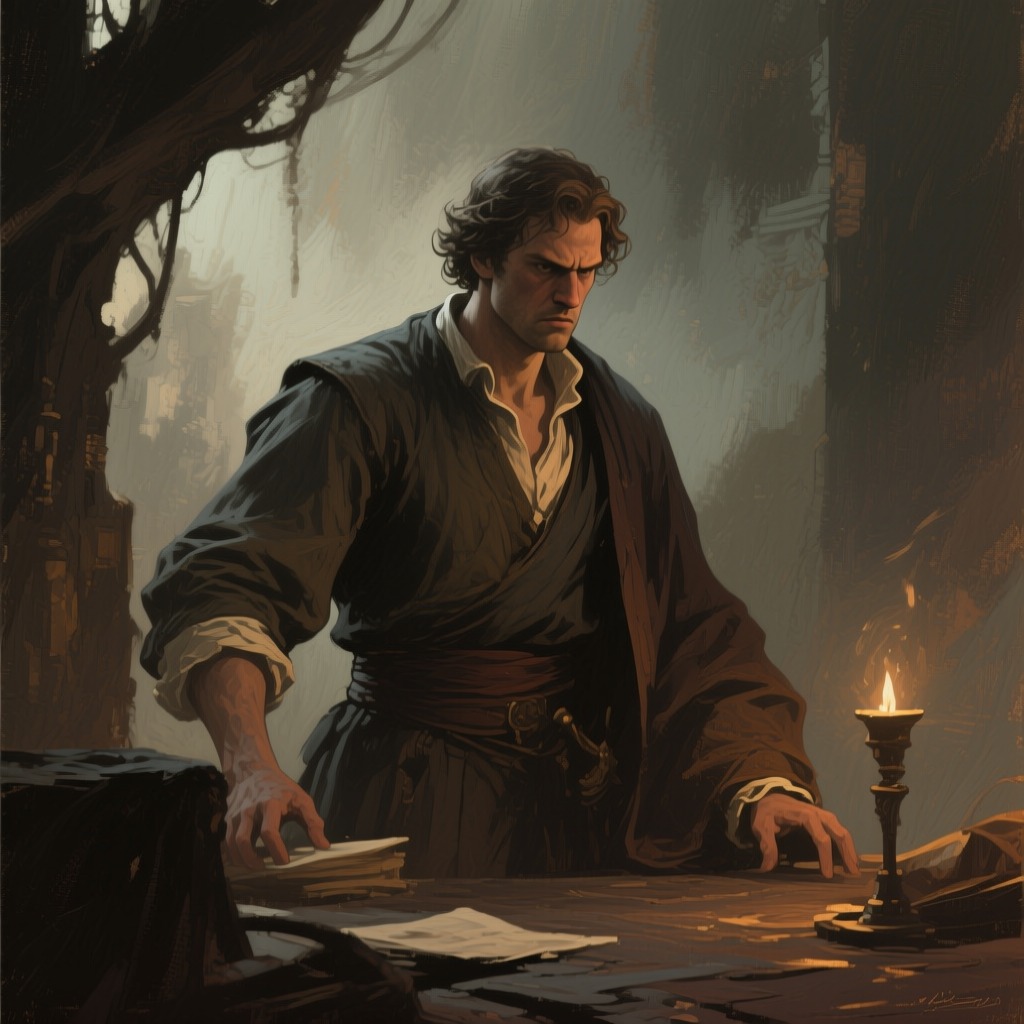
Professor James Darcy Pieixoto
Professor James Darcy Pieixoto, Director of the Twentieth- and Twenty-First-Century Archives at Cambridge University, appears as the keynote speaker at the Thirteenth Symposium on Gileadean Studies, held in Passamaquoddy, Maine, on June 29–30, 2197. He is the scholar who introduces to the academic community the three textual discoveries that constitute The Testaments: the Ardua Hall Holograph attributed to Aunt Lydia, and the two witness testimonies of Agnes Jemima and Nicole. His presentation frames the entire novel for the reader, establishing the documentary frame through which the story is received and weighing the evidence for the authenticity of these remarkable finds.
Role and Authority
Pieixoto is introduced by symposium chair Professor Maryanne Crescent Moon as a speaker familiar to the audience both from his written publications and from his recent television series, Inside Gilead: Daily Life in a Puritan Theocracy. He is a figure of considerable academic prestige, and his presentation of objects from museum collections around the world—especially handcrafted textile items—is described as "truly spellbinding." He acknowledges the recent surge in popularity of Gileadean Studies, noting wryly that those who have "laboured in the dim and obscure corners of academe for so long are not used to the bewildering glare of the limelight." He also references his own previous missteps, promising to avoid the jokes that drew criticism at the Twelfth Symposium.
Presentation of the Documents
Pieixoto describes the three batches of materials that form the novel. First, the Ardua Hall Holograph: a series of handwritten pages discovered inside a nineteenth-century edition of Cardinal Newman's Apologia Pro Vita Sua, purchased at auction and eventually brought to his attention. He shows a slide of the first page, notes that the handwriting is legible to those trained in archaic cursive, and explains that the pages were trimmed to fit within the excavation in the book. The carbon dating of the paper does not exclude the Late Gilead period, and the ink shifts from black to blue after a certain number of pages. Second, the two witness testimonies, labelled 369A and 369B, which were located in the library of the Innu University in Sheshatshiu, Labrador, filed under the misleading title "Annals of the Nellie J. Banks: Two Adventurers." A graduate student, Mia Smith, opened the file while searching for a thesis topic and passed the material to Pieixoto for evaluation.
Authentication and Caution
Pieixoto carefully weighs the question of authenticity. He acknowledges that the holograph could be a forgery from within Gilead itself—a trap meant to frame its object, like the Casket Letters used against Mary, Queen of Scots—perhaps composed by Aunt Elizabeth or Aunt Vidala. However, he inclines to the view that the holograph is authentic, noting that the two half-sister fugitives themselves claim that Aunt Lydia was the source of the crucial microdot. He also raises the possibility that the girls' story is itself a misdirection intended to protect the real Mayday double agent. Of the witness testimonies, he says they are "almost certainly authentic," though he notes the frustrating absence of dates. He describes the mission they recount as instrumental in initiating the final collapse of Gilead, since the material smuggled out by the younger sister—a microdot embedded in a scarified tattoo—revealed discreditable personal secrets that touched off the Ba'al Purge, thinned the elite class, weakened the regime, and instigated a military putsch and popular revolt.
The Statue and the Inscription
Pieixoto concludes with a slide of a statue located on the Boston Common, depicting a young woman wearing the costume of the Pearl Girls, carrying a bouquet of forget-me-nots, with two birds on her right shoulder. The inscription reads: "In Loving Memory of Becka, Aunt Immortelle. This memorial was erected by her sisters Agnes and Nicole and their mother, their two fathers, their children and their grandchildren. And in recognition of the invaluable services provided by A.L. A bird of the air shall carry the voice, and that which hath wings shall tell the matter. Love is as strong as death." Pieixoto takes this inscription as a convincing testament to the authenticity of the two witness transcripts, arguing that the two young messengers must indeed have lived to be reunited with their mother and their respective fathers, and to have children and grandchildren of their own. He closes by inviting the audience to ponder the meaning of the cryptic windowsill markings discovered at the Campobello refugee centre, suggesting that the correspondence of the initial letters to several key names in the transcripts is "highly evocative."