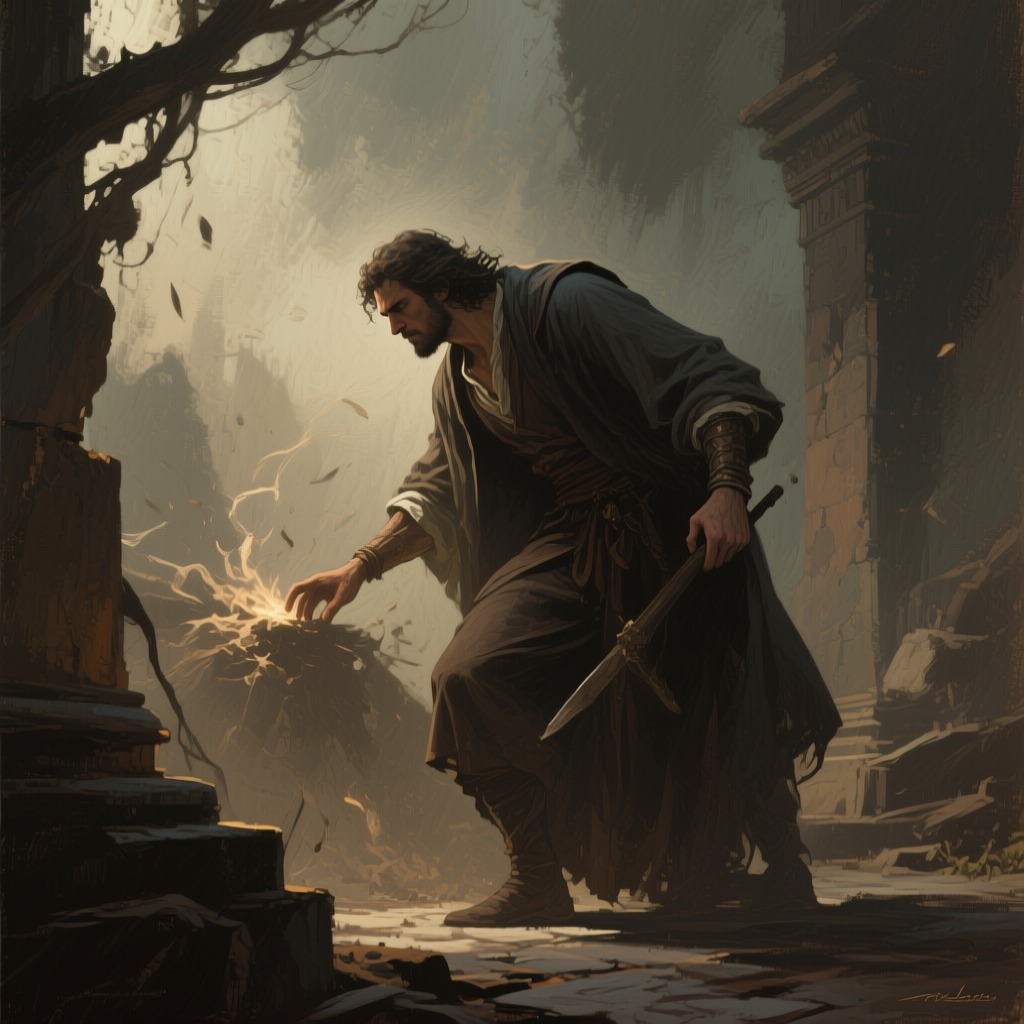
The Guardians
The Guardians of the Faith, commonly called the Guardians, form the lowest tier of Gilead's armed male hierarchy. They are the uniformed men who drive cars, mow lawns, stand at gates, and perform the routine policing that keeps the regime's everyday machinery running. Unlike the Angels, who fight at the front, or the Eyes, who conduct internal surveillance and purges, the Guardians are the visible, mundane face of male authority in the streets and homes of Gilead. Their presence is constant but their power is circumscribed: they are trusted only with the most basic tasks of enforcement and are themselves subject to the suspicion of the higher security organs.
Identity and Role
A Guardian's uniform and duties mark him as a functionary rather than a warrior. In the dollhouse that Agnes Jemima plays with as a child, the Guardian doll wears a cap and drives the car and mows the lawn, while the two Angels stand at the gate with miniature plastic guns. This hierarchy is reflected in the playing-card system used in Gilead: Clubs are Guardians, while Spades are Angels. The Guardians are the men who escort school outings, drive Commanders' Wives on errands, and patrol the gates of schools and compounds. They are also the men who, when a girl is being married, will be the best she can hope for if she reaches eighteen unmarried and is considered "dried goods" — a fate that means she will be "lucky to get even a Guardian."
Guardians and the Control of Women
The Guardians are the primary male enforcers of the rules that govern women's movement and behavior. They drive the schoolgirls in their long double lines, they stand at the locked gates of the Vidala School, and they are the ones who would pursue a runaway girl. When Agnes Jemima, desperate to avoid her marriage to Commander Judd, tricks her Guardian driver into taking her to see Aunt Estée, she must manipulate him with a promise of future reward and a display of ankle — a transaction that reveals both the Guardian's limited but real power over her and the sexual economy that underpins even the most routine male-female interaction in Gilead. The Guardian is flustered by her touch and her hint of future favor, but he is also suspicious and resentful when he realizes he has been deceived.
Guardians and the Eyes
The Guardians are explicitly subordinate to the Eyes, Gilead's secret police. When Aunt Lydia, after her arrest, is taken to the headquarters of the Eyes, she notes that the building was once a police station but is no longer: the lettering has been covered over, and on the front door there is an image of an eye with wings. The Guardians, as the former police, have been displaced and demoted. The Eyes are the ones who conduct the real work of surveillance and interrogation; the Guardians are left with the menial tasks of driving and gatekeeping. This hierarchy means that a Guardian who disobeys or is suspected of disloyalty can be reported to the Eyes, as Agnes Jemima's driver fears after he is tricked into helping her.
Narrative Significance
The Guardians serve as a constant reminder of the pervasiveness of male surveillance and control in Gilead, even at its most mundane level. They are the men who see women every day, who drive them, who open doors for them, who could report them. Their presence normalizes the regime's authority, making it seem as natural and unavoidable as the traffic on the streets. At the same time, their low status and limited power make them figures of potential manipulation for women who are clever enough to exploit the gap between the Guardians' authority and their vulnerability to higher-ups. Agnes Jemima's successful manipulation of her driver is a small but significant act of resistance, a reminder that even the most rigid systems have cracks that can be pried open.