3 August 2004
The First Shift
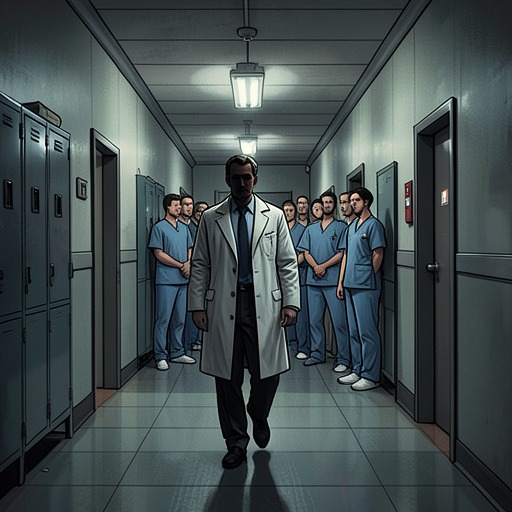
[Adam Kay](entity:character-recall-character-adam-kay-177cd5d97bc0) begins work as a junior doctor with a packed lunch from H and a bag of new equipment. A misspelled email address gives him a private joke: if anything goes wrong, he can blame the mysterious “Atom.”
The first day introduces the combination of nerves and humour that will carry him through years of hospital work.
30 August 2004
Unusual Complaints
Over lunch, junior doctors trade stories about patients with strange symptoms, from itchy teeth to pain in an arm during urination. The anecdotes receive polite laughter until Sam describes a patient who can sweat from only one side of the face.
The group recognizes that this could indicate a serious lung problem, and Sam rushes to arrange the patient’s return. [Adam Kay](entity:character-recall-character-adam-kay-177cd5d97bc0) finishes Sam’s abandoned Twix as the joke turns into a clinical alarm.
10 September 2004
The Pulse Count
Puzzled that every patient’s chart records a pulse of sixty, [Adam Kay](entity:character-recall-character-adam-kay-177cd5d97bc0) secretly watches a nurse count a patient’s pulse with a watch. The slow, careful method explains the suspiciously uniform entries.
The episode offers an early glimpse of the routines and small absurdities of ward life, where even basic measurements can acquire comic significance.
17 October 2004
The First Death
A patient suddenly sprays blood from his mouth, and [Adam Kay](entity:character-recall-character-adam-kay-177cd5d97bc0) is overwhelmed by the emergency, briefly considering kitchen roll as a solution. His boss arrives and puts a tube into the patient’s throat, but the bleeding fills the room and the man dies.
After the death is confirmed and the family is informed, Adam Kay changes out of his blood-soaked clothes. His boss takes him outside for a cigarette, though Adam Kay does not smoke; it is his first encounter with death at close range.
9 November 2004
The Midnight Sleeping Pill
At three in the morning, just as he finally closes his eyes after three shifts, [Adam Kay](entity:character-recall-character-adam-kay-177cd5d97bc0) is called to give a patient a sleeping pill. He staggers to the ward and discovers that the patient has already fallen asleep.
The harmless anticlimax underlines the exhaustion and misplaced urgency that shape his nights on call.
12 November 2004
The Dangerous Plant
[Adam Kay](entity:character-recall-character-adam-kay-177cd5d97bc0)’s boss Henry traces abnormal blood tests to herbal tablets taken by a patient hoping to feel calmer. The patient is astonished to hear that plant-based remedies can be dangerous.
Henry lists poisonous plants and mushrooms to make his point, then tells Adam Kay that a water lily in his garden would kill anyone who sat beneath it. The claim is a joke, but the patient throws the tablets away.
6 December 2004
Ninety-Seven Hours
Asked to record the extra hours he has worked, [Adam Kay](entity:character-recall-character-adam-kay-177cd5d97bc0) realizes he has seen H for less than two hours that week. His total comes to ninety-seven hours, much of it unpaid.
The calculation makes the cost of his new career brutally concrete, and foreshadows the strain that will reach into his relationship and private life.
31 January 2005
A Life Saved
[Adam Kay](entity:character-recall-character-adam-kay-177cd5d97bc0) is called to an old man close to death and acts quickly, doing what he has been trained to do before his senior colleague arrives. The patient improves, and Adam Kay briefly feels like Superman.
His boss says he has bought the man a few more weeks of life. The achievement matters all the more because Adam Kay recognizes how rarely an individual saves someone alone; most recoveries depend on teams working steadily together.
7 February 2005
The Lamp-Post Injury
An eighteen-year-old patient has slid down a rough lamp post after dancing on a bus shelter roof. The fall tears skin and muscle from his penis, an injury [Adam Kay](entity:character-recall-character-adam-kay-177cd5d97bc0) finds almost impossible to forget.
When the young man asks whether the skin can be reattached, Adam Kay’s boss explains that it has been left across the length of the lamp post. The episode becomes one of the job’s grotesque stories, while also exposing the patient’s distress beneath the joke.
21 February 2005
The Price of a Sick Note
A patient offers [Adam Kay](entity:character-recall-character-adam-kay-177cd5d97bc0) money to extend her sick leave, first ten pounds and then fifteen. He laughs, but she is serious.
On the way home, he privately wonders how much it would take to make him agree, deciding that fifty pounds might be enough. The thought reveals the financial pressure behind the professional temptation, even as he does not accept the offer.
14 March 2005
The Hospital Alarm
Out for pizza with H and friends, [Adam Kay](entity:character-recall-character-adam-kay-177cd5d97bc0) hears the restaurant’s order buzzer. Its sound is almost identical to his hospital alarm, and he jumps to his feet.
For a moment, the workplace has followed him into an ordinary evening. The reflex shows how difficult it is to separate his life as a doctor from everything outside the hospital.
11 April 2005
A Mother’s Reassurance
[Adam Kay](entity:character-recall-character-adam-kay-177cd5d97bc0) watches Colin calmly explain a child’s operation to the boy’s worried mother. Colin describes what is wrong, what the team will do and how long recovery should take, visibly easing her fears.
As the child is taken away, Colin suggests that his mother give him a quick kiss. She kisses Colin on the cheek instead, leaving her son’s cheek untouched; the small misunderstanding punctures the tenderness of the scene with comedy.
16 June 2005
The Threatened Legs
A patient furious about waiting for a scan threatens to break both of [Adam Kay](entity:character-recall-character-adam-kay-177cd5d97bc0)’s legs. Adam Kay’s first response is to wonder whether the injury might earn him a few weeks away from work.
The joke captures how normal the threat of violence has become in his thinking, and how overwork can make even an alarming encounter seem like a possible break.
5 July 2005
Three Bottles on a Good Day
[Adam Kay](entity:character-recall-character-adam-kay-177cd5d97bc0) asks an elderly woman how much wine she drinks each day. She says about three bottles on a good day, and only one on a bad day.
The exchange turns an attempt at routine clinical history-taking into a sharp, unsettling joke about the patient’s drinking.
7 July 2005
The London Bombings
After the [7 July 2005 London bombings](entity:event-recall-event-7-july-2005-london-bomb-3b598c911206), doctors are ordered to report to A&E. [Adam Kay](entity:character-recall-character-adam-kay-177cd5d97bc0) is told to discharge patients whose lives are not in danger so that beds will be free for casualties.
He charges through the wards sending patients home, convinced the hospital must be cleared for an influx. The expected wave of bombing casualties does not arrive at his hospital, leaving him to realize that he may have discharged people with unnecessary haste.
13 July 2005
The Empty Week
In the days after the bombings, the hospital has received no extra patients. Because [Adam Kay](entity:character-recall-character-adam-kay-177cd5d97bc0) discharged so many people in anticipation, he has little to do for the rest of the week.
His overshooting becomes an embarrassing consequence of his eagerness, and a comic counterpoint to the tension of the emergency response.
23 July 2005
The Missed Stag Do
[Adam Kay](entity:character-recall-character-adam-kay-177cd5d97bc0) has to cancel at the last minute on [Ron](entity:character-recall-character-ron-6f149753c007)’s stag do because a colleague who was meant to cover his shift backs out. He loses the money he spent and misses the celebration, while his friends struggle to understand how often work disrupts their plans.
He sends Ron an unaffordable bottle of whisky as an apology and arranges to meet after his night shifts. The missed event becomes another cost of the rota, not a one-off inconvenience.
29 July 2005
A Night of Impossible Triage
On a night shift, [Adam Kay](entity:character-recall-character-adam-kay-177cd5d97bc0) feels as though the ward is flooding while he tries to bail it out with a mouse’s contact lens. Patients arrive faster than he can see them, and the senior doctors are occupied in A&E.
He prioritizes the sickest and tells nurses that other patients may wait hours. At the end of the shift, a nurse praises him as a good doctor; exhausted and moved, Adam Kay mistakenly ends their call with “Love you, bye.”
8 February 2009
Simon’s Suicide Attempt
[Simon](entity:character-recall-character-simon-99ba1396ec7a) tells [Adam Kay](entity:character-recall-character-adam-kay-177cd5d97bc0) that he cut his wrists after an argument with his new girlfriend and ended up in hospital. Simon asks whether Adam Kay is angry with him; Adam Kay says no, though part of him is angry that Simon did not call first.
He feels guilty both for failing to prevent the attempt and for his anger, then stays on the phone and repeats that Simon can call at any hour. He begins to see that Simon’s distress is not a broken limb that can simply be fixed, but something Simon must learn to manage over time.
17 February 2009
The Collapsing Ceiling
An emergency buzzer sends staff rushing toward a room filled with dust and rubble. For a moment, the scene seems to promise the scale of a television disaster.
The cause is a midwife pulling the alarm cord so hard that she brings down much of the ceiling. The crisis becomes a physical-comedy interlude amid the genuine emergencies of the ward.
4 March 2009
The Blood on Grandma’s Face
For once, [Adam Kay](entity:character-recall-character-adam-kay-177cd5d97bc0) leaves work on time to have dinner with his grandmother. After the starter, she licks her finger and wipes food from his cheek, then licks it again.
Only too late does Adam Kay realize that the substance she has wiped away was a patient’s blood. He decides not to tell her, allowing an affectionate family moment to continue undisturbed.
7 March 2009
The Supermarket Patient
A woman recognizes [Adam Kay](entity:character-recall-character-adam-kay-177cd5d97bc0) in the supermarket cheese aisle and remembers that he delivered her baby. He cannot remember her, but asks after the child and learns that he is doing well.
As she recalls details of their conversations, Adam Kay feels guilty that the birth was one among many shifts for him but a defining day for her. She then offers to weigh his goat’s cheese as cheddar, a small proposed bonus that her boss immediately refuses.
3 April 2009
The Career Question
Over a drink, [Ron](entity:character-recall-character-ron-6f149753c007) tells [Adam Kay](entity:character-recall-character-adam-kay-177cd5d97bc0) that he is moving to a better job and suggests that a doctor’s skills might transfer elsewhere. Adam Kay struggles to imagine a different career, reasoning that his training is unusually specific.
He jokes that few jobs would involve retrieving babies and Kinder Eggs from people. The exchange exposes how hard it is for him to picture an exit from the [National Health Service](entity:organization-recall-organization-national-health-bff89133aadc), even as the work is wearing him down.
4 May 2009
The Face-Down Baby
[Adam Kay](entity:character-recall-character-adam-kay-177cd5d97bc0) arrives to assist at a birth but finds the midwife handling it well. As the baby’s head appears, the father panics and shouts that he cannot see the baby’s face, causing the mother to scream and push the head out.
Adam Kay explains that babies are normally born face down, then prepares to stitch the mother. The child’s face is perfect despite the blood, and the family’s alarm dissolves into an awkwardly comic misunderstanding.
25 June 2009
Michael Jackson’s Death
While waiting for the next patient in A&E, [Adam Kay](entity:character-recall-character-adam-kay-177cd5d97bc0) reads that Michael Jackson has died. He announces the news to the staff.
A nurse gets up and asks which room the singer is in, treating Adam Kay’s headline as a possible hospital admission. The joke captures the way news and clinical routine collide in an emergency department.
28 July 2009
The September Birth Dates
A couple ask whether they can choose the date of their caesarean, and [Adam Kay](entity:character-recall-character-adam-kay-177cd5d97bc0) assumes they are seeking a lucky day from the Chinese calendar. He offers to try to arrange it.
The husband explains that September babies fall into a different school year and may do better in exams. Adam Kay’s confident attempt at cultural sensitivity has misread a practical calculation.
10 August 2009
The Curry and Labour
[Adam Kay](entity:character-recall-character-adam-kay-177cd5d97bc0) answers a pregnant patient’s question about whether she will defecate during labour: yes, it is normal, and he cannot prevent it. He remembers that she has eaten a large curry to try to start labour.
His blunt advice turns an embarrassing concern into a matter-of-fact lesson about birth and the limits of folk remedies.
18 November 2009
Ron’s Father in Hospital
[Adam Kay](entity:character-recall-character-adam-kay-177cd5d97bc0) visits [Ron](entity:character-recall-character-ron-6f149753c007)’s father, whose cancer has left him painfully thin. The man jokes that it will cost a fortune to make him look good at his funeral and marvels at the modern machines keeping him comfortable.
He asks whether cancer will be curable in twenty years, and Adam Kay admits that he only knows about vaginas. The father wonders why people say patients lose their battle with cancer rather than cancer winning, using humour to help his family remember him as himself.
10 December 2009
The Unexpected Pregnancy
[Adam Kay](entity:character-recall-character-adam-kay-177cd5d97bc0) delivers a baby for a woman he had once seen in clinic when she feared she might never have children. He feels the urge to raise the baby and sing “Circle of Life.”
While stitching her, he asks about the treatment he arranged. She became pregnant naturally the week after that appointment, but Adam Kay still counts the happy outcome as a win.
17 December 2009
The Red Sticker Alarm
The hospital uses red stickers on medical notes to help women discreetly ask for support with violence at home. [Adam Kay](entity:character-recall-character-adam-kay-177cd5d97bc0) sees a patient with several stickers and struggles to speak to her privately because her husband and small child are present.
A midwife helps create an opportunity, but the patient seems confused and frightened. They eventually discover that her two-year-old placed the stickers on the notes during a visit to the toilet, turning a serious safeguarding procedure into a false alarm.
8 January 2010
The Career Speech
At his old school, [Adam Kay](entity:character-recall-character-adam-kay-177cd5d97bc0) is asked to advise pupils considering careers. Other employers have leaflets, sweets and doughnuts, while he has nothing to hand out and speaks candidly about terrible hours, poor pay, little praise and feeling unsafe.
He also explains the joy of helping couples conceive, caring for babies in crisis and saving lives. Repeating the speech dozens of times feels like therapy, and he leaves encouraged to return to the labour ward after taking a free doughnut.
14 February 2010
The Valentine’s Day Candle
For the first time in four years, [Adam Kay](entity:character-recall-character-adam-kay-177cd5d97bc0) spends Valentine’s Day with H. They share a pleasant meal at a Thai restaurant.
The waiter presents two heart-shaped sweets in a wooden box, and Adam Kay eats his whole before discovering that it is a candle. Their rare evening together ends in a small, affectionate mishap.
16 February 2010
The Father’s First Touch
A husband and wife are distressed when they learn that she needs a caesarean. The husband is determined to be the first to touch the baby and asks whether he can lift the child out himself.
Knowing that the operation is no place for an untrained relative, [Adam Kay](entity:character-recall-character-adam-kay-177cd5d97bc0) proposes passing the baby directly to him while everyone is wearing gloves. The husband accepts, and Adam Kay finds a safe way to preserve the moment he wants.
27 March 2010
The Medical School Confessions
[Adam Kay](entity:character-recall-character-adam-kay-177cd5d97bc0) meets old friends from medical school after the group repeatedly struggles to find a date that suits everyone. Their drinking game, “I have never,” becomes an unexpected reckoning with their careers.
All six have cried because of work, felt unsafe on shift and missed important family events; three have lost relationships because of the job. The confessions expose the private cost concealed behind the group’s professional competence.
19 April 2010
Defending Dr Brown
When colleagues mock Dr Brown for taking time off after her dog dies, [Adam Kay](entity:character-recall-character-adam-kay-177cd5d97bc0) surprises himself by defending her. The doctor has often treated him harshly, including shouting at him and criticizing his weight, yet he argues that grief deserves compassion.
His colleagues concede the point, and he walks away feeling saintly, before privately deciding that two weeks off for a dead dog is excessive. The contradiction reveals both his empathy and his continuing resentment.
5 June 2010
Falling Asleep at the Light
[Adam Kay](entity:character-recall-character-adam-kay-177cd5d97bc0) is so exhausted that he falls asleep in his car while waiting at a red light. An old man taps on the window with an umbrella to check whether he is all right.
He recalls nearly falling asleep on a stool at work and questions the rule against resting during quiet night shifts. After leaving at half past nine, he struggles to write notes and worries that one day fatigue will make him crash into someone on the drive home.
11 June 2010
The Smoking Confrontation
Late in an overrun clinic, [Adam Kay](entity:character-recall-character-adam-kay-177cd5d97bc0) tells a pregnant patient she must stop smoking. She refuses a class and argues that her friends smoked while pregnant and their children are fine.
Tired and angry, he tells her that smoking will eventually kill her. He apologizes, but the blunt warning unexpectedly persuades her to ask about the classes, leaving him to joke that death threats can sometimes work.
27 July 2010
Ron’s Friendship on Trial
[Ron](entity:character-recall-character-ron-6f149753c007) tells [Adam Kay](entity:character-recall-character-adam-kay-177cd5d97bc0) that he is tired of being treated as a friend only when work allows. Adam Kay has missed Ron’s stag do, part of his wedding, his father’s funeral and his daughter’s christening.
Adam Kay insists that he loves Ron and has seen more of him than almost anyone else, but admits that the hospital never stops. He also confesses that he lied about the christening, a small betrayal beneath the larger truth that his career has repeatedly displaced his friendship.
2 August 2010
The Midnight Lockout
On his final night at one hospital, [Adam Kay](entity:character-recall-character-adam-kay-177cd5d97bc0) is meant to finish at midnight and begin a new job an hour later, ten miles away. At 12:10 a.m., his swipe card stops working and leaves him unable to get back onto the ward.
He bangs on the doors for fifteen minutes, afraid that someone may die while he is locked out. The absurdly efficient security system contrasts with the hospital’s failure to provide enough staff, chairs or working computers.
9 August 2010
The Baby Named Adam
After delivering a baby, [Adam Kay](entity:character-recall-character-adam-kay-177cd5d97bc0) says, as he often does, that Adam is a good name. For the first time, the parents agree and name their child after him.
A student estimates that nine out of every 1,200 babies are named Adam, suggesting that Adam Kay may have discouraged eight of the other nine sets of parents. He imagines recruiting his namesakes to work his shifts instead.
25 August 2010
The Rejected Whisky
An eighty-five-year-old cancer patient tells [Adam Kay](entity:character-recall-character-adam-kay-177cd5d97bc0) that she misses her dead husband, has had no visits from her children and cannot enjoy her customary bedtime whisky in hospital. He decides to arrange a bottle, adding whisky to her chart and giving a nurse money to buy it.
The patient rejects the drink because Jack Daniel’s tastes like cat urine. Adam Kay’s kindness is sincere, but the effort ends in an unexpected insult to his choice of whisky.
24 September 2010
Choosing the Better Operation
Five minutes before the end of a Friday shift, an emergency alarm sounds and [Adam Kay](entity:character-recall-character-adam-kay-177cd5d97bc0) learns that a patient needs an operation. A quicker procedure would leave a scar and require a longer stay in hospital; keyhole surgery would take more than an hour but make recovery easier.
Adam Kay is due on a rare date night with H and has missed their previous six, yet he chooses the better operation for the patient. His decision embodies the professional ethic that repeatedly costs him time at home.
11 October 2010
Simon’s Wedding Invitation
After eighteen months without hearing from [Simon](entity:character-recall-character-simon-99ba1396ec7a), [Adam Kay](entity:character-recall-character-adam-kay-177cd5d97bc0) receives a text asking for his address so Simon can invite him to his wedding. Adam Kay is touched that Simon thought of him.
His affection is immediately tempered by the expectation that work will force him to cancel at the last minute. Even a joyful invitation arrives shadowed by the rota that has governed his relationships.
14 October 2010
The FaceTime Smear Test
A patient begins texting during a smear test, something [Adam Kay](entity:character-recall-character-adam-kay-177cd5d97bc0) has seen often enough to find unremarkable. This time, she makes a FaceTime call to a friend while he is examining her.
The unusual intrusion captures the changing everyday etiquette of the clinic, where private medical encounters compete with patients’ phones and social lives.
8 November 2010
The Cut on the Baby’s Cheek
After a night shift with too few staff, [Adam Kay](entity:character-recall-character-adam-kay-177cd5d97bc0) performs an emergency caesarean and helps stabilize a limp newborn. Another doctor then tells him that his knife has cut the baby’s cheek while he opened the mother’s womb.
The cut is not serious and should not leave a scar, but Adam Kay returns to apologize to the parents. He knows he was dangerously tired and wonders whether the mistake would have happened earlier in the shift; he completes the incident paperwork and fears that no one will confront the long hours behind it.
18 November 2010
The Breakup
[Adam Kay](entity:character-recall-character-adam-kay-177cd5d97bc0) is supposed to be home at seven, but work keeps him on the labour ward until half past nine. He has to text H and cancel collecting his belongings from their home.
Their relationship has ended, and he is now living in a tiny flat ten minutes from the hospital. The proximity offers convenience, but the breakup makes plain how much the job has consumed their life together.
22 November 2010
The Four-Hour Target
A patient with mild stomach pain in A&E keeps sliding down [Adam Kay](entity:character-recall-character-adam-kay-177cd5d97bc0)’s list because the labour ward is busy. An angry doctor calls and says the patient will breach the four-hour target unless Adam Kay comes immediately.
Adam Kay replies that leaving his current seriously ill patient could mean that patient dies. The A&E doctor eventually agrees to wait, though he is unhappy; the exchange exposes the clash between administrative targets and urgent clinical need.
5 December 2010
The Catastrophic Birth
A first-time mother arrives in distress, and [Adam Kay](entity:character-recall-character-adam-kay-177cd5d97bc0) agrees with a junior doctor that she needs a caesarean because the baby is in trouble. The junior doctor begins the operation, but once the womb is opened, blood pours out and the birth reveals a catastrophic complication that should have been detected in pregnancy.
The baby is delivered dead. The mother loses blood in vast quantities despite Adam Kay’s efforts, and he holds her womb in both hands while waiting for senior help; ultimately, the most senior doctor removes her womb after she has lost twelve litres of blood. Adam Kay is told to expect the worst, then breaks down and cries for an hour.
after the 5 December 2010 emergency
The Last Diary Entry
The catastrophic birth is the final event [Adam Kay](entity:character-recall-character-adam-kay-177cd5d97bc0) records in his diary, ending the jokes that had threaded through the earlier entries. Colleagues tell him that the outcome was not his fault and send him home for the rest of the shift.
Although people ask whether he is all right, the system still expects him to return the next day and work as though nothing happened. The absence of time or staffing for recovery turns personal trauma into something doctors are expected to absorb silently.
the day after the catastrophic birth
The Interventionist Caesareans
[Adam Kay](entity:character-recall-character-adam-kay-177cd5d97bc0) returns to work convinced that nothing terrible can ever be allowed to happen again. If a baby’s heart rate drops even slightly, he chooses a caesarean, knowing that some women will undergo operations they do not need.
He understands why senior doctors fear risk: they too carry memories of outcomes that might have been different. But he recognizes that this is not recovery; it is trauma reshaping his decisions and making caution override judgment.
the six months after the catastrophic birth
The Silence Around Trauma
For six months, [Adam Kay](entity:character-recall-character-adam-kay-177cd5d97bc0) does not laugh, and his smiles are false. He believes he failed because he was the senior person everyone relied on, even though he had broken no rules and other doctors would have acted the same way.
He knows he should speak to someone and believes the hospital should have made sure he received help. Instead, a culture of silence and the expectation that tragedy is simply part of the job leave him to keep going without support.
after the catastrophic birth
The Bus of Loss
[Adam Kay](entity:character-recall-character-adam-kay-177cd5d97bc0) recalls a senior doctor warning students that, by retirement, every doctor will have a busload of dead or brain-damaged children bearing their name. She tells them that anyone unable to live with this should choose another career.
The warning helps explain the profession’s brutal expectations, but Adam Kay wonders whether hearing it earlier might have kept him from becoming a doctor. He asks to work part-time and is refused unless he is pregnant, then considers retraining as a GP and finds himself unsure whether he wants that future.
a few months after the catastrophic birth
Leaving Medicine
Unable to find a way to continue, [Adam Kay](entity:character-recall-character-adam-kay-177cd5d97bc0) hangs up his white coat and leaves medicine. He does not explain to colleagues why he is going, and his parents react as though he has announced a prison sentence.
At first he cannot discuss what happened; later, he simply avoids it, telling funny patient stories instead. Some of his closest friends will learn the true reason only through the book he eventually writes.
after leaving medicine
The Writer’s Life
[Adam Kay](entity:character-recall-character-adam-kay-177cd5d97bc0) becomes a writer, finding that the worst workdays now involve a crashed laptop or a bad review. He does not miss the medical version of a bad day, but he misses colleagues, helping people and the feeling of having changed someone’s life on the drive home.
He recognizes that leaving has not erased the doctor in him: he still stops to help people who fall from bikes and answers pregnant friends seeking advice. His professional identity persists even after the job becomes impossible to continue.
2016
The Junior Doctors’ Dispute
When the [UK Government](entity:organization-recall-organization-f09be6a20a26) pushes doctors to work harder for less money, [Adam Kay](entity:character-recall-character-adam-kay-177cd5d97bc0) becomes angry at claims that the doctors are simply greedy. He knows from his own experience that patient welfare, not money, is what drives them.
Junior doctors lose their dispute, their quiet voice overwhelmed by the Government’s louder one. Adam Kay concludes that NHS workers must speak publicly about the reality of their work so that political attacks cannot go unanswered.
six years after leaving medicine
The Cost of Staying
Writing his book, [Adam Kay](entity:character-recall-character-adam-kay-177cd5d97bc0) hears from former colleagues whose accounts still show a struggling [National Health Service](entity:organization-recall-organization-national-health-bff89133aadc). Whereas changing careers once seemed rare, doctors now leave frequently, move abroad or seek work in the City.
The doctors he meets remember the worst events in vivid detail, their voices shaking as they recount them. Adam Kay presents his own experience as one perspective, but hopes it reveals the human toll behind hospital care.
near the end of the book
A Plea to the Public
[Adam Kay](entity:character-recall-character-adam-kay-177cd5d97bc0) asks readers not to accept the next political attack on the [National Health Service](entity:organization-recall-organization-national-health-bff89133aadc) without considering what doctors, nurses and midwives endure. Their work is impossible in scale, he argues, and they still try to do their best for patients every day.
His closing appeal reverses the usual understanding of a hospital visit: a patient may suffer there, but the experience may hurt the people caring for them even more. The plea completes the book’s movement from private diary to public testimony.